by Winding Pathways | Dec 18, 2025 | (Sub)Urban Homesteading, Mammals
 When autumn’s spectacularly colored leaves drift by our windows they signal the end of a season. That’s also the beginning of a new season – when nests appear like magic.
A few years ago we sat on the front deck as leaves tumbled off a nearby maple. “What’s that big shape up there?” Marion asked. We looked closer through binoculars spotting a bald faced hornet nest.
Hidden From View
During the growing season we didn’t know the colony of these big hornets were nearby, because their growing paper pulp-like nest was deeply tucked among leaves. By the time we spotted it the nest had been abandoned. We watched as the weather gradually shredded it overwinter.
Winding Pathways is filled with wildlife, big and small, and many species nest close to the house, sometimes unseen during the warm months.
-

-
Spectacular contrast.
-

-
Heading to the nest
Birches and Bird Nests
On a warm late November day we pruned a river birch tree near the labyrinth, looked up, and spotted an abandoned robin’s nest built on a horizontal branch. Crafted of sticks, it was lined with dried mud and likely was a perfect home for a brood of babies.
Crafty Crows & Cozy Squirrels
Dropping leaves also reveal bulky, loosely formed crow’s nests up high on trees. After brooding and fledging crows abandon the nests which, typically, quickly fall apart. Crows to generally return to the same area year after year.
The leafy nests of squirrels high in trees are called dreys. Although they prefer using tree cavities, when these are scarce they’ll make a drey. Dreys are easy to spot after leaf fall. They’re usually at least 30 feet up and built in the fork of a branch. The ambitious animals weave together sticks, leaves, and grass to make one and snuggle inside during cold windy winter nights.
-

-
Cozy nest
-

-
A warmer nest
While walking through our yard and area trails we often spot other wintery nests. Here are a few of our favorites:
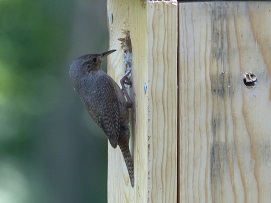
House Wren: All summer we’re serenaded by singing wrens, and we love watching them bring delicious caterpillars into their nests to feed babies. They are cavity nesters and claim the wooden boxes we put out for them. Each fall we open each wren house and remove the nest of woven sticks inside.
-

-
Sticks and feathers
-

-
Wrens carefully construct nests of small twigs lined with soft down.
Baltimore Oriole: Orioles visit us in the spring but prefer nesting along nearby Indian Creek. Their nests often hang down from the branches of tall trees and are sometimes built way above trails, lawns or water.
Goldfinches: Goldfinches love tall grasslands, and build their nest in tall wildflower stems or dense shrubs surrounded by prairie plants. They nest in mid-to late summer andline their nest with soft plant down, like milkweed fluff.
Wild Turkeys: Unlike many birds turkeys don’t work hard to build their nest. They just make a slight depression in the ground and line it with dry leaves. A few years ago our neighbor was doing yard work when a female turkey rushed out from under a bush right next to the home’s foundation. He was startled! Whether back in the forest or in suburbia female turkeys usually make their nest under a shrub and next to a log or foundation. Usually there will be a clearing nearby, and to a mother turkey a lawn is a good substitute for a natural grassy clearing.
Turkey vultures: While not exactly back yard birds, turkey vultures are denizens of summer thermals. We see them soaring in the country and over towns. A basswood tree just east of our property has been the home of nesting turkey vultures since before we settled here in 2010. The Derecho of 2020 took out many trees and broke some off the basswood. But, mostly it survived partly because it is more holes than tree!
-

-
Looking out the nest holes.
-

-
Sturdy tree.
Foxes, coyotes, and woodchucks all have favored places to tuck in. Not nests but cozy homes. Deer bed down on warmer south slopes. Various insects create nests. The photo gallery shows some examples.
-

-
Mystery nest
-

-
Elegant work
-

-
den in side of hill.
-

-
Deer yard.
Fall’s a great time to go on a nest hunt seeking a variety of structures built by birds, mammals and even insects. Sometimes they can be a challenge to identify, but a great source is nestwatch.org. It will help discover what birds made nests tucked in trees, in tall grasses, on the ground, and even under house eaves.
-

-
Robins are opportunists.
-

-
Stick nest
-
-
Mystery nest
-

-
Wasps
by Winding Pathways | Jan 25, 2018 | Mammals, Trees/Shrubs
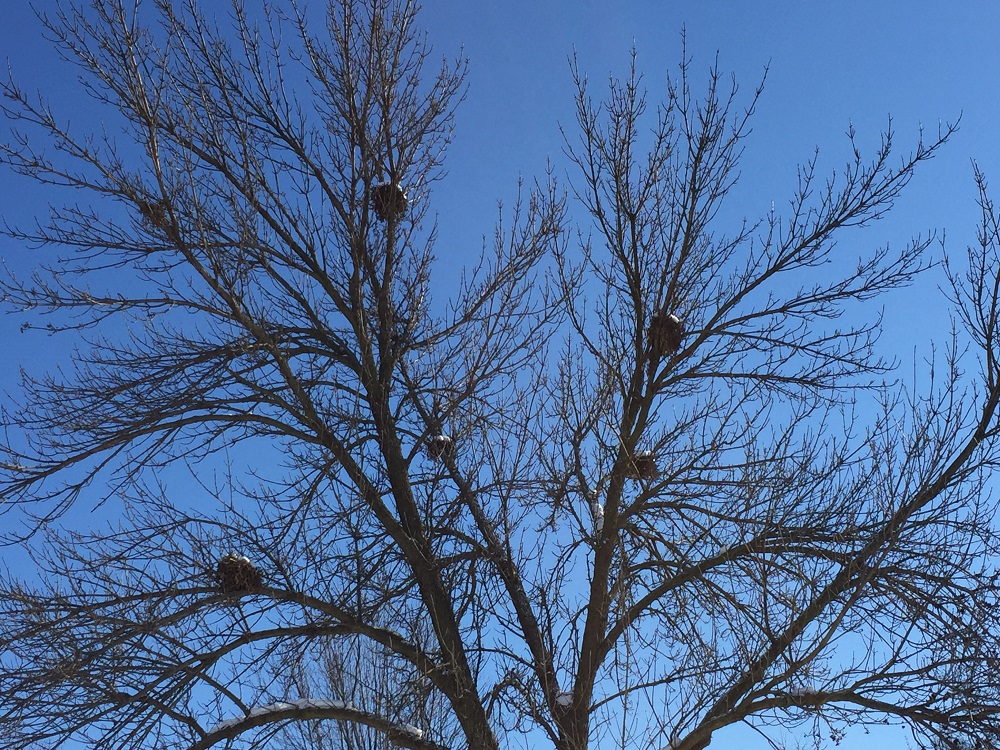
Winter is the best time to spot dens and nests. Usually, we think of bird nests, and we see abandoned ones topped with mounds of snow along roadsides and in shrubs. When we look up, we also spot large clusters of leaves and sticks – squirrel nests.
Squirrels make two types of nests: dens and dreys. Dens are cavities in trees and dreys are the large balls of leaves and sticks that squirrels fashion. From the ground, these dreys look small, but they are really good sized.
Dens
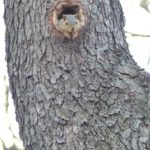
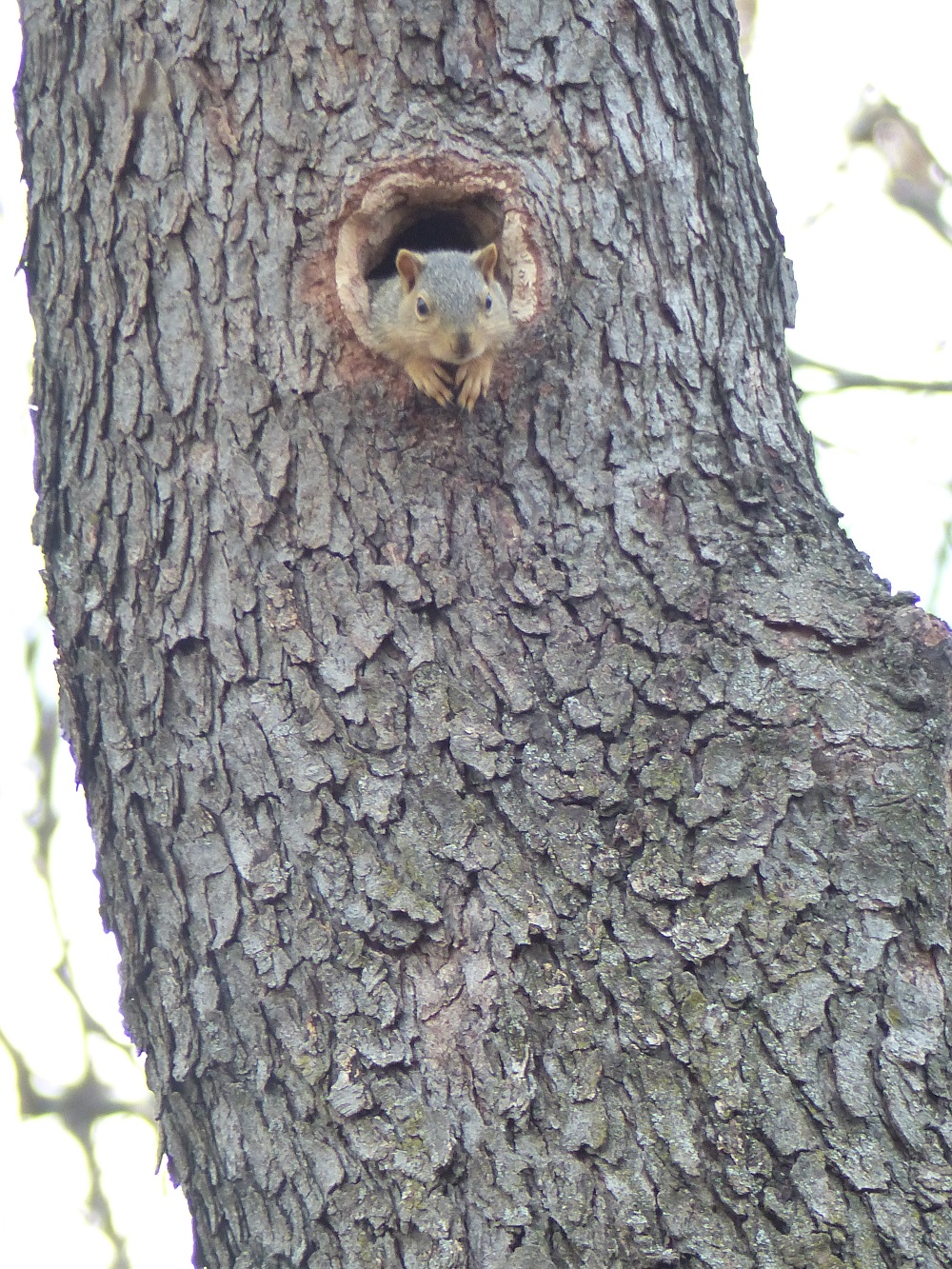
Taking in the view from the safety of a tree den.
When squirrel families mature in late summer, the young venture forth to find new lodgings. If the population of squirrels is low and the availability of hollows in trees is high, then squirrels take the dens. These are hollow spaces inside the trunk that squirrels line with leaves and bits of fur and bark. Squirrels do not create these hollows but use them. Wood rot and woodpeckers create the spaces and squirrels make the most of them. Dens offer great protection from the elements and predators and they are warmer. So, squirrels conserve their energy when they must “hole up” during winter storms. When the worst of the harsh weather passes, squirrels begin to stir, digging for nuts and raiding bird feeders.
Dreys
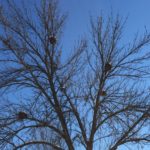
Squirrel Condominium
Squirrels make their dreys near sturdy forks in branches or close to the tree trunk. They will be high up for protection from predators. Usually, a tree might support one or two squirrel nests, but occasionally, we see half a dozen scattered throughout a wide-branching deciduous tree. Squirrel condominiums. These might be secondary homes or extensions of families. Secondary homes tend to be more loosely constructed and are scattered near the main home tree and serve as shelter in case a squirrel gets caught out in the elements or is being chased by a predator.
Each nest begins with a study base of twigs. Scientists have discovered that sometimes squirrels weave grapevines into the structure along with leaves, bark, moss, and twigs for added support. After all, the nest sways in the branches and get buffeted by winds, rain, and snow, so it needs to be strong. Inside, the nest is dry and warm.
When you are driving or walking look up and spot the nests of one of our most industrious small mammals. Squirrels mate in January and soon the young will be born – in the bleak mid-winter maybe in a squirrel condominium near you!
by Winding Pathways | Jul 3, 2017 | Wonderment
Summer in the upper Midwest has been pleasant and we are out and about!
Summer Flowers and Activity
And, Terry Pitts shared this video of an industrious bird making its nest. Likely a second brood.
by Winding Pathways | Jun 10, 2017 | Birds, Nature, Wonderment
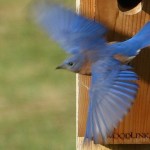
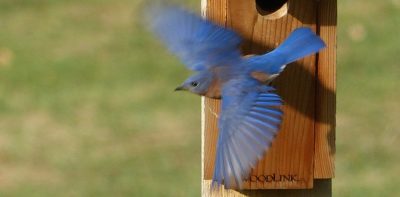
A male bluebird flies from the nest to bring back a snack for its mate.
Here’s a fun guest blog by friends, Gordon and Nancy, about their husbandry of birds on their “Little Acreage.”
“A few years ago my wife and I decided we wanted to attract wildlife to our little acreage. We already had deer and wild turkeys so we decided to try to attract some Bluebirds. We went on line to see where the best spot would be to place some houses to attract them.
“We then went to the Indian Creek Nature Center and bought a couple of houses. We felt that we needed the houses for bluebirds and the Center could use the donation. We placed four houses on the edge of the hay field.
“As time went on, all we saw were sparrows using the nest so we thought nothing would become of our houses. Then, a couple of years ago, a pair of Bluebirds started checking out the nest. But, we never found any eggs.
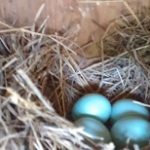
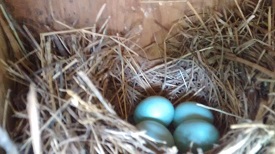
Four eggs! Photo: G&N Bena
“Earlier this year we looked in the house and nothing. A few days later we found these four eggs! What a great surprise for us. We now monitor the nest to watch the progress of our new friends.
Checking the other houses we found that a pair of wrens decided the house was satisfactory for their
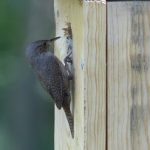
Feeding Young. Photo: G&N Bena
new home and I think they have at least seven eggs. We will be monitoring this nest, also. The other two houses have nests but I think they are sparrow nest. We decided to leave them because they need a home, also.”
Gordon and Nancy
Editor’s Note: Sialis.org has a fascinating set of pictures showing the progression of raising and fledging Bluebird young.
by Winding Pathways | Apr 18, 2017 | (Sub)Urban Homesteading, Birds, Nature
At Winding Pathways, we venture into our yard nearly every day, even if it’s raining, windy,
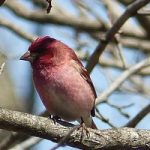
Some birds homestead at Winding Pathways.
or frigid out. Of all the times, early May is our favorite to linger outdoors. Why? It’s the best birding.
Very late April and the first couple of weeks of May boast normally glorious weather, blooming flowers and birds. Lots of birds, including those we can only enjoy for a fleeting week or two.
Here’s how we group the birds that we enjoy in our yard. Odds are the same or similar species follow this pattern in backyards with good habitat across much of the continent.
THE HOMEBODIES
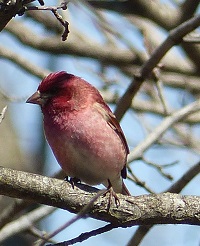
Some birds don’t migrate. They brave the cold and grace winter feeders. In summer, they often raise broods of babies on the edge of the yard. These include titmice, chickadees, cardinals, nuthatches, house sparrows, and many woodpeckers.
THE NORTHERNER
Juncos are almost always under our feeders all winter gleaning seeds. To a Junco Iowa is the balmy south with a “warm” winter. Around mid-April they head north to nest in the boreal forests of Canada and Minnesota. We won’t see them again until around Halloween.
THE LOCALS
Many people consider the first sighting of a Robin to be a sign of spring. They assume the birds just arrived from the south. Robins, and closely related bluebirds, aren’t ambitious migrants. As the weather cools each fall, they abandon suburbia and move to nearby brushy areas for the winter. Winter Robins are common in orchards, the edges of farm fields, and wherever they can find dry and frozen fruit. These much-admired birds do a dietary switcheroo each year. Robins are famed worm eaters, and during warm months, they mostly eat insects and other invertebrates. In winter, they’re mostly vegetarians and dine on frozen berries. In years when fruit is scarce they’ll move south until they find suitable foraging.
THE HOMESTEADERS
Many birds are true migrants that winter far to the south but return north to raise a family. Among these true migrants are house wrens, rose breasted grosbeaks, orioles and indigo buntings. The homesteaders that nest at Winding Pathways have reached their northernmost destination but many of the same species simply rest and eat for a day or two before flying further north to nest. They are mere passersby.
THE AMBITIOUS MIGRANTS
Many birds are serious migrants that winter in South or Central America or the southern US and wing north to Canada and even Alaska to nest, only stopping to rest and eat for a day or two on their long journey. Many are warblers, although dozens of other bird species only use Winding Pathways as their “quick stop” on the way north. We can only enjoy the procession for a week or two in early May as the migrants stock up and then catch the next southerly winds to propel them to their nesting areas.
BIRDING AT ITS BEST
What’s remarkable about early May is the sheer diversity of birds that visit yards. It’s the best time to bring a cup of coffee and pair of binoculars outside. Sit quietly and look and listen to discover the amazing array of birds not possible observe in other seasons. A good bird book helps with identification but we often use the resources of the Cornell University Laboratory of Ornithology to help us identify and learn about birds. Their website at includes outstanding information that helps us determine species by both sight and sound and we frequently use their MERLIN phone app when we’re hiking or camping.