by Winding Pathways | Apr 8, 2021 | Reflections/Profiles, Travel/Columns
Just before darkness, cold, and snow appeared last December we decided to try a new winter travel adventure. We purchased a “Great Course” called the Ancient Civilizations of North America that took us on a virtual trek across North America over a 10,000 year plus time.
The course contained 24 lectures on a CD with a paper book paralleling each class.
A Good Way to Enjoy Winter Evenings

Dr. Barnhart is the director of the Maya Exploration Center.
A few evenings a week we’d sit by our fireplace and enjoy a 30-minute lecture. Our professor was Dr. Edwin Barnhart, Director of the Maya Exploration Center. He’s also a Fellow of the Explorers Club and has traveled extensively. His knowledge of ancient cultures is extraordinary and his delivery impressive. As we watched him on our television it was as if he was speaking directly to us.
His course started with archeological terms and the first people known to cross the Bering Land Bridge and enter our continent in pursuit of mammoths and other gigantic now-extinct animals. Later lectures brought us forward in time to Native Americans along the East Coast just before Europeans arrived.
During the class, we “visited” such fascinating places as Chaco Canyon, Cahokia, Meadowcroft Rockshelter, and many others.
A Chat with Dr. Barnhart
Shortly after finishing his course, we had a delightful phone conversation with Dr. Barnhart. He lives in Austin, Texas, and was attempting to replace a water line that froze and bust in the late winter freeze that hit the Lone Star State and other southern states. Curious, we asked him a number of questions about archeology and how the Great Course we took was so effectively presented. Here were some of our questions and his responses:
- Do archeologists often have a feeling of awe when at a place where people lived hundreds or thousands of years ago? “Yes, very often.”
- We live in Iowa where ancient people often created large earthen mounds, often on high ridges above streams and rivers. Might we have mounds near our home above Indian Creek and how might we spot them? “The name Indian Creek sums it up. Yes. There might be mounds, but many may have been destroyed. Keep your eyes open. It’s important that these places be protected.
- When we mentioned that the area had been hit but a derecho’s 140 miles an hour wind that had uprooted many trees he responded, “Often artifacts are found in the root balls of uprooted trees. Look carefully at them and you might find stone tools or pieces of pottery.”
Keeping the Conversation Lively
- When we asked him about how he made his course delivery so interesting he replied, “We’ll I organized the class and its content but the technical people who did the filming for the Great Course are skilled in helping make and keep presentations interesting.” Among the aspects of the class and delivery that kept us fascinated were background murals that changed with each lecture, excellent graphics and maps, and Dr. Barnhart looking directly at us (the camera). He would also rotate about 90 degrees every ten or fifteen minutes and look at a different camera. Then he revealed a secret. Because he knew the material well and had written the script keeping a flow of conversation was easy. And, he quipped, “My notes were on a teleprompter.”
We thank Dr. Barnhart for his vast knowledge and ability to communicate it. We will take future Great Courses. They range from lifestyle topics to learning advanced calculus to European history and music. For information go to www.thegreatcourses.com.
Author note: We purchased and reviewed the Great Course on our own with no special consideration given to us.
by Winding Pathways | Apr 1, 2021 | (Sub)Urban Homesteading, Garden/Yard, Garden/Yard, Nature
Winter Wanderers
We’ve been having more adventures with possums. Marion spotted a new visitor to the bird feeder one late February afternoon.
It was a smallish opossum. We called him “Pogo” after one of our favorite cartoon characters but didn’t realize we’d be playing tag with him (or her) for the next few weeks.
Pogo’s Feet
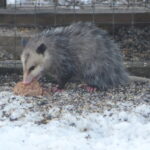
Possums’ feet help it hold food and climb.
Many people dislike possums and think they’re ugly and dumb. We like ‘em. They’re fascinating and love to eat ticks, including those that spread Lyme Disease. We find their paws especially interesting. Take a look at Pogo’s feet in the photos. They’re like strong-clawed hands that let him climb.
We spotted Pogo a few evenings later sniffing around our composter. He ambled off and scooted under a brush pile, where we assume he lived. That’s a fine place for an opossum to live so we left a scoop of dog food nearby for a late-night snack.
The next night Rich went out after dark to check the chickens in the barn. He turned on the light and there, staring at him from inside, was Pogo. Now, we like possums but not when they’re in the barn near the chickens.
Quite Comfortable

After eating an egg, Pogo took a nap.
I wondered, how in the world did he get in? We searched high and low for holes in the building big enough for a smallish opossum to squeeze through. There weren’t any, so we assumed he probably scooted in the open door during the day unseen. Rich ushered him out.
We didn’t see Pogo after that for a few days until Rich went out to gather eggs. There was Pogo napping in a nest! Our possum never seemed aggressive. He didn’t growl, snarl, or attempt to bite the shovel Rich used to scoot him out the door. He just opened his toothy mouth, stared at Rich as if to say, “What’s the problem?” and ambled to the brush pile. Again, we looked for possible openings and didn’t find any.
Quite at Home
No sign of Pogo for two more days. Then it was coop spring cleaning time. The chicken’s waterer was perched on two cinder blocks. Rich removed the waterer and went to pick up a cinder block when he saw a nose pointing out. There sat Pogo, curled up snugly inside one of the block’s cavities.
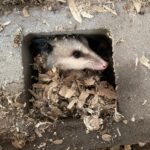
Opossum curled up in cinder block nest.
Again, all he did was stare and open his mouth as Rich explained that he was welcome to live under the brush pile but not in the barn.
We think we have the mystery solved. Pogo didn’t come into the barn after dark. He walked right through the chicken’s pop hole door when it was open during the day and made a home in the cinder block. It’s a great possum spot. He slept on soft wood chips and had plenty of fresh water and chicken feed nearby. Pogo probably snacked on an egg or two but never attempted to catch or kill a chicken.
We still want him to live in the brush pile but not in the barn. So, we now carefully monitor every nook and cranny in the barn before we lock the door at night. We haven’t seen Pogo in the coop lately and hope he’s relocated permanently to the brush pile.
by Winding Pathways | Mar 25, 2021 | Amphibians/Reptiles, Birds, Bugs, Nature, Trees, Wonderment
Quilting and the Chesapeake Bay
Guest Blogger, Sigrid Reynolds
I have always loved the humble arts of unknown women who pieced quilts. My own attempts at the craft had resulted in exactly 10 squares in the 1980s when I had small children at home who took afternoon naps. At the same time, I started looking through the piles of quilts at antique stores in the Shenandoah Valley. It thrilled me to see the patterns, colors, and precise stitching of women from the past. So seduced was I by these piles, I knew collecting could get out of control. But then I found a Pennsylvania Dutch unquilted top in an original bold tulip design of blue, red, and yellow colors. I decided to seek and purchase only this color combination. That kept the lid on it since these colors are rare in combination.
COVID-19 Quilting
Taking up quilting again didn’t occur to me until Spring 2020 when I was asked to join a young friend’s virtual pandemic quilt circle. In a time when we all faced our own mortality and the uncertain path the pandemic and the nation would take, we needed something to calm ourselves. As a retired person, I had nothing filling my time and frankly, felt the need to leave some little part of me behind in the lives of my descendants.
The group chose a striking geometric pattern with many triangular pieces. I purchased material, cut a few triangles, and then I went rogue. My inclination was to go faster, larger and more personal since I’d found piecing tedious in those earlier tries. Besides, I am 30 years older than the members in my group so my “life” time is more limited. I found purpose in a multi-generational family vacation home on the Chesapeake Bay just begging for Aunt Sig artifacts for posterity.
A “Fishy” Quilting Inspiration
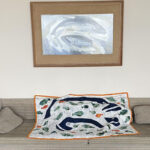
My first quilt was a re-interpretation of a fish painting that the family had owned for 90 years. The family has always asked guests to tell them how many fish they see in the painting. So, I added goldfish for a humorous twist and quilted in additional fish. In all, there are 40 fish in this quilt.
-
-
A humorous adaptation of the family fish painting.
-
-
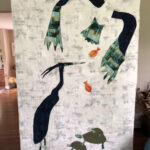
Remembering sunning turtles.
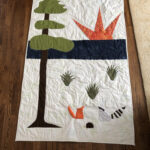
What came next was an urge to recognize the other birds and animals seen regularly on or near the Bay: herons in the morning and evening along with osprey all day. And then I was remembering sunning turtles in a nearby spring-fed pond. I added more goldfish and quilt fish to keep the puzzle going.
I next needed to represent the loblolly pines that line the shores of that estuary. And, of course, I needed additional visitors: raccoons, foxes, and box turtles. While quilting, I added one ghostly possum in the lower right-hand corner. And why not add some quilted poison ivy since that is always an island hazard? And yes, there are fish quilted into the water to count.
-

-
The beginnings of a personal quilt.
-
-
Capturing the sunrise
New Inspirations
Finally, as this quiet, worrisome time comes to an end, I realized that I needed to turn from nature to hail the Baltimore Light, a caisson lighthouse, that has defined the deep channel for ships going into Baltimore Harbor my entire life. Since it was winter, I recalled the two times that I had seen the Bay had frozen and decided that might be a good subject. And yes, there will be quilted fish to count under the ice floes.
Nature Continues to Inspire
I have pondered what prompts this late-in-life creativity and conclude that the pandemic opened up a fertile field in me that might have remained fallow. I, like many, turned to the nearby nature of our backyard and parks but memories of a barefoot childhood on the Bay persisted. Quilting allowed me to visit the nature of my memories.


by Winding Pathways | Mar 18, 2021 | (Sub)Urban Homesteading, Birds, Garden/Yard, Nature, Trees/Shrubs
March is a pivot month. It’s neither winter nor spring. Often called “mud season”, March is maple syruping time, but it’s also birdhouse building month at Winding Pathways.
As humans in northern climates wade through mud and long for spring, millions of birds far to the south are planning their long migration north. A few hardy waterfowl arrive as soon as the ice melts from lakes and ponds, but most birds appear, as if by magic, in April and May. We make sure our birdhouses are up before they arrive.
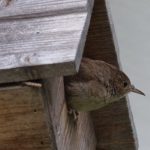
Looking out at the world.
House Wrens, Eastern Phoebes, American Robins, House Sparrows, and House Finches all nest on or near homes, barns, and garages. Although few people enjoy seeing messy House Sparrow nests tucked into nooks and crannies, most love hosting the native species as they raise the new generation outside the window.
Make Birdhouses
March is the best month to make birdhouses and restore older ones somewhat worse for the wear. Most are easy to build using simple carpentry tools. Better yet, birds aren’t fussy. Although the size of the house and the diameter of the entrance hole is important, the residents don’t care if the maker is an excellent carpenter or a novice. So, if the joints don’t fit perfectly it won’t bother birds!
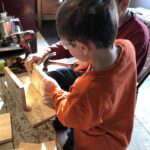
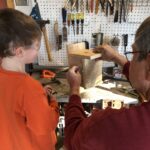
Helping children make birdhouses is a fun project that involves them in nature as they learn safe tool use and basic construction techniques.
We scrounge a nearby pallet pile for free wood. Often the discarded pallets are made from boards the right width for our houses. Relatively inexpensive pine, spruce, or fir work for people who prefer to buy wood.
-
-
Working with children to make a birdhouse is rewarding.
-
-
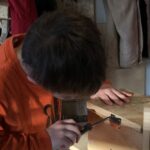
Children learn wood types, stages of building and how tools work.
-
-
The birdhouse is nearly complete.
Great Resources to Guide Your Work
The best information source for virtually anything about wild birds is the Cornell University Laboratory of Ornithology. Their website gives great information on many aspects of birds, including what species likely live in an area. The site is complex but fascinating. A second website, also by the Lab, is more specific to birdhouses and nesting. The Laboratory of Ornithology site helps anyone predict what birds might migrate to their yard and when they’ll arrive. It also includes plans on how to build birdhouses. There’s even a video showing construction tips.
There’s more to birdhouses than just making one. They must be erected in the right place and height above the ground. The Lab’s website provides the right information. And, here are two tips from Winding Pathways.
Tips from Winding Pathways
- Many birdhouse plans to use nails as a hinge so the house can be opened for cleaning. We buy and use small hinges, hooks, and eyes to make opening the box to clean it easier.
- It’s tempting to attach a birdhouse to a tree using a nail or screw. That may work but eventually, the birdhouse falls off. But, the metal remains embedded in the tree. This creates danger as the tree grows around the metal, hiding it. Hitting a nail with a chainsaw is downright scary and dangerous. Also, driving a nail into a live tree can introduce diseases that could kill it. We use wire or rope to attach our birdhouses to live trees and use screws to attach birdhouses to nonliving posts and poles. One of our wren houses is suspended from a hook screwed into our porch ceiling.
Building birdhouses and enjoying a wren couple raises a brood is a fun family activity that we never tire of.
by Winding Pathways | Mar 11, 2021 | (Sub)Urban Homesteading, Birds, Pests
Millions of people love their cats. Some 36% of households keep an average of two cats. They are the second most popular companion animal in the United States, lagging only behind dogs.
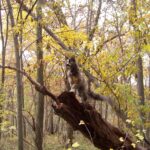
Cats decimate bird populations.
Some cats cause problems, especially when owners allow them to free-range the neighborhood. According to the American Bird Conservancy, they kill 2.4 billion birds a year and may be a significant cause of the decline of many species.
Catios to the rescue!
A growing number of cat lovers, many who also enjoy bird watching, recognize the problem and are increasingly adding a catio to their home. Wonder what it is???? It’s simply an enclosure that allows the family cats to enjoy fresh air, sunshine, and a bit of adventure without allowing them complete access to the neighborhood.
Many catios are enclosed patios, which spawned the name, that let cats play outdoors while their owners enjoy lounging or socializing nearby. They are relaxing places for both species. Other catios are small and positioned outside windows. Catios can be either purchased or homemade and often an existing patio can be modified into one.
Safety First!
Although cats love roaming the neighborhood, it is not a safe place. They pick up ticks and transfer them to humans, suffer accidents, are killed by cars as they cross streets, and are taken by predators.
A catio is a good solution to several problems. It allows cats to enjoy the outdoors safe from cars and predators in a place where they can’t kill birds. And, the owners always know where their cat is.
Harmony
An array of catio photos is visible on Catio Spaces. Many other websites feature them. Catios are a great way for cat lovers to show care of wildlife species, keep their cats safe, and live in peace with human neighbors who are frustrated when they spot a feline stalking birds under their feeder.