by Winding Pathways | Oct 16, 2025 | Amphibians/Reptiles, Garden/Yard, Nature, Water Resources
Wildlife Parade
Of all the wildlife attractions we’ve created at Winding Pathways nothing beats our tiny pond’s wildlife parade. Hardly the size of two king beds, it proves that even a miniscule water feature is one of the best ways to lure fascinating animals into a yard. How and why do ponds attract wildlife?
Simple: Animals need water. For shelter and nurishment.
We actually didn’t create our pond. It was here when we bought the property, but we’ve spiffed it up. At about 80 square feet and less than two feet deep its but a speck of water set beneath our dining room window.
A Pond Out of Place

Wildlife attractant
It shouldn’t even exist. Our house is built on an ancient sand dune. Water percolates quickly into the soil and no natural pond or stream would have a chance of staying wet here. Fortunately, the previous owners had a hole dug and lined with a waterproof membrane. They then had it lined with stones and planted water lilies in a shallow bit of mud over the membrane. We’ve added native vegetation and domestic flowers that attract insects, birds, mammals and amphibians.
Wildlife Attractant
While eating every meal we watch the pond. Wild turkeys, cardinals, titmice, nuthatches, and house sparrows, are among the regular residents that come to drink within a few feet of where we sit. This spring a mallard pair swam in tiny circles during the two weeks they rested on their way north, and a few times wood ducks have settled in to rest. Each summer and fall hummingbirds forage on the succession of plants like Solomon Seal, Purple coneflower, Obedient Plant and other seasonal flowers. Although there is plenty of nectar, they also seem to prioritize “scuffling” with each other. Insects routinely make their rounds to the flowers.
-
-
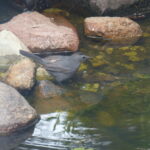
A catbird drinks by a pool.
-

-
Birds stop for a drink and to fill up on the berries nearby.
-

-
Keeping a wary eye, the robin cautiously gets a drink.
Squirrels, chipmunks, and deer visit routinely. Once a mink jumped in for a quick swim. Cagey woodchucks sip and scoot off when they spot any movement inside.
We can figure out how all these animals make their way to the pond’s edge.
Baffling Visitors
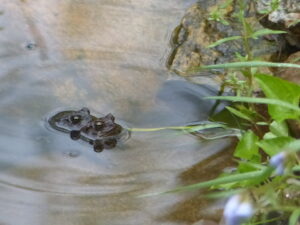
However, some visitors and temporary residents baffle us. Every spring toads and tree frogs call from the pond’s edge and lay their eggs in the shallow water. Where did they come from and how far did they have to hop? Do they use a “hop-ometer” to measure their hops?
-
-
Toads need water to mate.
Unusual Visitor Returns

Safe from predators
In the summer of 2020 an amazing visitor arrived at our pond unannounced. That same year, COVID-19, the Outdoor Writers Association of America held their conference virtually and sponsored the photo hunt with the theme “home.”
Marion’s photo of a frog sheltered in the pond’s egress won third prize!
That was the last we saw of frogs until this summer. Then, while we were eating lunch we spotted a bullfrog sitting on a rock at the pond’s edge. Frogs and ponds go hand in hand but what’s puzzling is, like with toads and tree frogs, how this frog knew our pond was there and how it found its way to it. Our home and pond are about a half mile from Indian Creek, the nearest body of water. And, we’re almost 200 vertical feet above the creek!
Long Way to Hop
To reach our pond the frog had to hop a long way through thick woods and prairies filled with animals that would love a frog dinner. Hawks, owls, snakes, coyotes, raccoons, opossums, and skunks live in the area and would quickly convert a hapless frog into lunch. Somehow our frog survived the gauntlet of predators and a long hop.
Our frog gives us joy watching it and we marvel at how it was able to hop into our lives.
-

-
Sunning
Opportunities To Create A Pond
Many wildlife lovers set up bird feeders and create diverse plantings to lure wildlife into their yard. They might consider taking it a step farther and building a tiny pond to entice a stream of wildlife to visit. Wonder how to do it? Check out thisoldhouse.com/yards. Scroll down for a good read. There are also several credible YouTube videos that show how to create a tiny yard pond.
by Winding Pathways | Oct 1, 2020 | (Sub)Urban Homesteading, Birds, Mammals, Nature
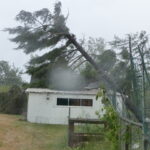
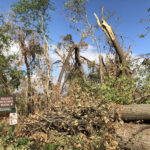
We’ll remember August 10, 2020, forever. On that day the wind changed Eastern Iowa and Winding Pathways in a way that will persist for a century. In 40 minutes, straight-line wind gusts up to 140 miles an hour toppled or broke 47 of our 53 trees. Two landed on our roof.
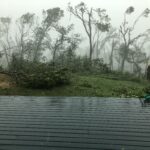
Our property adjoins Faulkes Heritage Woods, a 110-acre preserve of tall old trees, mostly oaks. The derecho felled most of its big trees that tumbled into a jumbled mass of trunks, branches, and leaves.
-
-
The pine toppled onto the cabin roof.
-
-
Effects of straight-line winds.
-
-
Twisted trees.
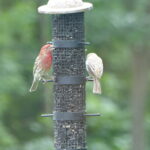
Wondering how the great change would impact wildlife, we quickly noticed two short term impacts. August and September are usually slow months for bird feeder visitors as birds normally have plenty of wild food. As soon as the wind calmed, all was still. Faithfully, Rich found and filled the feeders. The next morning, we noticed heavy use by house finches, titmice, nuthatches, cardinals, woodpeckers, and chickadees. It was almost like the feeding frenzy that happens as a winter blizzard approaches.
Short Term Impacts
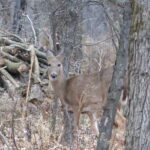
Trails are disrupted.
We quickly realized that deer, raccoons, coyotes, woodchucks, squirrels, and even chipmunks experienced a life-changing event. Their travel corridors changed as huge trees blocked deer trails, for example. They had to find new routes through the debris. One afternoon we saw a mother deer and fawn walking on the one remaining “open” trail around our prairie. Then, they crawled under a fallen tree and disappeared into the maze of branches. The ever clever raccoons have become more than pests as they tear up feeders and raid garbage cans. Also, the storm destroyed this year’s acorn and walnut crop, nuts that many species require. That is why the birds came so readily to the feeders. And still do!
-
-
The house finches eat serenely.
-
-
Even the crows come around to grab a snack.
-
-
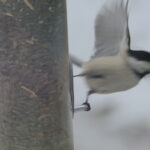
From early light to last dusk chickadees work the feeders.
Longer-Term Impacts
We are now watching for the long term impacts of the loss of so many trees. Our good friend, Jim Berry, is the former executive director of the Roger Tory Peterson Institute in New York. We asked him what we might expect following the loss of so many big trees in Faulkes Woods and our property.
“There are winners and losers. I would expect to see fewer wood thrushes, ovenbirds, and scarlet tanagers. They prefer mature forests. The more open woods and sunshine hitting the ground will cause an increase in cardinals, robins, and white-eyed vireos,” he said.
We have been fortunate to enjoy seven woodpecker species over the years. Some will benefit and some will lose from the great woods opening windstorm. According to Jim red-headed, red-bellied, and downy woodpeckers are likely to increase. So will flickers.
But sapsuckers and hairy and pileated woodpeckers that like the old trees and a closed canopy will probably decline.
-
-
The small mammals are hungry.
-
-
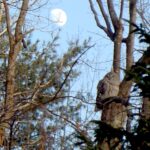
Owls will benefit from broken trees as cavities develop.
-
-
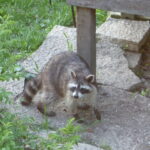
Raccoons ravage feeders at night.
The loss of hollow trees that shelter animals and the destroyed nut crop are going to make this a lean winter for squirrels. Deer, blue jays, woodchucks, chipmunks, and wild turkeys will also miss the acorns that normally rain down each fall.
We were saddened to lose so many trees but look forward to watching the forest restore itself. We’re also watching to see changes in wildlife.
by Winding Pathways | Oct 11, 2018 | (Sub)Urban Homesteading
Oceanfront property in Iowa! Well not really, but the state constantly interacts with our planet’s vast oceans.
Over six inches of rain fell on Winding Pathways in September 2018. Way above average. Not long ago those zillions of raindrops were swirling around in the Gulf of Mexico. Evaporation sucked moisture into the air, leaving salt behind. Winds carried the moisture north until it bumped into cool air. Bingo, heavy rain and flooding.
Rain isn’t the only way Iowa relates to the ocean. From the second it hits the ground rain heads back to the sea. It often carries fertilizer, dirt, and debris into tributaries that flow to the Mississippi River and then down to the Gulf of Mexico. Nitrogen and phosphorus fertilizer applied to lawns and fields end up stimulating oceanic algae that die, consume oxygen, and create the notorious “dead zone.”
People ship more than nitrogen to the ocean. Virtually anything that enters a storm sewer, creek, or river can make it to the sea. Cigarette butts, oil, Styrofoam, and plastic of all sorts swirl downstream.
Plastics: Blessing and Curse
Plastic is wonderful. It is made into hundreds of useful products. Even the computer keys we’re typing this blog on are made of the stuff. Unfortunately, too much is tossed away.
Much ends up in the ocean where vast quantities circulate in huge arcs. Birds, seals, and fish sometimes mistake it for something edible and end up with a plugged stomach after swallowing what they think is lunch. Wildlife also gets tangled up in plastic, especially plastic fishing nets.
Although Winding Pathways is a thousand miles from the Jersey Shore or the Gulf of Mexico, we take action to prevent sullying salt water. The aluminum water bottle in our pickup truck reminds us of this every day. Printed on the side says KICK PLASTIC, a slogan of the Costa Company. They teamed up with Bureo, a company that makes fishing nets. This encourages people to help keep plastic out of the ocean, partly by making products from recycled items. We like their approach.
Ways to “Kick Plastic”
According to Costa
- almost all plastic ever made is still around;
- The equivalent of one garbage truck filled with plastic goes into the ocean each minute;
- 98% of ocean pollution comes from the land;
- One in four ocean fish contains plastic.
The company asks people to do these things to reduce plastic pollution. Our suggestions follow in italics:
- Stop Using Plastic Bottles. Use a refillable water bottle.
- Say Goodbye to Grocery Bags. Bring reusable nylon or canvas bags to the store.
- Buying in Bulk Makes a Big Impact. Reuse those containers. We bought peanut butter in a large jar in 1976 in Kansas and have refilled it many times with bulk peanut butter from the health food store near home. That jar has been reused well over 100 times!
- Reel in Old Line. Recycle used fishing line.
Winding Pathways takes Costa’s suggestions further. Remember that anything put on the ground could find its way to the ocean, even from Iowa.
- Use fertilizer and pesticides sparingly and carefully, if at all.
- Buy quality products that last longer than cheap counterparts. Durable items aren’t discarded often.
- Put anything recyclable in blue plastic bins that most Iowa towns or trash collection companies collect. They make recycling easy.
Iowa oceanfront property? We hope climate change never raises the sea so high that our state has an ocean beach, but many Iowans enjoy delicious seafood and they vacation on the beach. Let’s keep the oceans healthy and safe, even if we live inland.
Note: The Costa Company did not provide any support to Winding Pathways. We created this article because we love their message, leadership, and products.
by Winding Pathways | Sep 20, 2018 | Chickens, Energy Efficiency, Flowers/Grasses, Garden/Yard, Garden/Yard, Nature
It’s turning time for wildlife, chickens, and people
As the Northern Hemisphere of the earth continues its ageless slow wobble away from the sun, days gradually shorten until a wondrous event happens.
The Autumnal Equinox happens around September 21st each year. It’s when daily hours of sunlight equal those of darkness. On only two days each year does every place on earth enjoy roughly 12 hours of sunshine. These are the fall and spring equinoxes. So, whether someone lives near the tropics or poles they will experience the same amount of light on only those two days.
Light changes quickly around equinox time. Up here in the Northern Hemisphere days shorten quickly and darkness advances until the December 21st Winter Solstice, the year’s darkest day. The Southern Hemisphere begins to enjoy its longest days through December.
Preparing
At Winding Pathways around the Equinox, we do these things:
- Stimulate our chickens. We plug in the timer and light bulb in the coop. Chickens lay the most eggs when there are about 15 hours of daylight. So, the coop light is set up to come on about 4:30 a.m. and turn off about three hours later when the sun pokes over the horizon.
- Drain, clean, and invert our rain barrels. We won’t need extra water until next spring, so we turn the barrels upside down, so they don’t collect winter water that freezes and can split the barrels. We weight them with stones to keep Arctic winds from blowing them away.
- Watch this short video on how to Prepare Rain Barrels
- Bring in pumpkins and winter squash. A frost is soon to come, and we don’t want it to bite our squash. We store

Winter Squash vary in color, texture, shape and size.
pumpkins and squash in a room we rarely use. It stays cool but above freezing. Butternut, Acorn, Hubbard, and most other winter squashes and pumpkins, which actually are a squash, keep for months and give us delicious and vitamin stoked food on cold days.
- Exclude, or try to, insects and mice. Somehow mice, box elder bugs and Asian beetles sense coming cold and find tiny cracks to enter the house and enjoy winter warmed by our furnace and wood stove. Each fall we caulk up cracks and weather strip doors to encourage them to stay outside where we prefer to see them. It’s never perfect. Some always find their way inside.
- Enjoy leaves. Each’s fall’s spectacular leaf color peaks in October but some leaves start turning sooner. Our backyard black walnut starts coloring up in early September. The real show is the deep orange, red, and yellows of our sugar maples. They peak in early to mid-October followed by russet oak leaves.
-
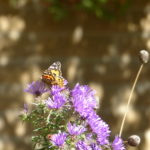
Fall wildflowers are an important food source for insects and birds.
Enjoy wildflowers. Asters, Goldenrods, and Maximilian Sunflowers are the very last blooms of the season. Their colors brighten the yard and provide nectar for insects and then seeds for migrating and overwintering birds. But all this comes with sadness as we know we’ll not see wildflowers again until next spring.
- Watch wildlife. It’s migration time and one of the best seasons for seeing unusual birds. We often look upward and sometimes spot pelicans and waterfowl winging high overhead. By now deer in their subdued winter coats are sleek and well fed on a diet of acorns. Bucks have polished their antlers. Chipmunks and squirrels scurry about caching winter food.
We’d like to hear what you enjoy about the Equinox time. Please email us your joys and projects in this wondrous season.
by Winding Pathways | Jul 13, 2017 | Chickens, Labyrinths, Wonderment
What fun hosting Bankers Trust staff and clients and welcoming an out of town visitor to the Phoenix Harmony Labyrinth. Tuesday, July 11 was steamy and threatening storms. But, the hardy crew engaged in lively discussions and asked probing questions about the more simple lifestyle we embrace at Winding Pathways. Now, simple does not mean easy. Tending a large yard and five circuit labyrinth are work. Rewarding work. And, people are curious about chickens, managing small gardens, maximizing space, retaining water on our property, heating with wood, and creating diversity that welcomes wildlife. Topics like ways to save energy which saves money to be invested or used caught their attention. And questions on managing pests like ground hogs and deer. We touched on a lot and had a great time.
Go to 1080 Labyrinth for a photo album of the afternoon and evening.
Then, with storms obviously to the south showing off cumulus and anvil clouds but no threat, all walked the Phoenix Harmony Labyrinth. Mike T’s comment summed it all up. As he and Terri entered the center a cool breeze touched their faces. Mike paused and said, “I never want to leave.”
Thanks Terri Doyle for organizing and promoting!