by Winding Pathways | Oct 15, 2020 | Nature, Trees
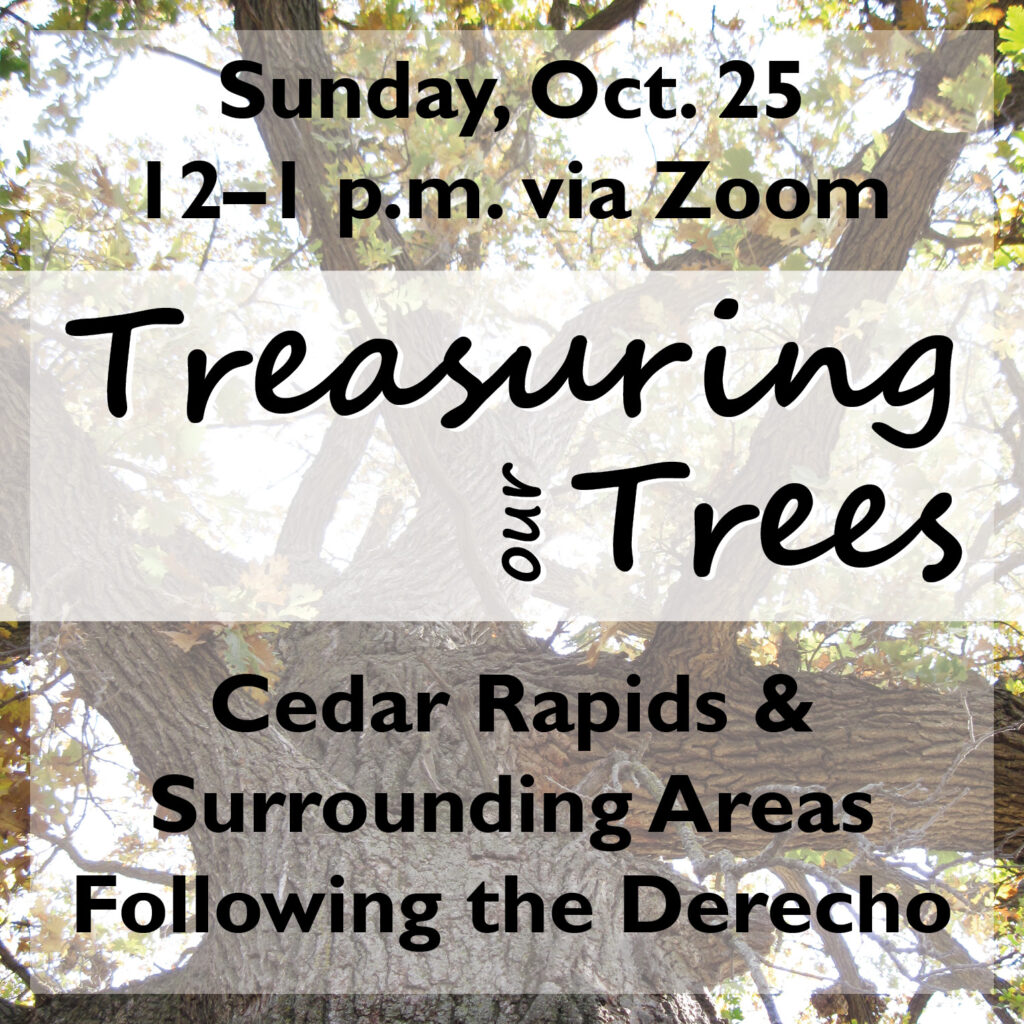
Winding Pathways is partnering with Cornell College, Indian Creek Nature Center, Peoples Church, Prairiewoods, and Trees Forever to present Treasuring our Trees.
Join us via ZOOM to honor and remember the fallen trees in the Cedar Rapids and surrounding areas following the Derecho of August 10, 2020. Sunday, October 25, 12:00 noon to 1:00 p.m. Learn more at www.prairiewoods.org.
Join using Zoom meeting ID 829 4883 0080 & password 056503.
-
-
ZOOM invitation to honor our trees.
by Winding Pathways | Oct 8, 2020 | (Sub)Urban Homesteading, Birds, Garden/Yard, Nature
The August 10 derecho changed Cedar Rapids, and Winding Pathways wasn’t spared. We lost 47 of our 53 large trees during the 40-minute windstorm. It greatly altered our restoration plans. Here’s what we did or plan to do in response to the loss of trees.
Prairie plant
New prairie plot: We planted this in early May. As expected, we only saw a glimpse of prairie plants in its first growing season, although early prairie plants give us promise that many more will appear next year. We will try to burn it either this fall or early next spring.
The derecho helped the prairie by felling or breaking four Douglas firs, one black oak, and one green ash. Two of these trees cast some morning shade on the prairie. The rest shaded it some in the late afternoon. They’re gone, so the site will enjoy more sunshine, and prairie loves sun. We mourned the tree loss but the prairie will benefit.
The trees didn’t go easily. Several tumbled into the prairie. They were big and filled with branches, leaves, and needles. We prioritized removing them. Many chainsaw and brush hauling hours later we had the trees moved into a big brush pile in the back. The sun now shines on the prairie planting. We’ll keep you posted.
-
-
The firs and oak smothered the emerging prairie.
-
-
The firs shaded the prairie. Now more sun will shine.
Derecho Creates Opportunity
After we cleared fallen trees from the prairie, we turned to many trees that tumbled down on the north and east ends of our land. It’s taken hours to cut shattered trees and cut pathways through fallen logs so we can walk our own land easily. This land was once shady. Now the sun hits the ground. The storm transitioned the land from dense forest to savanna – a landscape of occasional trees and rich plant growth hugging the ground. Wildlife will transition as the habitat changes. Because of this change in the forest, some bird species may decline temporarily and others will thrive.
Open woodland birds: Robins, cardinals, white-eyed vireos, flickers, and Downey, red-bellied, and red-headed woodpeckers.
Mature forest birds: Scarlet tanagers, ovenbirds, wood thrushes, and pileated and hairy woodpeckers.
Shade and Sunshine
We didn’t lose all our forest trees. Just most of them. The loss of shade creates opportunities for ground-hugging plants to thrive, including baby trees. We’re already found some tiny black raspberry plants growing and many oak and hackberry seedlings.
To make sure that appropriate native savanna plants establish in the now sunny areas we ordered a native seed mix from Pheasants Forever that we’ll plant this fall.
We will keep you posted on changes in our prairies and new savanna.
by Winding Pathways | Oct 1, 2020 | (Sub)Urban Homesteading, Birds, Mammals, Nature
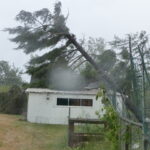
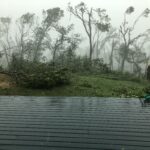
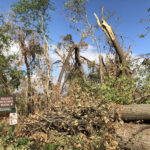
We’ll remember August 10, 2020, forever. On that day the wind changed Eastern Iowa and Winding Pathways in a way that will persist for a century. In 40 minutes, straight-line wind gusts up to 140 miles an hour toppled or broke 47 of our 53 trees. Two landed on our roof.
Our property adjoins Faulkes Heritage Woods, a 110-acre preserve of tall old trees, mostly oaks. The derecho felled most of its big trees that tumbled into a jumbled mass of trunks, branches, and leaves.
-
-
The pine toppled onto the cabin roof.
-
-
Effects of straight-line winds.
-
-
Twisted trees.
Wondering how the great change would impact wildlife, we quickly noticed two short term impacts. August and September are usually slow months for bird feeder visitors as birds normally have plenty of wild food. As soon as the wind calmed, all was still. Faithfully, Rich found and filled the feeders. The next morning, we noticed heavy use by house finches, titmice, nuthatches, cardinals, woodpeckers, and chickadees. It was almost like the feeding frenzy that happens as a winter blizzard approaches.
Short Term Impacts
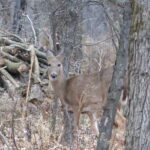
Trails are disrupted.
We quickly realized that deer, raccoons, coyotes, woodchucks, squirrels, and even chipmunks experienced a life-changing event. Their travel corridors changed as huge trees blocked deer trails, for example. They had to find new routes through the debris. One afternoon we saw a mother deer and fawn walking on the one remaining “open” trail around our prairie. Then, they crawled under a fallen tree and disappeared into the maze of branches. The ever clever raccoons have become more than pests as they tear up feeders and raid garbage cans. Also, the storm destroyed this year’s acorn and walnut crop, nuts that many species require. That is why the birds came so readily to the feeders. And still do!
-
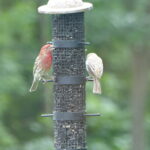
-
The house finches eat serenely.
-
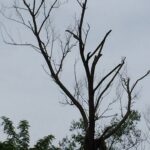
-
Even the crows come around to grab a snack.
-
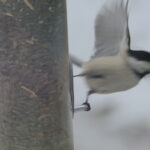
-
From early light to last dusk chickadees work the feeders.
Longer-Term Impacts
We are now watching for the long term impacts of the loss of so many trees. Our good friend, Jim Berry, is the former executive director of the Roger Tory Peterson Institute in New York. We asked him what we might expect following the loss of so many big trees in Faulkes Woods and our property.
“There are winners and losers. I would expect to see fewer wood thrushes, ovenbirds, and scarlet tanagers. They prefer mature forests. The more open woods and sunshine hitting the ground will cause an increase in cardinals, robins, and white-eyed vireos,” he said.
We have been fortunate to enjoy seven woodpecker species over the years. Some will benefit and some will lose from the great woods opening windstorm. According to Jim red-headed, red-bellied, and downy woodpeckers are likely to increase. So will flickers.
But sapsuckers and hairy and pileated woodpeckers that like the old trees and a closed canopy will probably decline.
-
-
The small mammals are hungry.
-
-
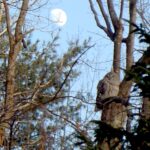
Owls will benefit from broken trees as cavities develop.
-
-
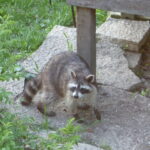
Raccoons ravage feeders at night.
The loss of hollow trees that shelter animals and the destroyed nut crop are going to make this a lean winter for squirrels. Deer, blue jays, woodchucks, chipmunks, and wild turkeys will also miss the acorns that normally rain down each fall.
We were saddened to lose so many trees but look forward to watching the forest restore itself. We’re also watching to see changes in wildlife.
by Winding Pathways | Sep 24, 2020 | (Sub)Urban Homesteading, Garden/Yard, Mammals, Nature
People in Eastern Iowa planting young trees to replace those shattered by the August 10 Derecho need to remember an important step. Protect those vulnerable and valuable young trees.
Here is our story. A distressing sight greeted us one September morning a few years ago as we walked to the mailbox to get the newspaper. Overnight a deer had chosen our favorite young maple tree to polish his antlers. He was thorough and had rubbed the bark off all around the two-inch diameter trunk. It was girdled and doomed.
We should have known better. Buck deer start growing their antlers in April and by about Labor Day, they are full size. Antlers are formed by a blood-rich skin called velvet. By late summer it has dried and bucks rub it off polishing up their antlers for dominance battles with rivals. By neglecting to protect our tree we gave a buck a great rubbing place. And doomed our tree to an early death.
Deer begin rubbing in early fall and sometimes continue until the deer mating season approaches in early November. Deer live in most American cities and regularly roam through suburbs. They are as happy to rub their antlers on an ornamental tree in the front yard as on one back in the woods. It’s never good for the tree.
Deer seem to prefer to rub on saplings with trunks a few inches in diameter. They especially seem to prefer pine and black cherry trees but we have even lost young spruces to their rubs. One thing is predictable. The tree that a family most treasures is the one a buck is likely to destroy.
Damage is preventable. We now run a four-foot-high circle of wire mesh around the tree and wire it to a fence post hammered securely into the ground. Once a tree reaches five or six inches in diameter deer rarely bother them, so the wire is only needed for a few years.
Be sure to water your new, young fall-planted tree. And, protect it with wire mesh.
-
-
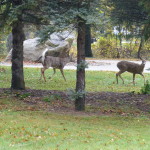
On Halloween day a buck was hot on the “tail” of this doe and yearling.
-
-
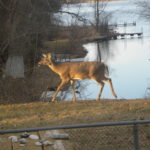
Deer in yard.
by Winding Pathways | Sep 17, 2020 | (Sub)Urban Homesteading, Energy Efficiency, Geology/Weather, Preparedness
Four years ago, we installed a net-metered photovoltaic system on our barn roof. Photovoltaics, or simply PV, is a term that means “light electricity” or solar energy.
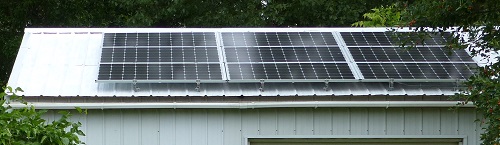
On sunny days solar powers our energy needs.
We appreciate our PV system. On sunny days, when our system produces more electricity than we use, it runs our meter backward as power flows out into the energy grid. At night and on cloudy days, when we’re using more power than we’re producing, we draw electricity in from Alliant Energy, our utility. At the end of each month, we pay the “net” so it’s called a Net-Metered System. This eliminates the need to have storage batteries. We’ve had a monthly bill as low as $5!
But what happens when the grid goes down? It did on August 10, 2020, when a derecho roared through Iowa with 140 mile an hour winds. Hundreds of miles of wires were torn down as trees crashed into them. We joined thousands of other homes without power.

Solar chargers help keep people connected when the power goes out.
So, did our PV system power our lights, computers, and television? Nope. We used candles and lanterns when it got dark and couldn’t power our computer, television, or any other electric appliance for about two weeks.
Net-metered systems, like ours, have an automatic switch built into them so they don’t export electricity back to the grid when it’s down. It’s a safety mechanism designed to prevent a utility employee working to restore power from getting a shock. Our system produced electricity during the blackout, but it just dissipated. As soon as our power was restored the PV system again sent power outward.
An Important PV Safety Tip
Our PV system survived the wind intact but others were ripped from roofs and tumbled to the ground. A PV panel laying on the ground upright makes electricity. Grabbing wires or the panel can give someone a tremendous shock. If a PV panel is on the ground stay away……or cover it with a tarp to darken it so it doesn’t produce electricity. It’s safest to wait until after dark to flip it.