by Winding Pathways | Jun 6, 2019 | (Sub)Urban Homesteading, Flowers/Grasses, Garden/Yard, Garden/Yard
Weeds Brighten Our Lawn
Too many people worry about lawn weeds and spend money to buy and spray toxic chemicals. We take a different view. What many call weeds are actually beneficial and we find fascinating. The often-uninvited plants that diversify our lawn connect us with human history, teach us botany, sometimes provide nutrition, and add color to our yard.
We don’t spray or fertilize our lawns at Winding Pathways. The mower gets exercise when grass gets shaggy, but we’re never bothered when new plants show up. Instead, we try to identify them and sometimes mow around them to let them bloom and add color to Winding Pathways.
Here are three “weeds” that we are enjoying this summer for their color:
Hawkweed
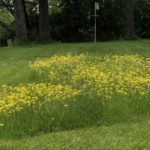
Hawkweed is “asexual”.
In mid-spring, a small patch of tiny hawkweed plants was poking through our grass. Rich mowed around them and by late May we enjoyed watching bright yellow hawkweed blooms dance in the sunny breeze.
There are many species of hawkweed. Most are exotic but some are native. Most sport yellow flowers although some can be reddish. Farmers sometimes consider them a weed. Perhaps the most interesting thing about them is their unusual reproduction. They usually spread by seed, but hawkweed seeds aren’t fertilized, meaning that the seed is an exact genetic clone of its parent. They’re asexual!
We’ll enjoy our Hawkweed until their blooms fade and then likely will mow the patch.
Star of Bethlehem
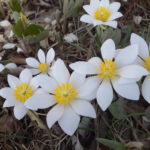
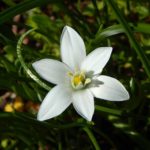
One of our favorite early spring wildflowers is the impressive but delicate bloom of the native Bloodroot. Its pure white petals are showy against the late March or early April ground. A common early summer lawn weed that has a bloodroot-looking flower is the Star of Bethlehem. It’s a lily that is sometimes sold in nurseries. The plant is not native and shows up in our lawn, probably the result of a previous owner planting bulbs years ago. Star of Bethlehem can be invasive, so we enjoy its showy bloom but mow it off before it has a chance to seed. The plant is a perennial and comes up from bulbs each year, so mowing won’t eliminate it but may keep it from seeding.
-
-
Bloodroot is an early spring bloomer. Photo credit Susan Hrobar
-
-
Star of Bethlehem.Six-petaled flower. Pixabay photo
Shepherd’s Purse
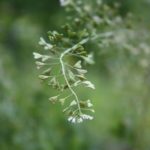
Shepherd’s Purse. From Pixabay
An intriguing plant that grows more on the side of the lawn than in the middle is Shepherd’s Purse. Its name comes from the triangular flat fruits that look like a tiny purse. Native to Europe and Asia Minor it may now be the second most common weed worldwide. Shepherd’s Purse has medicinal and food value and may have been deliberately spread by people.
Nature loves diversity. A function of invasive plants is their very nature. Spray a lawn and kill every plant species other than Kentucky Bluegrass and soon “weeds” will move right in. Diversity creates a certain degree of ecological stability, but there’s always change. A fascination of tending a natural unpoisoned lawn is learning to identify new species as they arrive by themselves and watching plant transitions over the years. A common uninvited plant one year may totally disappear the next to be replaced by some new species. Observing is just plain fun that can never be enjoyed by the person who poisons fascinating lawn plants.
by Winding Pathways | May 30, 2019 | (Sub)Urban Homesteading, Flowers/Grasses, Garden/Yard, Garden/Yard, Nature, Trees/Shrubs
Enjoying a Welcoming Yard
On the evening of May 17th, one of nature’s brightest colors greeted us at Winding Pathways. It was a brilliant male scarlet tanager, a somewhat rare bird that we only see briefly each May.
The next morning, he was joined by a female, and we assume they’ll nest in Faulkes Heritage Woods that adjoins our property. Tanagers are birds of the big woods, and they’ll find comfortable lodging in the big oaks nearby.
We bought Winding Pathways ten years ago partly because it adjoins the 110-acre Woods protected from development by a conservation easement. It’s mostly steep land that drops down to Indian Creek about a quarter of a mile from our home.
Creating a Welcoming Yard
Since we bought our land, we’ve diversified the yard by restoring prairies and increasing the variety of savanna and woodland wildflowers in shady areas, used prescribed fire to reduce exotics, and installed many birdhouses and feeders. Thanks to the nearby woods and our more open prairie yard with the savanna in between, we enjoy a rich array of bird species. Some, like woodpeckers and chickadees, stay around all year but more migrate to nest here or stop by on their trek to nest further north. We keep a running list of the birds we see from our dining room table each spring. Some we just see winging over but many stop to eat and rest.
-
-
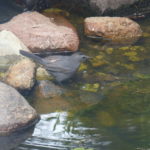
Catbird by water
-
-
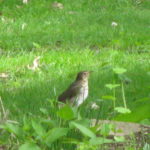
The Swainson’s Thrush moves through in the spring.
-
-
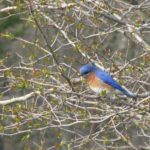
Bluebird in tree
Growing Bird List
We’re adding to this list daily but here’s what we’ve spotted and heard so far in May 2019:
Great Blue Heron, Barred and Horned Owl, Canada Goose, Black Capped Chickadee, Tufted Titmouse, Cardinal, White and Red Breasted Nuthatch, Downy, Hairy, Red Bellied, Red Headed, and Pileated Woodpeckers and Flicker, Turkey Vulture, House Sparrow, Wild Turkey, Red Breasted Grosbeak, Northern Oriole, Wood Duck, Common Yellowthroat, Indigo Bunting, Yellow Warbler, Louisiana Waterthrush, Blackpoll Warbler, Yellow Rumped Warbler, Scarlet Tanager, Eastern Kingbird, Phoebe, Great Crested Flycatcher, Cooper’s Hawk, Bald Eagle, Cowbird, House Sparrow, Starling, House and Carolina Wren, House Finch, Red Tail Hawk, Cooper’s Hawk, Crow, Pelican.
-
-
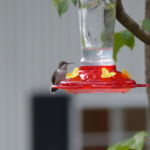
A hummer at the feeder.
-

-
A water source helps attract birds.
-
-
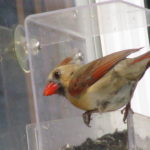
Female Cardinal at window feeder.
And the list keeps growing. You, too, can create a welcoming yard. This introductory YouTube video from Canada gives a quick overview of the important elements in attracting birds to a yard. It’s totally “Homegrown” and short. You can create welcoming space on a condominium patio, at a retirement or nursing home, an urban lot or spacious acreage.
Another YouTube video explains how to bring natural elements together to create natural areas. In this case, a “forest.” Again, from large scale to small we can all do this! We would, naturally, adapt to our region of the country and world. The concepts are similar.
What to Consider When Creating a Welcoming Yard
How much time/money do you want to invest?
Do you want to create a naturalistic landscape with native plants?
Do you want to harvest food from the space?
Are your neighbors tolerant of change?
What local codes affect what you want to do? (Ordinances or Covenants)
How prevalent are deer in the neighborhood?
How long do you plan to live in the home?
-
-
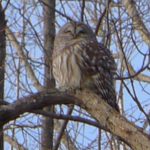
Waiting
-
-
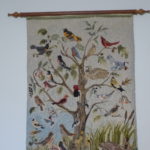
A hooked rug by Yvonne Fellows
We’re lucky to have Indian Creek and Faulkes Heritage Woods near Winding Pathways, but even yards not adjacent to natural areas can increase bird variety by creating diverse habitat. Spring is the best season to plant prairies and shrubs! Learn more about birds, their habits and habitats at the Cornell Laboratory of Ornithology.
-
-
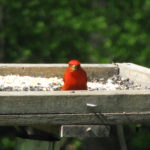
Extra nutrition at the feeder.
-
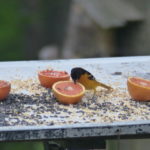
-
A male northern oriole
-
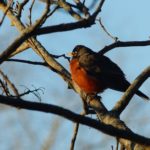
-
A robin surveys the area
by Winding Pathways | May 23, 2019 | Birds, Nature
A Tale of Baby Owls
Guest Blogger, R’becca Groff
The first sign of an owl living back on our acreage happened late last summer when I heard a rabbit being taken late one night. A rabbit sounds like a human baby when it’s in trouble, and it is the painful reality of the food chain.
Throughout this past winter, my neighbors and I have been listening to two owls living across our adjoining properties – a very large one and his smaller mate — we assumed.
I was the only one who wasn’t getting outdoors in time to see them, however.
The other day I heard the hooting midday and ran outside, determined to see where this owl was perched. It sounded so close to my office window. And there it was…staring down at me from one of the old Austrian pine trees between my house and my neighbor’s.
I spoke softly to it, hoping it wouldn’t mind but it wanted nothing to do with me, and promptly vacated its branch perch, gliding gracefully across my neighbor’s back yard to a safer distance.
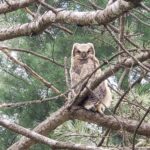
As I’d been hearing about a huge hawk nest way at the back of our property line, I went to have a look for myself. Studying the tree line as I walked, I came upon an owlet watching down from one of the lower branches of another pine tree. I couldn’t resist it. I had to try and converse with this beautiful creature. It sat there watching back at me, unhinged by my presence. Just for fun, I circled the tree, and the baby followed my every move.
Of course, I texted the neighbors, only to learn there are two new owlets as my northern neighbors have been watching that hawk nest through binoculars. They’ve been observing as mama owl hunts and feeds these babies around dusk. She obviously is doing a fine job as we all have plenty of owl pellets on the ground around our trees.
Throughout the day I couldn’t keep away. I kept walking back out to view this new baby living in my yard. Later that day I finally caught a glimpse of its sibling perched near the top of the pine tree at the end of our acreage’s property line.
The neighbors and I had a chuckle, as we’ve noticed the rabbits seem to have moved across the street —
out of our yards!
-
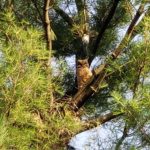
-
This owlet blends into the background of the pine bark trunk.
-
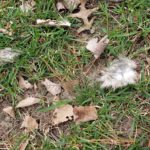
-
Look under trees for owl pellets.
-
-
Fuzzy owlet
by Winding Pathways | May 16, 2019 | (Sub)Urban Homesteading, Garden/Yard
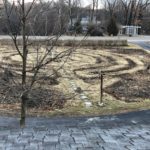
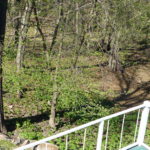
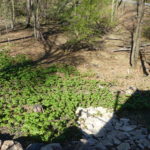
For the past few years, Marion and I have conducted managed burns on our prairie and woodland areas in the fall. We let the fire rise from the woods up into the prairie near our home. This followed removing some maples a few years back to allow more light to reach the ground. I’ve attached a photo taken this week. In the foreground is the burned area. Behind is the unburned. The impact on wildflowers is amazing. The density and diversity of wildflowers in the burned area are much greater than in the unburned and they emerged sooner. In nearby Faulke’s woods, we removed maple understory several years ago but it has not burned. With the elimination of additional shading from maples, wildflowers are certainly increasing, but this area has not been burned so they are not nearly as prolific as in the burned area on our property. The dark, bare ground free of leaf cover warms more quickly and the woodland and prairie plants access the ash nutrients and receive the warmth of the sun. So, they grow more quickly and robustly.
-
-
A fall labyrinth burn warms the soil for spring’s growth.
-
-
Leaf little slows plants emerging in the spring.
-
-
Note the difference between the burned area and unburned area.
by Winding Pathways | May 2, 2019 | Geology/Weather
Guest Blog by Jacki Hull of Bedford, Virginia
Written about April 19 and 20 storms
“Well, two ugly storms in one week is enough for us for a while. Today has been full of dark clouds, winds, rain. Then as we
were sitting on the porch for a quiet read of the daily paper, I could see rapidly rotating clouds, some heavy rain and heard
a roar of the wind.
“I told Peter (spouse) that we needed to get inside. As we moved ourselves to the living room, I prayed that it would not come
our way. (In 2002 a tornado did set down on Kelso Mill Road not far from us.) Well, the funnel stayed about a mile west of
us, but what a mess. Fortunately, no one was hurt, but our friends were really shaken. Buildings down along with trees.
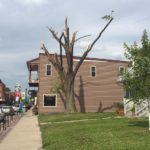
It was duly noted by me how fierce the wind was because the bark was stripped off branches and 200-year-old trees twisted
and shorn of their branches. Electricity was out because poles were down and the lines were broken.
“I called the electric company to report no electricity on Solaridge. The gentleman asked me my location which I told him. Then he
told me there had been a tornado, the crews were on their way and it would be a few hours before everything was back online.
“Because (at the time) Channel 13 didn’t seem to know for sure if it was a tornado, I called the National Weather Bureau to let them know what I had seen. I love the weather and clouds and have been a weather spotter for years since taking a weather class at CVCC. Anyway, Ben at NWB told me the investigators would be coming to Kelso Mill Road and Sharp Mountain Road to check the damage and make an assessment tomorrow which would be on the news Saturday night. I asked him to call me and let us know what their findings are.
“Well, that’s all the excitement for today. Like I said two ugly storms in one week is enough all ready.”
-
-
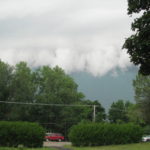
Classic storm approaching
-
-
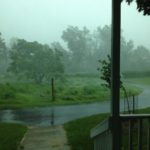
Winds whip small trees
-
-
After a tornado