by Winding Pathways | Jul 17, 2025 | Garden/Yard, Pests
An Invasive Species

Anaconda of the plant world
Oriental Bittersweet is the Anaconda snake of the plant world. Few plants are as destructive of native vegetation. It is awful.
Like many invasive species, Oriental Bittersweet was deliberately introduced to the United States in 1879 as an ornamental plant and for erosion control. It failed in both roles and is one of our most ecologically destructive plants.
How It Thrives
This sun-loving plant gets its dose of solar energy by twining up trees and spreading its branches over their crowns. Vines can be four inches thick near the ground as they wind around a tree. Anaconda snakes wrap around their prey to suffocate it. Oriental bittersweet circles a tree as it grows upward, effectively girdling it.
Cousin
The plant has a native cousin, the American Bittersweet, whose berries were once brought into wintery homes to encourage romance. It’s ecologically benign but has become much less common than the destructive import from across the Pacific Ocean.
How Winding Pathways Manages
Oriental bittersweet is an uninvited guest in our woods at Winding Pathways. We let it know it is unwelcome. Rich cruises our woods a couple of times each week, armed with clippers and lopping shears. He snips off even the tiniest bittersweet sprouts. We rarely use herbicides, but sometimes spray Oriental Bittersweet.
Here’s our advice for protecting native plants from this invasive species:
Woods With Established Big Vines
In woodlands where Oriental Bittersweet has been climbing trees for years, cut off the vines at ground level. For one-inch diameter or smaller vines, a sturdy pair of lopping shears works well. For bigger stems, a bow saw or even a small chainsaw makes the work easier. Treating the cut-off stem on the ground side with an herbicide will help prevent regrowth. Also, clip off baby vines just starting to climb.
Woods Just Getting Invaded
It’s easier to kill bittersweet in the early stages of a woodland invasion. Clip off the young vines. They quickly regrow, so repeated clippings are needed as the season progresses. Herbicides also work, but often it’s difficult to keep the spray off nearby desirable plants.
About a year ago, we bought a battery-operated clipper. It makes snipping off Oriental Bittersweet vines easier and faster than with muscle-powered tools and is also helpful in pruning fruit trees.
-

-
Variety of tools
-

-
Bittersweet vines start small.
Keep Oriental Bittersweet Out!
Oriental Bittersweet is one plant we don’t want around our home or in woodlands anywhere. We work hard to keep it from climbing our oaks, hickories, hackberries, and other trees, but we wish it had never been brought to North America in the first place.
by Winding Pathways | Jul 10, 2025 | Gazette Features
What fun we have had over years writing for various publications. Perhaps the most rewarding has been teaming with the Cedar Rapids Gazette writing features on different topics. These have been mostly travel. We’ve worked with excellent editors, had readers reach out in appreciation, and apprecited the opportunities to visit interesting and unusual places across the country.
We are still writing and here is an updated list of features since 2020. Rich keeps an extensive list of writings he and we have had published going back to the 1980s. More to come!
We hope you enjoy browsing the topics.
Features: 2020 – 2025
(For a list of features go to https://www.thegazette.com/marion-and-rich-patterson/)
July 9, 2025. Honoring Our Dad. Rock Island Veterans’ Cemetery.
June 4, 2025. Simple Fishing.
May 16, 2025. Keokuk’s Treasures.
May 1, 2025. Jens Jensen Prairie.
March 10, 2025. Michigan’s Keweenaw Peninsula
February 16, 2025. Seed Savers.
February 9, 2025. Winter Walking. (In print and Green Gazette)
*********
November 10, 2024. Riding the (t)Rails. (in print copy and Green Gazette)
November 3, 2024. Land of the Dawn.
October 23, 2024. Getting the Lead Out.
August 4, 2024. Washington’s Tri-Cities Region….
July 30, 2024. How Three Iowa Lands Became Home to Restored Prairie. Feature by Bailey Chichon about our work in restoration.
June 9, 2024. Heading South to View the Eclipse….
April 7, 2024. Trave: Wild Winter Wonderland (Alaska in winter)
January 28, 2024. Wandering Pennsylvania’s Wilds
January 15, 2024. Shed Hunting Season
********
December 10, 2023. Breathtaking Views (firetowers)
September 10, 2023. Peaceful Prairie (Grasslands of Saskatchewan, CAN)
August 5, 2023. Fly Fishing. (no link to date. Available Green Gazette)
July 16, 2023. Intriguing Riddles From the Hopewell Culture.
May 29, 2023. Head for The Hills. (Black Hills off Season)
May 21, 2023. Moving Heaven and Earth. (Earth Moving Legacy Museum)
May 5, 2023. Ax Throwing: a Fun Historic Skill.
April 2, 2023. Agritourism Attraction. (Fair Oaks Farms)
March 5, 2023. Seeking Independence. (Truman Presidential Library)
February 3, 2023. A Gem in Pennsylvania’s Laurel Highlands.
January 6, 2023. Ike’s Town. Abilene, Kansas & Western History.
********
December 4, 2022. Trap Shooting.
September 6, 2022. Riding the Rails (Alaska by Train)
July 17, 2022. Backyard Adventures. (No link to date)
July 11, 2022. Casper, WY, Gateway to the West.
May 12, 2022. Hobo Convention.
May 8, 2022. Splish Splash! Whitewater Kayaking in Iowa. (No link to date)
April 22, 2022. Finding America On Roadways East.
April 13, 2022. Muscle Over motor When Boating.
March 21, 2022. Rockhounding.
January 30, 2022. Backpacking Bonus. (8B of GZ. No link to date) Available Green Gazette.
January 24, 2022. Distinctive Religious Structures.
January 16, 2022. Hiking Wild Areas. (no link to date) Available Green Gazette.
********
December, 2021. Country Schools. (no link to date) Available Green Gazette
November 15, 2021. Making a (Mini) Pitch for Soccer.
October 6, 2021. A visit with Midwest’s Pioneering Authors.
September 8, 2021. Taking a Slow Boat to Cassville.
September 6, 2021. Camping in Iowa’s Trout Country & Decorah’s Celebrities.
August 4, 2021. Parking While Headed East. And Solar Panels at Peoples.
June 13, 2021. Alaska Recreation.
May 22, 2021. Museums of Quad Cities Area. https://www.thegazette.com/recreation/the-many-museums-of-the-quad-cities/
April 18, 2021. Finding Amelia. https://www.thegazette.com/recreation/an-unexpected-search-for-amelia-earhart/
April 11, 2021. Mississippi river Museum and Dubuque
March 25 , 2021 Cedar Falls_Waterloo. Memorable Museums
March 12, 2021. Time Travel. https://www.thegazette.com/subject/sports/outdoors/time-traveling-in-iowa-20210312
March 3, 2021 Entering the Battery Age (column)
February 19, 2021. Franconia Sculpture Park. https://www.thegazette.com/subject/sports/recreation/art-walk-in-a-park-20210219
February 2, 2021. Sprint Cars. https://www.thegazette.com/subject/sports/auto-racing/a-sprint-car-education-20210202
January 14, 2021. Embrace the Outdoors. https://www.thegazette.com/subject/sports/outdoors/embracing-x2014-and-enjoying-x2014-the-cold-outdoors-20210114
*****
December 20, 2020. Walking Cemeteries. https://www.thegazette.com/subject/sports/outdoors/a-peaceful-outdoor-walking-option-20201221
December 14, 2020 Iowa Meat Lockers: https://www.thegazette.com/subject/sports/outdoors/a-meaty-adventure-20201214
Nov 11, 2020 Iowa’s Inland Seas. https://www.thegazette.com/subject/sports/outdoors/enjoying-iowas-inland-seas-20201111
Oct 11, 2020. Barn Quilts. https://www.thegazette.com/article/barn-quilts-offer-brighten-up-the-countryside/
Sept 27, 2020: New Life to dead Trees. https://www.thegazette.com/subject/sports/outdoors/dead-trees-give-life-20200927
September 20, 2020: Walk Outside Safely. https://www.thegazette.com/subject/sports/outdoors/get-outside-and-walk-but-stay-safe-20200920
September 9, 2020: Rebirth Amid the Rubble https://www.thegazette.com/subject/sports/outdoors/a-rebirth-among-the-rubble-of-trees-20200906
August 22, 2020: Iowa’s National Parks. https://www.thegazette.com/subject/sports/outdoors/iowa-national-parks-guide-effigy-hoover-20200822
July 27, 2020: County Parks. https://www.thegazette.com/subject/sports/outdoors/take-advantage-of-iowas-county-gems-20200727
July 11, 2020: Tenting. https://www.thegazette.com/subject/sports/outdoors/why-rv-live-isnt-for-these-senior-tent-campers-20200711
June 26, 2020: Bear Sightings in Iowa: https://www.thegazette.com/subject/sports/outdoors/why-rv-live-isnt-for-these-senior-tent-campers-20200711
April 12, 2020” Walk on Wilder side. https://www.thegazette.com/subject/sports/recreation/take-a-walk-on-the-wilder-side-20200412
by Winding Pathways | Jul 3, 2025 | (Sub)Urban Homesteading, Flowers/Grasses, Foraging, Garden/Yard, Pests
A Variation on “The Four Horsemen”
A quartet of deadly and toxic plants lurks along trails and riverbanks in Iowa and some across much of the world. They are Poison Hemlock, Poison Ivy, Flowering Spurge, and Wild Four O’clock.
Poison Hemlock
We’ll start with Poison Hemlock. Socrates wasn’t the only person killed by it. The Greeks once used to execute criminals.
Poison hemlock isn’t related to the majestic hemlock tree. Rather, it’s a biennial herbaceous plant. In its second year it quickly shoots up to tower upwards of eight feet tall. In Iowa it prefers living in dappled sunlight where the soil is moist. That describes the land bisected by public trails paralleling rivers and streams—places where people go to recreate.
It’s deadly poisonous, but only when ingested. Walking or cycling by it creates no problem at all. But it’s wise to know about this potentially deadly plant. All parts of it are toxic to people and animals when ingested. Even dried, wintery stems are poisonous.
By early June, the tall green plants with feathery leaves begin bearing white clusters of flowers. Their prettiness is deadly.
Poison hemlock could be confused with Queen Anne’s Lace that’s sometimes called wild carrot. Poison hemlock also often lives near wild parsnips. This plant is also toxic, in a different way. It can create a vicious rash in people who rub against it with bare skin and then are exposed to sunlight.
Where Poison Hemlock Originated
Poison Hemlock is native to Europe and is especially common around the Mediterranean Sea. It was introduced to the Americas, New Zealand, Australia, and Asia, so today, it is a toxic invasive species worldwide.
The Internet and YouTube are loaded with sites describing this plant. A good quick read comes from the National Park Service at nps.gov/articles/poison-hemlock.htm.
Other Troublesome Plants
Unfortunately, several other deadly and toxic plants often live in the same places as poison hemlock. Here are a few.
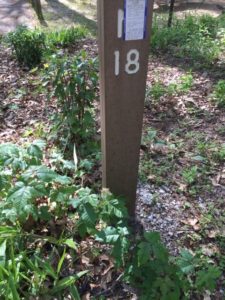
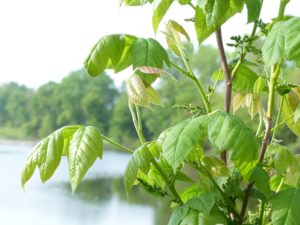
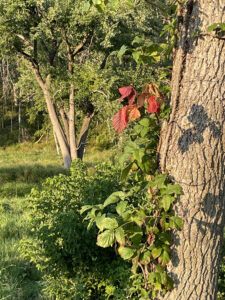
- Poison ivy often lines trails. It prefers living on the edge of woodlands where it gets some shade and sun. Unlike poison hemlock, poison ivy is a native plant that causes a contact reaction. That means if human skin brushes against it a nasty itchy rash can follow. And, if a pet wanders through the poison ivy and then comes inside where a human pats it, guess what? The irritating oils are transferred and the human gets a nasty rash. A friend of our discovered this earlier this year. Also, state parks are notorious for having poison ivy growing where people contact it – along unkempt trails and winding up trees in campgrounds even. Rabbits and deer eat it and birds eat and spread the seeds.
-
-
Birds drop seeds when they perch on campground posts.
-
-
Poison Ivy loves edges
-
-
Keep your distance from this beguiling, colorful plant.
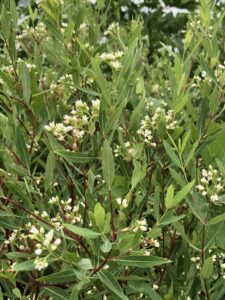
Pretty and irritating
Flowering spurge is also common along trails. Cut the plant and get some of its sap on skin and a nasty welt is likely to result.
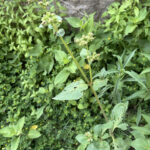
Unattended areas attract undesirable plants.
Wild Four O’clock also loves trail edges and is reported to be toxic.
None of these plants cause problems unless they are eaten or contact the skin. They won’t cause a problem for anyone just walking by
Be careful. Keep your distance.
by Winding Pathways | Jun 19, 2025 | (Sub)Urban Homesteading, Flowers/Grasses, Garden/Yard, Garden/Yard
Years ago, anyone attempting to create a diverse, native landscape in their yard sometimes experienced weed ordinance woes. Their local ‘weed commissioner” would order them to mow their “messy” yard.
Towns created ordinances to give them the authority to force landowners to remove what was perceived to be health or safety hazards. But, they were sometimes used to enforce conformity to the standard of neatly mowed, sprayed, monoculture lawns promoted by lawn product and care companies.
Cities do need the authority to deal with situations where landowners simply neglect their yards by not mowing, but they should not be able to use ordinances to enforce an aesthetic standard.
Changing Times – Responding to Declining Pollinator Populations
These days, homeowners everywhere recognize the importance of diversity. They are creating diverse landscapes of native plants even in tiny yards. Towns are responding by altering restrictive ordinances to allow the restoration of beautiful vegetation that supports beneficial wildlife, including pollinators.
Anyone who plans to diversify their yard in a way that makes it look different from their neighbors’ runs a risk of running afoul of their local town’s ordinance.
Guidelines To Reduce Neighbor or Municipal Friction.
- Research your town’s weed ordinance. Often, it’s printed on the town’s website.
- Develop a written plan and diagram of what the yard will become. It doesn’t need to be fancy or detailed.
- Cultivate and educate neighbors. Even towns that have old-fashioned ordinances rarely go out of their way to enforce them. Enforcement is triggered by complaints, usually from neighbors. Sharing a yard’s plan with neighbors before the change takes place may help them understand that what you are doing isn’t neglect.
- Start small. Maybe just replace a corner of a yard with prairie the first year and expand it gradually as the years go by.
- Make the yard look tended and not neglected. This can mean mowing pathways through tall grass, maintaining some lawns, and often being seen tending the yard tending the landscape.
- Avoid health or safety hazards. Avoid planting taller vegetation that will block a driver’s vision at intersections. Don’t allow allergens like poison ivy or ragweed to grow.
- Hiring a knowledgeable professional yard care company to plan and implement diversity.
Results
Restoring a gorgeous landscape of native vegetation is a delightful project that makes our world a bit healthier. Doing so is easier if it doesn’t irritate neighbors or invoke a stern town ordinance.
-
-
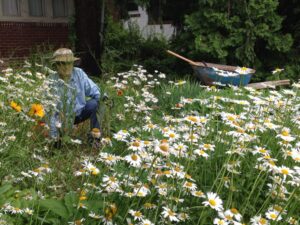
Native and cultivated plants brighten a front yard.
-
-
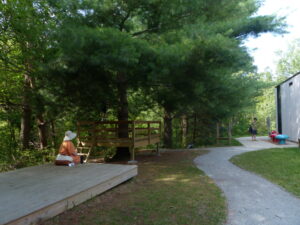
Families outside
-
-
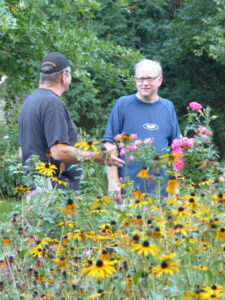
Converting a yard to more natural plants brings joy.
This first appeared on the Sustainable Landscape Solutions Website at sustainable landscape solutions.org. The company is based in Iowa City, Iowa, and helps landowners create wondrous yards.
by Winding Pathways | Jun 12, 2025 | (Sub)Urban Homesteading, Nature, Reflections/Profiles

Tracks easily run over a rough surface.
On a spotless spring day, Trackchair® made a delightful afternoon in nature’s beauty possible.
Marion had had surgery, so walking on soft or uneven ground during recovery was challenging. But it was May, the marvelous season of birdsong and wildflowers. We yearned to leave urban noise behind and hike a trail.
Why Nature?
Few activities are as refreshing, relaxing, and rejuvenating as being in nature’s stillness and beauty. For most people, all it takes is a walk in the woods, wetland, or flower-studded prairie. Marion’s walking challenges were temporary during recovery, but many people lack easy access to nature due to a permanent disability.
How We Got Outside
We made a reservation to use one of three Trackchairs® that the Indian Creek Nature Center welcomes people to use for free. Two are adult sizes, and one is designed for a child. The chair was charged up and ready to go when we arrived at the Nature Center. Staff member Michelle Basler gave us a quick orientation. “I love helping people use a Trackchair. They help people who usually use a wheelchair to venture into nature alone or with their more mobile friends or family,” she said.
The Nature Center’s Trackchairs® are made by ATZ Manufacturing in Marshall, Minnesota. “We have a nationwide system of distributors making it possible for nonprofit organizations, like the Nature Center, or individuals to purchase one and have it tailored to their needs. Distributors also service the chairs,” said Adam Henning, Marketing Manager.
How Trackchairs(R) Help
He told us the chairs are being used by a diversity of people with special needs. “We know they give access to nature for people close to the end of their lives. Even injured seasoned athletes use them to observe outdoor sports,” he said.
Our time outdoors wasn’t exactly quiet. We were serenaded by Baltimore Orioles, Rose-breasted Grosbeaks, Tennessee Warblers, and American Redstarts. Wildflowers lined the trail. The Trackchair(R) itself was so quiet we could hear birds as the chair purred along on its electric motor. “Quietness is important. Various ATVs on the market enable people to access nature, but they are noisy,” said Henning.
Friendly Features
The chairs are also easy on the ground. Marion used the joystick to turn the chair 360 degrees, and it barely scuffed the grass underneath. It has a leveling feature that enabled her to go up and down steep slopes without concern of tipping, and gingerly cross a narrow footbridge.
Where to Rent a Trackchair(R) Locally and Why

Controls are easy to learn.
We were fortunate to have access to one of three Trackchairs® recently purchased by the Indian Creek Nature Center in Cedar Rapids. “The Nature Center held a fundraising campaign to find money to buy the chairs and additional endowment funds to generate income to pay for their maintenance and eventual replacement costs,” said John Myers, Executive Director.
“The Nature Center strongly believes in the many mental and physical health benefits of being outdoors. The Trackchair® helps us extend access to those people who struggle to walk,” said Sarah Botkin, who manages the Nature Center’s Amazing Space Building.
The Indian Creek Nature Center is a private nonprofit organization on the east side of Cedar Rapids, Iowa. Annually, it hosts thousands of people for environmental education programming, special events, and rentals. Trails wind through over 400 acres of woodland, prairies, and wetlands and are open to the public for free use every day of the year. For information or to make a Trackchair® reservation, visit Indian Creek Nature Center and the reserve an all terrain wheelchair. You can learn more about AMZ Manufacturing and the many models of chairs they make by visiting their site.
What Is A Trackchair(R)?
ATZ Manufacturing made the Trackchairs® and is based in Marshall, Minnesota. It began in 2008 when a father worked to develop a device to enable his son to access the outdoors. It grew into a company that makes and distributes the Trackchair® we used and many other models suited to different needs. “We have one that enables people to stand and do things like grilling dinner,” said Henning.
Trackchairs® weigh between 400 and 500 pounds. They are best transported in a pickup truck or enclosed trailer, but can be moved on a hitch platform that has a tongue rating of at least 700 pounds. Transportation, of course, isn’t necessary at the Nature Center or the many other nonprofit organizations and government agencies that let people use them on their grounds. They move at three to five miles an hour and have about a seven-mile electric range. “We’re working to increase the range using advanced batteries,” said Henning.
Overall Impression

A Trackchair(R) helps people with limited mobility enjoy being outside.
We were amazed at the chair’s comfort, its quietness, and its ease of learning. After just a few instructions from Michelle, we were on our way up and down the Nature Center’s trails. Even after turning on a mowed section of the trail, the grass was undisturbed. The slower speed gave a leisurely pace. Time to note flowers and hear birds. The faster pace on rough ground was akin to riding a bronco. Kind of fun, but not recommended. The chair has a guard on the back to prevent tipping over. And, users can angle the seat forward or slightly back when going up or down steeper hills.
It was awesome to use!
An Update
About a week after we tried the Trackchair® Rich was volunteering at the Nature Center. A school bus drove in and unloaded a class of fifth grade students. One was in a wheelchair with an attendant. The Nature Center had the youth-sized chair ready and a staff member oriented the student right after he was transferred into the Trackchair®.
Then, off he went with his classmates. The chair enabled him to pace right along with the other students on his own. He was thrilled.