by Winding Pathways | May 24, 2018 | (Sub)Urban Homesteading, Flowers/Grasses, Foraging, Garden/Yard, Garden/Yard, Weeds
Years ago, a homeowner visited a garden store and bought plugs of a plant commercially called ground ivy, but most folks today call it Creeping Charlie.

A great ground cover that can get away from you.
In many ways this exotic plant was an ideal ground cover. It’s tough, easy to transport and plant, adaptable to a wide range of conditions, needs no special care, and it spreads like crazy. It only grows a few inches tall so was touted as a plant that, once established, needs no maintenance. And, it attracts valuable pollinators early in the season before other flowering blooms appear.
Benefits
Creeping Charlie’s benefits are also its curse. It does everything too well. Creeping Charlie doesn’t creep. Rather, it races to cover a yard with astonishing speed, often crowding out more desirable plants.
There are two ways to view Creeping Charlie.
It’s either a pernicious pest or a friend that needs little care. At Winding Pathways, we look at it both ways depending on where it’s growing. When it’s crowding wildflowers or our garden vegetables we rip it out of the ground. In places where it can’t infect a garden or native wildflowers we leave it be and know we won’t need to mow that area often.
Controlling Creeping Charlie
There are lots of ways to control Creeping Charlie. We pull it out of the ground. Roundup and other herbicides kill it, and it’s possible to smother it under black plastic sheeting. Mulch works for a while but soon the plant will thrive on even a thick layer of shredded wood mulch.
A member of the mint family and also known more romantically by an elderly Irish friend as “Gill-Over-the-Ground”, Creeping Charlie is also edible steamed, added to omelets or brewed as a tea.
Other Ground Covers
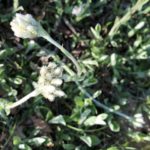
We prefer ground covers that are less aggressive than Creeping Charlie. One of our favorites is the native Pussy Toes, which grows in patches in our lawn. We planted some when we moved in eight years ago and because we don’t put herbicides on our lawn it is spreading nicely. It is hardy and thrives in dry, sandy soil in baking sun. The hairy, silvery leaves lie close the ground and in spring send up enchanting stems with little “pussy toe” flowers. The Lady Bird Wildflower Center confirms this native plant is widely spread and thrives in open meadows and woodlands and rocky areas. We’ve seen it all over the eastern half of the country and Canada. We love it! Again, it saves mowing, adds color and texture to the landscape and attracts early season pollinators.
We also use Vinca, with its periwinkle flowers, on some parts of our lawn especially areas we do not want to mow. It spreads easily, adds color and texture to the landscape and reduces maintenance.
-
-
Pollinators like ants flock to pussytoes.
-
-
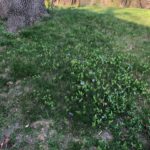
An excellent ground cover.
-

-
Pretty purple violets.
Our lawn actually is a mosaic of many plants. Since we shun herbicides we have a lawn blend of grasses, violets, dandelions, pussytoes, and many other plants. They are all fascinating and help pollinators through the seasons.
by Winding Pathways | May 17, 2018 | Bugs, Garden/Yard, Nature, Pests
Creepy Crawlers
Even before Lyme disease created a serious tick-borne health hazard no one wanted ticks crawling on them. We sure don’t want them at Winding Pathways and because our yard has tall grass, shrubs, and a woodland we have tick habitat.
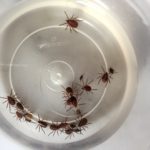
Collection of ticks
A few years ago, Rich contracted Lyme Disease caused when a tick injected bacterium into him. Thanks to a wise physician and effective antibiotics he was cured, but it’s possible to get Lyme Disease again and again. We’re more cautious about avoiding ticks now.
Ticks of many species live throughout most of the United States. They’re common in brushy, grassy, and woodsy habitat but they also love living in yards. It’s possible for a tick to enjoy a human meal even if that person never leaves a mowed yard.
Natural Tick Predators
Although naturalized yards are sometimes good tick habitat they also attract tick predators that love to snack on the tiny invertebrates. Many small birds, including warblers, wrens, and brown creepers among them quickly convert any tick they find into lunch.
Possums Are Us!
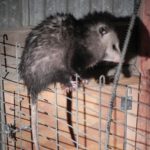
Opossums groom themselves carefully.
A newly understood tick-lover is the common opossum. Many people consider this ancient marsupial a homely animal and would prefer to not have one in their yard, but they might want to rethink this. According to the Carey Institute, opossums are tick vacuum cleaners. As they walk through a yard ticks hitch a ride, thinking they will be able to burrow into the animal’s skin and feast on warm blood. The tick doesn’t realize that possums groom their fur often and comb out ticks. These are readily eaten by the always hungry mammal. Having an opossum in the neighborhood can reduce tick numbers.
Foxes and Coyotes
Small predators, like the fox, are also valuable in tick reduction. According to a study by Dr. Hofmeester, Foxes and coyotes eat mice that ticks feed on. Ticks need three meals before they can reproduce, so more foxes and coyotes can reduce the mouse population and thus, the tick population by “…breaking the cycle of infection.”
Life Cycle
Tick numbers are also associated with climate change and abundance of food. Dr. William H. Schlesinger in an April 2018 issue of Citizen Scientist wrote about the work of Rick Ostfeld with the Carey Institute. The occurrence of ticks one year relates to mice numbers the year before, which relates to food abundance in previous years. The chain of life! And, according to Ostfeld, white-tailed deer are less implicated, unlike initial beliefs, and turkeys also appear to help reduce tick numbers. That is great news for us at Winding Pathway because the wild turkeys pretty much take over our yard at times!
Gobbling Guineas
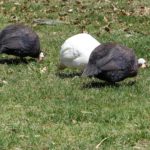
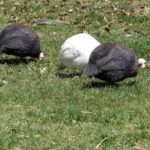
Guineas eat ticks.
A domestic bird that loves ticks is Guineas. They are tick lovers. They are African natives that have been domesticated. Elise Gallet de St Aurin, of Cheshire Moon Farms, told us the guineas that roam her farm near Atkins, Iowa, keep it clear of ticks. These attractive but loud animals roam widely, roost in trees, and eat all sorts of invertebrates, including ticks.
It’s impossible to buy or confine an opossum. But, guinea chicks can be ordered from Hoover’s Hatchery. Some people also enjoy eating guineas.
Repelling Ticks
A simple way to reduce odds that a tick will hitchhike on a person is to use repellents and chemicals that kill them. Any insect repellent containing DEET will repel ticks. Spray it heavily on the legs and arms and on clothing, especially pant legs, shoes, and socks. DEET doesn’t persist long and disappears after clothes are washed so it needs to be reapplied often.

Various forms of tick repellent.
A more permanent solution is to use a spray containing permethrin. This chemical actually kills the ticks. It lasts a long time, even through several wash cycles. It should not be applied to the skin. We spray it on our pants, socks, and shoes. One set of Permethrin-sprayed-pants remains hung in our cabin – not in the house – to put on when we are venturing in likely tick habitat.
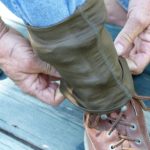
Protect yourself with gaiters
Ticks usually access a person from down near the ground. They’re most likely to cling to pant legs or socks and then walk uphill on the skin. Tucking pants into socks makes life harder for these pesky animals, and we take it one step further. We bought a pair of tick gaiters from Forestry Suppliers, Inc. They cost about $11 and fit over shoes and pant legs, forming a tight seal.
Tick Checks
Doing a “tick check” is important. After being outside take a hot sudsy shower and check the body over for ticks. Fortunately, they usually wander around on the skin for several hours before burrowing in. A tick that has not penetrated the skin won’t spread disease and often is simply washed down the drain. Launder the clothes right away.
Ticks deserve respect. They can spread serious disease and they lurk where people often go. Don’t let a fear of ticks keep you inside. Go outside and play but take precautions to reduce the chances of catching a tick-borne illness.
by Winding Pathways | May 10, 2018 | Garden/Yard, Reflections/Profiles
A Visit to Cheshire Moon Farm
Fans of Alice and Wonderland know the famous Cheshire Cat grin. That feline gave its name to a happy place called Cheshire Moon Farm in rural Atkins, Iowa. Winding Pathways visited in late April and left smiling.
The farm is perched on high ground with a clear view in all directions. “The night sky is gorgeous and the crescent moon reminded me of the Cheshire Cat’s grin, so that’s how our place got its name,” said Elise Gallet de St Aurin.
Happy Animals Reflect Caretakers’ Enthusiasm
The name is appropriate. Elise and her family are caretakers of goats, sheep, horses, guineas, chickens, and a couple of dogs. As she led us around, her cheery enthusiasm was matched by that of the animals. All seemed happy, and if the animals could grin like the Cheshire cat we’re sure they would.
-

-
A great smile
-

-
Elise Holds Goat
-

-
Goats follow Elise around.
-
-
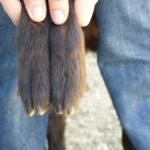
Goathooves
Elise holds a master’s degree in agriculture education and chose to return to the family farm after college, where she meshed her considerable energy with enthusiasm and knowledge to build a business centered mostly around goats.
How Goats Help People
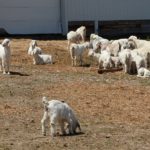
There are lots of goats at Cheshire Moon Farm. Some are meat breeds sold for the niche meat market. Other goats are kept for breeding. And, at least one semi-retired animal mentors the herd of younger goats. Still, others are milkers that produce the raw material for the soaps and lotions that Elise makes. Although not approved by the Food and Drug Administration (FDA) for people who suffer from eczema and psoriasis, Elise indicated that some customers find the products helpful.
Thanks to Elise we received a goat education. They are truly amazing and were the first animal domesticated by people some 30,000 years ago in the Middle East. A goat can yield about 45 pounds of meat and a milker may yield up to a gallon a day. Some people enjoy having a goat pet, which has a lifespan similar to that of a dog. Goats live in herds. Sheep in flocks.
There are many goat breeds, and the animals come in many colors and configurations. One goat Elise calls her reverse Dalmatian because of its black body with white spots.
Goats are curious, love to climb on things and are voracious eaters. “They love snacking on woody plants and like poison ivy, Canada thistle, and other prickly plants. In contrast, sheep are grazers that prefer to eat grass,” she said.
-

-
Elise Points
-

-
Spotted Goat
-
-
Guineas eat ticks.
-
-
All sorts of goats.
Landowners hire her to bring goats to places loaded with exotic undesirable prickly plants. In a short time, the animals devour honeysuckles, barberries, and poison ivy. We asked how she cleans the poison-ivy-eating-goats off. “I mix Dawn soap with water and squirt them down until they turn blue, then hose them off,” she explained.
A Woman on a Mission
In addition to raising goats for brush clearing, milk, and meat Elise, is a farrier who travels to trim the hooves of sheep and goats and had just returned from a Minnesota hoof trimming trip when we met her. She works full time at the Cedar Rapids Tractor Supply Company. Among many duties at the store, she manages baby chick sales.
Despite her vast knowledge of animals, what shines through is her boundless enthusiasm for education, augmented by her master’s degree in that field. She’s also an adept cooperator. “I don’t know machines too well but teamed up with Larry’s Landscaping to fill voids in the farm operation,” she said. While we visited, Larry and two of his children were buzzing around tidying up the property for an upcoming open house.
As we left for home we glanced back at Cheshire Moon Farm. Goats, sheep, chickens, guineas, and horses all seem to give us a big happy grin as if to say, “Hurry back”.
We’ll do that. Anyone is welcome to an Open House from 10 a.m. to 3 p.m. on Saturday, May 19, 2018.
3169 74th St Atkins, IA 52206. 1-319-929-5201.CLG.CONSULTANTS.INC@gmail.com. For information check out CGLHEARTANDHOOVES.COM.
by Winding Pathways | May 3, 2018 | Birds, Mammals, Nature
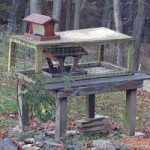
Keeping Squirrels at bay
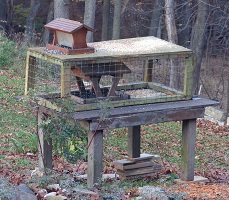
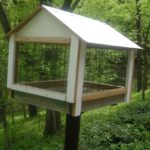
Bruce Frana, a Winding Pathways visitor, saw one of our blogs on our “squirrel proof” feeder and how we discourage squirrels from gobbling up sunflower seeds we put out for birds. He crafted a similar but much more attractive version that’s in his yard. Our contraption is a box framed with 2X2 lumber with sides of 2” x 2” wire mesh. A piece of plywood forms the roof, and we attached it to a wooden table with a pair of hinges. The hinges let us lift the cage to sprinkle sunflower seeds inside.
It works. Sort of. Cardinals, chickadees, and nuthatches easily pass through the wire mesh to feed. Some squirrels and wild turkeys, which we like but get frustrated when they gobble up all the seed, can’t get through the mesh. Our fox squirrels are too chunky to squeeze through, but smaller gray squirrels manage to get in and gobble seeds. We could keep the grays out if we could find 1 ¾ x 1 ¾ mesh wire on the market. As far as we know it doesn’t exist, but if it did it would let birds in but exclude even the skinniest gray squirrel.
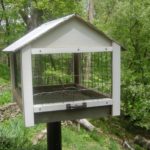
Bruce reports that his fox squirrels can’t enter either but the grays do. Here is a photo of his squirrel foiling feeder:
Do It Yourself “Squirrel Proof” Feeder!
Here is what he shared: “I have had a platform feeder for several years but, like your blog mentioned, turkeys, and even some clever squirrels, were able to get on top of it. I built (a feeder) based on the plan/picture you shared on your blog. I adapted the plan to the platform feeder I had and made some of my own modifications.
“As you can see from the pictures, I attached the structure onto the original platform by using hinges, just as your plan had done. I also put a pitched roof and handle to be able to easily lift the one end to place seed on the platform. The entire system is attached to a 2″ PVC pipe that slides over a steel post. I have had one ingenious small grey squirrel figure out how to get into the feeder and solved that problem, at least for now, by making the wire openings a bit smaller on two sides.” It works…sort of!”
Readers can go online and find “Do It Yourself” (DYI) “squirrel proof” feeder instructions. Good luck and let us know how it goes! Thanks, Bruce Frana.
-
-
Adaptation to feeder
-
-
Back View of feeder
by Winding Pathways | Apr 26, 2018 | (Sub)Urban Homesteading, Foraging, Travel/Columns

At the Iditarod Start
Food in Alaska is just plain fun! The Last Frontier state has one of the most ethnically diverse area codes in the country. English, Irish, Scottish, German, French, Norwegian, Swedish, Dutch, Polish, Filipino, Hawaiian, Samoan, Tongan, African Americans, Laotians, Japanese, Vietnamese, Indian, Chinese, Native American, Italian, Mexican and Russian are among the many groups of settlers. Alaska Natives with their several family identifications make up even more diversity.
And, as the spring 2018 issue of “Bake From Scratch” magazine points out, each cultural group brought its own type of food which has since fused into uniquely Alaskan fare. I sampled lots the few days I was in Alaska this winter. Some from different cultures and some from the subsistence foraging that is part of being Alaskan.

Art on a wall
My daughter and son-in-law hosted me for a fun Fur Rondy-Iditarod time in March. At a charming downtown restaurant, we enjoyed the wall art being prepped for “First Friday” when art galleries and restaurants feature new art, stay open for music and sometimes introduce new dishes. Tomato bisque and roll and grilled cheese sandwiches hit the spot on a cold and grey late winter day.
After walking off the lunch we hit Wild Scoops for their truly Alaskan sourced ice cream of “wildly” exciting flavors. From the micro-creameries to the harvested berries they boast ingredients from Alaska in generous Wild Scoops portions. We then wandered through the Alaska Museum to walk off those calories.
On the morning of the Iditarod, the first order of business for Brian and me was the stop at the Fire Island Rustic Bake Shop. This truly family affair of making traditional and specialty breads, muffins and scones using organic ingredients was a delight to see and smell. Lines out the door gave a clue to the popularity and was worth the wait to select a roll and coffee for the walk up to the Ceremonial Start. We saved a muffin for Nancy who was working at Campbell Creek Science Center where the Ceremonial Start ends at the Campbell Airstrip.
While not particularly “ethnic” the hotdogs for sale by vendors at the downtown Ceremonial Start of the Iditarod had long lines waiting with numerous sauces and spreads to tempt the taste buds.
-

-
Tasty treats!
-

-
Artisan Breads ready to buy.
-

-
New and different foods!
-

-
Coffee!
A trip to New Sagaya market was an eye-opener. So many choices from so many countries and cultures within each country. We snacked on interesting appetizers while we sipped great coffee. Poke – Hawaiian for slice or section – can be both a fish salad and an appetizer. We ate aku a raw oily tuna. Well, it was OK to try – once. Mochi is a round rice ball. Kind of soft and squishy. It had a subtle sweetness. Mike Barnes, Chief Operating Officer, accurately boasts, “NEW SAGAYA DOES WHAT NOBODY ELSE WANTS TO DO…WE GO THE EXTRA MILE.” Indeed, they seem to! Friendly, knowledgeable and the store is well-stocked with about any diverse food customers could want.

Waiting for the movie to start.
The Bear Tooth Theatre Pub is a “have to visit” place to eat and sample craft beers while watching first run, indie and foreign films. Broken Tooth Beer served there is just one of the best! And the pizzas are loaded with great locally sourced toppings on a crispy yet substantial crust. And, the popcorn…of course! Have to take it in. The background is that a few “fresh-faced college friends” concocted the idea of The Theatre Pub in the late 1990s. They gave up lucrative careers in computers and law when craft beers were coming of age and have been going strong since.
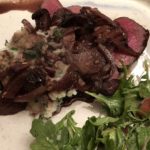
Not only did we eat out, but also, Nancy and Brian prepared wonderful meals at home. Most Alaskans forage and they are onto this one. They’ve had great adventures halibut fishing, picking berries and making jams and chutneys. Brian has plans for fall hunting and fishing expeditions. Meanwhile, they served elk and moose from previous trips, halibut tacos, Dutch Babies with their jams, and salmon from a neighbor. One friendly fact about Alaskans I learned is that if someone offers to help or offers food, say, “Yes. Thank you.” Alaskans mean it when they offer.
-
-
Moose and elk with greens and side dish.
-

-
Beautifully presented dinner.
-

-
We enjoyed wonderful home cooked meals.
Alaskans I met are genuinely friendly and use organic and local products as much as possible. Always, the dishes are infused with a truly Alaskan personality – We are Glad you are Here!