by Winding Pathways | Sep 20, 2018 | Chickens, Energy Efficiency, Flowers/Grasses, Garden/Yard, Garden/Yard, Nature
It’s turning time for wildlife, chickens, and people
As the Northern Hemisphere of the earth continues its ageless slow wobble away from the sun, days gradually shorten until a wondrous event happens.
The Autumnal Equinox happens around September 21st each year. It’s when daily hours of sunlight equal those of darkness. On only two days each year does every place on earth enjoy roughly 12 hours of sunshine. These are the fall and spring equinoxes. So, whether someone lives near the tropics or poles they will experience the same amount of light on only those two days.
Light changes quickly around equinox time. Up here in the Northern Hemisphere days shorten quickly and darkness advances until the December 21st Winter Solstice, the year’s darkest day. The Southern Hemisphere begins to enjoy its longest days through December.
Preparing
At Winding Pathways around the Equinox, we do these things:
- Stimulate our chickens. We plug in the timer and light bulb in the coop. Chickens lay the most eggs when there are about 15 hours of daylight. So, the coop light is set up to come on about 4:30 a.m. and turn off about three hours later when the sun pokes over the horizon.
- Drain, clean, and invert our rain barrels. We won’t need extra water until next spring, so we turn the barrels upside down, so they don’t collect winter water that freezes and can split the barrels. We weight them with stones to keep Arctic winds from blowing them away.
- Watch this short video on how to Prepare Rain Barrels
- Bring in pumpkins and winter squash. A frost is soon to come, and we don’t want it to bite our squash. We store
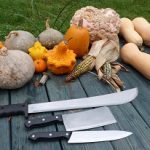
Winter Squash vary in color, texture, shape and size.
pumpkins and squash in a room we rarely use. It stays cool but above freezing. Butternut, Acorn, Hubbard, and most other winter squashes and pumpkins, which actually are a squash, keep for months and give us delicious and vitamin stoked food on cold days.
- Exclude, or try to, insects and mice. Somehow mice, box elder bugs and Asian beetles sense coming cold and find tiny cracks to enter the house and enjoy winter warmed by our furnace and wood stove. Each fall we caulk up cracks and weather strip doors to encourage them to stay outside where we prefer to see them. It’s never perfect. Some always find their way inside.
- Enjoy leaves. Each’s fall’s spectacular leaf color peaks in October but some leaves start turning sooner. Our backyard black walnut starts coloring up in early September. The real show is the deep orange, red, and yellows of our sugar maples. They peak in early to mid-October followed by russet oak leaves.
-
Fall wildflowers are an important food source for insects and birds.
Enjoy wildflowers. Asters, Goldenrods, and Maximilian Sunflowers are the very last blooms of the season. Their colors brighten the yard and provide nectar for insects and then seeds for migrating and overwintering birds. But all this comes with sadness as we know we’ll not see wildflowers again until next spring.
- Watch wildlife. It’s migration time and one of the best seasons for seeing unusual birds. We often look upward and sometimes spot pelicans and waterfowl winging high overhead. By now deer in their subdued winter coats are sleek and well fed on a diet of acorns. Bucks have polished their antlers. Chipmunks and squirrels scurry about caching winter food.
We’d like to hear what you enjoy about the Equinox time. Please email us your joys and projects in this wondrous season.
by Winding Pathways | Sep 18, 2018 | (Sub)Urban Homesteading, Chickens, Garden/Yard
Hoover’s Hatchery is sponsoring a “Chicken Shaming” contest! Seriously! Join the fun for some good clean Chicken Shaming by sending your story and photo. Winding Pathways works closely with Hoover’s Hatchery and we love their work.
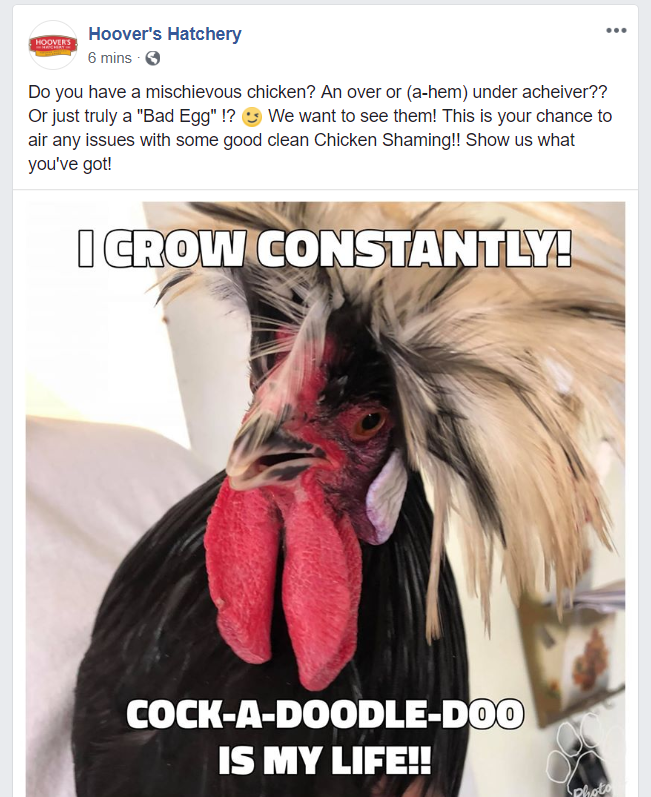
Hoovers Hatchery Invitation
by Winding Pathways | Jul 26, 2018 | (Sub)Urban Homesteading, Birds, Bugs, Flowers/Grasses, Garden/Yard, Nature, Reflections/Profiles, Wonderment
The Gazette in Cedar Rapids has had several interesting nature stories connected to creating wondrous yards. Living Section features “Birds do it, Bees do it”, “Add a Little Luck to Your Landscape” and Purslane (by Winding Pathways). We loved reading about the birds and bees’ cooling strategies and welcomed the return of clover to yards as natural nitrogen fixers and deep-rooted water retention plants. And, of course, we love to eat purslane. Let us know ways you fix this healthy vegetable.
Also an article on wasps of late summer. They are beneficial, ‘though deserve keeping distance.
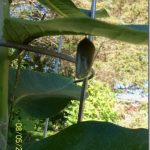
Success on the Bena Farm!
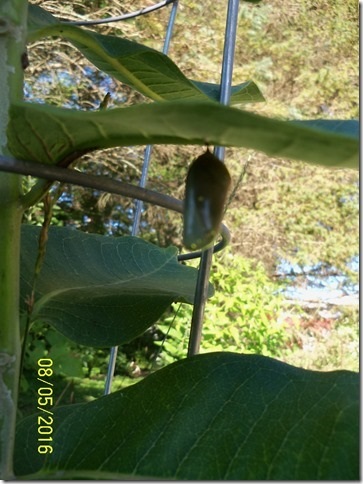
Best of all was the picture of the Monarch Chrysalis from friends, Nancy and Gordon Bena found on their farm. Let’s keep encouraging habitat for insects that form the basis of life for many other creatures.
by Winding Pathways | Jul 19, 2018 | (Sub)Urban Homesteading, Amphibians/Reptiles, Birds, Garden/Yard, Mammals, Nature
Susan Hrobar
guest blogger
Fun Through the Window
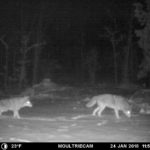
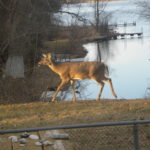
We are fortunate to live at the end of a channel on a small lake. Our north facing windows face our backyard and the channel. One of our friends, who knows very little about nature, does not understand that after living here for 18 years, we still get excited when we see any wildlife in our yard and in the channel. Most of my photos are taken from windows inside the house, hoping to not spook my photo subjects. We frequently have deer coming through and we can tell which paths are being worn into the ground. During the winter we’ve taken photos of deer amidst the falling snowflakes. And, on our trail cam, we have “caught” coyotes, fox, raccoons, opossums, and neighborhood kitties.
Tom Turkey
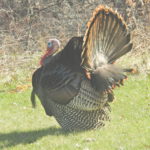
Strutting
This spring we have had a special bonus of occasionally watching a male turkey strut between our and the neighbors’ yards. Usually, he is skittish and if he spots me looking out a window, he quickly moves out of sight. One morning he must have felt like he was “king of the hill” and actually posed for photos about 20 feet from where I was watching him. I have also watched him fly over the channel near dusk and find a tree to roost in for the night. It always amazes me to watch these big birds fly through the trees, as normally you only see them walking and running on the ground.
Turtle Habitat
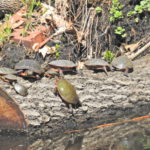
Lounging on a log
Last summer when the water level was high, an oak tree uprooted and fell into the channel, covering both sides of the channel, and completely blocking our water access to the main lake. Because the channel is narrow, there is little clear land on either side. The oak landed at the bottom of a steep hill, so removing it was quite a process. It took a bucket truck on top of the hill, a small boat in the channel, lots of ropes, and a very talented arborist to take care of the problem. This spring the water is lower and that downed tree is now a horizontal stump about four feet long partially submerged from where it fell.
The turtles love this new sunning perch! We have never seen so many turtles at one time. So far, our biggest count has been nine painted turtles on the log. In spring we sometimes get lucky to see a large soft-shell turtle swimming in the channel and climbing out onto the shore. The females are much larger than the males.
Wood Duck- Goose Dustoff
On a recent rainy day, we spotted a pair of wood ducks. They are also very skittish and do not like to pose for photos. We watched as they flew up into a large basswood tree and perched on the branch. I think that is the first time I have ever seen ducks sitting in the trees. It was not a great day for photos, but I tried anyway.
The ducks flew to another tree, rested for a while, and then flew down to the water. Mr. Wood Duck and Mr. (Canada) Goose then had an altercation on the grass with much hissing, honking, flapping of wings, and chasing.
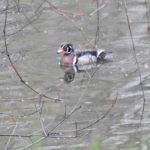
Male wood duck
Mr. Wood Duck was very proud of himself for chasing the goose parents and two goslings of out “his” channel. Mrs. Wood Duck cheered him on while sitting on top of our boat motor. My husband, John, had the fun of watching the goose and duck stand-off. I was trying to get to a different window without all the raindrops obscuring my view. That did not work, but it made me smile to hear John laughing and enjoying the whole spectacle.
Loving Our Wildlife
Even after nearly two decades, we still so enjoy our yard and sharing our stories about animals and plants.
-
-
Night activity
-
-
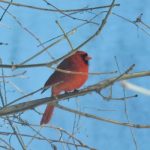
Male Cardinal in a tree.
-
-
Deer in yard.
-
-
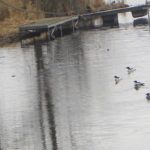
Swimming
-
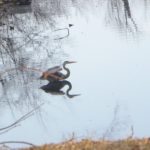
-
A heron spreads its wings
-
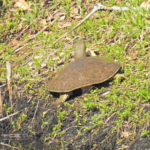
-
Female soft shells are larger than the male.
by Winding Pathways | Jul 8, 2018 | Birds, Garden/Yard, Garden/Yard, Nature
This Nectar is TOOOO Hot! Ahh, Just Right!
Lijun Chadima, Guest blogger
Every year I always like to put the hummingbird feeder out as soon as the weather warms up. It’s been difficult this spring because of the crazy temperature fluctuations. Earlier this spring I was enjoying the warm sunshine on our porch when a beautiful ruby-throated hummingbird flew over and seemed to be wondering, “Where the heck is the feeder?” I boiled the sugar water that afternoon and hung out the feeder the next morning.
Mystery – Why No Hummingbirds?
After a couple days the level of the sugar water in the feeder didn’t appear to go down at all. My little friend stopped by a couple more times, but each time he flew off after just a brief sip. I went out to
check the feeder and discovered it was so hot that I could barely hold it in my hand. No wonder the hummingbirds weren’t drinking any! I suddenly remembered a bird show I saw on PBS that stated hummingbirds try to avoid extreme heat, so that afternoon I took the feeder down from its regular spot which was in direct sunlight, and moved it to a new location where it was in the shade under the sun umbrella.
Mystery Solved!
That apparently did the trick because the very next day multiple hummingbirds took turns drinking from the feeder.
Hummingbirds are a source of endless fascination for me. They are full of energy and dart around the sky in all directions like little helicopters. What a treat when one actually stops to rest on the ledge and enjoy a drink from the feeder. Just remember to keep it in the shade so it’s not too hot for them!
Click on the link below, download and watch the video by Lijun of the hummingbird happily sipping nectar in the shade.
by Winding Pathways | Jul 5, 2018 | Garden/Yard
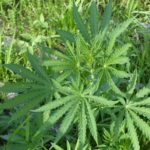
Hemp is amazingly tough and useful.
As we drove along a rural road recently we spotted a healthy patch of wild marijuana.
Most Iowans call it ditch weed. For an” illegal” plant it’s amazingly common across much of the United States and loves living in poor soil out in the hot summer sun.
The plant is technically called Cannabis sativa and comes in two forms that look identical. One is usually called marijuana and contains the active ingredient THC that gives it medicinal and psychoactive properties.
Ditch weed, or hemp, is the other form. It lacks much THC but can grow to 12 feet or even taller on sturdy stalks. It has many industrial uses such as strong rope, clothing, recyclable plastics and animal feed.
A thick patch of it even stopped the old truck we had once when it veered off the road with an approaching train. Phew! Dodged that disaster.
Cannabis was domesticated at least 12,000 years ago in South Central Asia, where it is also a native wild plant. People valued it so highly that they brought it along whenever they migrated to a new place. Uncommon in the United States until the early 1900s it was probably brought to our country by Mexican immigrants.
Cannabis was banned in 1937 by the Federal Marijuana Tax act that remains in force, even though several states have decriminalized it.
A fast-growing annual, cannabis may spring up in nearly anyone’s garden. Birds love the seeds, and patches are excellent habitat for pheasants and other wildlife.
Few plants are as controversial, but society is moving toward legalizing it for its many benefits. Read in The Gazette Natures’ Notes on some fascinating history of marijuana.