by Winding Pathways | Apr 4, 2024 | (Sub)Urban Homesteading, Garden/Yard, Pests
Easy Peasy Life for Ticks
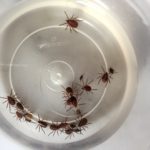
Collection of ticks
The recent warm winter was easy on heating bills and back muscles used to shovel snow, but it may mark an early return of Lyme Disease and the ticks that spread it.
At Winding Pathways we take a multi-pronged approach to reducing the odds of being bitten by an infected tick. Here’s great news! A new way to reduce Lyme Disease in white-footed mice is emerging which is good news for human health.
It was once believed that whitetail deer were the primary carriers of Lyme Disease with the theory that an infected tick leaves a deer and bites a human. Deer can carry Lyme Disease and pets and other wild animals can get it, but new research shows that white-footed (or deer) mice are the major carrier. Those tiny rodents are abundant where people live.
Old Standby Ways To Protect Against Lyme Disease
For many years we’ve done several things to lessen the chance that an infected tick will bite us.
First, we use repellents, even when working in the garden or enjoying a backyard barbeque. Deet-based repellents are widely available and repel ticks, mosquitoes, and even pesky flies. Deet can be applied to the skin. Permethrin is fatal to ticks and shouldn’t be applied to the skin. Spraying it on clothing makes life challenging for any tick seeking a human blood meal.
In recent years we’ve bought clothing from the Insect Shield Company. It is permeated with permethrin. Their clothing is stylish, comfortable, and durable, so we invested in several sets. In winter those clothes are stowed in the attic but worn daily during months when ticks are on the prowl.
Permethrin is sold in spray containers and it’s easy to treat jeans, shirts, socks, and shoes without needing to buy specially treated clothing. The chemical remains in clothing through several washings.
Second, we always do a tick check after being outside. Ticks typically walk around on a person for a few hours seeking a warm spot with thin skin to best extract blood. An unattached tick won’t spread disease, so after being outside we shed clothes, put them in the washing machine, take a warm sudsy shower, and check our bodies for ticks. They’re most likely to lurk in warm moist body parts but can be anywhere.
-

-
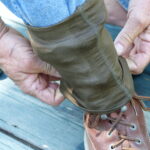
Pants, boots, varied sprays can reduce odds of picking up ticks
-
-
gaiters with tick guard helps repel ticks.
-

-
Pants, shirts, and socks infused with permethrin appear to keep ticks off.
New Promising Way to Reduce Lyme Disease
Relatively new research links the incidence of Lyme Disease with the presence of white-footed mice. Before we knew this we were already doing the right thing by encouraging mouse predators to live on our property. We love spotting hawks wheel overhead and hearing the chilling calls of nighttime owls. Both feast on mice. So do foxes, many snake species, and coyotes. Domestic cats also do but they kill many birds, so we are a catless family.
US Biologic is introducing a new way to reduce the odds a human will contract Lyme Disease from a tick that had bitten an infected mouse. They’ve been working on its development for 20 years, and it’s becoming available through pest control companies in many states.
Lyme Shield
It’s called the LymeShield System which combines traditional tick control with Lyme vaccine-coated pellets in a timed application dispenser. It doesn’t kill the mouse or any predator that might catch and eat it. A tick that bites an inoculated mouse will not pick up the Lyme bacteria. So, if that tick then bites a human it will not transfer the disease. The home page has a fascinating map that shows the progressive spread of Lyme disease.
US Biologic has come up with a clever way to help protect a family from Lyme Disease. We’re going to try it when it’s available in Iowa but we’ll keep using Deet and Pyrethrin and doing tick checks after being outside. We’ll also keep saying “thanks” to our predator neighbors that are constantly on the prowl for mice meals.
Being outdoors is amazingly good for human health. Playing ball, fishing, gardening, grilling, and even just sitting in a lawn chair offer healthy fresh air and sunshine. Fear of contracting Lyme Disease encouraged many people to stay indoors. Winding Pathways urges them to take tick precautions but spend as much time as possible outside.
Go outside and have fun.
by Winding Pathways | Mar 21, 2024 | Garden/Yard, Garden/Yard, Trees
Bright! Beautiful! Ominous!
As we walked across a New Jersey parking lot last summer an amazingly colorful, and new-to-us, insect fluttered in front of us. It had a gorgeous creamy white and bright red body covered with black spots.
Identifying it was easy and ominous. It was a Spotted Lanternfly. First found in Pennsylvania in 2014 it likely came to the United States from its native China as a hitchhiker in a crate or box.
It may be a pretty bug but its presence is ominous. It feeds on at least 172 different plant species and is spreading rapidly westward from its start close to the Atlantic Ocean.
Feeding off Another Invasive
What’s somewhat ironic about the lanternfly is the insect’s affinity for another Chinese invasive, the Tree of Heaven or Ailanthus. Although the inch-long insect will eat many different plants it prefers this highly aggressive and fast-growing tree.
Important Contact Information
The Iowa Department of Agriculture and Land Stewardship is on the lookout for the Spotted Lanternfly. They ask anyone spotting one in Iowa to report it by calling:
l (515)725-1470 or logging onto their website at IowaAgriculture.gov.
How To Reduce the Invasion
A key to reducing this insect’s abundance may be reducing Ailanthus tree numbers. This invasive tree thrives in urban and rural areas, often forming large groves. It displaces native trees, has little commercial value, and now harbors an introduced insect pest.
Winding Pathways encourages anyone with an Ailanthus in their yard to remove it, convert it to firewood if you can, and replace it with a native tree species. Remember, report any Spotted Lanternflies you spot.
-
-
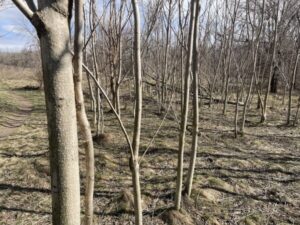
Grove of young Ailanthus.
-
-
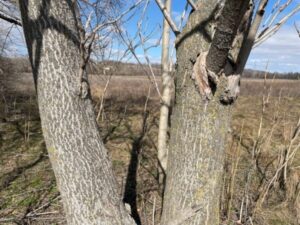
Ailanthus trees grow fast.
by Winding Pathways | Feb 29, 2024 | (Sub)Urban Homesteading, Home Improvements, Nature, Trees
Knot Just Lumber
A local store
When driving through Hiawatha, Iowa, recently, a nondescript sign caught our eye. Posted on what looked like a warehouse the sign said, KNOT JUST LUMBER. We had to check it out and soon entered the ultimate wood candy store.
Leaning upright were immense slabs of white and red oak, walnut, cherry, and mulberry destined to become gorgeous tables. Nearby were smaller boards of at least a dozen tree species. Most were cut from native Iowa trees, but some racks held exotic wood from foreign lands. Purpleheart caught our eyes. It comes from trees that grow in Central and South America. When first cut the wood is dull grayish but within a few days, it transforms into an eggplant purple color.
Local Connections
We returned to visit Nic Carter, who co-owns the store with his sister, Caris. The family is from Alburnett and Nic was an active 4-H member dabbling in woods making jewelry boxes for art shows. After stints as a woodworker and home builder Nic, and his family opened Knot Just Lumber in September 2022. He and his sister decided to open the store because, “The area has no local woodworking place, so, I started one here,” he explained.
His father and son help run this family-owned and operated business located just north of Cedar Rapids. We enjoyed an in-person tour, which is augmented by their website and includes a virtual walk-through.
Knot Just Lumber caters to hobbyists, commercial customers, and families. We have visited several times and enjoyed chatting with individual customers and couples, and watched kids touch and smell the smooth, fragrant wood. The company buys trees from wood brokers. Most originate from trees in southern Iowa. The company mills wood into various-sized boards and turning rounds, dries it in an onsite kiln, surface planes, and sands most boards.
Wood is Special
Wood is special. We’ve noticed that in many brand-new houses doors, window frames, and floors are crafted from composite materials and plastic.
Nothing seems natural. In contrast, our 1947-era house has floors of Douglas Fir and White Oak with our furniture crafted from solid oak, pine, walnut, and cedar. Different woods make our home feel closer to nature while gracing us with the individual vibrant colors, textures, and grain patterns of each species. The woods connect us to woodworkers, friends, and craftspeople from bygone and current eras.
Commercial Lumber
Commercial lumber is usually cut from the straightest and most uniform trees. Buy it from a large commercial outlet and it’s attractive and easy to work but lacks the character implanted in wood by knots and irregular growth. In contrast, every wood slab we saw at Knot Just Lumber showed the individuality and character of the tree that created it. “Some of the most interesting wood comes from trees that grew in urban areas where their branches spread widely. It helps give the wood wonderful character and beautiful grain,” said Nic.
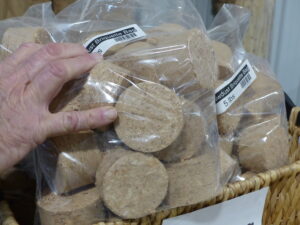
Unfortunately, every year millions of trees, many growing in towns, are felled after they die. Beautiful wood inside the bark is frequently hauled to a landfill, ground into shavings, or cut for firewood. Knot Just Lumber converts old veteran trees into lumber destined to be crafted into furniture that endures for generations. The company even saves sawdust and compresses it into briquettes to feed a wood stove or campfire. We bought some and found that they work wonderfully. We appreciated Nic’s caution that they do burn hot, so we use them sparingly. We are excited to use them with our occasional campfires out back.
-
-
Value added and no waste.
-
-
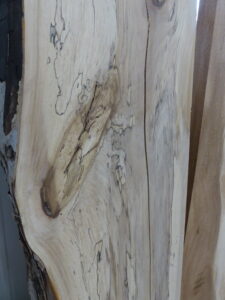
Fungi-laced wood
A Way to Add Character to a Room
The materials from our recent downstairs bathroom renovation are mostly manmade. That’s understandable, as the surfaces need to be easily cleaned and resist moisture. But the room needed the character of wood. So, we bought an oak board from Knot Just Lumber to cover a small area of plaster. It adds the warmth of nature to an otherwise utilitarian space.
Hidden Gems

Fusing old and new technology.
Knot Just Lumber is a local store we found by accident. The staff consult, have working spaces and classes for customers and specialize in epoxy with the wood to create gorgeous pieces for homes. Their prices are reasonable, especially compared to national stores or online sources. Similar local stores are scattered across the country. Finding them can be tricky but hobbyist woodworkers know where they are and anyone can Google hardwood lumber and they might learn of a nearby place to buy gorgeous local wood.
Resources
One of our favorite resources to learn the diverse characteristics of dozens of different species of native and exotic woods is the book WOOD! Identifying and Using Hundreds of Woods Worldwide, by Eric Meier.
-
-
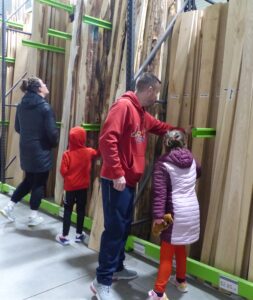
Families taking in the lumber.
-
-
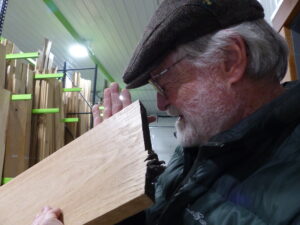
Assessing lumber.
-
-
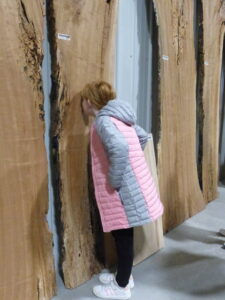
wood has a characteristic smell.
by Winding Pathways | Jan 18, 2024 | (Sub)Urban Homesteading, Birds, Nature, Pests
Frustration Yields to Creativity
Reprising the blog on thwarting House Sparrows. Here is a recap of our initial frustration and subsequent ways to encourage native birds and discourage exotics.
As we wrote earlier, hordes of House Sparrows almost made us give up feeding birds. We’d fill our feeders each morning and hope to watch juncos, cardinals, chickadees, woodpeckers, and nuthatches visit on cold winter days. Unfortunately, hordes of House Sparrows began arriving. We don’t mind feeding a few, but dozens soon devoured all the expensive seed, leaving empty feeders for native species.
Coming Up Short on “Expert Advice”
We asked bird experts what we might do to discourage House Sparrows and tried several of their ideas. Nothing worked well, so we experimented and came up with a few tricks that seem to discourage House Sparrows to a degree yet let other species eat. Our tricks aren’t perfect and sparrows still come, but not in huge numbers.
Here’s what we did:
Altered filling time:
We noticed that cardinals, jays, chickadees, and nuthatches visited feeders in the early morning and late afternoon, but House Sparrows came more late morning and toward the middle of the day. So, we put out small amounts of seeds early in the morning and again in late afternoon. Often our feeders are empty mid-day when the house sparrows prefer to visit.
Eating from platform feeder
Sparrows enjoy feeding on the ground, on horizontal tables and other flat surfaces, and from silo-type feeders with long perches and large openings. We took down our standard silo feeders and replaced them with a silo shape feeder made of hardware cloth with a quarter-inch mesh.
In our quarter-inch mesh feeder, we put a mixture of black oil sunflower seeds and hulled peanuts. Native birds seemed better able to extract the sunflower from the mesh than House Sparrows. The peanuts don’t fit through the mesh, but many native bird species peck at them through the wire and extract pieces of peanuts. House Sparrows seem less able, or willing, to do this.
We also stopped feeding cracked corn and millet on the ground. Sparrows love them. Instead, we now toss full kernels of corn on the ground. Sparrows can’t swallow the big seeds and are unable to peck them apart. Woodpeckers, cardinals, blue jays, and nuthatches swallow or carry away the big seeds.
Put up with some House Sparrows
Our system helps deter these pesky exotic birds but is far from perfect. House Sparrows still visit and eat seeds but not as many as before we started using these tricks. Maybe they’ll work for you.
A few of you have shared. Now Others Can Share.
Winding Pathways is eager to learn other ways to deter House Sparrows. If you have discovered something that works, please let us know.
#
by Winding Pathways | Dec 14, 2023 | (Sub)Urban Homesteading, Bugs, Garden/Yard, Nature, Pests
Autumn Reveals Nature’s Wonders
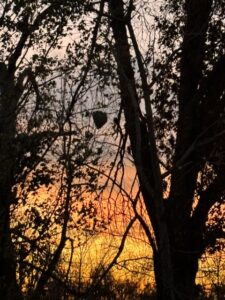
Bare trees reveal a bald-faced hornet nest.
November’s wind stripped the leaves off one of our maples and revealed a big gray football-shaped bald-faced hornet nest. Although we’d walked under it all summer, we had no clue it was there.
This fall many people will discover similar “paper wasp” nests in their trees or shrubs or even tucked near a light fixture. Made of a paper-like material, the nest was really made by insects called “bald-faced hornets” that are related to other wasps, including yellow jackets.
These social wasps can attack in droves. Their sting hurts. Because their stingers are smooth, unlike honey bees, they can sting again and again.
So, what do you do when you spot a nest on a crisp fall afternoon? Leave it alone!
Life History
The insect’s life history gives the best clue on how to avoid painful stings.
Last fall the colony of 500, or so, worker wasps died as the weather cooled. The fertile queen survived by tucking herself under a rotting log somewhere to slumber through winter. Come spring she’ll make a tiny paper-like nest, usually in a tree, and lay eggs that become workers. These hard-working new insects expand the nest and forage widely.
They are omnivores eager to dine on rotting fruit, but among their favorite foods are caterpillars and adult insects. Bald-faced hornets are a gardener’s friend, removing vegetable-chomping insects. They also sip on nectar so are good pollinators.
Aggressive or Protective?
Most sources claim they are highly aggressive, and they are if someone disturbs their nest. Several years ago, an adult neighbor spotted a nest above the doorway that the family had used all summer. He tried to knock it down and only damaged the nest. His misguided aggression unleashed an attack by dozens of upset bald-faced hornets. Stung many times, he’ll likely never again molest a nest.
We walked under and near the bald-faced hornet’s nest in our yard many times this summer and didn’t even know it was there. They didn’t attack us. Rather, they snacked on our vegetable gardens’ pests.
The lesson: leave these insects and their nest alone.
Ironically, by the time most people discover a nest in very late fall, the colony has already abandoned it. The best thing to do is NOTHING. Winter’s wind, rain, and snow will disintegrate the nest, and the queen will find a new spot to build next year’s colony.