by Winding Pathways | Dec 18, 2025 | (Sub)Urban Homesteading, Mammals
 When autumn’s spectacularly colored leaves drift by our windows they signal the end of a season. That’s also the beginning of a new season – when nests appear like magic.
A few years ago we sat on the front deck as leaves tumbled off a nearby maple. “What’s that big shape up there?” Marion asked. We looked closer through binoculars spotting a bald faced hornet nest.
Hidden From View
During the growing season we didn’t know the colony of these big hornets were nearby, because their growing paper pulp-like nest was deeply tucked among leaves. By the time we spotted it the nest had been abandoned. We watched as the weather gradually shredded it overwinter.
Winding Pathways is filled with wildlife, big and small, and many species nest close to the house, sometimes unseen during the warm months.
-

-
Spectacular contrast.
-

-
Heading to the nest
Birches and Bird Nests
On a warm late November day we pruned a river birch tree near the labyrinth, looked up, and spotted an abandoned robin’s nest built on a horizontal branch. Crafted of sticks, it was lined with dried mud and likely was a perfect home for a brood of babies.
Crafty Crows & Cozy Squirrels
Dropping leaves also reveal bulky, loosely formed crow’s nests up high on trees. After brooding and fledging crows abandon the nests which, typically, quickly fall apart. Crows to generally return to the same area year after year.
The leafy nests of squirrels high in trees are called dreys. Although they prefer using tree cavities, when these are scarce they’ll make a drey. Dreys are easy to spot after leaf fall. They’re usually at least 30 feet up and built in the fork of a branch. The ambitious animals weave together sticks, leaves, and grass to make one and snuggle inside during cold windy winter nights.
-

-
Cozy nest
-

-
A warmer nest
While walking through our yard and area trails we often spot other wintery nests. Here are a few of our favorites:
House Wren: All summer we’re serenaded by singing wrens, and we love watching them bring delicious caterpillars into their nests to feed babies. They are cavity nesters and claim the wooden boxes we put out for them. Each fall we open each wren house and remove the nest of woven sticks inside.
-

-
Sticks and feathers
-

-
Wrens carefully construct nests of small twigs lined with soft down.
Baltimore Oriole: Orioles visit us in the spring but prefer nesting along nearby Indian Creek. Their nests often hang down from the branches of tall trees and are sometimes built way above trails, lawns or water.
Goldfinches: Goldfinches love tall grasslands, and build their nest in tall wildflower stems or dense shrubs surrounded by prairie plants. They nest in mid-to late summer andline their nest with soft plant down, like milkweed fluff.
Wild Turkeys: Unlike many birds turkeys don’t work hard to build their nest. They just make a slight depression in the ground and line it with dry leaves. A few years ago our neighbor was doing yard work when a female turkey rushed out from under a bush right next to the home’s foundation. He was startled! Whether back in the forest or in suburbia female turkeys usually make their nest under a shrub and next to a log or foundation. Usually there will be a clearing nearby, and to a mother turkey a lawn is a good substitute for a natural grassy clearing.
Turkey vultures: While not exactly back yard birds, turkey vultures are denizens of summer thermals. We see them soaring in the country and over towns. A basswood tree just east of our property has been the home of nesting turkey vultures since before we settled here in 2010. The Derecho of 2020 took out many trees and broke some off the basswood. But, mostly it survived partly because it is more holes than tree!
-

-
Looking out the nest holes.
-

-
Sturdy tree.
Foxes, coyotes, and woodchucks all have favored places to tuck in. Not nests but cozy homes. Deer bed down on warmer south slopes. Various insects create nests. The photo gallery shows some examples.
-

-
Mystery nest
-

-
Elegant work
-

-
den in side of hill.
-

-
Deer yard.
Fall’s a great time to go on a nest hunt seeking a variety of structures built by birds, mammals and even insects. Sometimes they can be a challenge to identify, but a great source is nestwatch.org. It will help discover what birds made nests tucked in trees, in tall grasses, on the ground, and even under house eaves.
-

-
Robins are opportunists.
-

-
Stick nest
-
-
Mystery nest
-

-
Wasps
by Winding Pathways | Dec 4, 2025 | (Sub)Urban Homesteading, Energy Efficiency
We’ll soon celebrate the 10th anniversary of our solar electric system. Did our decade-old solar arraays investment save money?
The short answer is YES!
Here’s the back story.
Our system is small with only nine panels on the barn’s roof. When we had it installed our intention wasn’t to produce all of our electricity. It was to tame the sting of high utility bills and produce as much electricity from the sun as possible.

Men installing panels.
Our system was built by the Enphase Company and installed by SiteGen, a part of Paulson Electric. At the time it cost us about $9,000. We received about half of that back on our federal and state income taxes, so our net cost was around $4500.
We are “net metered” with Alliant Energy. This means that electricity moves back and forth through our meter. When we produce more than we use, the excess goes out to provide electricity to other users. When we need more than we produce electricity comes in from the grid. At the end of the month, we pay Alliant the “net”.
When we travel and our electric use is low, we push power outward, but most of the time we use more than we produce. We get a monthly bill from Alliant but it’s always lower than if we didn’t have solar.
Was Our System a Good Investment?
Every month we get a report from our Enphase system through a phone app and an Alliant bill. Monthly production varies based on how much solar energy strikes our panels. Long clear summer days boost production, while clouds and short winter days reduce it.
Overall, we calculate our system averages about $60 worth of electricity a month. In a decade we’ve made about $7200 worth of electricity at a net investment cost of $4500. That’s a good return. Lacking tax credits, it would have taken us another few years to break even.
-

-
Impressive graph
-

-
Production
How Long Do Solar Panels Last?
Solar electric companies project the lifespan of panels at 25 years. So, for many years we will enjoy cost reductions on our electric bill. As electric rates rise the value of our investment in solar becomes ever more valuable.
The Indian Creek Nature Center installed solar on its Sunroom 23 years ago. Despite its age the system produced 3055 kilowatt hours of electricity in 2024, its year of best production. There is no sign of degradation in production due to age,” said John Myers, the Center’s executive director.
Here are things we’ve learned from our system:
- Our only maintenance is to use a roof rake to remove snow. Panels make no noise and have survived severe storms intact.
- Annual electric production is a bell curve with its peak during the summer’s longest days and the lowest during midwinter.
- Shade has a major impact. Even one puffy cloud on a clear day causes production to briefly drop as its shadow crosses our panels.
- A big oak tree on our property, immediately east of the panels, got first dibs on sunlight. The tree shaded the panels in the morning. After we removed the old declining tree in early 2025 our morning electricity production jumped upward.
-

-
Low maintenance.
-

-
Full sunlight
Society Going Backwards
The Trump administration and your representatives eliminated tax credits in the latest budget. Next year, credits will no longer be available to help homeowners reduce their electric bills.
Goinig Forwards
Back to the main question: Is investing in solar energy worth it today? Yup.
The payback time is longer but newer panels are more efficient than our decade-old ones and they’ve dropped in price.
We’d do it again, even without the credits.
Want to install solar?
Local companies skilled in setting up systems are found nearly everywhere today. A quick Internet search should yield several companies close to home. For general information check energy.gov solar. We’ve been happy with our Enphase system. Information is at enphase.com.
by Winding Pathways | Nov 27, 2025 | Foraging, Nature, Trees
As Christmas approaches, nearly every American radio station will play the familiar “The Christmas Song” commonly called “Chestnuts Roasting On An Open Fire.”
The song was written by Robert Wells and Mel Tormé in 1945 and made famous by the Nat King Cole Trio. Released in 1946 it became a Christmas melody popular for nearly 80 years. A pdf in the Library of Congress has an intriguing story.
Cruel Irony.

Chestnut blight wiped out Americn Chestnuts all over the East.
For thousands of years Native Americans harvested baskets full of chestnuts. So did Eur-Americans who swept across North America. Nutritious and abundant, chestnuts fed people and wildlife. Many were, indeed, roasted by open fires and on woodstoves.
The American Chestnut was one of the abundant trees in the Eastern Hardwood Forest.
It was a perfect tree with gorgeous honey colored wood that was strong, lightweight, and easy to work. Chestnut’s abundant nuts fed wildlife and people. Settlers turned their hogs loose into the woods to fatten on them.
Then one of America’s greatest ecological tragedies happened when an imported fungus created a blight that killed nearly every single one of billions of trees. They disappeared from forests and the human diet……almost.
Disease Resistant Options
Rich bought a couple of pounds of edible chestnuts from Iowa’s Stringtown Market and roasted them on our woodstove for a gathering of friends to enjoy. How?
Well, across the world are Chinese, Japanese and European chestnuts. Chinese Chestnuts resist the blight and have been planted here and there. The nuts Rich roasted were either Chinese or a hybrid of a few types.
Personal Connection to American Chestnuts
Growing up in wooded New Jersey Rich remembers fallen trunks of blight killed American Chestnut trees and small trees growing from their roots. They die before maturing enough to produce nuts. Rich’s Dad, Henry Patterson, salvaged wood from fallen chestnuts and fashioned many objects from it. Marion’s father, Les Fellows, remembers gathering chestnuts when he was a child in New Hampshire. He crafted picture frames that we think are from American Chestnut wood. The pictures in the frames are of Hardwick, MA, where Marion lived first out of college. Chestnuts are part of our personal heritage.
-

-
Handmade Frames
-

-
Honey colored wood.
Enjoy Edible Chestnuts
Although hard to find in the market edible chestnuts still make delicious fare. Many recipes can be found online. We like plucking them from their shells and eating them right after roasting. Here’s how Rich prepares them:
- Cover the nuts with water and boil them for at least 15 minutes to soften the hulls and leach out tannin.
- When they are cool enough to handle, use a stout sharp knife to make an “X” shaped cut on the top of each damp nut.
- Place the nuts in a cast iron skillet and heat on the woodstove. Watch them carefully and stir occasionally. The idea is to drive off most of the water.
Putting them on a cookie sheet and baking them in an oven also works well.
Then they’re ready to peel and eat.
-

-
Slice the nuts
-

-
Boiling softens the nuts’ shells.
-

-
Chestnuts in cast iron pan roasting.
Beware
Edible chestnuts are unrelated to horse chestnuts or buckeyes but the nuts look similar. Horse chestnuts are toxic. DON’T EAT THEM. Here’s how to tell them apart.
> Horse chestnuts have compound leaves with leaflets that radiate out like fingers on a human hand. Edible chestnuts have single elongated leaves, often with shallow pointed lobes.
> Nuts in tight husks that don’t have porcupine-like spines outside are characteristic of Horse chestnuts. You could call edible chestnut husks “vegetative porcupines.” Prickly!
> Horse chestnut nuts are entirely smooth, while edible chestnut nuts have a “nub” at their end. See the photo with the arrow pointing toward the nub.

Note the nub.
The Future
Enjoying Edible Chestnuts, Growing Them, and Saving the American Chestnut
We mostly enjoy peeling and eating edible chestnuts as they are. And, they work perfectly in many recipes. A good recipe source is at foodandwine.com.
(search for edible chestnuts)
Many nurseries sell chestnut seedlings. Pure American chestnuts are most likely to thrive when planted outside their native range where the blight still lingers. Many hybrids sold by many nurseries resist the blight. It’s wise to plant them a ways from the house for these reasons:
- Blossoms just plain stink. And the trees produce hundreds of “porcupines”. Don’t step on one with bare feet!
For these two reasons, we will never know why Marion’s dad planted the edible chestnuts near the house in New Hampshire.
The American Chestnut Foundation
The American Chestnut Foundation, tacf.org, has worked for years seeking ways to restore this valuable tree. Its website has excellent photos and information.
We hope some day to spend an evening sitting by our woodstove snacking on genuine American Chestnuts while listening to Nat King Cole’s Christmas song. Until then we’ll roast the hybrid Chinese Chestnuts we buy.
by Winding Pathways | Nov 20, 2025 | Garden/Yard, Mammals, Pests
One early November day we watched an enormous whitetail buck saunter across our yard. Seeing big bucks during their short mating season is common, but where do they hide the rest of the year?
Does and Young Always Around
It’s perplexing. We see does and fawns in all seasons in our yard and crossing roads as we drive around. Sometimes we wish they’d stay away. Marion sprays flowers with stinky deer repellent to reduce their hungry browsing and Rich builds fences around our vegetable garden and young trees.
Beauty

Fawns quickly grow to yearlings. Some are bucks and rub their antlers on trees.
Deer are beautiful animals. Despite the occasional damage they do we love seeing them and sharing some aspects of our yard with them. But where the bucks are is puzzling. Except for early November and early December, we never see them. They are huge and some have massive antlers. How can they hide?
Our Guess
Here’s our guess. For most of the year bucks are more nocturnal than does. We often find droppings in the morning and during the fall we see their rubs on small trees from unseen overnight visitors.
Bucks also have an amazing ability to hide in small patches of thick cover surrounded by roads, houses, and even factories. These places are common and often are scraps of undevelopable land or the back areas of city parks. Usually, people avoid these areas because walking in them is wet, buggy, or blocked by fallen trees. They’re perfect hiding spots for bucks.
How the Rut Works
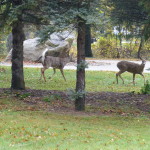
On Halloween day a buck was hot on the “tail” of this doe and yearling.
Like most animals, but unlike humans, deer have a specific short mating season that biologists and hunters call the rut. It’s stimulated by decreasing daylight hours. Across the United States the main rut starts around Halloween and runs for a couple of weeks into November. During this time nearly all mature does become impregnated.
Young does born in the spring of a year generally don’t breed during the main rut. About a month later, in early December, there’s a secondary rut when young females breed. By the end of the year nearly all female deer are pregnant and will bring fawns into the world next May or June.
Caution Advised!

Buck with antlers
For most of the year bucks are shy, cautious and stay out of sight. During the rut they’re so focused on breeding that they abandon caution. So, beware when driving. They can be spotted at any time of the day or night. It’s always fun to see them, except when they cross a road in front of us in hot pursuit of a female.
Of all months, November is when most deer are hit by cars.
by Winding Pathways | Oct 23, 2025 | Energy Efficiency
In midsummer we made a major cooking change at Winding Pathways when we bought an induction stove. For 50 years we’d been cooking on a gas kitchen range, so we faced a learning curve.
Induction stoves work by creating an electromagnetic field below a smooth glass surface that energizes magnetic cookware above. Induction heats quickly and precisely.
Motivation to Buy Now
We’d been thinking about swapping gas for induction for some time, encouraged by our friend Sigrid Reynolds. She had used hers for several years. When we learned that the new Federal Budget would eliminate tax credits for energy efficiency items at the end of 2025, we checked around at several stores that sell induction stoves. We chose Slager Appliance store in Cedar Rapids. Their prices are competitive and their information, stove options and customer service excellent. Because we cook simply we settled on a basic model that also has an intriguing feature of an “air fryer”, an easy wash removable oven tray in the conventional oven.
Reasons We Decided to Switch
- First, induction stoves are amazingly energy efficient. We always seek ways to reduce our consumption of fuel, especially fossil fuels.
- Second, we knew that induction stores heat food and water quickly and allow precise temperature control.
- Third, we could capture Federal tax credits.
- Fourth, safety. There is no open flame or electric coils that stay hot. Induction stoves heat cookware and their contents, not the stove surface. The stove surface heats stainless steel pans and contents but quickly cools. Touch it by mistake after removing a pot and a burn is unlikely. If a burner is accidentally turned on without a pot above it won’t heat up.
Induction Stoves promote clean indoor air
For years we’ve used gas fueled camping stoves with instructions stating to only use them outdoors where there’s plenty of fresh air. Why, then, was it safe to burn similar fuel indoors on our kitchen stove? Kitchen gas stoves emit pollutants into a home’s air.
Induction stoves don’t, so our stove promotes clean indoor air.

Smooth top of induction stove makes easy cleaning.
Induction Stove Considerations
Along with the many benefits of induction stoves, customers need to consider the changes involved. The first is visible in the appliance store. They cost more than comparable gas or conventional electric stoves. Since they work by magnetism our old trusty copper bottom pots and pans wouldn’t work on induction. So, we gave them away and bought new magnetic stainless-steel pans. Fortunately, our time-tested cast-iron skillets work great on induction.
Most induction stoves run on 220 amps of electricity. We only had a 110 line to our former gas stove, so we hired a Munson Electric Company electrician to run a 220 line to our stove location.
The Learning Curve
As soon as our new stove was installed, we faced a learning curve. The stove’s quick heating ability took getting used to. It boils water in a flash. However, turn the dial down….or up….and the stove responds instantly with less or more heat without the lag common in other stoves. We learned to stay close in the kitchen and mind the progress of the cooking.
Cleaning and Bills
Another part of the change to an induction stove was cleaning it. We wipe down the stove top and inside after each use, and use prescribed materials to regularly wipe to top. These tasks take only a few minutes and leave the stove looking great. We chose knobs vs. total “push button” so we can look back when leaving the kitcher or house, see the knobs upright and that nothing is left on the stove and know with assurance all is safe.
Our electric usage and bill may rise some. Our gas usage will decrease.
We also make sure nothing is left on the stove top when we are not cooking. This simple technique ensures more safety.
We’re still getting used to it but we like our ultra-modern efficient induction stove.