by Winding Pathways | Sep 19, 2024 | (Sub)Urban Homesteading, 1080 Labyrinth Blog, Garden/Yard, Nature, Wonderment
Partnership with Sustainable Landscape Solutions Creates Natural Beauty
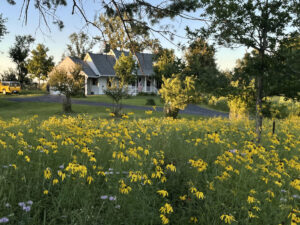
Brilliant flowers
When we bought our home near Cedar Rapids in 2010 we had a vision to transform the yard that had been sprayed and manicured by its former owner into a wondrous place, brimming with natural beauty and fascinating wildlife. It would be a delightful yard with prairie and savanna wildflowers bouncing in the breeze, and goldfinches and swallowtail butterflies winging over. We sought to create natural beauty.
We have years of ecological restoration experience. Rich had been restoring prairies and oak savannas since 1975 in his position as executive director of two nature centers. Like Rich, Marion is an inspired naturalist and a labyrinth expert. Together we had managed our former home for diversity, but the new property offered more space.
Beginning almost immediately, we planted prairies in portions of our front and back yards and worked with Linn County Roads to restore prairie in the nearby road ditch. This helped hold runoff water that could percolate into the ground.

Working together.
Fortunately, we have experience managing fire. Rich is a former US Forest Service Hot Shot (wild firefighter) and we’ve used prescribed burns to help nurture the prairie. Burning has helped us resurrect native plants and wildlife.
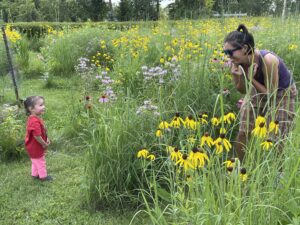
August – Joy is a part of labyrinths.
In their largest prairie Marion crafted the Phoenix Harmony Labyrinth. This is a five-circuit, dual-entry path to the center where people can enjoy a bur oak and be surrounded by prairie grasses and forbs. She welcomes people to play and encourages anyone wishing for moments of contemplation to visit and walk its curving paths between blooming prairie plants. Her labyrinth is listed on the international labyrinth locator registry.
How Sustainable Landscape Solutions
Helped the Pattersons

Several organizations and businesses are collaborating to create and manage the prairie.
We needed help with our newer projects. “We wanted to transform a hilly patch of our front lawn into a prairie rich in wildflowers and fewer tall prairie grasses. The site was a long-established conventional lawn composed of exotic grasses,” said Rich. “That’s a challenging environment to establish prairie. I’ve established prairies on lawns before by broadcasting seeds and following up with prescribed burns. But, it’s a slow process. We wanted to speed up restoration and needed help killing the turf and preparing the soil,” he added.
In 2020 we hired Sustainable Landscape Solutions to do the prep by first spraying the existing turf and later working the soil. Pattersons took it from there and planted a seed mix they purchased from Pheasants Forever. It’s called their Leopold Mix and contains seeds of 82 species of native prairie wildflowers.
Patience
It takes prairie time to mature. A year after planting we had a few blooms. The next year a few more. In its third year, it began to look like a prairie, and by its fifth growing season, the area was a magnificent spread of colorful flowers fluttering in the summer breeze. Alive with bumblebees, butterflies, and other insects, it was rich with life.
Next Steps
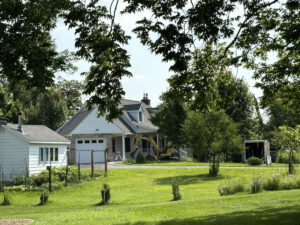
Four years later we decided to pursue a different sort of property upgrade. The 2020 Derecho did a job on a cozy nook next to the garage. “We wanted to transform a weedy nook south of our house into a delightful place to sit on cool spring and fall days where the sun would warm us. We worked with Virginia Hayes of Sustainable Landscape Solutions to come up with a patio plan that allows us and our visitors to sit and enjoy our thriving natural landscapes.
Patience, Again
Multiple rains delayed the project as Sustainable Landscapes worked diligently to catch up on already scheduled, and now rain-delayed projects. The new patio was crafted in July 2024. “It’s an example of how our company was able to work with homeowners to create a vision and gorgeous yard. Pattersons had much restoration knowledge but we’re happy to help people less experienced transform their yards into areas of natural beauty,” said Sean Pearl of Sustainable Landscapes.
-

-
Weeds overtook the area
-
-
Small evergreens have replaced fallen Derecho trees.
-

-
First removing dirt.
-

-
Next steps
-

-
Dusty job
-

-
Water flows away

Coming together
Now, in early autumn, the nook is coming together nicely and we look forward to sharing it, the yard, and the labyrinth with others.
A Little More About Labyrinths
The Patterson’s labyrinth is created in a tallgrass prairie but these can be built in many ways, including in formal landscaping. “Many are made of bricks or pavers that enable a walker to negotiate the winding pathway,” said Marion. “Ours has a wide grassy path with borders of prairie grasses and forbs that change seasonally.” Labyrinths are structures with a path that winds to a center. Each time walkers follow the path around the center is called a circuit. Walkers find that the winding path slows down their minds and they can settle into a more relaxed space. Because of the natural setting, many walkers comment on how they recall times in nature as youth. Patterson is available to help landowners create labyrinths.
Blessings of the Changing Landscapes
We welcome visitors to our Winding Pathways website and to see our prairies.
by Winding Pathways | Sep 5, 2024 | (Sub)Urban Homesteading, Foraging, Mammals
A few years ago, after seeing many squirrels with nearly naked tails we researched and posted a blog in February 2022. Furless Tailed Squirrels.
The response amazed us. People from around the world visited it and still do every day. We had no idea this condition was so widespread.
So, we’re posting a follow-up. Two winters have passed and our squirrels now have perfectly normal furry tails. We’re unsure if older squirrels have regrown fur or if the new generation never had the condition. Since most squirrels don’t live for more than a few years, we will likely see younger animals.
Whatever conditions caused them to lose their fur seem over. That’s not unusual in wildlife populations. If a serious disease or calamity reduces the population the condition subsides and survivors reproduce with enthusiasm, rapidly restoring abundance.
Based on our website traffic we suspect furless-tailed squirrels have been found far and wide. We predict that they, like our Iowa squirrels, will rebound with healthy furry-tailed animals.
A Short Squirrel Primer
Although many people dislike squirrels for their habit of gobbling up feed intended for birds, we like them. Squirrels are just as fascinating as goldfinches or cardinals, so we put out enough seed for both.
During the 2024 Summer Olympics, we were thrilled watching the graceful and powerful movements of Simone Biles, other gymnasts, and pole vaulters like, Armand “Mondo” Duplantis.
What happens when a squirrel falls?
We’ve not heard of a comparable competition for squirrels, but they are also amazing gymnasts and vaulters. In our yard a small oak and a large walnut live next to each other. Every fall the walnut is loaded with nuts that tempt squirrels. We love watching them climb the oak to its tippy top and then make an amazing upward leap to a flimsy walnut twig above. Like human gymnasts and vaulters, squirrels have impeccable balance, flexibility, strength, determination, and courage.
Treetop leaps aren’t always successful. Twice we’ve seen squirrels slip off high oak branches and fall 30 or 40 feet to the lawn below. Both times the hapless animals spread eagle, landed with a thump, and scampered off apparently uninjured. They are an amazing animal.
Late Summer Activity
As we write this in late summer walnuts and acorns are maturing. People may not like squirrels but these trees need them so much their annual nut crop is a bribe. Squirrels eagerly gather and eat many of the nuts but they scamper off and bury some, often a long way from the parent tree. Some nuts are never dug up and become a new tree generation. The exchange is a good deal for both trees and squirrels.
The rodents get nutritious food. Walnuts and acorns get free tree planting. Both win.
Hopefully, anyone reading this is enjoying squirrels that have grown fur on their once furless tails. Enjoy these amazing animals. To learn more about squirrels visit Animal Diversity.
by Marion Patterson | Aug 29, 2024 | (Sub)Urban Homesteading, Foraging
Eatin’ Weeds
We don’t just pull weeds. We eat them!
Every summer gardeners spend hours pulling, digging, and spraying weeds that pop up overnight and grow like – Weeds! Marion’s family, especially grew up eatin’ weeds. Raised on a small, hardscrabble New Hampshire farm where the biggest crop was rocks, her family of seven supplemented produce with wild foods. Her dad, of the Depression era, knew the wild plants. So, she grew up eatin’ weeds and picking wild berries.
At the nature center in Kansas Rich was always looking for unique programs to present and wild edibles were a hit. Using the Euell Gibbons and Adrienne Crowhurst wild food guides, we learned which foods have the highest returns: easy to gather and process, moderately difficult yet rewarding, and survival-only foods.
We also realized that many are as tasty and nutritious as intentionally planted crops.
Dozens of weed species are edible, but we especially enjoy eating lambs quarter, purslane, and Asian dayflower that we haven’t planted but harvest from our garden. All were introduced from faraway continents and have gone wild. Each is easy to identify.
Lambs quarter
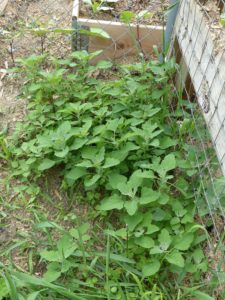
Lamb’s Quarters readily grow in disturbed soil.
This Eurasian native plant has many names. It’s sometimes called lamb’s quarters, goosefoot, or pigweed and has the scientific name Chenopodium album. Lambs quarter is a fast-growing annual weed that we first notice in early spring. We pick and eat it about the same time in April that we plant spinach and lettuce. We keep picking and eating the new shoots as the season advances.
Identification and Preparing
Lambs quarter is easy to identify. One characteristic we like is the leaf’s ability to shed water. Dunk a leaf in water and it looks silvery. Like most wild and garden greens, Lambs quarter is best when picked young and tender. We wash and steam it for a few minutes, much like we cook Swiss chard. Topped with melted butter, it’s delicious. Very young leaves can be rinsed and eaten raw in salad.
Asiatic Dayflower
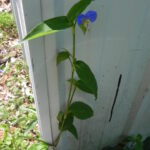
Likes partial shade.
Since lambs quarter is wind pollinated its flowers aren’t showy. That’s not the case with Asiatic dayflower. Its sky-blue blooms last only a single day but add color to our garden. It prefers living in partial shade and thrives under our rain barrels and alongside raised beds in the garden. Botanists call it Commelina communis.
Like lambs quarter, the young leaves and stems are delicious in a salad or can be lightly steamed.
Purslane
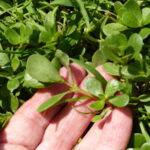
Cultivated world wide
Although Americans constantly pull weedy purslane from their gardens, it is actually a planted crop in India and the US Southwest. Native to the Mediterranean region, it was introduced around the world centuries ago. Purslane is a fleshy plant with the scientific name of Portulaca oleracea.
Purslane grows like crazy and loves hot soil and full sun. It’s somewhat mucilaginous and tends to be gritty. Well-washed young stems and leaves can be eaten raw or steamed. The plant is high in oxalates, so people with kidney problems may want to avoid eating it.
Foraging and Safety
In this era of high food prices families seek ways to trim the grocery bill. Gardening helps and a small flock of backyard chickens adds delicious eggs, but foraging wild foods is becoming increasingly popular.
There are cautions. Many plants have lookalikes that could be inedible or even toxic.
Fortunately, the Internet is loaded with reliable information that helps a novice identify edible plants and learn how to harvest and prepare them for the table. Plenty of printed books are available, but the very best way to learn is to find a skilled forager and tag along on a collecting spree.
Cardinal Rule and Cautions
A cardinal foraging rule is to identify any new plant by at least three sources before attempting to eat it. Don’t take our word for it. If you want to try the plants we mention above, double check identification and edibility on at least two websites, books, or with an expert person.
Cautions. Most people may be able to enjoy eating a certain plant but you may be allergic to it. So, for the first meal or two eat a new food sparingly to make sure no unpleasant symptoms arise. Also, avoid picking plants that may have been sprayed or are alongside a road or near a factory where they might be contaminated by emissions. If you want to go on private property, always have landowner permission before collecting. In public parks make sure picking or gathering is permitted before picking.
Resources
Books:
Euell Gibbon’s classic Stalking the Wild Asparagus got us started on foraging decades ago.
A comprehensive modern book is Nicole Apelian’s Foragers Guide to Wild Foods.
Adrienne Crowhurst’s classics, The Weed Cookbook and The Flower Cookbook were staples in Marion’s family.
App: An app that helps identify edible and nonedible plants is SEEK by iNaturalist.
Websites: There are many. Often a good way to use a website is to first identify a plant and then GOOGLE it. Usually, that will lead to sites that further help identify the plant, give its history, and tell whether it is edible or toxic.
by Winding Pathways | Aug 22, 2024 | Garden/Yard, Nature, Wonderment
Guest Blogger – Jacqueline Hull
Have you ever tried something fun as a gardener? Well, I have. My curiosity wondered if it were possible to root the head of a pineapple.
We love fresh pineapple. The head has to be cut off then the sides to get to the juicy pieces. Then, we stash the severed pieces in the compost pot for future use in the garden.

Will the pineapple take?
One day, after my husband, Peter, dissected our fresh pineapple, I retrieved the top piece and placed it into some moist potting soil. I made sure the soil was damp each day as I waited for it to root. After a time, to my delight, I discovered the head had indeed grown roots and was holding tightly to the soil.
For several years I fertilized and watered this pineapple as the spears grew larger and taller. I also transplanted it to a huge glazed pot.
Peeking down into the center of the plants one day, I saw a teeny tiny fruit that had developed. It kept growing and growing and eventually, a soft, golden color appeared in its greenery. It had about seven inches of fruit and I knew it was ready to be picked.
To our delight when we harvested the pineapple, the inside was sweet and juicy.
Now, we wait for the two that are growing on the porch to ripen. One has a fruit and we anticipate the other to develop its fruit.
Our adventure continues as we try to grow onions from pieces with roots and wonder if we could do the same with celery…maybe!
Editor’s note: Share your growing experiments with us on the comments page.
by Winding Pathways | Aug 15, 2024 | (Sub)Urban Homesteading, Chickens
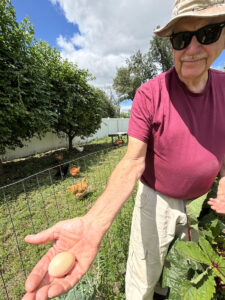
First eggs are a delight to find.
August 26th brought an unexpected and delightful surprise. We found an egg in our coop! Bringing the garden season’s first tomato, cucumber, or summer squash into the kitchen is always an event to celebrate, but it doesn’t compare to the excitement of finding the first egg.
We were expecting eggs soon, but not so soon. Our tiny baby chicks arrived from Hoover’s Hatchery on April 10th. It normally takes a female chick about 20 weeks to mature and lay her first egg. Some old-fashioned breeds don’t start laying until they’re 24 or even 30 weeks old.
We expected our small flock to start laying around Labor Day, but our first egg came when one of our pullets, or young hen, was only 18 weeks old. It was surprising.
Odd Shapes
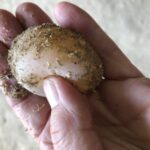
Sometimes calcium does not form on eggs.
A hen’s first eggs are small and sometimes shaped oddly. Sometimes these early eggs can be found in stores marked as, “pullet eggs”. After a few weeks of laying, her eggs reach medium or large size. Sometimes early in a hen’s laying life, she’ll lay a whopper of an egg with two yolks. It’s startling to crack an egg into the frying pan and discover that second yolk. As her reproductive system matures her eggs will be more uniform in size, shape, and have hard shells, and eggshell tint.
Best Breeds
Hundreds of chicken breeds have been developed since the species was domesticated thousands of years ago. They come in a vast array of size, feather color, temperament, and productivity. The best breed is the one its owner likes.
Our 12-hen flock at Winding Pathways is a mix of egg laying superstar breeds and traditional breeds that don’t lay at a furious pace. We like them all. It’s hard to beat Rhode Island Reds, Barred Rocks, or California White breeds for early and plentiful eggs. We have a few but round out our flock with Brown and White Brahmas, Mystic Onyx, Buff Cochins, and a Rainbow.
Fall Chicks
Most families buy chicks in the spring, but fall is also an ideal time to start a flock. Babies hatched in September begin laying by January or February’s baking season.
For detailed information on breeds and chicken care visit Hoover’s Hatchery Website.
It includes blogs filled with tips and Facebook Live Videos filmed at Winding Pathways.