by Winding Pathways | Jul 29, 2016 | (Sub)Urban Homesteading, Flowers/Grasses, Nature, Reflections/Profiles, Wonderment

A brilliant harbinger of summer with a long lasting biannual bloom.
Many years ago word came that a dear friend had tragically died in Utah, over a thousand miles from our Iowa home. With deep feelings of grief of the loss of a vibrant young woman I (Rich) felt the need to “do something for her.”
We were in the process of restoring prairie to a bare patch of ground on recently purchased piece of land at the Indian Creek Nature Center. A bag of prairie wildflowers perched against my office wall caught my eye. I grabbed the bag, walked to the meadow and scattered the seeds in the woman’s honor.
The seeds thrived. Now, a dozen years later they grace the prairie with color and restore memories of my friend. We shared this story with our friend’s husband who was moved. So, we decided to share our way of honoring and memorializing ones dear to us.
Planting flowers, shrubs, and trees in a yard or park is an outstanding way to reduce grief, maintain memories, honor someone, and make our world healthier and more vibrant.
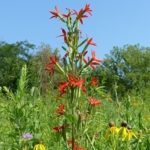
What a stunner!
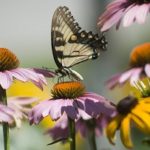
Sipping nectar

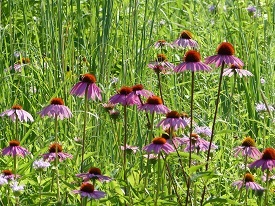
Purple Coneflowers add color to a prairie.
by Winding Pathways | Jul 26, 2016 | (Sub)Urban Homesteading, Flowers/Grasses, Garden/Yard, Nature, Reflections/Profiles, Wonderment
Periodically readers send lovely essays and observations of their Wondrous Yards. Below is a poetic piece by Katrina Garner.
“One of the benefits of creating and maintaining burn barriers around prairie areas is that the resulting “pathways” provide the perfect opportunity to observe the prairies from all sides. Every morning I head out with our Lab Schatzie for our long daily walk around the property, letting Schatzie choose our route. Sometimes she startles a deer, and sometimes a turkey blasts out of the grasses right in front of us. Schatzie holds on to the hope that one day she’ll actually catch one of the hundreds of rabbits who manage to stay just out of her reach. Always there’s a chorus of bird songs, blending together like a pastoral symphony, to remind me to focus on nature’s sounds.

Capturing the essence of prairie blooms.
“I have my phone handy in case I see the perfect view for a future landscape painting. One day this past week we were ending the walk along the path between our first prairie planting and the pollinator strip next to it. The house was above us beyond the prairie. Our farm is named “Himmelhof,” a phrase coined by a friend of ours as an approximate Austrian translation for “House in the Heavens.” Seen from many points on the property, the house does seem to “float” above the prairie, and I’m particularly fond of those views of the house. At this point in our walk, the coneflowers and Black-eyed Susans were plentiful and at their peak, so I took out my phone and framed my photo to capture the “floating house” with colorful flowers in the foreground.
“A few days later, going through the recent photos on a larger computer screen, I was startled to see what looked like a ballerina with her arms raised to the heavens and her face turned towards the sun. If I wished to be pragmatic, I would acknowledge the fact that “she” was a cup-plant (Silphium perfoliatum) just masquerading as a fairy ballerina. However, the romantic in me chooses to see my prairie ballerina fairy as a joyful, whimsical reminder that I should always keep my mind and heart open to the beauty of the nature around me.
Katrina Garner, July, 2016″
Keep sharing about your lovely spaces, folks! Thanks, Katrina.
by Winding Pathways | Jul 5, 2016 | Bugs, Children/Play, Flowers/Grasses, Nature, Wonderment
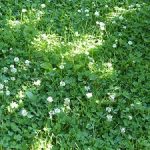
Soft and fragrant underfoot, clovers naturally fix nitrogen in our lawns.
A man whom Rich hadn’t seen for years recently approached him in a parking lot. “You once wrote a newspaper column suggesting that people not spray their yards for insects or weeds. We took your advice and magic happened,” he said.
He explained that a couple of years after he stopped spraying, white clover appeared in the yard and fireflies graced the evening darkness. “We’re enjoying both,” he added.
A major problem with poison sprays is that they aren’t usually selective. Often people spray to rid their lawn of grubs without realizing they also are killing fireflies, pollinators, and a host of other interesting and beneficial insects and the animals that dine on them. If you poison dandelions, you also kill clover that fixes nitrogen naturally and a wide range of other flowering plants that add diversity to the lawn and buffer it from unusual growing conditions.
FIREFLIES
What child has not delighted in chasing fireflies on a warm summer evening and, perhaps, catching a few to watch light up the inside of a glass jar? In fact, an adult friend who grew up on the eastern plains of Colorado was enchanted with them when she visited Iowa one summer. Fireflies, or lightning bugs, are common across much of the Eastern United States. Some blink yellow while others green, but whichever color they blink it is probably an effort to seek a mate. Some firefly species live in the West, they just don’t glow! The larvae, sometimes called glow worms often live in rotting wood where they seek insect prey.
To enjoy an evening firefly display leave edges and corners of your yards unmowed. Perhaps position some wood there to gradually rot and provide homes for their larvae. Certainly avoid insecticide spray!
CLOVER
Many species of clover are common across much of North America but the one most often found in unsprayed yards is the White Clover. It can be planted but usually just avoiding herbicides for a few years will encourage it to move in on its own. Clover blooms provide wonderful pollinator food while sprinkling a lawn with attractive white flowers. The plant is a legume, meaning that it is able to fix nitrogen and improve soil health – naturally! Why anyone would want to kill such a valuable and beautiful plant is beyond us.
Sometimes the very best lawn and yard management is simply leaving it alone. Stop spraying and the result is likely…….beauty.
by Winding Pathways | Jun 30, 2016 | Nature, Reflections/Profiles, Wonderment
Take in some great summer reading! Cornelia (Connie) Mutel, Winding Pathway’s good friend, sent us her most recent book, A Sugar Creek Chronicle: Observing Climate Change from a Midwestern Woodland.
Her book weaves three themes together that encourage readers to enjoy woodlands and embrace actions to lessen climate change.
Connie is a gifted nature writer who transforms her observations into delightful prose that reminds us of Joseph Wood Krutch‘s style. Her book is a pleasant way to learn about and enjoy a woodland as it progresses through seasons and responds to weather.
As the title implies, she relates changes in her woods caused by climate change. Nature is neither politically correct nor untruthful. A knowledgeable observer, as the author is, recognizes alarming signals of a warming planet communicated by vegetation and wildlife but often unnoticed by those less informed.
Finally, she weaves her personal story into a blend of woodland delight and climate concern. She bemoans her reliance on fossil fuel to get to and from work and to run her air conditioner, expresses joy at sharing woodland hours with grandchildren, and relates her long term cancer relationship with earth health.
Sugar Creek Chronicle is a lovely book about a serious environmental threat. Perhaps its major virtue is how the author blends joy of nature’s beauty, concern about the planet’s future, and a love of life that encourages readers to lessen the impact of climate change.
University of Iowa Press Bur Oak Series
www.uiowapress.org
ISBN: 978-1-60938-395-4
Marion’s all time favorite summer series is by Jean Craighead George: My Side of the Mountain, The Far Side of the Mountain, and Frightful’s Mountain.
Other good books to read this summer:
The Intelligent Optimist”s Gide to Life. Jurriaan Kamp. Berrett-Koehler Publishers, Inc. 2014. ISBN: 978-1-62656-275-2
Places of Quiet Beauty: Parks, Preserves and Environmentalism. Rebecca Conrad. University of Iowa Press. ISBN: 0-87745-558-9
Their Name Is Today: Reclaiming Childhood in a Hostile World. Johann Christoph Arnold. Plough Publishing House. ISBN: 978-0-87486-630-8
by Winding Pathways | Apr 19, 2016 | Labyrinths, Nature, Trees/Shrubs, Wonderment
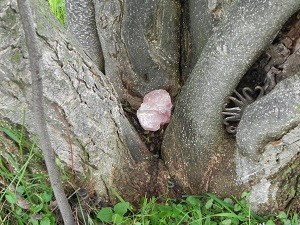
Heart of the tree
A short reflection walking in the Laughing Labyrinth.