by Winding Pathways | Sep 25, 2025 | Mammals
“There’s a bobcat in our yard!” Rich exclaimed in a text. One July evening he’d been working on his computer when the cat sauntered in front of his window. It was the first bobcat we’d seen in our yard. Soon we started getting texts and calls from neighbors also spotting the impressive and beautiful predator.

Hoh Rainforest bobcat
We once watched a bobcat trying to catch a fish in Olympic National Park and, years ago, Rich had a fleetingly glimpse of one in New Jersey. Sightings are rare but increasing as bobcats expand their range.
Apex Predators
They are apex predators that love catching and snacking on squirrels, cottontails, mice, birds, and whatever else they can catch. They’re big. A male can weigh upwards of 40 pounds while a female can reach 34 pounds. They can run at 30 miles an hour and jump ten feet. It all helps them catch dinner. They are no danger to people.
We live between Cedar Rapids and Marion. Aside from a 110 acre natural area north of our yard, houses and roads fill the area. How can a large predator live here?
Habitat

Bobcat in woods. Photo credit, Mark Yilmaz
According to many wildlife biologists bobcats do well in suburbia. They den in rock outcroppings, under big dead trees and other places where they enjoy some privacy. Many city and county parks have those places where a cat can raise its kittens and forage in nearby suburbs while rarely being seen.
“We know bobcats are doing well near Des Moines. Bobcats and coyotes don’t really like each other but they seem to coexist. Coyotes eat berries and other fruit,” (as well as small mammals) said Vince Evelsizer, the Iowa DNR furbearer biologist.
Food Sources and Habits
Think about a suburban neighborhood. Cottontail rabbits scamper about most lawns, mice are everywhere, and even stray house cats wander about. All could make a nearby bobcat a meal.
Bobcats mostly hunt when the light’s low in the early morning and late afternoon and often find good hunting near houses and roads. Our neighbors are seeing them in broad daylight.
Expanding Range
They were once nearly extirpated from Iowa but a few hung on in the rough pastureland of the state’s southernmost counties. They began spreading north in the 1970s and 1980s and we first started hearing about them in the Cedar Rapids area in the early 1990s. Now they seem well established in our metro area.
Are there bobcats in other towns and cities? You bet. They are an amazingly adaptable animal that range from Florida’s everglades up to chilly Rocky Mountain Peaks. They’re at home in Arizona’s deserts and Minnesota’s farm country. No doubt they live in and near even large cities across much of the continent.
How to Tell a Bobcat From a House Cat
Bobcats resemble house cats but have a few bobcat in woods.
- Bobcats are much bigger than house cats, but it’s sometimes tough to tell how big an animal is during dim light and at a distance. There’s a trick to learn the size. Watch the cat as it passes a fencepost, tree, or building and note where the animal’s back is in relation to a tree branch, knothole, or strip of siding. Later take a ruler there and measure how tall the animal is. A bobcat will stand 18-24 inches at the shoulder while a house cat measures nine to 10 inches tall.
- Bobcats are really “bob tailed cats”. Look for a short stumpy tail.
- A bobcat’s legs are longer in proportion to its torso than a house cat’s. They can walk quickly.
-

-
Note the long stride of the Bobcat.
-

-
Stalking
Photo by Ben Kock
Photo Op
Worried about being attacked by a wildcat? Not to worry. They keep their distance from people. Instead, be happy if one is spotted, and try to snap a photo.
by Winding Pathways | Sep 18, 2025 | (Sub)Urban Homesteading, 1080 Labyrinth Blog, Flowers/Grasses, Garden/Yard, Nature

Dancing in autumn’s breezes.
An autumn pleasure is sitting on our front porch watching Maxmillian Sunflowers – Summer’s Goodbye wave as they dance in September’s breeze.
Our yard is a seasonal progression of color from spring’s delightful dandelions that grace our mowed yards to Maxmillion’s final wave. In early summer our porch view is of pale purple coneflowers that gradually yield to common purple sunflowers. Then yellow coneflowers, purple prairie clover, compass plant and rattlesnake master make their appearance as white clover looks like sprinkles on the lawn. We can tell the month by what’s blooming.
Autumn’s Hello
Fall’s a time for both joy and sadness. As summer’s warmth diminishes we know we won’t see our flowery color for months, but three blooms give us late summer gladness.
First comes the goldenrod of many species. We spot their earliest blooms on the final days of July but they come into full glory in late August and September. Then they’re joined by asters of several species. Our favorites are tiny flowered heath asters and deep lavender New England asters. And the surprise pink petaled New England aster.
-

-
Important pollen producer. NOT an allergenic.
-

-
New England Asters and goldenrod blooming
Final Actor
The final actor to appear in the season’s progression of blooming color is the Maximilian Sunflower. Ours thrive in the south part of our labyrinth prairie and stretch higher than prairie grasses. Even a slight breeze entices their golden blooms to dance above the prairie as if to say, “thanks summer for your warmth and water.”
They are stalwart and resist early fall’s frosts and keep dancing. Their final bow of color coincides with a hard freeze.
About Maximillian Sunflowers
Maximilian sunflowers are true sunflowers with many relatives. They are a perennial native to the Great Plains and tallgrass prairie, but people have planted them all over the world. Tall and vigorous, they make a delightful backdrop to a prairie or flower garden.
Supporting Actors

Goldfinches show up in the yard when various sunflowers bloom and turn to seed.
As a final delight our resident goldfinches love dining on any nutritious sunflower seeds. They start with cupplant and move on to Maximillian Sunflowers.
We delight that the blooms are exactly the same yellow hue as late summer male goldfinch feathers.
Brightening Autumn’s Days
Dancing sunflowers are a delight. Perhaps it’s sad that they herald an approaching winter, but they brighten fall’s gorgeous weather and lure us to sit on our porch
by Winding Pathways | Sep 11, 2025 | Chickens
People know that chickens are tasty yet, a myth persists that they are dumb animals lacking emotions. The prevailing attitude is that they’re merely industrial grade food producers. They are not chicken companions. Well, maybe that is not true.
We’ve kept small flocks of chickens for years and learn from every grouop. They’ve taught us how similar they are to humans in some ways. They are adaptable and can be good parents regardless of the offspring lineage. An example happened this year.
Broody
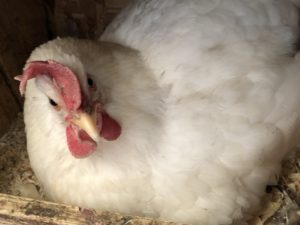
The California White patiently sitting.
We have one California White. She is a commercial hybrid chicken developed for the egg industry. Small, skinny and nervous California Whites are prolific layers, not inclined to go broody. Broodiness is a bird trait that simply means that a hen wants to be a mother.
A broody hen lays a clutch of a dozen, or so, eggs, fluffs up her feathers, changes her clucks, and settles down for a three-week incubation. After that stint of sitting, eggs miraculously hatch. Mom cares for chicks as they grow, protecting them from the cold while teaching them how to find food and water, and avoid danger.
Egg Producer Needs
Egg producers don’t want chicken motherhood. Commercial egg producers dislike chicken motherhood because a broody hen pauses egg laying for a couple of months. That costs money. Breeders have supposedly eliminated the broodiness from California White genes.
Persistent Broodiness
Not ours. In November and again in March our California White decided “yes to motherhood”. She fluffed her feathers, and began sitting on eggs laid by her flock mates. The first time, in the fall, we kept removing her and taking the eggs in an effort to discourage her broodiness. She temporarily stopped being broody. Then, in the spring, she started being broody again and was more persistent than we are. She just kept sitting and sitting.
Finally, we said OK and let her incubate five eggs. After three weeks a brown egg hatched. We knew the chick wasn’t our California White’s biological mother, as she lays white eggs.
Good Parenting is Good Parenting
Ancestry didn’t matter. Our hen was an attentive mother. On cold nights her baby nestled into her warm downy feathers and during the day scampered about under Mom’s watchful eye. We didn’t know if the chick was her son or daughter but as it matured it became an obvious female that’s now five months old.
-

-
Parenting
-

-
Keeping the chick warm
Companionship

Bonded
Enter companionship. Every night our California White sleeps next to her now adult daughter. Is it affection? Simple familiarity? Chicken Companionship? We don’t know, but the pair seems to look out for each other and enjoy each other’s company.
We see other signs of chicken companionship and caring. Our dozen birds seem to make friends and two or three will often hang around together during the day and sleep side by side on the roost at night. When a hen is not feeling well often another will sit with her during recovery.
All are signs of bonding. We don’t know what they’re thinking or feeling, but our chickens demonstrate that they’re more than just food producing machines.
Wealth of Information
Want to learn more about backyard chickens? Check out the Hoover’s Hatchery website at hoovershatchery.com. It’s loaded with information.
by Winding Pathways | Sep 4, 2025 | (Sub)Urban Homesteading, Nature
Blog by guest authors, Peg and Angus!
Our dog, Angus, and I were sitting on the deck one summer afternoon. I was reading and Angus just looking around. Suddenly, I heard a commotion.
Angus got all excited and started barking. It turns out, a bear commotion!
I looked up and there was a big (200-300 lb) black bear climbing the maple tree beside us. About 40 feet away.
Fortunately, Angus was on his run and close to me so I could get hold of him and hurry us both into the house. He was not a willing participant in this process! The bear just watched us the entire time. It took quite a while before my hands stopped shaking enough for me to take pictures.
I think what scared me most is that Angus showed no fear and kept barking at the bear. I wasn’t sure how the bear would react to him but it totally ignored us. As much as I like to be outside I was very happy to be in the rest of the afternoon. No more bear commotion for me or Angus.
-

-
Boots and dog
-

-
A fierce character
From safe inside, my husband, Bruce, and I watched the bear as he (just guessing) relaxed on a large limb and munched away. Eventually he climbed down, lumbered across the yard, found our dwarf apple tree and stopped for dessert of green apples. Eventually he wondered off into the woods.
I love seeing wildlife but he was too close and way too big for me!
Click on the links for other bear encounters in the East. One in Virginia and another in New Hampshire. Of course, in Alaska, bears are common. And troublesome.
-

-
Bear standing tall.
-

-
Deck in foreground
-

-
Curious
by Winding Pathways | Aug 28, 2025 | (Sub)Urban Homesteading, Bugs, Garden/Yard, Garden/Yard, Nature
Early one humid summer morning we discovered lawn lace in the yard. Dozens of laces were scattered on the grass and mulch we’d put around trees. Dew drops on their tiny filaments sparkled in the early morning sunshine. What had we found? Who made them?
As kids we called them fairy rings and marveled at their delicate nature.
-

-
Fairy rings.
-

-
A delicate lacing on evergreen shrub.
Shelf Spiders

The hole reveals the entrance to the web.
They were crafted by industrious hungry spiders overnight. We call them shelf spider webs because they are positioned horizontally. Others call them funnel or tunnel spiders. Look closely to find a hole, usually toward the side, where the spider lurks.
The web isn’t sticky but has so many tiny filaments that a wandering insect often gets its feet tangled there, slowing it down. In a flash the fast-moving spider is out claiming its breakfast.
What Are They?
There are many species of shelf spiders found throughout the world in the genus Aselemidae. Some 111 species live north of Mexico. They pose no threat to people, but may pose a major threat to bugs, who often see the conspicuous webs but not their builders. The web’s architect and builder stay hidden. By late morning sunshine has usually evaporated the dew, making the webs hard to spot. They’re best enjoyed when the world is cool and fresh at dawn.
We usually think of shelf spiders as a September yard feature but in 2025 we began seeing them in July. We like them. Their dainty webs are as intriguing as they are beautiful. Perhaps more important, the presence of these spiders indicates that the lawn is healthy. It’s not been poisoned with insecticides. This allows harmless insects to thrive in the turf to feed the spiders.
Surrounded by Spiders
Many people consider spiders threatening, ugly, and undesirable animals. Come Halloween some even stretch fake webs in their porch to scare trick or treaters. A few spider species can inflict a painful and dangerous bite, but most species are tiny and hardly ever seen by people. They cause no problems and live in lawns, gardens, prairies and trees. They are beneficial.
Want to learn more? An interesting resource is spidermentor.com.
We enjoy watching brown creepers, nuthatches and warblers climbing tree trunks or flitting around branches. They’re often foraging for tiny protein-rich spiders. Even in the depths of winter dormant spiders provide food for hungry songbirds.
Be happy if some morning you spot lawn lace. Shelf spiders have been at work setting their intricate traps to catch a breakfast of tasty insects.