by Winding Pathways | Jan 26, 2020 | Nature, Reflections/Profiles
News Reports and Remembering
Recent photos of burned and displaced kangaroos and koalas from massive Australian wildfires are heartbreaking and bring back memories of both fighting and setting fires in American woods and prairies.
As a 24-year-old US Forest Service Hot Shot back nearly 50 years ago I had the good fortune to help contain three wildfires in Southern Idaho. One left a memory of towering flames roaring up a steep slope toward my crew as we hurriedly dug a fire line parallel to the ridge. I wielded a chainsaw, dropping pines and firs toward the approaching flames. It was noisy, hot, and scary but our line, with the help of an airplane that dropped a load of “slurry”, stopped the blaze.
Not All Fires Respond the Same
Just a year later I lit a fire in dry prairie grass at the Dillon Nature Center in Hutchinson, Kansas. It roared onward until stopped dead by a mowed path. Green grass doesn’t burn.
We burn our prairie and oak woodland at Winding Pathways every year, usually in the fall because we know that our land, like much of North America, needs fire for good ecological health.
Misleading Reporting
Evening news stories about the terrible destruction of wildfires can be misleading and are never complete because:
* They show the most incinerated place in a vast burned area. Sometimes the land is not nearly so consumed by the fire.
* They never follow up. Months after a burn the same spot is lush with green growth and spangled with wildflowers.
Fire is as much a force of nature as rain and wind. Yes, they destroy houses in their path. Remember, often these were built in the woods without the fire-resistant construction recommended by the US Forest Service. In North America, fires don’t destroy forests or grasslands. They invigorate them.
Every year we look forward to abundant wildflowers and healthy grass in areas we’ve burned. But what about wildlife caught in a rapidly spreading fire? I’ve had the opportunity to watch rabbits, birds, deer, and even elk respond to flames. They don’t panic. Rabbits simply seem to hop to places unlikely to burn. So do deer. Snakes and some insects might enter holes and tunnels in the ground. Some are probably cooked. Baby animals would be unable to flee flames. Fortunately, spring fires, when babies are helpless, are rare.
2019 marked a huge fire event. It was Smokey the Bear’s 75th birthday! I love Smokey. He is one of the most successful marketers ever convincing people to drown campfires and snuff out matches. Smokey was so successful that fires became rare enough for plenty of dead wood to accumulate in Western Forests. That, combined with climate change, helped create the conditions for the catastrophic fires that have burned in recent years. Smokey’s message was a little off, but he’s still a loveable character.
Here is how he came to be. In 1950, after the Smokey Bear character was created, a singed bear cub was found after a fire. He lived for years in the National Zoo in Washington, DC. Known as Smokey, millions of people saw him until his death in 1976. He’s buried near the Smokey Bear Museum in Capitan, New Mexico.
An outstanding website about Smokey and wildfires is sponsored by the US Forest Service. If you are ever in Moscow, Idaho, be sure to stop at the Smokey Bear store on Main Street.
by Winding Pathways | Jan 23, 2020 | Gazette Features, Geology/Weather, Nature, Travel/Columns
Winding Pathways invites readers to enjoy past features in the Cedar Rapids Gazette.
Wandering Nebraska and South Dakota’s Rich Fossil Freeway. Follow US Highway 20 across northern Nebraska while exploring its fossil-rich history. Along the way wet your line in trout streams, paddle clear rivers through sandhills, camp in a National Forest in the Great Plains, and bicycle parts of the Great American Rail-Trail. Then, end up in the enchanting Black Hills of South Dakota.
Alaska In Winter. Most folks experience Alaska in summer. Winter has its rewards, too! Plenty of activities for outdoor enthusiasts and mild-mannered indoor types. Museums. The Bear Tooth Theatrepub. Great eateries. Iditarod Ceremonial Start. XC ski races. Campbell Creek Science Center. And, perhaps most wonderful of all – no skeeters or bears!
Indiana Dunes National Park. A great stop while speeding along I-80 is the Indiana Dunes National Park. A cooperative venture among city, county, state and federal government, this necklace of preserved areas rings the southern end of Lake Michigan. Soft sand beaches to explore, dunes several hundred feet high to scale, charming villages, bicycle trails to follow, and varied places to rest your head at night. This new national park can fulfill any family’s vacation dreams.
America’s Magnificent Mounds line the Mississippi River and many other waterways in North America. While most mounds have been lost to “development” many remain. And, travelers can learn so much about ancient cultures and appreciate why preserving these mounds is important.
by Winding Pathways | Jan 19, 2020 | 1080 Labyrinth Blog, Reflections/Profiles
Labyrinths have been integral to this year’s activities. Locations have spanned from the East Coast to the deep South, and from Alaska to Hawai’i. Catch up with Winding Pathways’ 2019 walks at 1080 Laughing Labyrinth website.
May you enjoy labyrinth walks in 2020. Join Veriditas Council for a Qualifying Workshop for those interested in learning more about labyrinths. For trained facilitators a Renewal Day in Rapid City, SD, April 25, 2020.
Solvitur Ambulando.
by Winding Pathways | Jan 16, 2020 | (Sub)Urban Homesteading
A few minutes after we dropped a match into our front yard’s dry prairie grass, the wind unexpectedly puffed up. Almost as fast as an explosion, eight-foot flames roared up from the burning grass. Our yard was on fire. The heat was intense as the fire zoomed toward our house.
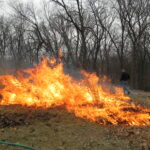
The grasses catch quickly and subside as quickly.
Were we worried? Nope. Between the fire and the house was a three-foot mowed lawn, then our ten-foot-wide driveway and finally another 30 feet of mowed green lawn. Asphalt and green lawn don’t burn. When the raging blaze met the first strip of lawn it almost immediately calmed. Soon all the dry prairie was consumed, and with a final weak smoke puff, the fire was out.
From many years of experience with fire and its impact on the land, we know that our annual burn will stimulate a rush of colorful wildflowers next year while toasting any unwanted brush that tries to establish itself in our grassland.
MEDIA PROMOTE FIRE FEAR
It seems like almost every evening newscast shows photos of burned-out homes, usually in California, and reports of wildfires rampaging across the landscape. It’s easy to become fire scared without understanding how, where and why fires burn, their benefits, and how to protect a home from a wildfire. News reports and photographers frequently show the worst appearing spot and never return months later to show the profusion of wildflowers and tree seedlings the burn created.
As a former Forest Service Hot Shot, and with nearly 40 years of prescribed burning in prairies and oak savannas, Rich has much fire experience. Marion has been tending prescribed burns for years. They annually burn the prairie and savanna surrounding their home in Cedar Rapids, Iowa. Here’s their perspective.
FIRE IN NORTH AMERICAN HISTORY
Many of us remember grade school history lessons telling of Europeans discovering a forest primeval when their sailing ship landed along the East Coast. We often have the notion that North America in 1492 was pristine and untouched by people, allowing trees to grow into an immense phalanx. It wasn’t so.
Historical ecologists know that North America’s vegetation had been altered by people ever since humans colonized the continent some 11,000 years ago. The Eastern Forest that European explorers found had burned frequently, with most fires started by Native Americans. This created an open woodland of massive trees. Sunlight reached the ground, stimulating a dense growth of wildflowers and grasses. There was little brush, making it relatively easy to walk through the woods.
Prior to the settlement of North America by mostly Europeans, the land burned often enough that vegetation became dependent upon frequent fire. Indigenous people set fires because the resulting landscape produced more food from an increased abundance of wildlife and acorns, berries, and other edible plants stimulated by fire. Europeans generally viewed fire as an enemy and began suppressing it almost as soon as they colonized the continent. This fire aversion is reinforced by modern newscasts showing burned-out homes and towns.
FIRE IS A NATURAL FORCE LIKE THE WEATHER
Like the weather, fire is a natural force that sculpts the landscape and its vegetation. Many ecosystems decline in health when years go by without the rejuvenating impact of a burn. Areas suffering from fire starvation tend to build up flammable brush and tree debris, creating a potentially devastating future fire.
BASIC FIRE BEHAVIOR
Knowledge of the predictable aspects of a fire helps us manage burns near our home at Winding Pathways as well as helping fire managers plan prescribed burns and fight out-of-control fires. Fires generally burn most vigorously when:
- The humidity is low.
- The wind is strong because fires burn faster with the wind.
- There is a steep slope because fires tend to burn fastest uphill.
- There is an abundance of dry fuel.
We take all these factors into account before we start a fire. For example, if we want our fire to move slowly and be easiest to control, we set it to run against the wind, downhill, and at a time when the humidity is high, usually before 10 a.m. If the area is reluctant to burn, we’ll do it when the humidity is low and plan it to go with the wind and upslope.
SAFETY FIRST WHEN BURNING
Early in the season, we get a fire permit from the county. It requires us to check the air quality and only burn on days when it is good. We call the sheriff’s office before we burn so they are aware of our activity. We also prepare firebreaks and reinforce our nonburn able asphalt driveway with mowed strips of lawn. Before lighting it, we have our water turned on, the hose stretched out and ready if we need it, and have a backpack fire pump called a “Smith Indian” ready to use to stop or slow the burn.
AVOID PREDICTABLE PROBLEMS
It is tragic when communities and homes are ignited by wildfires. Almost all are in Western coniferous woodlands or in California’s chaparral vegetation. These plants burn with extreme heat and create embers that blow in the wind, igniting new patches of forests and homes. Ironically many western plants, including Lodgepole pine and chaparral require fire to seed or be invigorated, yet people often disregard the risk and build fire-prone homes within historically fire-prone areas. Building a home in a flammable wood is akin to building in a floodplain or on a bluff over the ocean. It’s risky. Always have good insurance and follow fireproofing directions provided by the US Forest Service, insurance companies and others. In contrast, fires in Eastern deciduous woods rarely ignite homes. Here are a few resources for tips on how to reduce the odds that a wildfire will ignite a home:
Sierra Club and Protecting Your Home from Wildfire
Smokey Bear
The US Forest Service has extensive information online on how to protect a home from fire.
Individual Insurance Companies also provide information on fire protection.
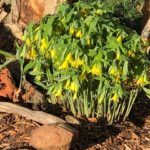
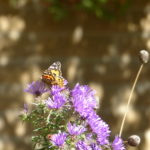
We appreciate watching the impact of prescribed burns on the plants at our home at Winding Pathways. In the spring following a fall burn our savanna ephemeral wildflowers thrive and grace our property with color. By summer prairie wildflowers dance in the wind in our front yard. We’ve attached a few photos of our fires and resulting wildflowers.
-
-
An early wildflower for pollinators.
-
-
Fall wildflowers are an important food source for insects and birds.
by Winding Pathways | Jan 14, 2020 | Labyrinths, Nature, Trees
2020 The Great Pause
Unlike other years when we have traveled and walked labyrinths along the way, in 2020 we have pretty much stayed at home. Like the rest of the world. That’s OK. We found calm, solace, and yes, even joy.
Remembering day-to-day, when so much seems the same is a challenge, and I can only remember walking a few labyrinths this year. A friend recently termed it “Blursday.”
Except for the Phoenix Harmony Labyrinth in our front yard. That, I have continued to walk every day. And, I am ending my third or fourth year doing so. Indeed a “Blursday” thing. How long HAVE I done this? More on the daily walking later. First, some labyrinths I have been involved with.
Great Plans Gone Astray
It seems that photos mysteriously disappear when I think I have placed them carefully on the computer. Ha! So, the photos of the walks at Westminster Presbyterian in Waterloo, Iowa, that I took in preparation for a March dedication are, like so many other things in 2020 – gone! Poof! The memory is sweet. I’d worked with a team there and colleagues and friends here to create a lovely workshop. We planned to acquaint the larger congregation with labyrinths through music, movement, spiritual readings, and art. By weaving in multiple modalities, we believed people would more readily use the labyrinth on their own and in groups from children to adults in religious education, special interests, and incorporate in formal church services.
The pandemic changed everything. I hope the ceremony happened at some time during the year. There’s been no communication from the church since the program was canceled in early March. May they all be well.
Reconnecting

St. Paul’s in Cedar Rapids is home to a lovely indoor labyrinth. (Photo courtesy Mary H.)
Years ago, Mary H. and I worked together in Lamaze Classes. And, even though our paths diverged, we stayed loosely connected over the years. One day Mary and I visited by distance and she shared about a labyrinth at St. Paul’s Methodist Church on Third Ave SE. What a find! It is beautiful! And, what a treat it will be to walk when the pandemic ends.
From Destruction, A Creation of Healing
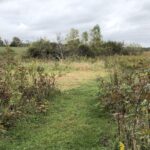
After the derecho that struck Iowa on August 10, 2020, a colleague, Edith Starr Chase, pursued creatively repurposing the downed trees and stumps to a labyrinth of natural materials. She found the right place at Wickiup Hill Learning Center. In September, three of us, wearing masks and keeping a distance, blessed the well-chosen site. Flat, surrounded by prairie and a lively marsh. Close to trails. Accessible. Near a parking lot yet, set aside for privacy. The county mowed the area and laid down woodchips. In October Edith and friends began measuring and placing stumps for a truly sublime labyrinth. At the entry stands a young guardian oak. A wide path opens to the tree-stump labyrinth. Walking it, pilgrims feel themselves releasing the trauma of the event, settling into the ground, resting and laying hands on stumps, recalling, restoring. Edith and her friends created a wonderful healing memorial. For the winter solstice, she planned a walk – one of many to come.
-
-
A wide path leads to the entry.
-
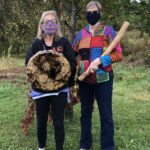
-
The guardian oak awaits the blessing of the labyirnth.
-
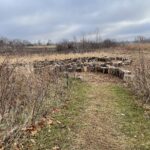
-
The stump labyirnth invites walkers.
-
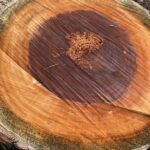
-
Each wood stump has a distinctive color and shape.
-
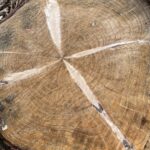
-
Various patterns on the rounds make an interesting walk.
-
-
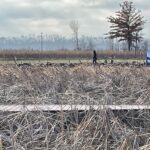
Creating beauty from destruction.
The Phoenix Harmony Labyrinth
We started the year with a mild winter’s day New Year’s Day Labyrinth Walk. Teri P. joined others walking for peace, tranquility, hope, and courage. Cold and snow hit later that week and the weather remained cold and snowy for several weeks. Each day, I strapped on snowshoes and crunched along the five-circuit dual entry labyrinth.
Practicing the Shamanic tradition, I often pause at each turn toward the Cardinal Points – East, South, West, North – Below to Mother Earth, Above to Father Sky, and Center – the emerging Bur Oak we planted a few years ago.
-
-
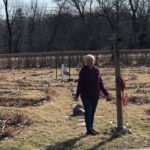
Some of us began the year with a New Years Walk.
-
-
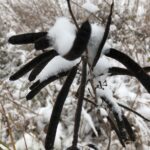
Snow captured on seedheads.
-

-
Any weather
Mostly I walk with Gratitude. For all – those I care about, those I don’t know, those I disagree with, and those I do not like. Asking for kindness in my heart and blessings to all. It’s hard sometimes. Insights are important, too. So, it’s OK to let my mind wander a bit and wonder. Nature. Seasons. Love. Hate. What drives people. Thankfulness for our families and this home and property.
-
-
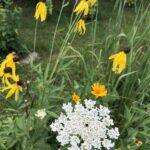
Summer denizens.
-

-
Each summer this gnome finds a new home.
-
-
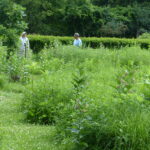
More species visit the labyrinth because of the diversity of plants.
-
-
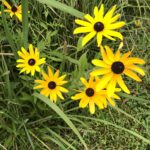
Summer riot of color attracts pollinators
-
-
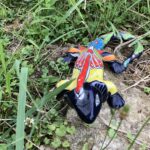
Up from Texas!
-
-
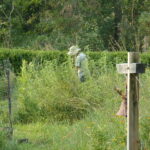
After the Derecho friends helped clean up the labyrinth.
Each day is different. The angle of the sun, sprinklings of rain, fog, presence of insects and birds. Tracks and poop in the snow are telltale signs of night visitors. Sometimes I walk before dawn even in winter, looking back at the house’s gentle glow from windows and smoke wafting from the chimney. Other times about 6:40 a.m. a neighbor’s truck lumbers up the road. We exchange a friendly wave. Occasionally, on early winter and summer nights I walk. The solar lights guide my way in winter. By summer the glow of twilight keeps me on the path. A bat swoops. A coyote yips. Crickets sing. Trees creak stiffly. Stars and planets glow.
-
-
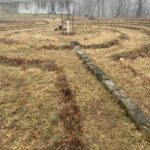
One family regularly walks and runs the labyrinth on the astronomical and cross-quarter dates.
-
-
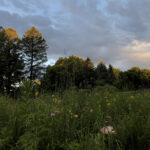
Summer delight was watching the sun kiss the sentinel fir trees.
-
-
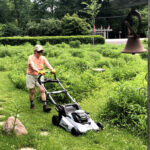
Using an electric mower helps create a quiet yard.
-

-
Remnants of the Derecho blown into the labyrinth.
-
-
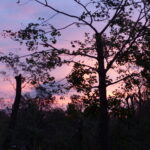
Sunrise after the derecho.
-
-
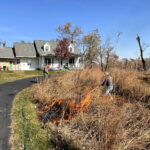
The most thrilling activity each fall is burning the Phoenix Harmony Labyrinth.
-

-
Evening walk by solar lights.
-

-
Surpise!
-
-
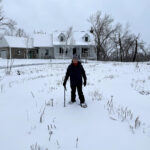
On our first lasting snow, I strapped on the snowshoes to walk the labyrinth.
It’s all good. A discipline and a joy.