by Winding Pathways | Jul 19, 2018 | (Sub)Urban Homesteading, Amphibians/Reptiles, Birds, Garden/Yard, Mammals, Nature
Susan Hrobar
guest blogger
Fun Through the Window
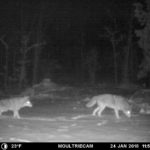
We are fortunate to live at the end of a channel on a small lake. Our north facing windows face our backyard and the channel. One of our friends, who knows very little about nature, does not understand that after living here for 18 years, we still get excited when we see any wildlife in our yard and in the channel. Most of my photos are taken from windows inside the house, hoping to not spook my photo subjects. We frequently have deer coming through and we can tell which paths are being worn into the ground. During the winter we’ve taken photos of deer amidst the falling snowflakes. And, on our trail cam, we have “caught” coyotes, fox, raccoons, opossums, and neighborhood kitties.
Tom Turkey
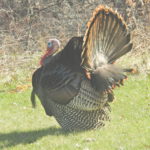
Strutting
This spring we have had a special bonus of occasionally watching a male turkey strut between our and the neighbors’ yards. Usually, he is skittish and if he spots me looking out a window, he quickly moves out of sight. One morning he must have felt like he was “king of the hill” and actually posed for photos about 20 feet from where I was watching him. I have also watched him fly over the channel near dusk and find a tree to roost in for the night. It always amazes me to watch these big birds fly through the trees, as normally you only see them walking and running on the ground.
Turtle Habitat
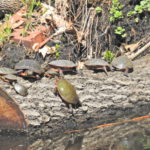
Lounging on a log
Last summer when the water level was high, an oak tree uprooted and fell into the channel, covering both sides of the channel, and completely blocking our water access to the main lake. Because the channel is narrow, there is little clear land on either side. The oak landed at the bottom of a steep hill, so removing it was quite a process. It took a bucket truck on top of the hill, a small boat in the channel, lots of ropes, and a very talented arborist to take care of the problem. This spring the water is lower and that downed tree is now a horizontal stump about four feet long partially submerged from where it fell.
The turtles love this new sunning perch! We have never seen so many turtles at one time. So far, our biggest count has been nine painted turtles on the log. In spring we sometimes get lucky to see a large soft-shell turtle swimming in the channel and climbing out onto the shore. The females are much larger than the males.
Wood Duck- Goose Dustoff
On a recent rainy day, we spotted a pair of wood ducks. They are also very skittish and do not like to pose for photos. We watched as they flew up into a large basswood tree and perched on the branch. I think that is the first time I have ever seen ducks sitting in the trees. It was not a great day for photos, but I tried anyway.
The ducks flew to another tree, rested for a while, and then flew down to the water. Mr. Wood Duck and Mr. (Canada) Goose then had an altercation on the grass with much hissing, honking, flapping of wings, and chasing.
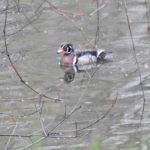
Male wood duck
Mr. Wood Duck was very proud of himself for chasing the goose parents and two goslings of out “his” channel. Mrs. Wood Duck cheered him on while sitting on top of our boat motor. My husband, John, had the fun of watching the goose and duck stand-off. I was trying to get to a different window without all the raindrops obscuring my view. That did not work, but it made me smile to hear John laughing and enjoying the whole spectacle.
Loving Our Wildlife
Even after nearly two decades, we still so enjoy our yard and sharing our stories about animals and plants.
-
-
Night activity
-
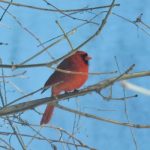
-
Male Cardinal in a tree.
-

-
Deer in yard.
-
-
Swimming
-
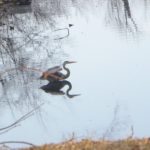
-
A heron spreads its wings
-
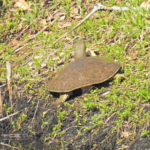
-
Female soft shells are larger than the male.
by Winding Pathways | Jul 12, 2018 | 1080 Labyrinth Blog, Nature, Travel/Columns, Wonderment
A Guest Blog by
Teri Petrzalek
Background Information:
Sunnylands is the 200-acre estate outside Palm Springs of Walter and Lenore Annenberg. In 2001 they created a trust fund to “address serious issues facing the nation and the world community.” A 25,000 square foot, Mid-Century marvel, this peaceful oasis is set in the center of a 9-hole golf course. The property is now used for retreats as well as high-level summits. Former President Obama met Chinese President Xi Jinping. Other dignitaries include the Reagans, Prince Charles and Margaret Thatcher. The work of the Foundation is committed to sustainability, Global Cooperation, Democratic Institutions and Global Health and Food Security.

A hint of Thyme.
A visitor center was constructed at the entry and with it several breath-taking garden vignettes. As we toured the gardens, the tree-lined path around the great lawn opened to a clearing which contained a labyrinth. The 7-circuit path was wide and separated by low plantings.
To finish reading this guest blog, go to 1080 Labyrinth of Recovery and Laughter.
by Winding Pathways | Jul 8, 2018 | Birds, Garden/Yard, Garden/Yard, Nature
This Nectar is TOOOO Hot! Ahh, Just Right!
Lijun Chadima, Guest blogger
Every year I always like to put the hummingbird feeder out as soon as the weather warms up. It’s been difficult this spring because of the crazy temperature fluctuations. Earlier this spring I was enjoying the warm sunshine on our porch when a beautiful ruby-throated hummingbird flew over and seemed to be wondering, “Where the heck is the feeder?” I boiled the sugar water that afternoon and hung out the feeder the next morning.
Mystery – Why No Hummingbirds?
After a couple days the level of the sugar water in the feeder didn’t appear to go down at all. My little friend stopped by a couple more times, but each time he flew off after just a brief sip. I went out to
check the feeder and discovered it was so hot that I could barely hold it in my hand. No wonder the hummingbirds weren’t drinking any! I suddenly remembered a bird show I saw on PBS that stated hummingbirds try to avoid extreme heat, so that afternoon I took the feeder down from its regular spot which was in direct sunlight, and moved it to a new location where it was in the shade under the sun umbrella.
Mystery Solved!
That apparently did the trick because the very next day multiple hummingbirds took turns drinking from the feeder.
Hummingbirds are a source of endless fascination for me. They are full of energy and dart around the sky in all directions like little helicopters. What a treat when one actually stops to rest on the ledge and enjoy a drink from the feeder. Just remember to keep it in the shade so it’s not too hot for them!
Click on the link below, download and watch the video by Lijun of the hummingbird happily sipping nectar in the shade.
by Winding Pathways | Jul 5, 2018 | Garden/Yard

Hemp is amazingly tough and useful.
As we drove along a rural road recently we spotted a healthy patch of wild marijuana.
Most Iowans call it ditch weed. For an” illegal” plant it’s amazingly common across much of the United States and loves living in poor soil out in the hot summer sun.
The plant is technically called Cannabis sativa and comes in two forms that look identical. One is usually called marijuana and contains the active ingredient THC that gives it medicinal and psychoactive properties.
Ditch weed, or hemp, is the other form. It lacks much THC but can grow to 12 feet or even taller on sturdy stalks. It has many industrial uses such as strong rope, clothing, recyclable plastics and animal feed.
A thick patch of it even stopped the old truck we had once when it veered off the road with an approaching train. Phew! Dodged that disaster.
Cannabis was domesticated at least 12,000 years ago in South Central Asia, where it is also a native wild plant. People valued it so highly that they brought it along whenever they migrated to a new place. Uncommon in the United States until the early 1900s it was probably brought to our country by Mexican immigrants.
Cannabis was banned in 1937 by the Federal Marijuana Tax act that remains in force, even though several states have decriminalized it.
A fast-growing annual, cannabis may spring up in nearly anyone’s garden. Birds love the seeds, and patches are excellent habitat for pheasants and other wildlife.
Few plants are as controversial, but society is moving toward legalizing it for its many benefits. Read in The Gazette Natures’ Notes on some fascinating history of marijuana.
by Winding Pathways | Jun 28, 2018 | Nature, Pests, Trees/Shrubs
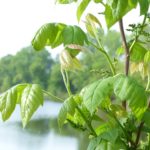
Poison Ivy loves edges
This summer millions of Americans will have unhappy encounters with poison ivy. For most people, the result is a patch of itchy bumpy skin that goes away after a few days to a week or so. Unfortunate others will develop a serious reaction that includes severe itching and swelling.
The very best way to not get a case of poison ivy is to avoid the plant and its culprit – urushiol, an oil that causes the allergic reaction. It’s on the plant’s leaves, in the vines and the sap.
Avoiding urushiol is a surefire way of avoiding a poison ivy rash, but many people have trouble identifying the plant. Fortunately, poison ivy has a secret. Knowing it helps people avoid the plant.
Poison ivy is an amazingly adaptable, hardy and confusing plant. It can be a low growing ankle high sprig, a shoulder high shrub, or a vine winding up to the top of a tall tree. The old saying “Leaves of three, let them be” is only partially helpful in identifying the plant. Usually, it does have leaves in groups of three but many animals love dining on poison ivy and are immune to its ill effects. So, a rabbit or deer may have eaten a leaf, giving the plant leaves of two! And many nonpoisonous plants have leaves of three.
Enter the plant’s secret. Poison ivy is a plant of the edge. It’s rare in the middle of a sun-soaked prairie or in a deeply shaded forest. The plant almost always hugs the edge of a habitat, especially if it gets partial sunshine.
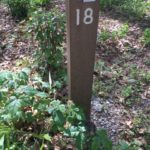
Birds drop seeds when they perch on campground posts.
We’ve seen poison ivy on the edges of:
- Lawns, including ours
- The ocean sand dunes
- Lakes, especially along trails
- Roads
- Trails anywhere
- Ballfields – the rough where balls sometimes go
- Picnic areas
- It especially seems to love life in state park campgrounds especially around the posts that mark a site number and the trees that shade a campground area and that kids love to hug!
So, to avoid poison ivy be especially cautious on the edge. Look carefully at edge plants and study photos of poison ivy in books and on the Internet. Avoid poison ivy when you can.
But, if you accidentally touch the plant or have been wading through likely habitat, get home soon, remove clothes carefully, avoiding touching the outsides of clothes where poison ivy sap may have touched, take a sudsy shower, toss the towels in the laundry, and odds are good that the oil will be soaped off before it creates an allergic reaction.