by Winding Pathways | Aug 23, 2018 | Pests
Lyme Disease Has Spread
According to National Public Radio physicians in all 50 states have reported treating cases of Lyme Disease. It is named for the town of Lyme, Connecticut, where it was first identified in the 1970s.
At first, the disease was confined mostly to the Eastern States and parts of the upper Midwest, but it has since spread widely, and the Center for Disease Control considers it one of the fastest spreading vector-borne diseases. Lyme Disease can cause fatigue, joint pain, and serious long-term problems. It is spread to people bitten by a tick so tiny that often the victim never sees it.
What’s Up With the Fatigue?
Rich contracted Lyme Disease in 2015 and again in 2018 and was successfully treated by Cedar Rapids Physician, Mary Anne Nelson, both times. His experience may help anyone who may have contracted the disease enjoy recovery from the disease. A major symptom can be fatigue.
“In 2015 I felt utterly fatigued for weeks on end. I never saw a tick or had a rash so didn’t suspect Lyme Disease. Because I wasn’t terribly sick I delayed going to Dr. Nelson until I started having knee joint pain. She prescribed a blood test that was positive for Lyme and treated it with powerful antibiotics. Fortunately, the medication worked, I had no side effects from the medication, and after a couple of months my energy returned as the joint pain faded,” he said.
Return of Lyme Disease
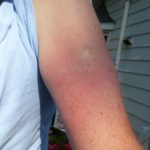
A common symptom is a generalized rash that is warm to the touch.
In 2018 a pinkish rash appeared on Rich’s left shoulder along with shoulder joint pain.
He immediately visited Dr. Nelson. She prescribed antibiotics, skipping the blood test. Symptoms vanished in a few weeks.
Not all Lyme victims are as fortunate as Rich and many struggle with the disease for years. Anyone who experiences the symptoms of rash, joint pain, or lethargy, even if they don’t feel terribly sick, should get to their physician right away. Early treatment may be most effective.
Hard to Detect
According to Dr. Nelson, Rich’s second round of Lyme was fairly typical. Like him, many victims are unaware they were bitten by a tick and often a pink rash is more common than the classic bullseye rash once thought to be a key symptom.
Lyme Disease isn’t restricted to people who slog through woods and prairies. The tick can lurk in yards, on golf courses, and in city parks. Although Lyme Disease is serious, remember, being in Nature offers tremendous health benefits. The risk of Lyme Disease shouldn’t discourage people from enjoying the outdoors.
Tips
Winding Pathways is concerned that people will shun the outdoors for fear of Lyme Disease. We encourage people to continue to enjoy their yards but be aware of the possibility of Lyme Disease, know its symptoms and take some precautions to ensure good health. Here are suggestions:
- Tuck long pants into socks to make it difficult for a tick to access the skin.
- Spray clothing with Permethrin. This chemical kills ticks and insects and is meant to be applied to clothing, not skin. It persists on clothes through several washings. Rich keeps a pair of permethrin-treated pants in the garage that he dons when working or walking in ticky areas.
- Purchase and wear clothing permeated with permethrin. Socks are available from Red Start Birding. A full line of clothing is available from Insect Shield. Local stores may sell permethrin treated clothes.
- After being outdoors take a sudsy shower and do a body tick check. Ticks sometimes walk on the skin for hours before biting. A tick strolling on the skin but not dug into the skin won’t cause Lyme Disease. Flush it down the toilet. Wash your hands.
- Be aware of symptoms. If a rash, lethargy, or joint pain appears get to a doctor right away.
Go Outside and play. The mental and physical benefits from contact with nature are huge. Just be tick aware.
by Winding Pathways | Aug 16, 2018 | (Sub)Urban Homesteading, Energy Efficiency
Tested by Winding Pathways LLC
An independent review of the EGO Cordless Lawn Mower
A WOMAN’S PERSPECTIVE
Winding Pathways recently received a loan of an EGO Cordless Lawn Mower. For several weeks both Rich and Marion used it in the various ways we’ve used our gas power mower. These include conventional and some non-conventional ways we mow.
Just What Is a Cordless Mower
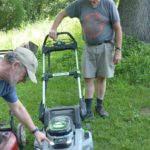
The EGO cordless lawnmower even has lights!
Electric mowers have been on the market for years, but they’ve been corded, meaning they have a long wire and need to be plugged into an outlet to function. They are quiet and low maintenance but have two disadvantages. First, they are only useful as far as the cord will reach. Second, the cord itself is both a trip hazard and a shock hazard. There’s the possibility that the mower could accidentally cut the cord, exposing the user to a hefty shock.
In contrast, the EGO mower is cordless. It operates on a 56-volt battery that is placed in a compartment on the mower deck. This modern lithium-ion battery packs plenty of power and runs for about 45 minutes before its depleted and needs recharging. There is no cord to tangle or cut. And, it even has headlights!
CORDLESS VS GASOLINE MOWERS

Comparison of a gas mower and the EGO cordless lawnmower.
For years we’ve used a conventional gas-powered mower on our 10,000 square foot conventional lawn. That’s about a quarter of an acre. We also use it to create pathways in our prairie labyrinth and through the prairie behind the house. Each fall we use the mower to grind up large prairie grasses and flowers.
We found the EGO as effective, or more so than the gas model for all our needs. It is truly amazing. Here are some positives to the cordless mower:

Batteries charge quickly.
RUNTIME: We ran it at least 45 minutes and it was still going strong. It took 40 minutes to completely charge a battery. That means if an owner has two batteries, one in the mower and one on the charger, mowing can be continuous. Or, when the battery is discharged but there’s more lawn to mow it’s a great time to enjoy a glass of ice tea while it charges!
NOISE: We are conscious of hearing loss from power tools and household equipment like blenders and vacuum cleaners. So, we use an app to measure noise. We compared the noise of the operating EGO mower with the gas mower. The EGO ran at 75 decibels. This is below the threshold where noise can create hearing loss. In contrast, the gas mower ran at 95 decibels, putting it in the hearing loss danger zone. We always wear hearing protection when using the gas mower but didn’t need it with the EGO.
There’s another great advantage to a quiet mower. Noise doesn’t respect property lines, and mowers create neighborhood noise pollution. Not the EGO. We doubt our neighbors would even know we’re using it.
MAINTENANCE: The Ego is a maintenance dream. Our gas mower requires us to store and add gasoline, check the oil periodically and change it annually, change the spark plug and air cleaner element annually, and clean the carburetor every couple of years. Because the EGO does not need gas and has no oil, air cleaner element, or carburetor it eliminates the maintenance need of a gas mower. Both gas and the Ego need two types of maintenance that include cleaning the mower after use and sharpening the blade occasionally.
USER-FRIENDLY: The Ego is user-friendly. Even with the fairly heavy battery installed it is lighter than our gas mower. Adjusting the length and angle of the bar the operator holds is a snap. So is adjusting the mowing height. Perhaps even better, the mower handle folds up reducing storage space needs. It could even be hung on a wall for winter storage as there are no liquids to drain out.
MARION’S PERSPECTIVE
Last year I injured my right shoulder pulling the gas mower cord trying to get it started. With the EGO, starting is a breeze: push and hold the button, lift up on the bar, listen for the soft whir of the blade and off you go! Goodbye rotator cuff problems!
Mowing the labyrinth with its several turns is a task and I was concerned initially about not having a self-propelled mower. It is not an issue because the EGO mower is lightweight and easy to maneuver. Also, the grass discharger or mulcher is within the width of the mower itself. No more concern about accidentally knocking off the attachment and breaking the small prongs that hold it in place. An additional advantage to the EGO is that it has one large, encased cord instead of several small ones that get snagged easily on shrubs. A very nice feature.

Women appreciate the ease of starting and moving the EGO cordless lawnmower.
After we were satisfied with the EGO, we invited neighbors to give it a try. They loved it for all the above reasons and, especially, the ease of starting the mower. Tom has shoulder issues and appreciated the easy start. He prefers the push mower as he has several retaining walls to negotiate around.
After tentatively starting off, a big smile spread across Sherrie’s face as she pushed the mower easily through the grass. She was impressed with the mulcher feature and how easy adjusting the height of the mower was.
We have found the EGO cordless mower more than satisfactory for personal, environmental and neighborhood relations reasons. Give it a whirl!
by Winding Pathways | Aug 9, 2018 | Birds, Nature

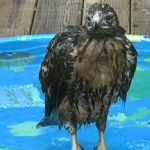
Young hawk cooling off.
On May 31st just before we were leaving for an Outdoor Writers Association of America Conference, a friend messaged pictures to me of a large bird in her little dog wading pool. It looked like a hawk of some sort. The day was super hot for late May and the bird seemed distressed. Soon it wandered off.
Rich and I drove to our friend’s home and looked around, finding the bird burrowed into the cool, wet soil shaking its head as gnats and flies tormented it. I emailed Dave Coates who has worked with eagle counting and asked if he had contacts for someone to rescue the bird. He suggested the Mcbride Raptor Center that I knew had closed.
Then, Rich reminded me of Phil who works with raptors at the RARE group. (Raptor Advocacy, Rehabilitation, and Education is now the contact group).
I buzzed True Value on Mt. Vernon Rd. and the staff kindly put me in touch with Phil.
That is where our involvement stopped. And, I had wondered several times since the outcome.
-
-
On edge of pool
-
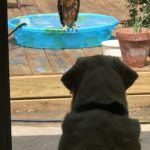
-
Sizing each other up.
-
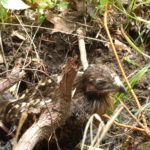
-
Hawk being tormented by gnats and flies.
Dave emailed me in mid-June because he had also wondered about the outcome. His email spurred me to follow up. Here is Nancy’s reply.
“The red-tailed hawk was taken to the RARE center by Phil where they fed her, gave her fluids and made sure she was healthy, then returned her to a tree in our yard. They thought the parents would find her and help her until her flying feathers were more mature. She stayed for about 24 hours but then she was gone. We’re hoping she reunited with a Mom hawk. Actually, I keep thinking I’ll see her in the wading pool again someday.”
So, all is well that ends well. This is the second raptor rescue of the season we have been involved in. Many thanks to folks who care enough to follow through.
by Winding Pathways | Aug 2, 2018 | Garden/Yard, Nature, Pests
Mugging Barberry
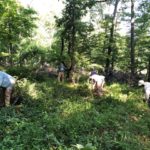
It’s a tough task eradicating Barberry.
One pleasant Saturday morning a couple dozen heavily armed people walked to the interior of Faulkes Heritage Woods. Their weapons were those used to help heal the forest and included thick leather gloves, lopping shears, hand saws, and clippers. They were out to defeat Japanese Barberry.
For two hours they attacked a huge patch of Japanese Barberry that had infiltrated the Woods. Grasping small ones with both hands people yanked them from the soil, shook them off and placed them so the roots would dry out and not re-root. In winter, when the Barberry has berries, the plants are placed on tarps and hauled off so the berries do not drop and root. Ones too big to pull were cut off at ground level.
Volunteers were organized by the Iowa Natural Heritage Foundation. It holds a conservation easement on the property that’s owned by the Marion City Parks Department. Park staff helped, and so did a crew of young people enrolled in AmeriCorps. Various local volunteers pulled and cut.
In Its Native Habitat, It is OK.
Just why is Japanese Barberry such an onerous plant? Actually, it’s a fine shrub in Japan and other parts of Asia where it’s native. There it has natural forces that keep its density in check. It was brought to North America as a landscaping plant because barberry is easy to propagate and transplant. It thrives in many locations, including compacted soil of building sites. It is an ideal landscape plant with one terrible trait.
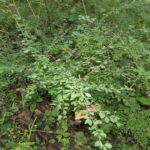
Barberry creates impenetrable tangles and changes the soil chemistry.
The plant produces red fruits in late summer that birds find delicious. They gobble them up, fly away, and poop the seeds out. So, birds snacked on barberries planted in yards and delivered the seeds into Faulkes Woods, where the seeds grow with gusto into impenetrable “pukka brush”.
Barberries crowd out native wildflowers and do much more damage. They actually change the soil chemistry to their advantage while making it less suitable for native plants. And, the dense shrubs create pockets of humidity. Each becomes an oasis of comfort for ticks.
Preserving and Exploring Faulkes Heritage Woods
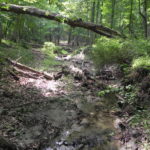
Many hollows and ravines characterize Faulkes Heritage Woods.
Faulkes Heritage Woods is a gorgeous 110-acre steep forest adjoining Winding Pathways. We walk there often. Huge oaks and other native trees fill its wondrous spaces. Wildflowers abound, especially in the spring, and birding is excellent for woodland species. Pileated woodpeckers are common.
A looping footpath starts and ends at a trailhead off Tama Street Southeast. Visitors can park along the street and enjoy the woods. But, they don’t have to stick to the trail that only covers a small area. Walkers are welcome to go off trail and scramble through the woods to enjoy its beauty and solitude.
For information:
Marion Parks and Recreation: (319)447-3580
Iowa Natural Heritage Foundation: (515)288-1846
Winding Pathways LLC.
by Winding Pathways | Jul 26, 2018 | (Sub)Urban Homesteading, Birds, Bugs, Flowers/Grasses, Garden/Yard, Nature, Reflections/Profiles, Wonderment
The Gazette in Cedar Rapids has had several interesting nature stories connected to creating wondrous yards. Living Section features “Birds do it, Bees do it”, “Add a Little Luck to Your Landscape” and Purslane (by Winding Pathways). We loved reading about the birds and bees’ cooling strategies and welcomed the return of clover to yards as natural nitrogen fixers and deep-rooted water retention plants. And, of course, we love to eat purslane. Let us know ways you fix this healthy vegetable.
Also an article on wasps of late summer. They are beneficial, ‘though deserve keeping distance.
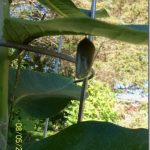
Success on the Bena Farm!
Best of all was the picture of the Monarch Chrysalis from friends, Nancy and Gordon Bena found on their farm. Let’s keep encouraging habitat for insects that form the basis of life for many other creatures.