by Winding Pathways | Jun 15, 2017 | Wonderment
The Bubble Gum Clouds!
This poem is in honor of memories at Grammy Gibbs’ home in Maine where my sister, Lucy, and I used to swing on the hammock in the summer watching the clouds. Yvonne Gibbs Fellows Perrault also took pictures of clouds and captured narratives and poems in small photo albums.
The Bubble Gum Clouds!
Oh, the Bubble Gum Clouds!
Come swing on the hammock
To the Bubble Gum Clouds!
The mushroom and billow
Like fluffy soft pillows.
The GROW and shrink
Until you think
They will disappear.
Then, they swirl and pop
Like they are really hot
And we get caught up
In our imagination!
Salmon and pink,
Dusty blue, black as ink.
There’s nothing better
Than a swing to the Bubble Gum Clouds
I think.
-

-
Capturing sunset over Cedar Lake, Iowa.
by Winding Pathways | Jun 10, 2017 | Birds, Nature, Wonderment
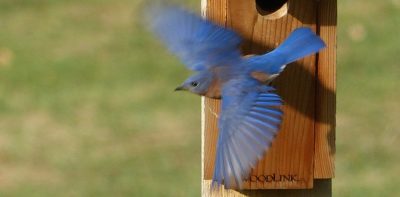
A male bluebird flies from the nest to bring back a snack for its mate.
Here’s a fun guest blog by friends, Gordon and Nancy, about their husbandry of birds on their “Little Acreage.”
“A few years ago my wife and I decided we wanted to attract wildlife to our little acreage. We already had deer and wild turkeys so we decided to try to attract some Bluebirds. We went on line to see where the best spot would be to place some houses to attract them.
“We then went to the Indian Creek Nature Center and bought a couple of houses. We felt that we needed the houses for bluebirds and the Center could use the donation. We placed four houses on the edge of the hay field.
“As time went on, all we saw were sparrows using the nest so we thought nothing would become of our houses. Then, a couple of years ago, a pair of Bluebirds started checking out the nest. But, we never found any eggs.
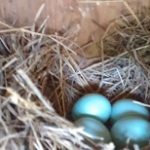
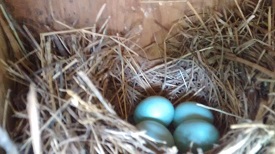
Four eggs! Photo: G&N Bena
“Earlier this year we looked in the house and nothing. A few days later we found these four eggs! What a great surprise for us. We now monitor the nest to watch the progress of our new friends.
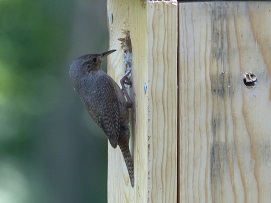
Checking the other houses we found that a pair of wrens decided the house was satisfactory for their
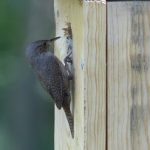
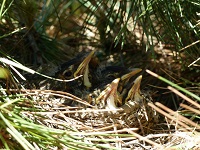
Feeding Young. Photo: G&N Bena
new home and I think they have at least seven eggs. We will be monitoring this nest, also. The other two houses have nests but I think they are sparrow nest. We decided to leave them because they need a home, also.”
Gordon and Nancy
Editor’s Note: Sialis.org has a fascinating set of pictures showing the progression of raising and fledging Bluebird young.
by Winding Pathways | Jun 8, 2017 | Birds, Garden/Yard, Nature
“Oh my gosh! I just found an ‘orphaned’ baby bird sitting on the front porch. What do I do?”
“There’s an ‘abandoned’ fawn in my hostas! What do I do?”
“Oh, the poor baby bunnies, they have no mom. What do I do?”
We get these type comments all the time at Winding Pathways. The short answer is: Do Nothing!
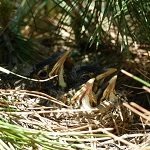
The babies are ready to “branch out!”
This summer millions of Americans will discover baby birds, fawns, bunnies, and a host of other seemingly helpless newborn animals in their yards and face the dilemma of “What do I do?”. Usually the baby is all alone with no mother in sight. It’s easy to assume the poor baby’s mother suffered a tragic fate and that the baby is doomed to an early death unless people “help” it.
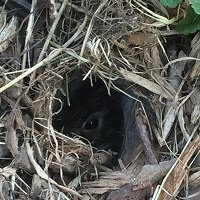
We’ve often found baby bunnies and birds at Winding Pathways and we know the best way to help it is to leave them alone. A cottontail nest we found last spring is a good example.
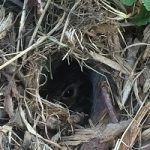
Female rabbits sometimes make a shallow nest in lawns. They leave the nest along and only return to nurse the young.
Cottontail mothers bear their young in a small hole they dig in the ground, frequently at the edge of a lawn or near a shrub. Mom knows that predators ranging from house cats to owls would love to dine on her babies, so she’s developed a sensible strategy to protect them. She stays away except for twice-a-day feedings.
If you see a cottontail sitting quietly on a spring or summer lawn there are good odds she’s above her nestlings and they’re enjoying breakfast or dinner of her rich milk. Stay away and keep your pets inside so she can complete her job. Other than at feeding time she stays away so predators don’t spot her and find the nest.
There’s a common misconception that if a human touches a baby fawn or bird it will be rejected by its mother. Not true! Maternal instinct is stronger than fear of people and many videos have shown fawns touched by people quickly reunited with their mothers. Birds have little or no sense of smell so can’t detect human scent. Still it’s not a good idea to touch a baby. The baby is likely a fledgling and learning to fly.
Many baby birds go through a growth phase we call “branchers”. Babies quickly outgrow space in the nest. When it’s too crowded they hop out and sit on a nearby branch, or a front porch, or a driveway. With the parent not visible it’s easy to assume the baby is orphaned or abandoned, but that’s hardly ever the case. It’s normal for parent birds to feed their young after they’ve left the nest, so mom and dad are probably out foraging and will return soon. The babies need energy and may be resting and waiting for a snack, so, again, keep pets and kids inside and stay away. Occasionally, placing the baby on a low branch may be appropriate in areas where there are lots of activity and the baby would be at risk of getting stepped on. Otherwise, leave the babies alone.
The best way to help wildlife babies is to stay away and quietly enjoy watching them from a distance. It’s likely you’ll soon see the parent or parents caring for its young.
by Winding Pathways | Jun 1, 2017 | Bugs, Nature, Wonderment
Reminiscing on some Haikus from the past. These seemed a good way to honor spring and welcome summer.
March
Quivering seed pods
Last year’s fruit, This year’s promise
Red buds produce life.
April
April ‘to Open’
Birds beckon, flowers unfold
Hope, re-birth, re-new.
May
Dampness Awakens.
Slow green shoots appear and grow.
Spring bursts in splendor.
How goes butterfly
So gaily in morning dew.
Quiet. Elusive.
Surf booms, with great roar.
Coquinas ride waves to rest
On white, clean beaches.
Pelicans I
Spring aerial art.
Wheeling, gliding all in sync
Pelicans migrate.
Pelicans II
Spring aerial art
Banks, wheel. Dive. Glide in sync
Pelicans migrate.
Mountain tall, distant
Shelters small creatures that live
In harmony there.
Laughter tumbles free,
From souls to the earth.
Children, living gifts.
Understand
Begin where we are
Understanding nuances
Plain talk ease nerves.
by Winding Pathways | May 28, 2017 | Mammals, Nature
Our dining room table overlooks a tiny pond circled with large stones. Many wild animals come to drink or bathe. One of our favorites is the sleek Eastern Chipmunk. Often, chipmunks fill their cheeks with seeds that fall from our bird feeders and carry them off to a stash.
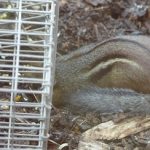
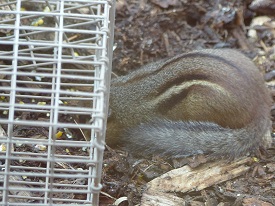
This chipmunk figured out how to tunnel under the trap to get the seeds.
One summer we watched a clever chipmunk problem-solve how to access seeds from a live trap without getting trapped itself. The ingenious chipmunk tunneled under the trap and up through the wire, helped itself to the food and returned back out the tunnel to store its treasure for later eating.
We love chipmunks but many people utterly hate them and ask us how to rid their yard of the tiny mammals. Although they can undermine rock walls by tunneling otherwise chipmunks do slight damage. They are most commonly found in shady yards with woodpiles or rock walls.
Chipmunks may be unusually numerous in suburban yards because people discourage their predators. Bull snakes love dining on tasty chipmunk dinners but few homeowners want a six or eight-foot-long snake sharing their yard. Many hawks also devour chipmunks but, like snakes, they aren’t common in town. So, these small rodents have few predators to fear other than marauding house cats.
An effective way to keep chipmunk numbers in control is to encourage predators. If snakes can’t be tolerated, removing woodpiles and rocks will eliminate chipmunk homes.
Occasionally chipmunks and white footed mice climb into vent pipes plumbing or clothes dryers. An easy way to discourage them is to buy a few stainless-steel scrub pads sold in most grocery stores. These are balls of coarse, somewhat sharp metal. Put the pad in the pipe in a way that fills the void but doesn’t cause the pad to compress much. It acts like a filter, allowing air to move through it but not letting rodents pass.
But, mostly just enjoy your chipmunks.