by Winding Pathways | May 21, 2017 | (Sub)Urban Homesteading, Foraging, Nature, Trees/Shrubs
This is a tale of free trees. Our friend, Marilynn Keller, learned how to plant the best tree species in her yard at no cost and with little work.
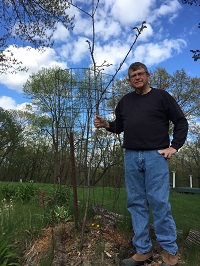
She simply didn’t mow a tiny area of lawn where she wanted a tree to grow. As if by magic, a White Oak, Sugar Maple, and Shagbark Hickory sprouted there this spring. Although the spot is too small for three trees Marilynn can simply decide which one she wants and mow the others off.
Likely a squirrel buried a nut that has sprouted.
Last fall an industrious squirrel gathered acorns and hickory nuts and buried them in her yard. The squirrel might have forgotten his hidden cache or perhaps died. Either way the unrecovered nuts sprouted.
Although squirrels often eat maple seeds, it’s most likely that Marilynn’s baby maple sprouted because a gust of wind pulled the ripe seed off a nearby tree and it helicoptered to her yard.
While Maples are usually easy to transplant, and are widely sold by nurseries, not so Hickories. Although any of the many Hickory species make outstanding shade trees, as soon as a nut sprouts it sends an enormous taproot deep into the ground. Moving a hickory is difficult and often unsuccessful. Commercial nurseries avoid them.
The same goes for white oaks, one of our favorite trees. It’s difficult to buy one to plant in the yard. Because they are slow growing and challenging to transplant, few nurseries bother with them. Fortunately, they readily sprout on their own.

In autumn Maples glow with color.
Anyone living where there are mature Hickory, Oak, or Maple trees nearby can use Marilynn’s tree planting method. Simply don’t mow a patch of lawn where a tree is desired. Odds are one will appear on its own next spring. If more sprout than the spot can support just mow the others off and put wire screening around the new tree to protect it from hungry cottontails and deer.
If a tree sprouts in the wrong place it can be easily transplanted with just one shovel of dirt. Move it before the tiny tree has grown a long taproot.
by Winding Pathways | May 19, 2017 | (Sub)Urban Homesteading, Garden/Yard
Nature is not all sunshine and roses, cute baby animals and gentle breezes. Sometimes nature is rough, sometimes vicious, sometimes other creatures simply clean up carcasses of fallen animals. This spring the Heartland has had its share of hail, winds and heat. The front yard maples and Phoenix Harmony Labyrinth’s budding Bur Oak survived by bending with the winds. With the variable weather comes casualties. The last video graphically shows the scavengers cleaning up a fawn carcass that showed up on the back lawn after a night of cold, wind, and heavy rain. It’s sad but we have to remember than Mother Nature’s clean up crew will benefit from the loss. And, life goes on.
by Winding Pathways | May 16, 2017 | (Sub)Urban Homesteading, Garden/Yard, Nature, Trees/Shrubs
We never spray our lawn at Winding Pathways. Occasionally, that yields an exciting discovery like what happened in early May.
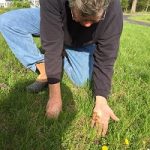
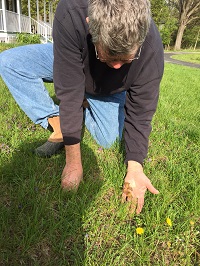
Rich shows the tiny oak seeding.
We wanted to plant a tree, preferably an oak, on the south side of our garage. But, we got busy and never found time to buy or plant one. One morning Rich, while walking across the lawn to fetch the morning newspaper, spotted a baby white oak tree that sprouted exactly where we wanted to plant one. It was serendipity.
Seed Banks”
Plant ecologists talk about the “seed bank.” In land that hasn’t been greatly disturbed by plowing, spraying or compacting of soil, seeds of desirable native plants often remain dormant in the soil for years or decades. Then, when conditions are right they’ll sprout like magic. Other desirable plants spread their seed through the wind or enlist the help of a hungry squirrel to carry and bury a nut or acorn. That’s probably how our new oak got planted.
Before mowing walk across your unsprayed lawn. You may discover a plant you want that is starting to grow. Just mow around it to let it thrive. Mark it with a stake or fence it off from rabbits and deer. If the plant is not quite in the right place, remember that tiny plants are usually easy to move with just a shovel full of dirt.
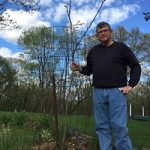
We protect volunteer trees that grow where we want them.
About seven years ago we found another baby oak in our lawn. We protected it from mowing and ran a screen around it to keep hungry deer away. It’s now about seven feet tall and growing rapidly.
That black oak didn’t cost a penny and will grace our yard long after we’re gone.
Another way to go about natural or plant and wildlife friendly yards is to deliberately plant certain forbs and grasses to attract a variety of beneficial insects and interesting birds and other wildlife.
by Winding Pathways | May 15, 2017 | (Sub)Urban Homesteading, Foraging
Chicks are amazing! How quickly they learn and adapt. Their personalities amuse us at Winding Pathways and their problem solving is the best! Enjoy the videos of the Hoover’s Hatchery chicks at about ten weeks.
by Winding Pathways | May 10, 2017 | Birds, Flowers/Grasses, Nature, Travel/Columns
May is about the most exciting month to travel and camp out in Iowa. We took in the Driftless area of Iowa and Wisconsin where we learned more about mounds at Effigy Mounds National Monument, ate at funky Café McGregor, took in Starks and Cabelas in Prairie du Chien, and entered our favorite forest over the “Forest Road” into Yellow River State Forest.
- Note our reviews and thoughts are independent, unpaid and unsolicited.
Enjoy this photo journal of our stay.