by Winding Pathways | Apr 11, 2017 | Nature
There’s lots going on out on the lawn every dreary drizzly spring evening. Don’t miss the annual night crawler mating season. Night crawlers are a species of earthworms. Crawling is a fun family activity that only takes a few minutes and yields great fish bait.
Night crawlers are huge earthworms that originally came from Europe. They were likely brought to North America in dirt used as ballast in sailing ships in the 1700’s and have been moved around the country wherever dirt was transported. Sometimes they hitch hiked in the root balls of nursery trees.

Worms castings are great fertilizer. Worms convert organic matter like leaves grass and table scraps to great compost. Long live “worm poo!”
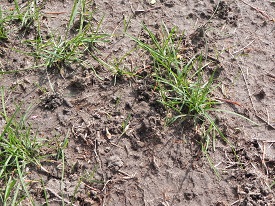
Today night crawlers are common in lawns nearly everywhere. During the day and in dry spells they stay underground. But, on damp spring evenings they rise to the surface to both feed and mate, leaving behind their tell-tale signs – castings.
Each night crawler is both male and female. During the spring mating season, they crawl around on the lawn surface looking for a likely mate. When they find one the two temporarily cement themselves together with a mucus ring. Sperm are swapped between the two and soon they separate and perhaps munch on some dead leaves or bits of organic debris before returning underground. Eventually they’ll lay eggs to create a new generation of night crawlers.
How to Go Night Crawling
A drippy 50-degree night in April or May is the perfect time to go night crawling. Bring the kids. Don a raincoat and carry a can if you want to save some for fishing. An ideal flashlight has almost depleted batteries so it just glows. Or cover a brighter flashlight with a cloth handkerchief to mute its light. The cloth can be secured with a rubber band.
Night crawlers are wary and sensitive to soil vibration and noise, so walk gently and deliberately, shining the light in front. Crawlers are wet and look shiny in the dull light. Single crawlers usually keep their tail stuck down in the earth. If a noisy person approaches, it will quickly retreat underground backwards. If you approach with stealth you can grab the surprised worm firmly but gently. It will respond by swelling its tail to grip the soil, making it hard to pull out.
There’s a trick. Hang on to the front of the worm but stop pulling and drop your hand toward the ground. The worm will loosen its grip in an attempt to go deeper into its hole. This is when you pull it out with little resistance. Worms will stay alive and healthy for a couple of weeks if kept in cool damp earth. Some folks keep them in a sealed container in the refrigerator. Make sure the container is sealed – you really don’t want crawlers in your ‘fridge! They make outstanding fish bait.
Anyone out night crawling might encounter two mating worms. They won’t or can’t escape because they are joined. Leave them alone. Trying to catch them often causes one worm to break in half and destroys mating.
So, on a drippy dreary spring evening go night crawling! Kids love it.
by Winding Pathways | Apr 4, 2017 | Birds, Nature
Rich made a New Year’s resolution to walk around Cedar Lake at least 100 times in 2017 after making over 90 lake circuits last year. The 60-acre lake is near downtown Cedar Rapids, Iowa, and features a 1.7 mile long paved trail following its shore. Every day pedestrians and bicyclists share the trail with Canada Geese.
“Lake circuits are always interesting, and many migrating water and shore birds visit Cedar Lake, but I especially like watching changes in goose behavior as the months go by,” Rich said.
Many people hate Canada Geese, mostly because of the mess they leave on the trail and lawns. But geese are fascinating animals. Closely observing them gives insights into their rhythm of life.
Geese live a long time. A quarter century is possible, which is a much longer lifespan than enjoyed by most wild animals. They pair up when young and mate for life. When a mate dies, the survivor often re-mates. Geese seem to enjoy plenty of leisure and like to socialize, and few predators bother them.
All winter they mingle in large flocks that are mostly big family groups of goose couples and their offspring. However, by early March the groups split up and human walkers around the Lake see mostly goose couples. They loiter near the trail, swim a bit, and forage on grass and grain spilled from nearby rail cars. In very early spring the female makes a simple nest on the ground. It’s hidden but if you see a goose pair in March their nest is likely close by.
Every day or two the female visits her nest and lays an egg before joining her mate for a day of foraging. Once the clutch of four to a dozen eggs is complete, she’ll begin a five-week incubation. During this time trail walkers only see single geese, and that’s likely the gander. He’s keeping a close eye on the hidden nest and his patient mate sitting on her eggs. Approach the nest and he will try to drive you away.
By the end of April, give or take a couple of weeks, the eggs hatch and for the next few months the parents protect and teach their youngsters. Baby geese, or goslings, grow fast and by late summer are full size and look just like their parents. For the next six or seven months they’ll stay with their family until it’s time to form pairs and begin the nesting process next spring.
Canada Geese are abundant and few urban wildlife sights are as pleasing to us as a flock winging over downtown at sunset.
by Winding Pathways | Mar 31, 2017 | Birds, Nature
The pileated woodpecker checked out the suet and finally flew to the ground then up to the feeder to hammer out chucks of suet. Then, off to the tree where a female played hide and seek with it.
by Winding Pathways | Mar 29, 2017 | Chickens, Preparedness
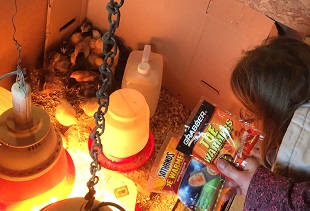
Keep hand warmers nearby in case of power outage.
We weren’t worried when a 37-degree north wind took to blowing on Saturday, March 25th. Our chicks were safe inside the barn brooder. Then, our electric power went out. Normally that wouldn’t be a problem. Our wood stove keeps the house warm without electricity and we have camp stove for cooking. And the adult chickens do well in most weather.
However, the sudden unexpected loss of electricity threatened our 50 baby chicks living in a plywood brooder under heat lamps out in the barn. Electric heat lamps normally keep them snugly warm in the otherwise cold barn.
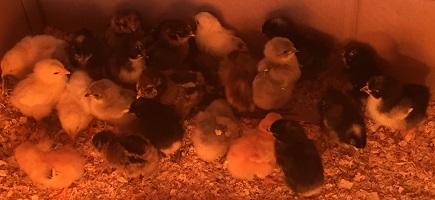
We heard about the power failure while shopping. It took a half hour to get home and we found the cold chicks huddled together in a vain attempt to keep warm. We had no idea how long the power would be off so immediately put our back up plan in place. Here’s what we did:
- Filled two plastic jugs with hot water and placed them near the chicks. The babies immediately snuggled up to the warm bottles.
- Tore the plastic covering off six chemical hand warmers to activate them. These are sold to farmers, carpenters, and hunters to keep their pockets warm during winter outings. They get very warm but not hot. We put them under the chicks.
The milk jugs and hand warmers didn’t warm the entire brooder, but they did keep the chicks warm enough to survive three hours until the power came back on.
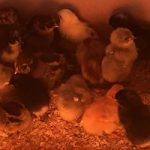
Chicks huddle together when cold.
Anyone brooding baby chicks should have a back-up plan to keep their peeping friends warm in case the electricity goes out. A couple of milk jugs and a few hand warmers can prevent a disaster.
by Winding Pathways | Mar 28, 2017 | Birds, Nature
Well, the turkey characters are at it, again! Up they come each morning even before sun up, looking quite fit and hale, and gobbling for breakfast. At Winding Pathways we get a kick out of the web pages and sporting flyers that detail all the equipment one needs to bag a turkey and how early one has to get up to beat the turkeys out of bed. Special camo clothes, calls, camo guns, shells. To the credit of the web sites, they do offer intriguing information on strutting, clutches of eggs, turkey senses, and habitat. A Kidzone site shares an interesting story of the “mix-up” of the name. and, of course, Audubon gives a great set of pictures and details about turkeys. All fun reading.
From the comfort of our home, we sip our coffee and watch a crew of seven meander up from the ridge where they roosted and another eight that saunter over from the neighbor’s trees. Then, it is the Sharks and the Jets (think West Side Story) as they squabble over the seed tossed out – not for them – but for the song birds. Or look at us with pathetic longing, trying to make us think they are starving. Ha!
Meanwhile, the less dominant males slide in for a feast.
Same with mating. The dominant males strut and intimidate and the less aggressive males sidle up to a female that is ready and mate. Maybe we will eventually have less pushy turkeys.
Enjoy this gallery of winter and spring turkey antics.