by Winding Pathways | Apr 5, 2018 | (Sub)Urban Homesteading, Chickens, Garden/Yard
It may seem odd for a bird that evolved in tropical Southeast Asia to thrive up in the frigid north but increasing numbers of people are enjoying the benefits of backyard chickens in Canada, Maine, Michigan’s Upper Peninsula, in Northern Minnesota, and even Alaska.
Although, chickens are hardy and adaptable, raising them way up north requires special management. Among the challenges both chickens and their owners face is frigid temperatures, vastly different day lengths between winter and summer, and the sometimes difficulty of buying feed and supplies in areas far from where chicken culture is common.
Steve Brown, extension agent for the University of Alaska Fairbanks Cooperative Extension office, Palmer, AK, has been advocating chicken husbandry in Alaska for many years. He has a flock and regularly helps others acquire and manage birds. It’s challenging but the rewards are many.
Frigid Temperatures
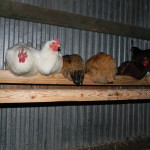
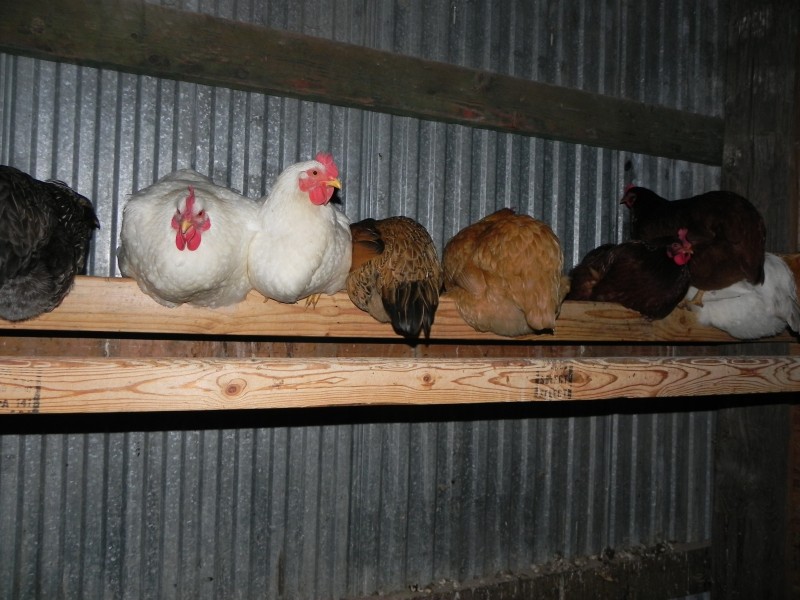
Chickens sheltered from the cold.
Everyone knows Alaska is a cold place, so during the long winter hens need a coop that protects them from the wind and predators and moderates the temperature some. Moisture causes chicken manure in litter to quickly generate ammonia so keeping the coop dry is important. Brown uses the deep litter method to keep the coop floor dry and only occasionally warms his coop when temperatures drop really low.
Daylight
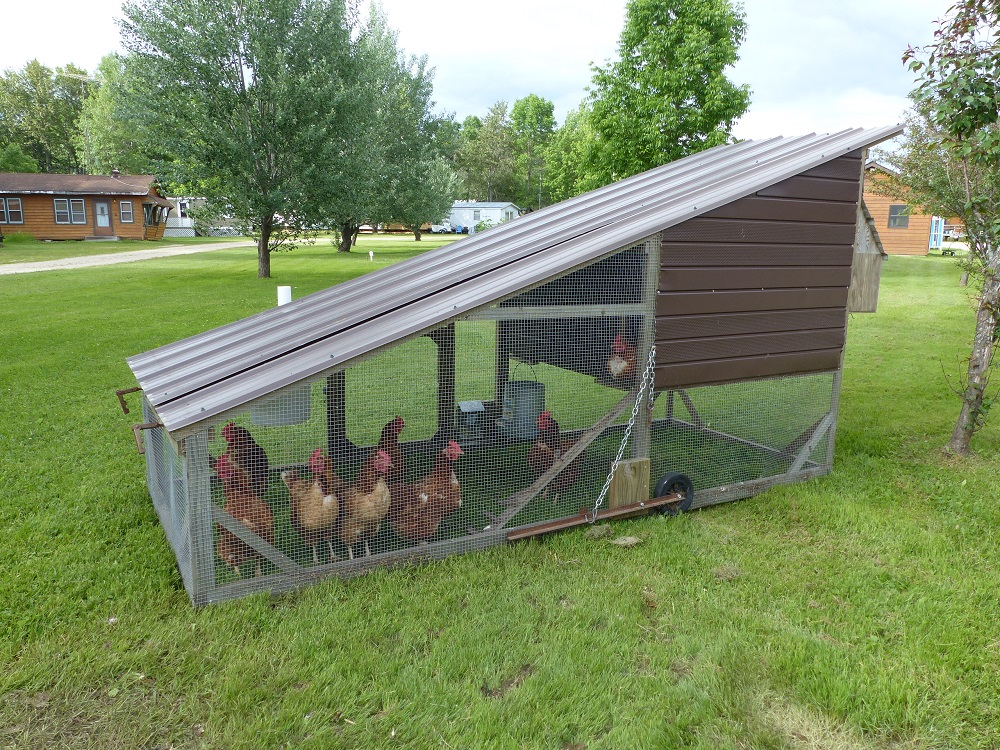
Chickens are daytime creatures and in southern Alaska there’s upwards of 17 hours of darkness in the winter. “LED bulbs solve the lighting problem and keep expenses down. Electricity is expensive here, and LED bulbs provide great light while consuming little energy, keeping my costs down,” said Brown. During warm seasons he lets his chickens forage in the yard and also uses a chicken tractor.
Supplies
Nearly all food is shipped to the state, so finding fresh eggs is challenging, but Steve and many others enjoy eggs that come directly from the coop. Fresh eggs sell for $8 a dozen!
Chicks can successfully be shipped to the cold north.
But, where do the chicks come from? “I buy chicks from a company in Texas. They airmail them to me and they arrive in good shape. Usually I buy about 100 chicks, raise them for several weeks and sell most of them to other families who want chickens using Alaskas List, like Craig’s List. I keep a small flock at my home,” he said.
Feed and supplies are hard to come by in Alaska and expensive. “I don’t buy grit but collect sand and small pebbles from a nearby river bank, and I feed my chickens a lot of kitchen scraps, dog food, and fish scraps. Sometimes fishy taste gets into the eggs,” he said.
Brown sticks with hardy brown egg laying breeds which stand the cold better than Leghorns. “I like Chanteclers, Rhode Island Reds, Plymouth Rocks, and Orpingtons,” he said.
Continental Climate Chickens
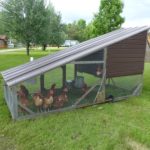
Chicken Tractor
Another family that raises far north chickens is Paul and Karen Colson. They probably raise the most northern flock in the contiguous United States. They live in Minnesota’s Northwest Angle. The Angle is a relatively small area bounded by the Lake of the Woods and Manitoba. To reach it, a driver must enter Canada, drive NE about 40 miles, and then reenter this remote part of the United States. Like Alaska, nearly all supplies must be hauled in a long distance.
The Colsons raise broilers and keep a small flock of laying hens. Although not as far north as Alaska they face the same challenges of cold, day length, access to supplies, and predators as Brown does and manage their chickens in a similar way.
No place is really too far north to keep chickens. It takes more time and work to keep hens healthy in a harsh climate but the fresh eggs and meat they provide make it worthwhile.
by Winding Pathways | Feb 22, 2018 | (Sub)Urban Homesteading, Garden/Yard, Mammals
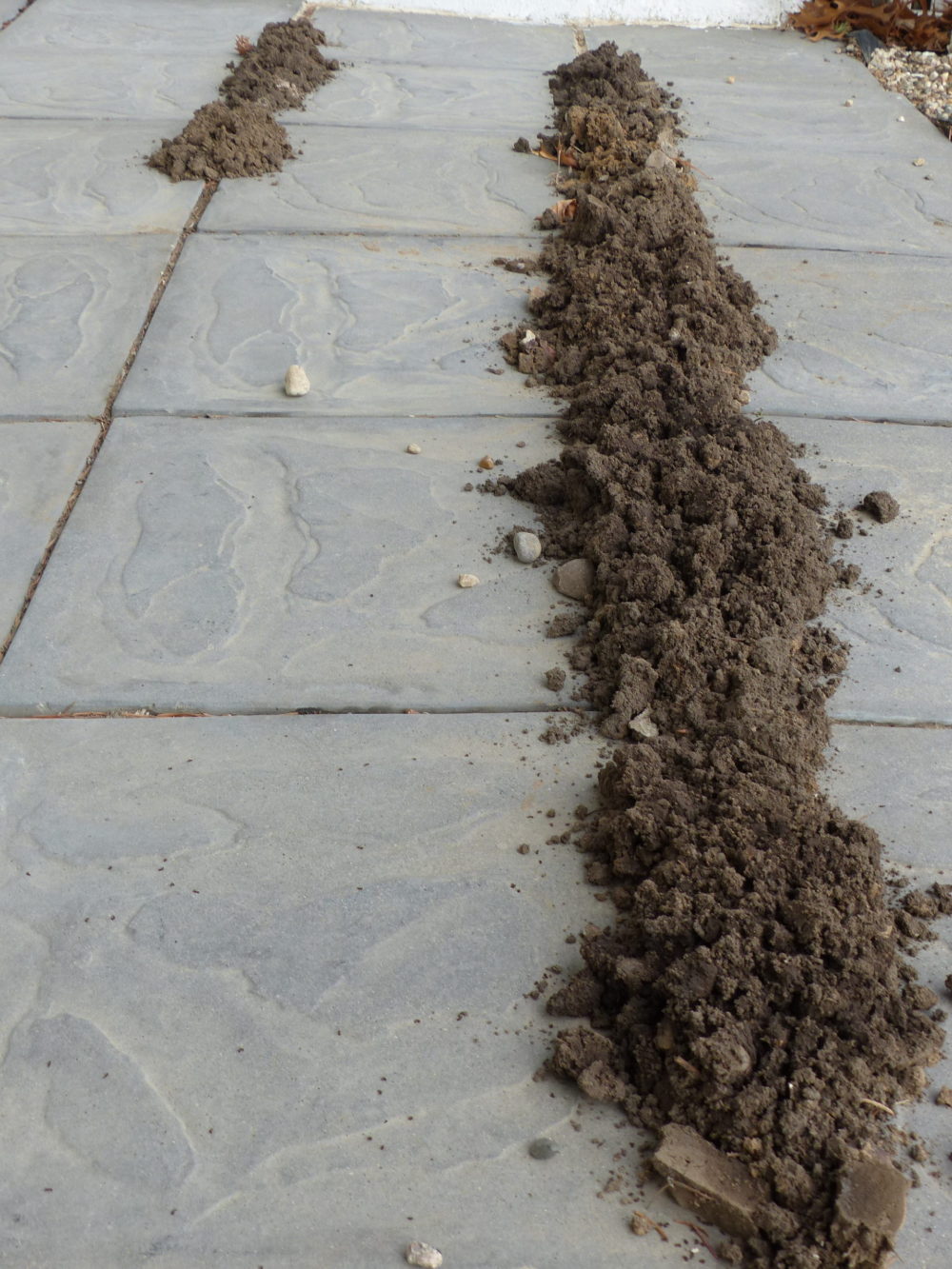
Moles in winter? You bet! We were amused and amazed to look out our den window and see a heaped-up line of topsoil on top of several stepping stones. Even in Winter, our moles are active!
Many people hate moles because their tunneling raises mini ridges in the lawn and their hills smother a patch of grass and get
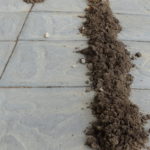
Moles bring rich dirt from below to the surface as they tunnel along hunting for earthworms and grubs.
caught in a lawnmower’s blades. Some go to great lengths to poison or kill moles.
How Moles Are Helpful
We don’t. They’re amazing animals that provide us with a wonderful service. Their endless digging in search of earthworm and insect meals softens the soil, enabling water to easily percolate in and helping plants grow. The greenest grass of the lawn always seems to be where moles tunneled last year.
Instead of persecuting our moles we simply stomp down the raised tunnels and rake out the mole hill before mowing, and then we quietly thank our subterranean helpers before starting up the lawnmower.
Moles are active all year but the frozen ground is daunting for them. Our January moles were tunneling in the soft unfrozen soil on the south side of the house and under dark stones that catch the sun’s heat and keep the ground underneath them unfrozen. We hope they found some grubs and worms for dinner.
We’re happy to share our yard with moles and appreciate the positive impact they have on the soil. Watch this YouTube Video about moles.
by Winding Pathways | Feb 15, 2018 | (Sub)Urban Homesteading, Chickens, Garden/Yard, Garden/Yard
Americans Waste Food!
We were astounded to read a news story stating that 20% of Iowa’s trash is food waste. That’s about 556,000 tons of food tossed out by our state’s people, and Iowan’s aren’t unusual. Americans everywhere discard food into the trash or grind it in the garbage disposal and send it off to the sewer plant. Other solutions exist!
Winding Pathways isn’t a contributor to this vast waste because we manage our family food carefully. Our main way of reducing waste is buying carefully so we don’t end up with more perishables than we can eat in a reasonable time. It saves money at the market, but still, a lot of scraps result from meal preparation.
Save Money. Create Soil.
Instead of tossing out potato and carrot peels, bits of rice that get caught in the sink strainer, onion skins, shrimp tails, egg shells, coffee grounds, and a host of other organic matter we separate it into two bowls that we empty daily.
Our first bowl becomes chicken treats. Our 14 hens love shrimp tails, wilted lettuce, bread crusts and other items we can’t eat. When we approach the coop with our scrap bowl our hens rush to meet us and devour the treats with considerable enthusiasm. In a day or two they return the favor by presenting us with delicious eggs.
Our second bowl is everything the chickens won’t eat or we don’t want them to eat and includes potato peels, egg shells, coffee grounds and filters, avocado skins, citrus fruit skins and other relatively course organic items that most folks toss in the trash. These become the ingredients for rich compost.
Our composter is gradually filled overwinter. We create a layer of food scraps a couple of inches thick and then add a layer of chicken manure mixed with wood chips from the coop and ash from the woodstove. Manure is another gift from our hens that speeds up the composting process. The layers gradually decompose, and by spring we harvest outstanding rich compost to dig into our garden.
Return on Our Dollar

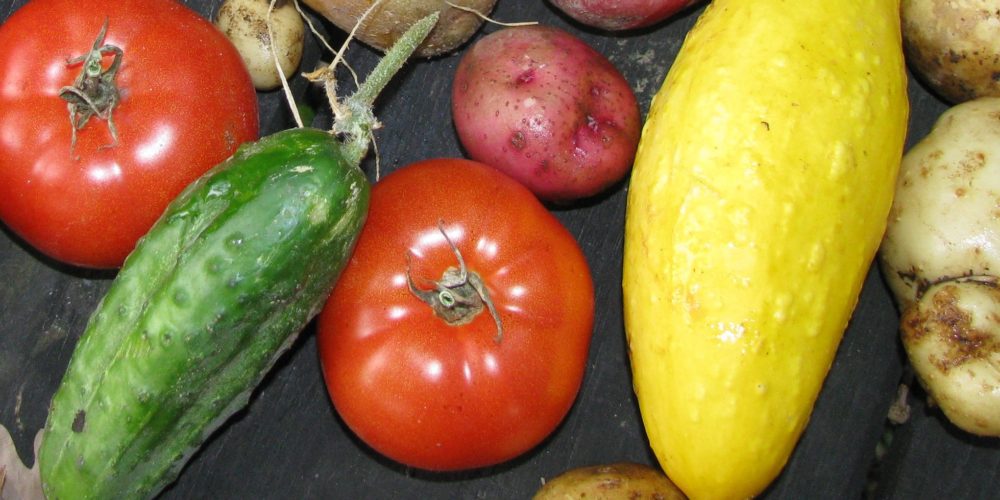
Summertime meal from the garden.
We don’t buy fertilizer. We make it from food scraps. Beans, squash, carrots, okra, chard, kale, lettuce, and tomatoes seem to jump from the compost-enrichened soil, and on many summer days everything we eat comes from the yard.
Then we return the little scraps from our garden vegetables to the chickens or compost pile, completing a cycle of abundance. We save money and spare the landfill unnecessary waste.
by Winding Pathways | Feb 3, 2018 | (Sub)Urban Homesteading, Garden/Yard, Garden/Yard
Each winter we love discovering colorful seed catalogs in our mail. The landscape may be snowy and the air frigid but flipping through catalogs and savoring photos of flowering prairies and ripe tomatoes makes us think spring.
We buy many types of seeds for our prairie and woodland restorations, the chicken run and the vegetable garden. Often, we order from several companies and buy some seeds in local garden supply stores.
Like many wildflower enthusiasts, we prefer buying seeds grown as close to our Iowa home as possible. They are well adapted to our climate and soil. Googling NATIVE PLANT SEED SOURCES will steer anyone to seed companies close to where they live, even if that’s Australia!
Here are some of our favorite sources:
SEED SAVERS EXCHANGE, 3094 North Winn Road, Decorah, IA 52101. www.seedsavers.org. This is our favorite source for garden vegetable seeds. The catalog lists hundreds of varieties. Many are heritage types hard to find anywhere else. It’s where we buy seeds for Silver Bell winter squash, our favorite. Seed Savers is a fun place to visit located near the college town of Decorah, Iowa.
ALBERT LEA SEED HOUSE, 1414 West Main Street, Albert Lea, MN 56007. www.alseed.com. We’ve bought prairie wildflower seeds and a few pounds of turnip seeds that thrived in our chicken run from this company, and we enjoy visiting their fun store.
ERNST SEEDS,8884 Mercer Pike, Meadville, PA 16335. www.ernstseed.com. A few years ago, we were looking for buckwheat seed to plant in our chicken run. We found it at Ernst Seeds, and it thrived. Ernst sells a wide range of seeds.
ION EXCHANGE, Harpers Ferry, Iowa, www.ionxchange.com. Ion Exchange sells both seeds and started plants for prairie and woodland restorations.
PHEASANTS FOREVER, www.pheasantsforever.org. This conservation organization sells seed mixtures especially developed to provide wildlife habitat and food. It is an excellent source of reasonably priced seeds for planting large areas.
Seeds are one of nature’s miracles. Given the right care and location each tiny and seemingly dead seed brings life to the land that is a feast for the eye and palate.
by Winding Pathways | Jul 27, 2017 | (Sub)Urban Homesteading, Garden/Yard, Mammals, Nature
We like opossums and are always happy to see one shuffling off when we startle it after dark. This amazing animal gets too little respect and appreciation by people who consider them dirty, stupid, and ugly. They are just the opposite!
Opossums are doing something right. They’re survivors who have been on the planet far longer that humans. Often called ‘possums, they were once common only in southern states. Their fur is sparse and doesn’t cover tails or ears, so winter is rough on them. Warming temperatures are helping this animal move north, and they’re now common in Maine, Minnesota and other more northern states where they once were absent.
‘Possums are our only native marsupial. Like kangaroos, female opossums have a pouch to nourish their young. Born after only a 13-day pregnancy tiny babies make their way into her pouch where they remain for about 100 days feeding on mom’s milk. Once they leave the pouch they follow her around learning how to fend for themselves.
Mostly nocturnal, possums aren’t choosy eaters. They love over ripe fruit, especially persimmons but they’ll also snack on insects, worms, dead animals, and nearly any other animal they can catch or find. Think of them as a gardener’s assistant because they gravitate to decaying material.
New research reveals an important diet item. They enjoy eating ticks! ‘Possums groom often and any tick that climbs aboard one and attempts to bite is in for a surprise. The grooming animal is likely to find the tick and quickly devour it. Fewer than 4% of ticks that climb on a O’possum successfully enjoy a blood meal. The rest become a meal themselves.
We’re lucky to have opossums in our yard. We enjoy sharing space with these ancient, clean, and useful animals. We hope you also have a neighborhood ‘possum. Be sure to share a photo of your ‘possum with us. For information on the opossum/tick relationship go to Cary Institute.
by Winding Pathways | Jun 22, 2017 | (Sub)Urban Homesteading, Amphibians/Reptiles, Garden/Yard, Nature
Every once in a while, when we’re out in our summery yard enjoying birds and flowers, we encounter a snake. We’ve been around snakes for decades and know there are no venomous species in our area but we’re still startled when one slithers away.
Managing a yard to attract a diversity of wildlife sometimes encourages snakes to move in along with birds and butterflies. Usually the snakes that visit yards are non-venomous species merely looking for a place to live and something for dinner. Most common are garter snakes that mostly eat insects. We’ve written about garter snakes on Winding Pathways before. Sometimes we spot tiny brown snakes no bigger than a nightcrawler. They also eat worms and bugs. Once in a while we see a beautifully colored and patterned fox snake. They probably seek tasty white footed mice or maybe a chipmunk. And lots of folks combat the undermining work of chipmunks.
Some backyard snakes can be downright startling. A few years ago, we spotted a husky snake that held its ground. It hissed loudly and was not willing to flee. Although looked threatening, we knew it was just an act. It was a hog nosed snake that sometimes flattens its head like a cobra and hisses when a human approach. It’s a trick that works. Most people quickly back off from this imposing act. This snake loves eating toads and frogs but won’t bite people.
There’s an irony about snakes. Many homeowners simply hate chipmunks. Yet they’ll kill any snake they find. Snakes are one of the best of all chipmunk predators and having a few around keeps the population of the small mammals in check.
Snakes range throughout the continental United States. Most species are non-venomous and even in places where venomous snakes live they generally avoid suburban and urban neighborhoods. It’s good to be cautious but be curious instead of terrified. When a snake is spotted give it plenty of space and try to identify it.
Identify Snakes
Binoculars that focus closely is a help in observation. And you can keep your distance. Concentrate on the shape of the head and tail, the color(s) and scale patterns and type of habitat. Google a guide to snakes of (name your state) for more information. The snake is likely harmless and fascinating. If it is not, then you might have to have it destroyed.
This is the case in some parts of the country. We have friends who live in the breaks of central Idaho where rattlers periodically come in. So, they are very aware as they move around the garden and yard.
We consider the snakes we occasionally find in our Winding Pathways yard as interesting and welcome as the goldfinches and cardinals that visit our feeders. We’ve even placed a few hollow logs at the edge of the yard so they have a a safe place to hide. They also enjoy a rock wall between our house and a patch of trees.
If we’re not sure what species of snake we’ve discovered we often go to the Internet. Many state universities have Websites that help people identify the snake species that live there. Iowa has a great site. So, does Florida, and an interesting one comes from Nebraska. Many field guide books are also on the market that feature color photos and information about snake species.
Tips
Wildlife Specialist Rebecca Christoffel of Iowa State University Extension reminds us that “…snakes eat worms, slugs, bugs and other small animals such as frogs or fish. Snakes don’t do any damage to buildings because they don’t dig their own holes, instead using holes other animals have made.” She has a few simple tips to remove a snake from areas of the yard where homeowners do not want them. If a snake is found in an undesirable place, like a garage or shed, Christoffel said a broom and a trash barrel can easily be used to remove it. Lay the trash barrel on its side, and with a broom (soft plastic bristles or straw), “sweep” the snake into the garbage barrel, gently forcing it down to the bottom of the barrel. The barrel, and snake, can then be taken to another area of the property and the snake released out of harm’s way.” (From ISU website)
Christoffel added, “An alternative solution is to learn to accept having the snakes around and appreciating the valuable ecosystem services they provide,” Christoffel added. “Snakes are excellent rodent and insect control.”
Find a snake in the yard? You may be startled. Remember, be cautious and curious. It’s likely a desirable and beautiful species that helps keep a balance of wildlife. After all, snakes, too, have a place in the eco-system.