by Winding Pathways | Feb 3, 2018 | (Sub)Urban Homesteading, Garden/Yard, Garden/Yard
Each winter we love discovering colorful seed catalogs in our mail. The landscape may be snowy and the air frigid but flipping through catalogs and savoring photos of flowering prairies and ripe tomatoes makes us think spring.
We buy many types of seeds for our prairie and woodland restorations, the chicken run and the vegetable garden. Often, we order from several companies and buy some seeds in local garden supply stores.
Like many wildflower enthusiasts, we prefer buying seeds grown as close to our Iowa home as possible. They are well adapted to our climate and soil. Googling NATIVE PLANT SEED SOURCES will steer anyone to seed companies close to where they live, even if that’s Australia!
Here are some of our favorite sources:
SEED SAVERS EXCHANGE, 3094 North Winn Road, Decorah, IA 52101. www.seedsavers.org. This is our favorite source for garden vegetable seeds. The catalog lists hundreds of varieties. Many are heritage types hard to find anywhere else. It’s where we buy seeds for Silver Bell winter squash, our favorite. Seed Savers is a fun place to visit located near the college town of Decorah, Iowa.
ALBERT LEA SEED HOUSE, 1414 West Main Street, Albert Lea, MN 56007. www.alseed.com. We’ve bought prairie wildflower seeds and a few pounds of turnip seeds that thrived in our chicken run from this company, and we enjoy visiting their fun store.
ERNST SEEDS,8884 Mercer Pike, Meadville, PA 16335. www.ernstseed.com. A few years ago, we were looking for buckwheat seed to plant in our chicken run. We found it at Ernst Seeds, and it thrived. Ernst sells a wide range of seeds.
ION EXCHANGE, Harpers Ferry, Iowa, www.ionxchange.com. Ion Exchange sells both seeds and started plants for prairie and woodland restorations.
PHEASANTS FOREVER, www.pheasantsforever.org. This conservation organization sells seed mixtures especially developed to provide wildlife habitat and food. It is an excellent source of reasonably priced seeds for planting large areas.
Seeds are one of nature’s miracles. Given the right care and location each tiny and seemingly dead seed brings life to the land that is a feast for the eye and palate.
by Winding Pathways | Oct 5, 2017 | (Sub)Urban Homesteading, Energy Efficiency
(This story first appeared in the Cedar Rapids Gazette.)
A few months ago, my wife called me to her computer to view our electric bill. Although the weather had been mild the previous month we were still proud to see a $13.18 bill, or about 45 cents a day.
That’s a low bill for us but even when we figure in higher use during hot and cold seasons our monthly average bill is $38, or about 32% of the average $114 residential bill. Our medium size home has typical appliances and lights yet we annually pay Alliant Energy about $936 less than other families.
We’ve done nothing magical, and nearly any home following our strategy is certain to reduce their costs without sacrificing comfort or convenience. Here are gradual steps we took to save money and electricity.
First, we exercise the power of the human index finger. If it’s not in use, we turn it off. The sun provides free light and heat yet never sends a bill. In winter, we open south facing blinds to welcome the sun’s light and warmth and close them at sunset.
Second, we embrace technology. Incandescent bulbs are bygone era dinosaurs. Modern LED bulbs provide better light while consuming much less electricity. Although costly just a few years ago, now LED’s are competitively priced. We didn’t gradually replace incandescents. Instead we tossed out those still working to convert the whole house to efficient lighting. It was a bit of an “ouch” for Marion, who is a “Yankee of the “use it up, wear it out, make do our do without” philosophy. However, almost immediately our electric bill shrank enough to cover bulb costs. Savings will continue for years.
Third, when buying a new appliance, we purchase the most energy efficient model available, which generally wears the Energy Star logo. Old appliances are costly thieves. Efficient replacements normally cost slightly more than less efficient models, but utility savings quickly erase the difference. Efficiency is a wise financial investment.
With high efficiency in place our bill shrank to $55 a month, or just under half the average home’s cost. We wanted to do better so contracted with Site Gen Solar in Cedar Rapids to install a solar electric, or photovoltaic, system.
Just before the 2016 June summer solstice they installed a modest system and six months months later we received tax credits that dropped its cost nearly in half. Every day our photovoltaics convert sunlight into electricity. When we’re making more power than we’re using electricity runs our meter backward, enters the grid, and helps power neighboring homes. The photovoltaic system dropped our average bill to $36, and we’re enjoying an 11% return on our solar electric investment.
Efficiency and photovoltaics do more than reduce cost. They help us avoid burning coal and gas used to generate electricity. We have taken a positive step toward reducing climate change. It feels good.
During our quest to reduce cost we had a surprising partner – Alliant Energy. Alliant gave us information and financial incentives to buy less of their product. It’s an ironic position for a company. Imagine Exxon Mobile or Walmart doing the same! We are neither employees nor stockholders of the utility but appreciate their help.
Nearly every family can protect itself from increased cost and help the environment by using energy efficiently. Some can add photovoltaics to further cut cost. For information on how to receive a free energy assessment, rebates for efficient equipment, and several other ways of easily reducing cost contact Alliant. For anyone interested in adding photovoltaics the City of Cedar Rapids and Linn County are partnering a Solar Group Buy this year to reduce installation costs. To learn more access www.SolarizeLinnCounty.com.
by Winding Pathways | Sep 21, 2017 | (Sub)Urban Homesteading, Mammals, Nature
This week Winding Pathways will feature two blogs that cover the “ins and outs” of harvesting deer, landowner responsibilities and a sample agreement between landowners and deer hunters. This blog includes The Law, Equipment, and Ways to Process a Deer. The next blog on this topic will cover how landowners can manage hunters on their land and a sample agreement form.
Eating Deer
Frustrated homeowners often discover their landscape plants, flowers, and vegetables devoured by hungry urban and suburban deer.
Although we can find them annoying, deer are amazing. Deer are resourceful and adaptable. In many rural areas, their former habitat has been transformed into seas of corn, soybeans, or other crops. The hedgerows, woodlots, and brushy patches that once offered deer shelter have disappeared. So, they moved into town.
Many suburban and even urban areas offer a perfect place for deer to live. Parks and protected natural areas have secure places to live, and vegetable gardens, flower beds, and fruit trees are outstanding deer food. It’s no wonder so many towns are home to robust deer herds.
Although most people love seeing wildlife and enjoy having a few deer around when the garden is raided attitudes change quickly. In response, Winding Pathways and many garden books and blogs offer tips on how to protect trees and plants from hungry deer. Some hardly work, while others, especially secure fencing around gardens, keep deer out. Unfortunately keeping the hungry animals at bay is a never-ending and sometimes expensive task.
Many gardeners are proud to produce local organic vegetables. They might consider the deer that raid their garden a local, organic, free-ranging source of delicious meat. When done according to state and local laws, converting a deer to family food in no way threatens deer herds. They rapidly reproduce, making deer a perpetual and sustainable food source.
Killing, dressing, and preparing deer meat is an unknown and somewhat mysterious process for suburbanites who have no experience with bows or firearms or converting a live animal to a meal. This blog will give them a basic idea how to do it.
To us shooting a deer is food gathering, much like picking spring nettles or mulberries. We view deer as an opportunity to harvest local, organic, free-range meat.
The Law
In the United States wildlife does not belong to a private landowner. It is the property of the people – all the people. Some wildlife protection laws are set by the Federal Government but individual states have the most responsibility for setting and enforcing laws that protect wildlife yet allow people to harvest certain species. Hunting is an important tool in reducing overabundant game species, such as deer.
Anyone wishing to harvest a deer must heed the laws of the state they live in. Generally, this means purchasing a license and hunting certain types of animals only during open seasons. The type of weapon used is also specified by the state.
Traditionally towns and cities have banned hunting and shooting of any sort for safety reasons. However burgeoning deer numbers and resulting vegetation damage and car collisions encouraged town councils to relook at their ordinances. Many have altered ordinances to allow citizens to harvest deer, even in fairly densely populated (by people) areas. State laws always apply and cities normally add their own regulations, mostly to ensure the safety of residents.
Our town of Cedar Rapids is a good example. People are allowed to buy licenses to harvest deer within city limits using bows and arrows if they:
- Attend a training session
- Prove proficiency with archery equipment
- Purchase tags and licenses
- Bring harvested deer to a fire station for officials to check
- Use only permitted weapons during legal seasons
- Inform neighbors of hunting
- And several other specific requirements.
Hunting has reduced, but hardly eliminated, vegetation damage and deer/car collisions. It has put thousands of pounds of nutritious meat on the tables of many families.
So, if anyone wants to harvest a deer they should first check with their city or town to see if it is legal and what specific requirements are in place.
Generally, anyone living outside city limits and a distance from neighbors only needs to abide by state hunting laws. These tend to be much less restrictive than urban or suburban hunting. Check your state’s Department of Natural Resources for information. Normally deer hunting regulations are posted online.
Two Ways to Harvest a Deer on Your Property
There are essentially two ways to convert a garden devouring deer to steaks, burgers, and chops. They are:
- Inviting a hunter to shoot a deer on your property. This eliminates the need to own a weapon, shoot an animal, and skin, dress and package it. It’s the easy way for most people but it’s not always simple. See the related Winding Pathways Blog on Tips for managing hunters on your land. Salespeople in local sporting goods stores can help locate a bowhunter. Landowners should request that their hunter provide them with some wrapped and frozen meat.
- Do it yourself. The rest of this blog is general information on how to shoot, process, and eat a deer.
DEER HUNTING EQUIPMENT
There are generally four types of devices legal and effective for killing a deer. A brief description follows:
BOW AND ARROW: Archery is the favored and often only legal way to kill a deer in cities and towns. Skilled archers are amazingly effective in quickly killing a deer. Unlike firearms bows are quiet. Arrows have a very limited range with 40 yards being about the maximum. It requires hunters to be close to their quarry. Usually, bowhunters place a stand up in a tree. Deer rarely look up when roaming around and often come close to archers perched high. Also, being in a tree requires a downward shot toward the ground. The shooting angle and limited range make archery a safe hunting method in areas of dense human population. It is not easy and skilled archers spend many hours throughout the year practicing to be accurate shots. An upside is that archery is fun. Many people enjoy target shooting, and this can be combined with bow hunting.
SHOTGUNS: Often states require firearm hunters to use shotguns in areas with dense human populations. Shotguns discharge either a single projectile called a “slug”, or a few large diameter pellets, called “buckshot”. Most states require hunters to use slugs. These tend to be heavy and relatively low in velocity. When fired from a smoothbore shotgun they are accurate only at a range of 50 yards or so. Newer rifled barreled shotguns using slugs made for them are more accurate and can humanely kill a deer at 125 yards or even longer. Deer slugs tend to not travel a long distance so are commonly mandated near towns.
RIFLES: High powered rifles are generally only allowed in areas of low human density away from cities. In the hands of a competent person, they are very accurate at a much longer range than shotguns. Rifles come in a wide range of calibers that launch bullets of different weights and velocities. It gets complicated, but generally, rifles aren’t allowed or used in places where the human density is high.
MUZZLELOADING RIFLES: Before cartridge rifles were invented muzzleloading rifles were the norm. These require loading powder and bullet from the bore or end of the barrel. It is a somewhat slow process and muzzleloaders are single shot since it takes a while to reload. Generally, muzzleloaders shoot large heavy bullets at a slower velocity than cartridge rifles. They can be very accurate at relatively short range. Winding Pathways is outside city limits and we use a muzzleloader to take a deer on our property each year.
An excellent way to learn how to safely and effectively shoot a firearm is to locate a local shooting range or sporting goods store that sells firearms. Many offer training and excellent information. Our next-door neighbor at Winding Pathways owns a nearby store called Cedar Valley Outfitters. It holds regular firearms training classes and will arrange private lessons to help novices learn how to safely handle and accurately shoot a firearm. Unlike big box stores that sell firearms smaller locally owned gun stores are likely to offer training. A resource to help locate a store or shooting range is the National Shooting Sports Foundation.
PREPARING TO HUNT A DEER
Think a year ahead. It will likely take that long for a novice to decide to convert a deer to food, research the local and state laws, purchase an appropriate bow or firearm, and learn to shoot it accurately. Finding a mentor may speed the process.
WHAT TO DO ONCE THE DEER IS ON THE GROUND
The easiest way to process a deer is to take it to a locker and pay a professional butcher to covert the carcass into cuts. Most also will grind it or process it into sausage of many types.
Butchering a deer at home is not hard. It takes us about three hours to convert a carcass to cuts of wrapped meat in the freezer.
Hunters normally eviscerate a deer immediately after shooting it. This makes the carcass lighter to transport and helps it cool quicker. The best way to learn how to do this is to tag along with an experienced hunter and learn first-hand. YouTube Videos also show how to do it. It is important to cool meat quickly to prevent spoilage. At Winding Pathways, we quickly bring a freshly killed deer to our garage where we have a simple block and tackle that lets us hang the deer by its hind legs. This allows us to easily skin and eviscerate it. Once completed we wash the carcass with water and cover it with a clean sheet to keep dirt and insects away from the meat. If the weather is cool – in the mid to high 30s or 40s – we let the meat age for a couple of days before cutting it into pieces ready for the freezer.
BUTCHERING
A veteran meat cutter is the best instructor to show how to cut a deer into steaks, roasts, chops, stew meat. Because our freezer is small we bone out all the meat. We prepare a few roasts and several steaks but much of the deer is cut up into chunks for stew or put into great-grandma’s old hand cranked grinder and converted to ground meat. We can fit a butchered medium-sized deer into our small freezer and eat it throughout the winter.
Many YouTube videos show how to skin, butcher, and freeze deer meat. Some include cooking tips. One of the better ones is called FIELD DRESSING, SKINNING, BUTCHERING TO FREEZING-LARGE GAME PROCESSING-DEER.
COOKING AND EATING DEER
When properly processed and cooked deer meat is delicious. It is very lean so tends to be somewhat drier than beef. Many people make the mistake of overcooking venison. We cook it to the same degree of doneness as we would a similar piece of beef. Most of our venison is chunks used in winter stew or ground meat used in place of beef hamburger in chili, spaghetti sauce, and many other dishes.
by Winding Pathways | Aug 10, 2017 | (Sub)Urban Homesteading, Chickens

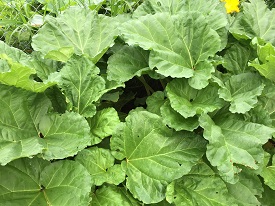
Rhubarb thrives in almost any soil.
About seven years ago we moved from a small house near downtown to Winding Pathways. We looked forward to our new home but didn’t want to leave some plants we’d cared for in the former yard. One was rhubarb. Fortunately, our move happened in early spring, so we were able to dig up dormant roots and plant them in our new yard. Now, they are thriving.
Rhubarb grows wild in parts of China but was domesticated centuries ago. It has been a valued garden and yard plant in temperate climates ever since. It is vigorous, attractive, and makes delicious food. Because it’s a perennial, it never needs replanting and pops out of the ground like magic each spring.
The plant thrives in rich soil and full sun but isn’t fussy. As long as it gets some daily sunshine and moisture, rhubarb grows well nearly everywhere. Few pests bother it, although deer eat the leaves in late summer or fall. Deer somehow resist toxins in rhubarb leaves that can sicken people. Fortunately, the stalks are delicious and nonpoisonous to humans.
Rhubarb is useful in landscaping and delicious in recipes.
We planted ours along a fence where it softens the straight line while giving us many pickings for the kitchen. We’ve never had rhubarb spread to places where we don’t want it. It is well behaved. Plant it where you want it and it likely will stay there.
When summer warmth arrives clumps of rhubarb often sent up a flower stalk. We pull out the flowering stalk, but other than that, the plants need little work. We are careful not to overharvest the stalks and give them plenty of time to regrow. Occasionally we do lightly harvest in summers of abundant rain and heat and enjoy recipes that include our own cherries and eggs from our chickens.
We prepare rhubarb one of several ways. The easy way is by pulling out a dozen, or so, stalks, adding the chopped off leaves to the compost bin, rinsing the stalks and cutting them into 1” chunks. We add sugar or honey to a pot full of stalk chunks and boil for about ten minutes with an occasional stirring. The resulting sauce is delicious on ice cream or pancakes or with plain yogurt. It’s good when added to oatmeal or just eaten as is. Rhubarb is tart and meshes well with ultra-sweet mulberries that ripen in late spring or nearly any other sweet fruit.
Two of our favorite pie and crunch recipes are Davenport Deluxe Pie by Joan Auterman and Rhubarb-Cherry Crunch from Clara Brown a long-ago friend from New England and Florida, Clara and Leon Brown were surrogate grandparents to a dear friend, Kathy Wentworth Taylor formerly of England. We love these best when all the major ingredients come from our garden, fruit trees and chickens.
Davenport Deluxe Pie
Preheat oven to 425°
1 large pie shell
3 cups chopped rhubarb in large bowl
Topping: ¼ cup flour, ¼ cup oatmeal, ¼ cup brown sugar, ¼ teaspoon each of baking powder and soda. ½ cup butter. Cut the butter into the above mixed ingredients. Set aside.
Mix: 2 cups sugar, 5 Tablespoons flour, 3 beaten eggs and stir in rhubarb. Add to pie shell.
Add topping. Bake 25 minutes at 425° and then 30 minutes at 350°
Cool before serving with rich vanilla ice cream.
Clara’s Rhubarb-Cherry Crunch
Preheat oven to 350°
Filling: Combine in a sauce pan and boil to thickness: 1 cup sugar, 1 cup water, 2 Tablespoons cornstarch. Add cherry pie filling. (if using real sour cherries drain well first so the acid does not thin the syrup.) Turn off heat and add 1 teaspoon almond flavor.
Bottom and crust: mix together 1 cup each of oatmeal, brown sugar and flour. Cut in ½ cup butter until pea sized mixture. Lightly grease bottom and sides of pan. Press ½ of this mixture on bottom of a pan.
Add rhubarb on top of the bottom crust. Add the boiled cherry pie filling. Top with remainder of crust. Bake at 350° for 45 minutes. Cool slightly and serve with rich vanilla ice cream.
by Winding Pathways | Jul 27, 2017 | (Sub)Urban Homesteading, Garden/Yard, Mammals, Nature
We like opossums and are always happy to see one shuffling off when we startle it after dark. This amazing animal gets too little respect and appreciation by people who consider them dirty, stupid, and ugly. They are just the opposite!
Opossums are doing something right. They’re survivors who have been on the planet far longer that humans. Often called ‘possums, they were once common only in southern states. Their fur is sparse and doesn’t cover tails or ears, so winter is rough on them. Warming temperatures are helping this animal move north, and they’re now common in Maine, Minnesota and other more northern states where they once were absent.
‘Possums are our only native marsupial. Like kangaroos, female opossums have a pouch to nourish their young. Born after only a 13-day pregnancy tiny babies make their way into her pouch where they remain for about 100 days feeding on mom’s milk. Once they leave the pouch they follow her around learning how to fend for themselves.
Mostly nocturnal, possums aren’t choosy eaters. They love over ripe fruit, especially persimmons but they’ll also snack on insects, worms, dead animals, and nearly any other animal they can catch or find. Think of them as a gardener’s assistant because they gravitate to decaying material.
New research reveals an important diet item. They enjoy eating ticks! ‘Possums groom often and any tick that climbs aboard one and attempts to bite is in for a surprise. The grooming animal is likely to find the tick and quickly devour it. Fewer than 4% of ticks that climb on a O’possum successfully enjoy a blood meal. The rest become a meal themselves.
We’re lucky to have opossums in our yard. We enjoy sharing space with these ancient, clean, and useful animals. We hope you also have a neighborhood ‘possum. Be sure to share a photo of your ‘possum with us. For information on the opossum/tick relationship go to Cary Institute.
by Winding Pathways | Jul 20, 2017 | (Sub)Urban Homesteading, Foraging, Nature, Trees/Shrubs
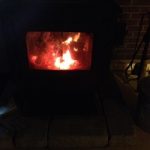
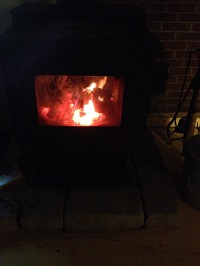
We love the cozy heat of wood burning in the woodstove.
Much of our heat at Winding Pathways comes from our two woodstoves. We love the cozy warmth given by our stoves but there’s more to it than just heat.
The wood we burn comes from trees that snatched carbon dioxide from the atmosphere in the past 100 years. Photosynthesis transformed carbon and water into wood, so we’re not contributing to global warming as much as if we burned coal, oil, or natural gas. And we get our wood free, thus helping the family budget.
Wood heat isn’t completely without cost. Each year we hire a company to clean and inspect our chimney and stove. So, we lay out some cash but far less than for conventional fuel. Wood heat also requires sweat equity to cut, stack and move firewood. At this point, it’s worth it. An added benefit is the security we feel when gazing at our six cords of stored wood. When storms shut down utilities we’ll stay warm.
Summer is an ideal time to prepare for autumn’s crisp nights.
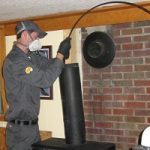
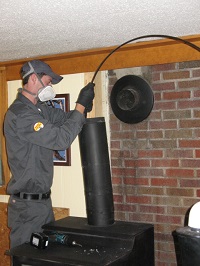
We have a professional chimney cleaner tend our chimney.In summer’s heat, we have our chimney cleaned. Chimney’s tend to accumulate build ups of a substance called creosote and soot. This build up can catch fire and ignite the entire house. Cleaning the chimney removes deposits and makes burning safer. We clean one chimney ourselves and hire a professional from Midtown Sweeps to clean a longer one that requires going up on our high roof. Chimney cleaning companies are located across the country and Midtown Sweeps has offices in many states. For information check them out. Don’t delay. As fall approaches cleaning companies get busy, so it’s best to have the chimney cleaned in the hot months of summer.
Burning the right type of wood properly yields the most heat and leads to minimal buildup of creosote. We get our wood free, and because we know how to find and choose firewood we keep cost and labor down. When choosing what wood to gather, cut, split, and burn it’s helpful to be able to identify the species of tree that the wood comes from. Every species yields a different amount of heat. Assuming the same level of seasoning, for example, a chunk of white oak yields about double the heat of a similar sized piece of basswood. By choosing high heat yielding wood labor and space needed to store wood is reduced. An outstanding way to learn relative heat value of most species of tree go to Chimney Sweep for a detailed chart. Many books and websites help with tree identification.
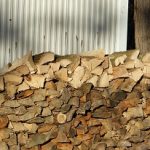
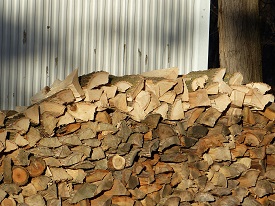
Stack wood in an airy place to cure.
To burn wood safely and hot, it needs to be cured. When we cut wood from a live, recently felled tree we split and stack it in an airy place sheltered from the rain. Place the wood up off the ground to promote air flow and reduce decay. The smaller the pieces the faster water will evaporate out of the wood. We prefer to season big chunks for 18 months but when properly stacked and split into relatively thin pieces, six months is usually adequate.
Two Scrounging tips:
- Sometimes scrounged wood is already seasoned. If the bark is off the tree and if the tree was dead and standing when it was cut down it’s likely the wood is already seasoned for burning.
- The best time for finding free firewood is during summer’s hot days when no one else is competing for firewood. The worst time to find free wood, especially seasoned wood, is during winter when competition is intense.
Winding Pathways Sources of Free Firewood
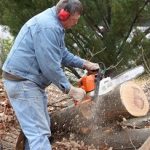
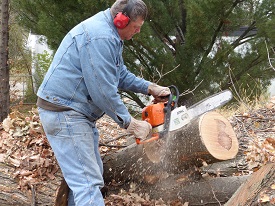
Wear protective gear when bucking up wood.
Our firewood comes from these sources that are generally available to most Americans:
YARDS. Whenever we cut or trim a tree we cut up the wood and put it in storage. Few of our neighbors burn wood and are happy to give us theirs when a tree breaks or is felled. We are also urban wood scroungers and when we find a chunk that’s fallen off a truck we collect it and add it to our woodpile. It’s surprising how much wood is available by simply being observant. After storms, home owners often drag bucked up limbs to the street edge, where they are free for the taking.
WOOD DUMP: Our city, Cedar Rapids, dumps sections of trees it has removed from streets and parks in a place they call THE WOOD DUMP. Sign a liability release form and the City welcomes anyone to remove as much wood as they’d like. It saves our town the cost of disposal and puts the wood to good use. Other cities may have similar programs. Call the town clerk or access their website for information.
SCRAP HEAP: Several nearby companies pile broken pallets and crates near their parking lot and let people scrounge wood. Mostly these are made of pine or spruce. It’s great for kindling to start fires but not for sustaining a vigorous burn. However, we sometimes find pallets made of ash, elm, or even oak. Often these include 2″x 4″ chunks, which do provide outstanding heat. We cut up pallet wood using a circular saw with a carbide blade. Use safety equipment and be careful of nails.
Get going now. Have the chimney cleaned and inspected in summer and have a shed filled with seasoned firewood before the first frosty autumn night.
Winding Pathways has no relationship, other than as a customer or user, to companies or information sources noted in this blog.