by Winding Pathways | Jun 22, 2017 | (Sub)Urban Homesteading, Amphibians/Reptiles, Garden/Yard, Nature
Every once in a while, when we’re out in our summery yard enjoying birds and flowers, we encounter a snake. We’ve been around snakes for decades and know there are no venomous species in our area but we’re still startled when one slithers away.
Managing a yard to attract a diversity of wildlife sometimes encourages snakes to move in along with birds and butterflies. Usually the snakes that visit yards are non-venomous species merely looking for a place to live and something for dinner. Most common are garter snakes that mostly eat insects. We’ve written about garter snakes on Winding Pathways before. Sometimes we spot tiny brown snakes no bigger than a nightcrawler. They also eat worms and bugs. Once in a while we see a beautifully colored and patterned fox snake. They probably seek tasty white footed mice or maybe a chipmunk. And lots of folks combat the undermining work of chipmunks.
Some backyard snakes can be downright startling. A few years ago, we spotted a husky snake that held its ground. It hissed loudly and was not willing to flee. Although looked threatening, we knew it was just an act. It was a hog nosed snake that sometimes flattens its head like a cobra and hisses when a human approach. It’s a trick that works. Most people quickly back off from this imposing act. This snake loves eating toads and frogs but won’t bite people.
There’s an irony about snakes. Many homeowners simply hate chipmunks. Yet they’ll kill any snake they find. Snakes are one of the best of all chipmunk predators and having a few around keeps the population of the small mammals in check.
Snakes range throughout the continental United States. Most species are non-venomous and even in places where venomous snakes live they generally avoid suburban and urban neighborhoods. It’s good to be cautious but be curious instead of terrified. When a snake is spotted give it plenty of space and try to identify it.
Identify Snakes
Binoculars that focus closely is a help in observation. And you can keep your distance. Concentrate on the shape of the head and tail, the color(s) and scale patterns and type of habitat. Google a guide to snakes of (name your state) for more information. The snake is likely harmless and fascinating. If it is not, then you might have to have it destroyed.
This is the case in some parts of the country. We have friends who live in the breaks of central Idaho where rattlers periodically come in. So, they are very aware as they move around the garden and yard.
We consider the snakes we occasionally find in our Winding Pathways yard as interesting and welcome as the goldfinches and cardinals that visit our feeders. We’ve even placed a few hollow logs at the edge of the yard so they have a a safe place to hide. They also enjoy a rock wall between our house and a patch of trees.
If we’re not sure what species of snake we’ve discovered we often go to the Internet. Many state universities have Websites that help people identify the snake species that live there. Iowa has a great site. So, does Florida, and an interesting one comes from Nebraska. Many field guide books are also on the market that feature color photos and information about snake species.
Tips
Wildlife Specialist Rebecca Christoffel of Iowa State University Extension reminds us that “…snakes eat worms, slugs, bugs and other small animals such as frogs or fish. Snakes don’t do any damage to buildings because they don’t dig their own holes, instead using holes other animals have made.” She has a few simple tips to remove a snake from areas of the yard where homeowners do not want them. If a snake is found in an undesirable place, like a garage or shed, Christoffel said a broom and a trash barrel can easily be used to remove it. Lay the trash barrel on its side, and with a broom (soft plastic bristles or straw), “sweep” the snake into the garbage barrel, gently forcing it down to the bottom of the barrel. The barrel, and snake, can then be taken to another area of the property and the snake released out of harm’s way.” (From ISU website)
Christoffel added, “An alternative solution is to learn to accept having the snakes around and appreciating the valuable ecosystem services they provide,” Christoffel added. “Snakes are excellent rodent and insect control.”
Find a snake in the yard? You may be startled. Remember, be cautious and curious. It’s likely a desirable and beautiful species that helps keep a balance of wildlife. After all, snakes, too, have a place in the eco-system.
by Winding Pathways | Jun 8, 2017 | Birds, Garden/Yard, Nature
“Oh my gosh! I just found an ‘orphaned’ baby bird sitting on the front porch. What do I do?”
“There’s an ‘abandoned’ fawn in my hostas! What do I do?”
“Oh, the poor baby bunnies, they have no mom. What do I do?”
We get these type comments all the time at Winding Pathways. The short answer is: Do Nothing!
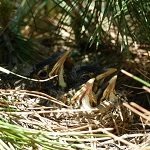
The babies are ready to “branch out!”
This summer millions of Americans will discover baby birds, fawns, bunnies, and a host of other seemingly helpless newborn animals in their yards and face the dilemma of “What do I do?”. Usually the baby is all alone with no mother in sight. It’s easy to assume the poor baby’s mother suffered a tragic fate and that the baby is doomed to an early death unless people “help” it.
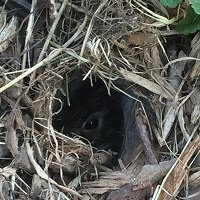
We’ve often found baby bunnies and birds at Winding Pathways and we know the best way to help it is to leave them alone. A cottontail nest we found last spring is a good example.
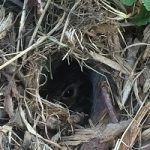
Female rabbits sometimes make a shallow nest in lawns. They leave the nest along and only return to nurse the young.
Cottontail mothers bear their young in a small hole they dig in the ground, frequently at the edge of a lawn or near a shrub. Mom knows that predators ranging from house cats to owls would love to dine on her babies, so she’s developed a sensible strategy to protect them. She stays away except for twice-a-day feedings.
If you see a cottontail sitting quietly on a spring or summer lawn there are good odds she’s above her nestlings and they’re enjoying breakfast or dinner of her rich milk. Stay away and keep your pets inside so she can complete her job. Other than at feeding time she stays away so predators don’t spot her and find the nest.
There’s a common misconception that if a human touches a baby fawn or bird it will be rejected by its mother. Not true! Maternal instinct is stronger than fear of people and many videos have shown fawns touched by people quickly reunited with their mothers. Birds have little or no sense of smell so can’t detect human scent. Still it’s not a good idea to touch a baby. The baby is likely a fledgling and learning to fly.
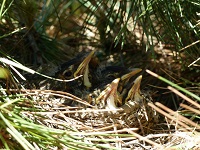
Many baby birds go through a growth phase we call “branchers”. Babies quickly outgrow space in the nest. When it’s too crowded they hop out and sit on a nearby branch, or a front porch, or a driveway. With the parent not visible it’s easy to assume the baby is orphaned or abandoned, but that’s hardly ever the case. It’s normal for parent birds to feed their young after they’ve left the nest, so mom and dad are probably out foraging and will return soon. The babies need energy and may be resting and waiting for a snack, so, again, keep pets and kids inside and stay away. Occasionally, placing the baby on a low branch may be appropriate in areas where there are lots of activity and the baby would be at risk of getting stepped on. Otherwise, leave the babies alone.
The best way to help wildlife babies is to stay away and quietly enjoy watching them from a distance. It’s likely you’ll soon see the parent or parents caring for its young.
by Winding Pathways | May 21, 2017 | (Sub)Urban Homesteading, Foraging, Nature, Trees/Shrubs
This is a tale of free trees. Our friend, Marilynn Keller, learned how to plant the best tree species in her yard at no cost and with little work.
She simply didn’t mow a tiny area of lawn where she wanted a tree to grow. As if by magic, a White Oak, Sugar Maple, and Shagbark Hickory sprouted there this spring. Although the spot is too small for three trees Marilynn can simply decide which one she wants and mow the others off.
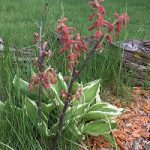
Likely a squirrel buried a nut that has sprouted.
Last fall an industrious squirrel gathered acorns and hickory nuts and buried them in her yard. The squirrel might have forgotten his hidden cache or perhaps died. Either way the unrecovered nuts sprouted.
Although squirrels often eat maple seeds, it’s most likely that Marilynn’s baby maple sprouted because a gust of wind pulled the ripe seed off a nearby tree and it helicoptered to her yard.
While Maples are usually easy to transplant, and are widely sold by nurseries, not so Hickories. Although any of the many Hickory species make outstanding shade trees, as soon as a nut sprouts it sends an enormous taproot deep into the ground. Moving a hickory is difficult and often unsuccessful. Commercial nurseries avoid them.
The same goes for white oaks, one of our favorite trees. It’s difficult to buy one to plant in the yard. Because they are slow growing and challenging to transplant, few nurseries bother with them. Fortunately, they readily sprout on their own.

In autumn Maples glow with color.
Anyone living where there are mature Hickory, Oak, or Maple trees nearby can use Marilynn’s tree planting method. Simply don’t mow a patch of lawn where a tree is desired. Odds are one will appear on its own next spring. If more sprout than the spot can support just mow the others off and put wire screening around the new tree to protect it from hungry cottontails and deer.
If a tree sprouts in the wrong place it can be easily transplanted with just one shovel of dirt. Move it before the tiny tree has grown a long taproot.
by Winding Pathways | May 19, 2017 | (Sub)Urban Homesteading, Garden/Yard
Nature is not all sunshine and roses, cute baby animals and gentle breezes. Sometimes nature is rough, sometimes vicious, sometimes other creatures simply clean up carcasses of fallen animals. This spring the Heartland has had its share of hail, winds and heat. The front yard maples and Phoenix Harmony Labyrinth’s budding Bur Oak survived by bending with the winds. With the variable weather comes casualties. The last video graphically shows the scavengers cleaning up a fawn carcass that showed up on the back lawn after a night of cold, wind, and heavy rain. It’s sad but we have to remember than Mother Nature’s clean up crew will benefit from the loss. And, life goes on.
by Winding Pathways | May 16, 2017 | (Sub)Urban Homesteading, Garden/Yard, Nature, Trees/Shrubs
We never spray our lawn at Winding Pathways. Occasionally, that yields an exciting discovery like what happened in early May.
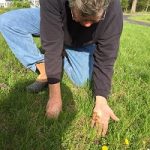
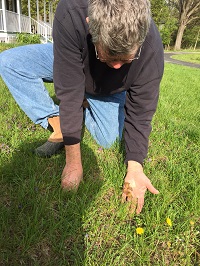
Rich shows the tiny oak seeding.
We wanted to plant a tree, preferably an oak, on the south side of our garage. But, we got busy and never found time to buy or plant one. One morning Rich, while walking across the lawn to fetch the morning newspaper, spotted a baby white oak tree that sprouted exactly where we wanted to plant one. It was serendipity.
Seed Banks”
Plant ecologists talk about the “seed bank.” In land that hasn’t been greatly disturbed by plowing, spraying or compacting of soil, seeds of desirable native plants often remain dormant in the soil for years or decades. Then, when conditions are right they’ll sprout like magic. Other desirable plants spread their seed through the wind or enlist the help of a hungry squirrel to carry and bury a nut or acorn. That’s probably how our new oak got planted.
Before mowing walk across your unsprayed lawn. You may discover a plant you want that is starting to grow. Just mow around it to let it thrive. Mark it with a stake or fence it off from rabbits and deer. If the plant is not quite in the right place, remember that tiny plants are usually easy to move with just a shovel full of dirt.

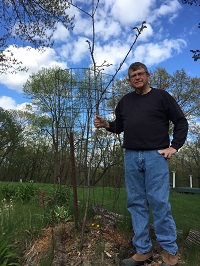
We protect volunteer trees that grow where we want them.
About seven years ago we found another baby oak in our lawn. We protected it from mowing and ran a screen around it to keep hungry deer away. It’s now about seven feet tall and growing rapidly.
That black oak didn’t cost a penny and will grace our yard long after we’re gone.
Another way to go about natural or plant and wildlife friendly yards is to deliberately plant certain forbs and grasses to attract a variety of beneficial insects and interesting birds and other wildlife.
by Winding Pathways | May 15, 2017 | (Sub)Urban Homesteading, Foraging
Chicks are amazing! How quickly they learn and adapt. Their personalities amuse us at Winding Pathways and their problem solving is the best! Enjoy the videos of the Hoover’s Hatchery chicks at about ten weeks.