by Winding Pathways | Oct 12, 2023 | (Sub)Urban Homesteading, Preparedness
What To Do When No Room At the Inn?
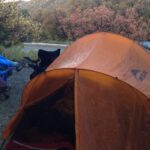
Even bivouac camping can be comfortable.
Basic bivouac camping gear saved our night as we drove along a rainy Ohio Interstate.
We were returning to Iowa from a business trip in New Jersey. The 1000-mile trip is too far for us to make in a day so we normally plan to overnight in a comfortable motel in Ohio or Indiana.
On this recent trip, we didn’t make a reservation in advance, so Marion called motels ahead of us as Rich drove through pelting rain. Bad news. They were all booked for the night.
Bivouac Camping Saved Us!
Our basic bivouac camping gear saved us. Marion spotted West Branch State Park on the map. Not far ahead of us and near the Interstate, we exited just as the downpour subsided. Soon we enjoyed a hot dinner inside a restaurant near our tent.
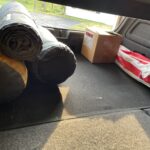
Lightweight camping gear stashed on the sides of the car.
Although we weren’t on a camping trip, we always carry basic bivouac camping gear just in case we run into a situation like our recent one. Modern backpacking gear is lightweight, compact, and effective. It’s essential for a long trail trek but also takes up little space in the car and comes in handy should camping be necessary.
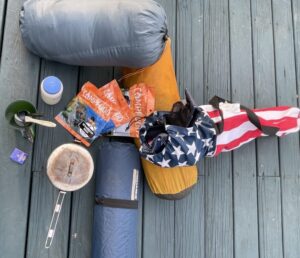
Here’s what we always slip into the car:
- Small nylon tent and ground cloth. Sturdy pegs (spikes or gutter nails are sturdy, don’t bend and so are useful to hold cords to tie a tent down.)
- Lightweight foam mattresses and sleeping bags.
- Folding chairs.
- Cooking and food gear that includes:
* Tiny featherweight butane stove and fuel bottle
* A few backpacking-type meals
* Basic utensils
* Matches! (Remember these!)
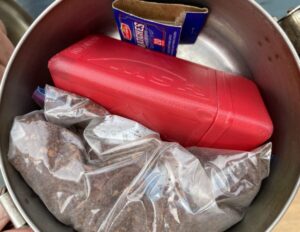
Cooking gear and dried meals fit in a small cardboard box and it’s easy to stash the other gear here and there in the car.
-
-
Looks like a lot! It’s not!
-
-
Essentials in box
The morning after our unplanned campout we woke well-rested, sipped instant coffee, packed up, found a breakfast cafe, and were soon back on the Interstate heading home.
A Note on Dried Food
Years ago, dried camping food was tolerable but hardly tasty. That’s changed. Modern foods are delicious. We keep two weeks of dried meals in our preparedness bin at home. Should we be impacted by a natural disaster we’d break out our camping stove and enjoy tasty meals. Although this food lasts for years we occasionally eat a few meals at home, on planned camping trips, and during emergencies. Then we restock with fresh meals. We have previously written about preparedness on our blogs.
by Winding Pathways | Sep 21, 2023 | (Sub)Urban Homesteading, Flowers/Grasses, Foraging, Nature
By September our thoughts and actions turn to autumn – fall sports, raking leaves, and cozy weekend campfires. For wildlife, especially pollinators late summer and early autumn are critical times to gather nourishment for migrations or hunkering down for winter’s scarcity.
-
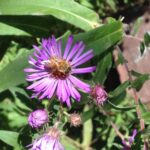
-
Foraging
-
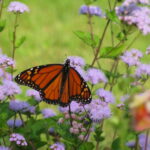
-
Feeding on nectar.
-
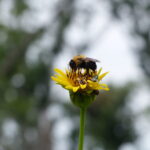
-
Insects find flowers.
-
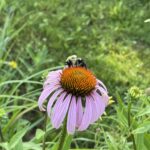
-
Busy at work.
On our daily walks, often in the early morning to avoid late-season heat, we notice and appreciate late bloomers and nut abundance. Nectar is an important food supply for pollinators who busily forage among flowers. When the weather cools, pollinators are out later in the day as the sun warms the air. Remember, there is a “night shift” of pollinators, too, who need flowers to feed from.
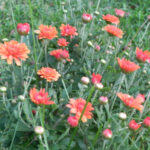
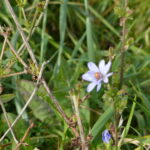
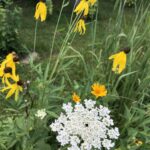
Here are some late-blooming flowers we have seen on walks or that we nurture in our yard.
-
-
cultivated flowers work, too.
-
-
Roadside blooms are important.
-
-
Color contrast.
-

-
Some flowers prefer low lying areas to grow.
by Winding Pathways | Sep 14, 2023 | Mammals, Nature, Travel/Columns
We were recently amazed to learn that Pennsylvania has a thriving herd of wild elk.
A couple of times each year we make the long drive from our Iowa home to visit relatives in New Jersey. We traverse Pennsylvania on Interstate 80. For years we’ve been intrigued by interesting and unusual town names we see on roadside signs. Jersey Shore, Mountain Top, and Snow Shoe are examples.
As we approached mid-Pennsylvania recently heading back to Iowa, we tired of the big semi-truck-filled road. So we exited at the tiny town of Snow Shoe and followed smaller paved roads through the forests and clearings of Moshannon State Forest. We soon reached the hamlet of Benezette, the epicenter of Pennsylvania’s wild elk herd.
Thanks to a stop at the visitor center of the Keystone Elk Country Alliance we learned the fascinating story of this massive deer’s return to an area called the Pennsylvania Wilds.
Where Elk Once Trod
When Columbus made landfall wild elk roamed much of what became the United States, even close to the Atlantic Ocean’s shore. Such tasty and large animals had little chance against explosive human population growth and the conversion of wild lands to farms, ranches, roads, and urban areas. By the late 1800s wild elk only lived in wild areas in the Rocky Mountain States.
Fortunately, that’s changed. Now there are wild elk herds in at least 19 states, including Michigan, Minnesota, West Virginia, Missouri, Arkansas, and North Carolina. Kentucky has the largest wild elk herd east of the Rockies with at least 13,000 of the massive deer roaming the state.
How It Happened
In 1912 a shipment of elk was trained from Yellowstone National Park to Pennsylvania and released in the north-central part of the state. It was joined by some animals from a private herd and further releases a few years later. The herd stayed small for years but began expanding during the past few decades. Today about 1,400 wild elk roam the area.
We loved our day in the Benezette area. The lands are managed so large patches of open woods allow visitors to see into the forests hoping to spot elk. It was hot, so the elk were somewhere deep in the shady woods. We didn’t see any but enjoyed learning more in the impressive museum. Then, we walked area trails looking for signs of elk – droppings, and rubs. Hot and thirsty, we stopped at the Elk Life Store for elk hot dogs and a cool beverage. Tasty and with great views. The hills shimmered in the light and streams coursed down the draws and valleys.
Elk bring tourists to the Benezette area. Small lodges, bed and breakfasts, and Airbnb’s abound. The most popular time is fall when male, or bull, elk bugle. Make lodging reservations well in advance. For information contact Keystone Elk Country Alliance.
-
-
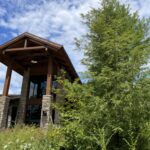
The Keystone Elk Country Land is a cooperative among agencies.
-
-
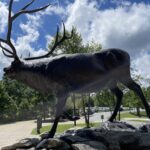
Gracing the entry
-

-
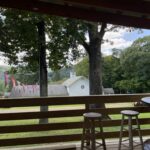
We enjoyed an elk dog and beverage.
-
-
Rolling hills and small shops characterize Elk Country.
Pennsylvania’s Not Alone
Thanks to the efforts of state wildlife agencies, the Rocky Mountain Elk Foundation, volunteers, and financial donors elk are thriving in many states. Read where elk live. And, for a map, check out the Izaak Walton League’s site.
We even have about 15 elk in Iowa. They’re at the Neal Smith National Wildlife Refuge near Prairie City east of Des Moines.
A trip to Wyoming, Colorado, or Idaho offers wonderful chances to see elk, but elk can be seen far and wide across the Eastern United States.
by Winding Pathways | Aug 17, 2023 | (Sub)Urban Homesteading, Energy Efficiency, Labyrinths, Nature
Coralville’s Unitarian Universalist Society Members
Live What They Profess
In the middle of a worldwide heat wave that scientists declared resulted, in part, from human-caused climate change, we entered the campus of the Greenest Church in Iowa, the Unitarian Universalist Society in Coralville, Iowa. Feeling depressed by climate change news, the visit buoyed our spirits and gave us a glimmer of hope for the future of our planet.
One of the Unitarian Universalists’ principles is respect for the independent web of all existence of which we are a part of. The members of the Coralville church live the principle and others that form their core beliefs.
The Greenest Church in Iowa
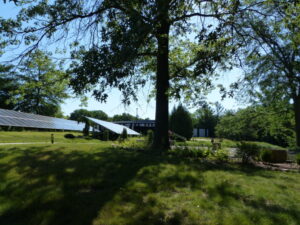
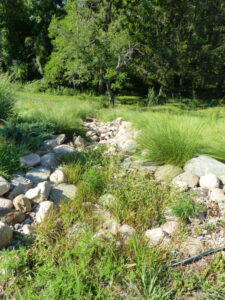
As we turned into the Church campus, everything was softer and quieter. We drove past rows of photovoltaic solar cells. Just past them was a world of green. Nestled within native vegetation was a lovely contemplative labyrinth. A vegetated detention basin is both the home for pollinating insects and a place to catch stormwater, preventing it from scouring its way downhill.
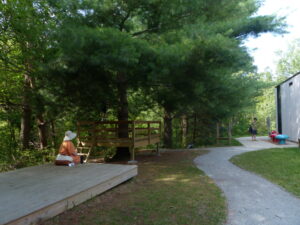
We walked a delightful path circling the organization’s eight acres. Native flowers were alive with pollinators, and a children’s play area was meshed into nature. It’s almost as if this location were meant to be.
-
-
south facing solar panels
-
-
Water slows down as it percolates through the bioswale.
-
-
Families outside
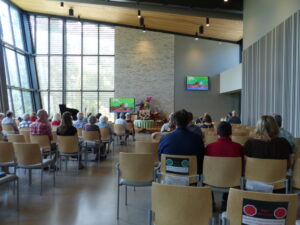
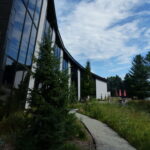
On entering the building, the Church’s low ceiling entry opens into expansive spaces, an echo of Frank Lloyd Wright’s style. An immediate sense of calm and comfort enveloped us. Just beyond the cozy foyer, our eyes were drawn upward. East-facing windows framed an Iowa summer sky dotted with puffy clouds. Outside, deep green pines swayed in a gentle breeze. Members greeted us and Sally Hartman, chair of the Social Justice team, hosted us during the service. Worship leaders were engaging, the acoustics excellent, and the presence of the outdoors through the windows soothed us.
-

-
A lovely, open space
-
-
Visuals and audio enhanced the service.
-
-
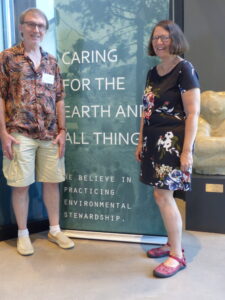
Living the mission
How Did This Come to Be?
Depending on one’s perspective, this church and location have been in the making since the 1990s. More recently since 2013. Sally, also a member of the Iowa UU Witness Advocacy Network, and Kirk Witzberger, who served on leadership teams that developed and implemented the plans, explained. Over many decades, the Society recognized that even with renovations, the former Gilbert St. site in downtown Iowa City could not meet 21st Century needs. Different teams looked for new property. After an almost certain deal for another property fell through, a member happened to chat with a realtor who mentioned the current site. The Congregation voted overwhelmingly to buy and the couple who owned the land, former Peace Corps volunteers, were delighted to sell to an organization that respected the land.
Multiple meetings and myriad decisions followed. The result is a beautiful net zero building that the congregation shares with the community. The building burns no fossil fuel. Solar energy produces all its energy needs, including lighting, heating, and cooling.
Efficient and Flexible
The building includes a sanctuary, gathering spaces, offices, classrooms, and food service areas. Tucked into the property, it fits well. As attractive as its outdoor vegetation is, the building was well thought out. Just a few examples include:
- Efficient glass walls boost energy efficiency while allowing people inside to feel like they’re sitting in nature. We enjoyed watching clouds drift by during the service we attended.
- Flexible space can accommodate large groups of up to 600 or be compartmentalized into smaller, more intimate gathering places.
- All areas are easily accessible for folks with walking challenges. Even carpets are precisely flush with adjoining harder floors.
When we asked Kirk Witzberger, who was instrumental in the transition to this location, what the utility bill is he said, “We don’t have one. This is a zero net energy building…..it produces all its energy needs.” For members of an organization to live as lightly on the land as possible is impressive!
-
-
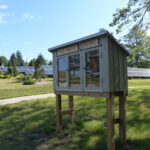
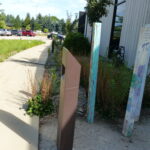
Free food and books.
-
-
Soft lighting directs footsteps.
-
-
Efficient east-facing windows let in light and bring a sense of nature inside.
-
-
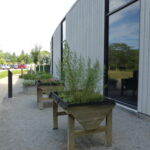
Greenery softens the outside scape.
Living Other Principles
The Coralville Unitarian Universalist Society members live their commitments in other ways, too. Members take turns recycling compostable materials. When outside groups rent the space, they agree to a contract of sustainability – i.e. use only recyclable materials. The church is investigating how to be a “cool” refuge in summer and a “warm” refuge in winter. Further, members are researching ways they can offer a safe learning space for marginalized youth with activities like art and music. Members have held summer Nature Camps and environmentally-themed Trunk and Treats, and sponsored an environmental fair designed to raise awareness and action in caring for our world.
Inspiring Model
After touring the building and grounds we wondered why the model of the Unitarian Universalist Society isn’t more common in society. It should be. If people associated with all buildings everywhere did what they could to produce their energy needs through renewable sources the threat of climate change would be muted and our children could look forward to a cleaner and safer world.
Want to visit? The Church welcomes you. Details are on their website.
by Winding Pathways | Aug 10, 2023 | Mammals, Nature, Trees/Shrubs
Squirrels: Free Tree Planters
Our neighborhood squirrels proved they are the best tree planters.
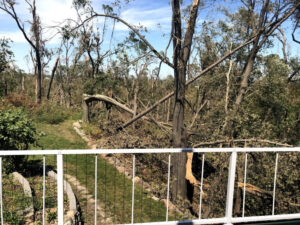
We lost most of our mature trees in the 2020 Derecho.
An August 2020 derecho tore through Iowa pushing 140-mile-an-hour wind against trees and buildings. Trees by the hundreds of thousands tumbled to the ground. Winding Pathways wasn’t spared. We lost most of our firs, oaks, hickories, and cottonwoods. The devastation in nearby Faulkes Heritage Woods was even worse.
Almost immediately, shocked people took action. Government forestry departments, aided by tree planting nonprofits, and private citizens unleashed their shovels and planted thousands of trees. So did the squirrels. Well, not really. People planted trees.
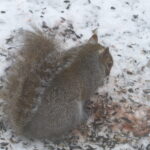
Squirrels bury nuts in caches to retrieve them later.
Squirrels planted nuts and acorns.
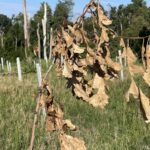
Then three seasons of drought followed. Once planted, most trees were not tended as they need to be. So, many human-planted trees shriveled in the heat and dryness, while the nuts buried by squirrels sprouted and the new trees were flourishing.
But why?
We have theories. A human-planted tree seedling needs plenty of moisture to keep its trunk and new leaves hydrated. Sparse roots must pull water from the ground and send it upward. That’s a tough job in a wet year. Come drought it’s nearly impossible.
Squirrels did better. These industrious rodents don’t mean to create new trees. They’re simply storing nuts underground so they have enough fat and protein-rich food to tide them through winter. All they need to do is dig up a nut when hunger calls. Squirrels overfill their larder, burying more tasty nuts than they’ll ever need. Unfortunate squirrels are eaten by hawks, foxes, owls, or humans, but the nuts they’d buried remain patiently waiting for spring’s warmth to germinate.
Sprouting nuts grow roots able to pull scarce moisture from the soil and send it to new baby leaves poking through the ground.
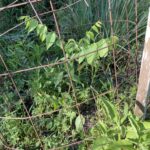
As we walked through July 2023’s dry woods we sadly see human-planted trees shriveled up and dead, while nearby a new generation of tiny walnut, oak, and hickories is rising from nuts planted by industrious squirrels.
-
-
Newly planted trees need watering.
-
-
This squirrel planted walnut seedling sprouted just this year in spite of the drought.
Squirrels Don’t Plant All The Trees
Squirrels are the best friends of nut-bearing trees, but other tree species can’t rely on the furry rodents. Cottonwoods, for example, produce millions of seeds too tiny for squirrel food. So, the trees grow cottony fluff that floats seeds to distant places. If one lands in a patch of moist bear soil a fast-growing cottonwood sprouts. Maples have helicopter-like seeds that whirl a gig away from the parent to sprout a ways away.
Pity the poor Osage Orange tree that grows huge citrus-smelling balls containing hidden seeds. Many folks call them hedge apples. A tree must get its seeds away from its own shade. Squirrels do the job for oaks. The wind for cottonwoods. Massive mastodons once munched on Osage Orange hedge apples, wandered off, digested the pulp, and pooped out the seeds. When these massive elephants went extinct the tree lost its partner and saw its native range shrink from much of North America to a tiny spot down south.
Nature provides many ways for trees to reproduce and the results are often superior to what humans can do. We appreciate the squirrels that plant nuts many of which sprout into healthy native trees. Thanks, squirrels!