by Winding Pathways | Aug 14, 2025 | (Sub)Urban Homesteading, Nature
We were astonished to discover a chicken of the woods close to our home at Winding Pathways. We have about a dozen laying hens in our backyard coop, but what we found wasn’t an escaped chicken.
Fungus
It was an amazing fungus. We’d not seen one before and think our woodsy chicken resulted from a series of weather events. Five years ago, derecho winds of 140 miles an hour knocked down or broke off most of our trees. Following were a series of dry years. That changed in late June 2025 when several bands of heavy rains soaked our area and high humidity filled the air for weeks. The combination of plentiful dead wood, moisture, and a spore landing in the right place created our woodland treasure.
Edible
A Chicken of the Woods is a large edible fungus that loves moisture and feeds on dead wood, especially wood from hardwood trees. The two chickens we found presumably are feeding on the roots of a derecho-killed cherry tree. The fungus is well named. Take a look at the photo and notice the scale-like appearance of the plant and its bands of color. It reminds us of the lacy coloration and markings of our Delaware chickens, one of our favorite breeds.
-

-
Colorful edges
-

-
Pair of fungi.
-

-
Size comparison
The fungus Chicken of the Woods (or Wood as found in some resources) is a large fungus sometimes called a shelf fungus. Many species grow worldwide.
Mushroom enthusiasts consider them, along with morels, one of the tastiest of fungi……….so will we eat ours?
Caution
Well, no. We’ve taught classes on foraging and encourage people to eat only wild plants that are easy to identify and hard to mistake for toxic counterparts. We always caution anyone planning to eat something for the first time to follow these guidelines:
- Positively identify the plant from at least three sources. These could include a paper field guide, a credible Internet website, or a real-life human expert.
- Eat only a small portion the first time. A particular plant may be perfectly edible for most people, but a few people may be allergic to it. Assuming there’s no negative reaction and the plant is positively identified, one can consider adding it to a diet of delicious wild foods.
We are certain that our mushroom is edible, but we remain somewhat skeptical. Not quite sure.
So, for now, our Chicken of the Woods will stay down in our woods feasting on the wood of an unfortunate cherry tree.
A Daily Walk Reveals Serendipitous Treasures
Nature’s always changing. Each day brings new and delightful surprises. We have created pathways through our small woodland and prairies and traverse them at least every other day. We usually spot something new and fascinating on every walk.
by Winding Pathways | Aug 7, 2025 | (Sub)Urban Homesteading, Flowers/Grasses, Garden/Yard
This must be the year of crabgrass! It seems to be everywhere, growing at lightning speed. But actually, every year is a crabgrass year.
After months of drought, July 2025 brought welcome and abundant rain to Iowa, along with heat and humidity. It’s not the type weather that we like but many plants disagree. They thrive in the muggy heat. Crabgrass in our vegetable gardens and flower beds is growing faster than we can rip it from the earth and toss it into our chicken run.
What’s in a name?

A fast grower
Botanists give it the name Digitaria for its many fast-spreading leaves that seem to shoot out from the center in a fingerlike radius. There are several species, but the one most common in our yard and beyond is hairy or large crabgrass, Digitaria sanguinalis.
Where Did Crabgrass Come From?
It wasn’t always on the North American continent. The plant had been eaten by grazing farm animals in Europe for centuries. In early Europe, people harvested crabgrass seeds and used them as grain. It must have taken an enormous amount of patience and time to pick the tiny seeds, but it beat not eating at all! It was natural for immigrants to bring crabgrass with them when they came to North America.
Value of crabgrass
Crabgrass remains an important livestock forage feed, especially in early to mid-summer when it is green and tender. We pull it from our garden and toss it over the fence into the chicken run. Our hens love snacking on it.
Crabgrass is an annual. Each plant can produce upwards of 150,000 seeds in late summer. Some will sprout in next summer’s gardens and lawns. The plant is most successful growing in bare soil.
Pioneer Plant
Many people hate crabgrass, but is it all that bad? It’s a pioneer plant that establishes quickly to fill in bare spots in lawns. It’s a problem when it lives around tomato plants and between rows of beans. We don’t mind it in our lawn, as we simply buzz it off when mowing. Our lawn is blotchy due to the diversity of ground-hugging plants that live there. We never spray or water our lawns. That encourages plants that stay green despite poor soil and odd weather.
Keeping Crabgrass Out of a Lawn
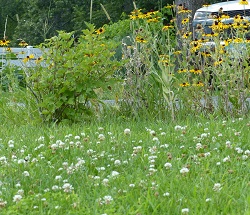
Rich, deep clover lawns are charming and healthy.
We avoid herbicides and don’t mind if our lawn is blotchy due to its diversity of plant species. Crabgrass fills in bare spots and is challenged by healthy, thick, established vegetation. Anyone wanting to exclude it from a lawn should work to keep other plants healthy and continuous. We annually sprinkle white Dutch clover seed on bare patches. The plant’s dainty white mini snowball-shaped flowers attract pollinating insects as the plant enriches the soil. Usually, clover grows earlier in the year than crabgrass, so it reduces bare spots where the weedy grass needs to colonize.
Note: White Dutch clover is also an exotic nonnative plant, but it’s valuable because it puts nitrogen back in the soil. No need for sprays.
For more crabgrass information, check extension.umn.edu/weeds/crabgrass.
Our diverse lawn attracts butterflies, bumblebees, and cottontail rabbits. They are a joy to watch. If we used pesticides to produce a monoculture bluegrass lawn, we’d not be able to enjoy these wildlife visitors. Our lawn would be sterile, kids could not safely play on it, and we would be contributing to water pollution. In Iowa, the quality has degraded for decades.
Crabgrass is here. It’s not going away. We enjoy this fast-growing grass for its benefits while grudgingly tearing it from our garden soil.
by Winding Pathways | Jul 31, 2025 | (Sub)Urban Homesteading, Birds, Nature
Every summer, we are surrounded by wrens. When we sit on our back deck, the loud call of the Carolina Wren serenades us. It’s a tiny bird that stays back in the woods and vines. It’s hard to spot. It’s surprising how such a smidgen of a bird can sing at high volume.
Different Wrens
Most of our wrens are more common House Wrens. Where Carolina Wrens stay away from our deck, House Wrens love living and nesting close to us. They’re easy to see and observe. Serious birders aren’t crazy about them because they sometimes take over the nests or destroy eggs of other native species, but we like them.
Our wrens winter down south toward the Gulf of Mexico. We look forward to their arrival in mid-April, just when our winter juncos head north. It’s like the changing of the guard. The switch happens again each fall when wrens leave as juncos arrive in October.
Early each April, we set up several wren houses near our house. They’re easy to make from scrap wood. An entrance hole of 7/8ths or 1 inch lets tiny wrens in while barring larger House Sparrows.
Industrious Birds
When wrens first arrive, we hear their near-constant chatter coming from the woods, but by early May, they’ve moved close to the house and start housekeeping. The male brings sticks into the nest box. Sometimes his stick is too long to fit into the small hole, but eventually he figures it out and pokes it through from the end. The female lines the nest with feathers and whatever soft items she can find. Soon she’ll sit on three or four reddish spotted eggs that hatch in about two weeks. Then we enjoy seeing a constant stream of wren parents bringing tasty and nutritious bugs to their nest to feed the kids.
Within two weeks, they fledge. We clean the old nest out of the box, and often a wren couple nests in mid-summer.
-

-
Lined nest with feathers
-

-
Curious
Diet

Nearby foraging
Our wrens forage for insects mostly at the edge of the woods and in our prairies. Unlike mowed lawns, these areas have plenty of insects. The industrious birds also forage for insects in our garden. We never need chemical pesticides thanks to our friendly wrens.
House Wrens also forage on pollinators, but somehow all our fruit trees and vegetables get pollinated.
To learn more about nearly any bird species, visit the Cornell University Laboratory of Ornithology’s website, All About Birds. The site contains photos, recorded sounds, and videos of hundreds of birds.
Few animals are as animated, ambitious, and noisy as House Wrens. We enjoy them for about half of every year.
by Winding Pathways | Jul 24, 2025 | Foraging, Garden/Yard, Nature, Pests, Trees
The white mulberry is a trickster tree. We match wits with it often at Winding Pathways.
“All Around the Mulberry Bush” may be a kid’s jingle but the tree is an ecological pest with some positive traits.
Our front hedge is an example. It’s a dense growth of privet. Few plants can live in its shade but the mulberry has a trick that lets it thrive. The mature tree craves sunshine to grow to its full height of 75 feet. We wouldn’t think they’d stand a chance growing under our shady hedge. But it has a trick.
White Mulberry Trick
Birds poop out mulberry seeds when they roost in our hedge. These readily sprout, and the tiny tree sends up a skinny stem that quickly grows through the thick, shady hedge branches to emerge into the sunshine above them. We don’t want a mulberry there so we need to frequently clip down their tall leggy stems.
Another White Mulberry Trick
It’s a trickster in another way. Although called the white mulberry, Morus alba, it can have ripe white berries but more often they’re red to purple. Don’t let the color fool you. And that’s not all. Most trees have leaves of just one shape. Not the white mulberry. It has three common leaf shapes. See the photo. An individual tree can have all its leaves one shape, two shapes, or a mix of the three.
While many people join birds in eating the sweet fruits, it’s an invasive species that seems to take root wherever there’s a bit of bare soil. Then it grows like crazy. Cut it down and the stump sprouts that can grow a couple of feet in a flash.
Range of the White Mulberry
White mulberry trees grow throughout temperate North America and on other continents. Silkworms feast on their leaves, and probably white mulberry trees were introduced around the world to create a silkworm industry. The tree liked living in America but silkworms didn’t. They died out and a hoped-for silk industry never took root here.
Telling Apart the White Mulberry Cousin
Closely related is the native red mulberry, Morus ruba. It’s hard to find and may be declining due to hybridization with the exotic invader. Here’s how to tell them apart:
White Mulberry: Relatively small leaves. The top surface of the leaf is smooth and often shiny. It grows fast in the sun. Common.
Red Mulberry: It’s more of an understory tree. The fruit is red. The leaves are big – three to seven inches long with a sandpapery textured top surface and somewhat hairy bottom. Uncommon.
Although Red mulberry is native to Iowa we’ve not found any here. All mulberry trees seem to be the white species or hybrids.
Mulberry Tree Benefits
Firewood: We love burning mulberry wood. It’s an attractive yellowish wood that burns with a pleasant aroma as it gives off lots of heat. For example, a cord of mulberry contains 25.8 million BTUs of energy. In comparison, white oak has 25.7.
Food: Kids love the sweetness of mulberries. The berries normally ripen in June. Birds also flock to ripening mulberry fruit. They love them so much that they’ll eat mulberries before nearby ripening cherries. So, having a fruiting mulberry can increase a cherry tree’s yield. Mulberries can be eaten fresh and made into pies. We love adding some to our breakfast oatmeal. The fruit’s robust color makes an attractive natural die in drinks. Because mulberry fruit is sweet and rather bland it is excellent when blended with rhubarb or tart cherries.
Native Red Mulberries Are in Trouble
The native red mulberry tree is in danger. It’s uncommon and apparently declining, possibly because it so readily hybridizes with white mulberry. Red mulberries tend to live in small groves in forested, bottomland areas. Look for their large sandpapery feeling leaves. Finding one is a treasure.
White mulberry trees are tricky, but they are plentiful, prolific, and useful. We have a few growing at Winding Pathways. As long as they stay out of our hedge, we like them.
-

-
White Mulberry Trickster Tree
-

-
Mitten, oval, “other shape”
-

-
Good firewood.
by Winding Pathways | Jul 3, 2025 | (Sub)Urban Homesteading, Flowers/Grasses, Foraging, Garden/Yard, Pests
A Variation on “The Four Horsemen”
A quartet of deadly and toxic plants lurks along trails and riverbanks in Iowa and some across much of the world. They are Poison Hemlock, Poison Ivy, Flowering Spurge, and Wild Four O’clock.
Poison Hemlock
We’ll start with Poison Hemlock. Socrates wasn’t the only person killed by it. The Greeks once used to execute criminals.
Poison hemlock isn’t related to the majestic hemlock tree. Rather, it’s a biennial herbaceous plant. In its second year it quickly shoots up to tower upwards of eight feet tall. In Iowa it prefers living in dappled sunlight where the soil is moist. That describes the land bisected by public trails paralleling rivers and streams—places where people go to recreate.
It’s deadly poisonous, but only when ingested. Walking or cycling by it creates no problem at all. But it’s wise to know about this potentially deadly plant. All parts of it are toxic to people and animals when ingested. Even dried, wintery stems are poisonous.
By early June, the tall green plants with feathery leaves begin bearing white clusters of flowers. Their prettiness is deadly.
Poison hemlock could be confused with Queen Anne’s Lace that’s sometimes called wild carrot. Poison hemlock also often lives near wild parsnips. This plant is also toxic, in a different way. It can create a vicious rash in people who rub against it with bare skin and then are exposed to sunlight.
Where Poison Hemlock Originated
Poison Hemlock is native to Europe and is especially common around the Mediterranean Sea. It was introduced to the Americas, New Zealand, Australia, and Asia, so today, it is a toxic invasive species worldwide.
The Internet and YouTube are loaded with sites describing this plant. A good quick read comes from the National Park Service at nps.gov/articles/poison-hemlock.htm.
Other Troublesome Plants
Unfortunately, several other deadly and toxic plants often live in the same places as poison hemlock. Here are a few.
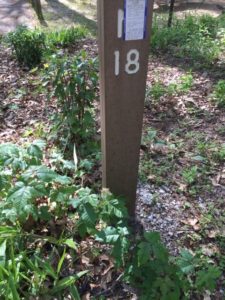
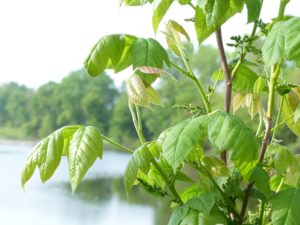
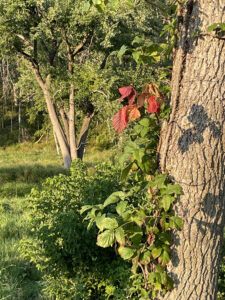
- Poison ivy often lines trails. It prefers living on the edge of woodlands where it gets some shade and sun. Unlike poison hemlock, poison ivy is a native plant that causes a contact reaction. That means if human skin brushes against it a nasty itchy rash can follow. And, if a pet wanders through the poison ivy and then comes inside where a human pats it, guess what? The irritating oils are transferred and the human gets a nasty rash. A friend of our discovered this earlier this year. Also, state parks are notorious for having poison ivy growing where people contact it – along unkempt trails and winding up trees in campgrounds even. Rabbits and deer eat it and birds eat and spread the seeds.
-
-
Birds drop seeds when they perch on campground posts.
-
-
Poison Ivy loves edges
-
-
Keep your distance from this beguiling, colorful plant.
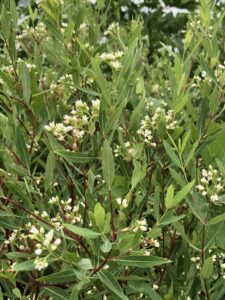
Pretty and irritating
Flowering spurge is also common along trails. Cut the plant and get some of its sap on skin and a nasty welt is likely to result.
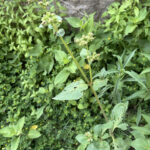
Unattended areas attract undesirable plants.
Wild Four O’clock also loves trail edges and is reported to be toxic.
None of these plants cause problems unless they are eaten or contact the skin. They won’t cause a problem for anyone just walking by
Be careful. Keep your distance.