
This must be the year of crabgrass! It seems to be everywhere, growing at lightning speed. But actually, every year is a crabgrass year.
After months of drought, July 2025 brought welcome and abundant rain to Iowa, along with heat and humidity. It’s not the type weather that we like but many plants disagree. They thrive in the muggy heat. Crabgrass in our vegetable gardens and flower beds is growing faster than we can rip it from the earth and toss it into our chicken run.
What’s in a name?

A fast grower
Botanists give it the name Digitaria for its many fast-spreading leaves that seem to shoot out from the center in a fingerlike radius. There are several species, but the one most common in our yard and beyond is hairy or large crabgrass, Digitaria sanguinalis.
Where Did Crabgrass Come From?
It wasn’t always on the North American continent. The plant had been eaten by grazing farm animals in Europe for centuries. In early Europe, people harvested crabgrass seeds and used them as grain. It must have taken an enormous amount of patience and time to pick the tiny seeds, but it beat not eating at all! It was natural for immigrants to bring crabgrass with them when they came to North America.
Value of crabgrass
Crabgrass remains an important livestock forage feed, especially in early to mid-summer when it is green and tender. We pull it from our garden and toss it over the fence into the chicken run. Our hens love snacking on it.
Crabgrass is an annual. Each plant can produce upwards of 150,000 seeds in late summer. Some will sprout in next summer’s gardens and lawns. The plant is most successful growing in bare soil.
Pioneer Plant
Many people hate crabgrass, but is it all that bad? It’s a pioneer plant that establishes quickly to fill in bare spots in lawns. It’s a problem when it lives around tomato plants and between rows of beans. We don’t mind it in our lawn, as we simply buzz it off when mowing. Our lawn is blotchy due to the diversity of ground-hugging plants that live there. We never spray or water our lawns. That encourages plants that stay green despite poor soil and odd weather.
Keeping Crabgrass Out of a Lawn
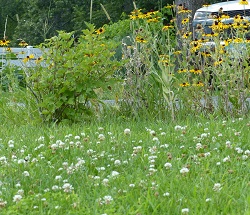
Rich, deep clover lawns are charming and healthy.
We avoid herbicides and don’t mind if our lawn is blotchy due to its diversity of plant species. Crabgrass fills in bare spots and is challenged by healthy, thick, established vegetation. Anyone wanting to exclude it from a lawn should work to keep other plants healthy and continuous. We annually sprinkle white Dutch clover seed on bare patches. The plant’s dainty white mini snowball-shaped flowers attract pollinating insects as the plant enriches the soil. Usually, clover grows earlier in the year than crabgrass, so it reduces bare spots where the weedy grass needs to colonize.
Note: White Dutch clover is also an exotic nonnative plant, but it’s valuable because it puts nitrogen back in the soil. No need for sprays.
For more crabgrass information, check extension.umn.edu/weeds/crabgrass.
Our diverse lawn attracts butterflies, bumblebees, and cottontail rabbits. They are a joy to watch. If we used pesticides to produce a monoculture bluegrass lawn, we’d not be able to enjoy these wildlife visitors. Our lawn would be sterile, kids could not safely play on it, and we would be contributing to water pollution. In Iowa, the quality has degraded for decades.
Crabgrass is here. It’s not going away. We enjoy this fast-growing grass for its benefits while grudgingly tearing it from our garden soil.

A yard that doesn’t need mowed sounds amazing! We are seeing this growing trend in the Center Point community. Where do you purchase white Dutch clover seed? Do you have any recommendations for someone who wants to transition their yard to clover?
Jami, Rich can better answer these questions. You have his contact information. This was a bumper year for White Clover!