Summertime With Winding Pathways
Summer in the upper Midwest has been pleasant and we are out and about!
And, Terry Pitts shared this video of an industrious bird making its nest. Likely a second brood.

Summer in the upper Midwest has been pleasant and we are out and about!
And, Terry Pitts shared this video of an industrious bird making its nest. Likely a second brood.
The Bubble Gum Clouds!
This poem is in honor of memories at Grammy Gibbs’ home in Maine where my sister, Lucy, and I used to swing on the hammock in the summer watching the clouds. Yvonne Gibbs Fellows Perrault also took pictures of clouds and captured narratives and poems in small photo albums.
The Bubble Gum Clouds!
Oh, the Bubble Gum Clouds!
Come swing on the hammock
To the Bubble Gum Clouds!
The mushroom and billow
Like fluffy soft pillows.
The GROW and shrink
Until you think
They will disappear.
Then, they swirl and pop
Like they are really hot
And we get caught up
In our imagination!
Salmon and pink,
Dusty blue, black as ink.
There’s nothing better
Than a swing to the Bubble Gum Clouds
I think.

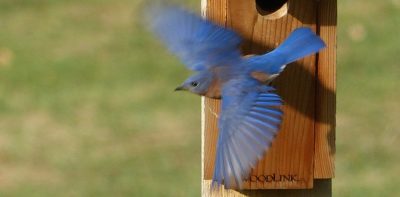
A male bluebird flies from the nest to bring back a snack for its mate.
Here’s a fun guest blog by friends, Gordon and Nancy, about their husbandry of birds on their “Little Acreage.”
“A few years ago my wife and I decided we wanted to attract wildlife to our little acreage. We already had deer and wild turkeys so we decided to try to attract some Bluebirds. We went on line to see where the best spot would be to place some houses to attract them.
“We then went to the Indian Creek Nature Center and bought a couple of houses. We felt that we needed the houses for bluebirds and the Center could use the donation. We placed four houses on the edge of the hay field.
“As time went on, all we saw were sparrows using the nest so we thought nothing would become of our houses. Then, a couple of years ago, a pair of Bluebirds started checking out the nest. But, we never found any eggs.
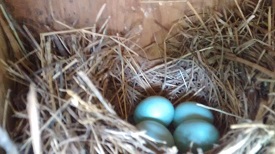
Four eggs! Photo: G&N Bena
“Earlier this year we looked in the house and nothing. A few days later we found these four eggs! What a great surprise for us. We now monitor the nest to watch the progress of our new friends.
Checking the other houses we found that a pair of wrens decided the house was satisfactory for their
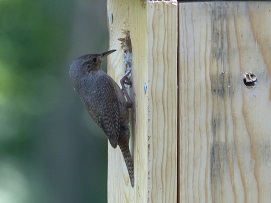
Feeding Young. Photo: G&N Bena
new home and I think they have at least seven eggs. We will be monitoring this nest, also. The other two houses have nests but I think they are sparrow nest. We decided to leave them because they need a home, also.”
Gordon and Nancy
Editor’s Note: Sialis.org has a fascinating set of pictures showing the progression of raising and fledging Bluebird young.
Reminiscing on some Haikus from the past. These seemed a good way to honor spring and welcome summer.
March
Quivering seed pods
Last year’s fruit, This year’s promise
Red buds produce life.
April
April ‘to Open’
Birds beckon, flowers unfold
Hope, re-birth, re-new.
May
Dampness Awakens.
Slow green shoots appear and grow.
Spring bursts in splendor.
How goes butterfly
So gaily in morning dew.
Quiet. Elusive.
Surf booms, with great roar.
Coquinas ride waves to rest
On white, clean beaches.
Pelicans I
Spring aerial art.
Wheeling, gliding all in sync
Pelicans migrate.
Pelicans II
Spring aerial art
Banks, wheel. Dive. Glide in sync
Pelicans migrate.
Mountain tall, distant
Shelters small creatures that live
In harmony there.
Laughter tumbles free,
From souls to the earth.
Children, living gifts.
Understand
Begin where we are
Understanding nuances
Plain talk ease nerves.
We invited readers of Winding Pathways blogs to submit a photo and short description of a favorite spring scene. The response spanned from the Pacific Northwest to Canada and from the Desert Southwest to New England. Enjoy readers’ reflections on our emerging spring. The essays appear as they came in to Winding Pathways. Thank you all for your charming observations. Happy Spring! And soon, welcome summer.
***
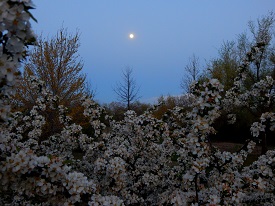
“Every year I wait for our Sargentina crab apple trees to bloom.”
As much as I love our native prairie plants and various garden inhabitants, every year I wait for our Sargentina crab apple trees to bloom. Not too long ago, in the company of one of our barn cats, I sat out on the patio and watched the full moon rise with the sweet smell of the flowers drifting over. Bees lay full claim to the blossoms during the day, from the little sweat bees to the bumbles, so I try to give them some space and wait until evening before diving nose-first into the branches myself.
Emily Groom Hemmerling, Kansas
***
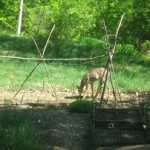
Here in NH, spring is slowly unfolding. The barred owls are getting amorous and I’ve heard, although not seen, “our” hawks. There’s a barn swallow that’s building a nest under the eaves, and the bear visited the other night. The weather seems to be lacking any nuance. We are alternating between two or three days of cold, windy, rainy (tell the truth–nasty) days and occasional beautiful sunny days in the ’70s.
Waiting is hard after a long winter, but change should accelerate very soon. The hummingbirds return on average on May 11th, and by then many flowers should be in bloom and the trees that are barely budding today will be fully green. This time of year Carly Simon is often on my mind–“Anticipation”. Sue Fehsinger, New Hampshire
***
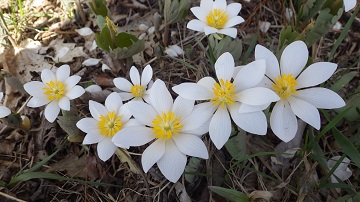
Dazzling white petal surround deep yellow centers.
These Bloodroots are found at the western end of our road. We have now lived on this road for 17 years and have watched the progression of growth and expansion each year of more and more desirable plants. The area has become a huge carpet of white under all the trees. The blossoms on the north side of the road show their faces first and a few days later the blossoms on the south side of the road appear. Since we have been here, each year it has been the same blooming schedule. We also have Bloodroots in our yard which don’t appear until the ones on the road seem to be in full bloom. They are only 1/4 mile apart.
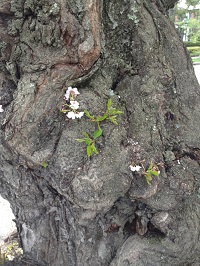
The ancient tree sprouted leaves and flowers all over.
I walked this Chestnut Hill neighborhood in Boston often while living and working in the area. My first fall a few heavily gnarled trunks of a handful of trees planted in the boulevard strips particularly captivated me. These trunks reminded me of Italian grandmothers; stout, sturdy, not particularly tall, deeply wrinkled and absolutely beautiful. When spring arrived I was amazed to see how blossoms not only appeared in their canopies but also sprang from their very bark. I loved these elderly trees all the more and saw them as clothed from head to toe in spring attire. May all of us exhibit such beauty and grace as we mature. Adria J, Illinois and Maine
***
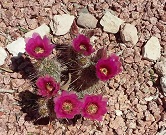
The desert Southwest alive with color.
Here is my first cactus bloom of the season! Soon my yard will be bursting with color, from all of the different cacti!
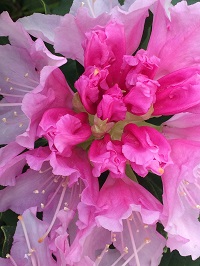
A close up of a western Rhododendron.
After the daffodils and the flowering trees fade is time in the Pacific Northwest for our native rhododendron to flower. They grow wild on the coast, but also are prized in yards because their large leaves are green all winter. Found growing wild near Port Discovery on the Washington coast in 1792 by Archibald Menzies who was with George Vancouver, it has been a favorite ever since. Officially it has been the Washington state flower since 1995, but women in 1893 designated it as such for a Worlds Fair that year. The rhododendron pictured is the Washington Centennial rhododendron from 1989. I love the way the blooms start out bright pink and fade to a pale pink as they open.
Jocelyn Berriochoa, Washington state
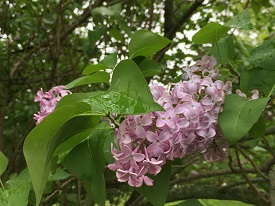
Raindrops on lilacs.
I opened the door this morning and looked out to see our lilacs blooming; pretty as could be. I thought, “Thank you, Grandma, for planting them over seventy plus years ago.” What a special way to start the day and welcome some of the beauty of spring. Claire Patterson, New Jersey
Spring came early to Bedford, Virginia, this year by about three weeks which means farmers, orchardists and gardeners began planting and hoping for early crops. Then to their surprise, we had two serious freezes back-to-back in March. The orchardists were especially chagrined because peaches, pears and apples took a hit. Watch for rising fruit prices.
As a gardener, it was thrilling to clean out the flowers and raised vegetable beds early on. As I began checking the asparagus patch, I noticed two silvery milkweed spears poking their heads through the soil next to the asparagus. They had begun their quiet vigil for the returning Monarch butterflies. I know the Monarchs have reached their most northern breeding grounds. However, I’ve not seen one returning Monarch here at the Ridge House.
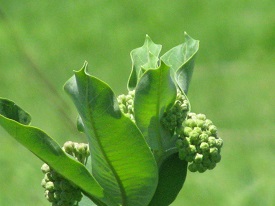
Milkweed is an important plant for Monarchs and other pollinators.
How did the milkweed come to be in my asparagus bed? There are a number of possibilities. Perhaps the birds deposited the seeds long ago. Or, the wind may have blown these wispy silky pinwheels into the patch. Another thought occurred to me that the seeds may have been tangled in the straw I scattered in the patch to help hold moisture through the dry summer months. However the seeds arrived, they are a God send as unthinking highway department mowers clear the roadsides, or a farmer applies toxic weed killer, or a home owner wanting a pristine lawn shears them off. The end result is far fewer pollinators like Monarchs and other butterflies, bees, and even birds. Where am I going with this you ask? This sage says, “All my weeds are wildflowers.” Peace. Jackie Hull, Virginia
***
Spring in New York City. Dan Patterson, New York
***
Snow is melting gradually this spring. And, despite the string of rainy days lately, at the end of April we still had mounds of it around the house and in the woods.
The slow melt has meant that I’ve kept up with yard cleanup and, while trimming around the edge of the yard, I have come across early gems, like the bright purple crocuses with their eye-popping yellow-orange stamen, nestled among moss covered rocks near the path into the woods.
Elsewhere, along the edge of the woods, the early Spring ground cover, known as ‘William & Mary’, is starting to show its pink and blue blossoms. (I think of my patch as ‘Will & Kate’.)
And, I uncovered the little pile of beach stones that granddaughter Cadence assembled one summer.
Every Spring is different and every day brings different discoveries and possibilities in the garden.
Now, I’m headed out and about to see what new stuff is uncovered before the heavy rains come. I’m thankful we live outside the flood zone, but Fredericton will see another 100 year flood this weekend I fear. Lucy Fellows, New Brunswick, Canada