by Winding Pathways | Apr 25, 2017 | Flowers/Grasses, Nature, Wonderment
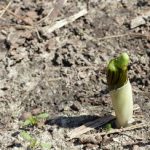
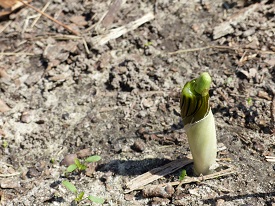
Tightly wrapped Mayapple pushes through the early spring ground.
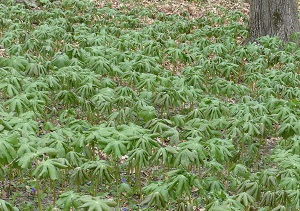
Early each spring we look forward to the appearance of hundreds of Mayapples in our small woods. They appear like magic, usually after a few warm April days. Only a couple of days after their first shoots poke through the ground our woods are carpeted with umbrella-like Mayapple leaves.
It’s too bad that the Mayapple is misnamed. In most parts of its range, from Florida to Quebec and west to the Great Plains, it starts growing in early spring, flowers in May, and produces “apples” in June or early July. So, perhaps it should be called Mayflower or Juneapple.

Mayapples populate open slopes.
Mayapples love living in the dappled sunlight in open forests. They spread by rhizomes and occasionally creep out into sunny areas and into deeper, darker woods. One of the delights of this plant is how easy it is to identify. No other North American wildflower sports the large umbrella like leaves that often appear in large patches.
When we look closely at our Mayapple patch we notice that most are leafy umbrellas rising on a single stalk while some are forked with a stem that splits like a “Y” and sporting two umbrellas.
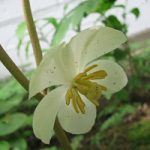
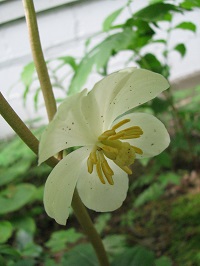
Beautiful blossoms hide under the umbrella-like leaves.
In May, these double leafed stems each grow one gorgeous but easy to miss white flower that’s usually pollinated by bumblebees. The flowers are easy to miss, because they are shaded by the large leaves.
The flower grows into a green fruit that looks like a mini lemon. It gradually turns yellow as it ripens.
All parts of this plant are toxic including the green fruit. However, once the fruit turns yellow it becomes edible and may people enjoy its custard-like fruit. But, be cautious. If eating it for the first time just enjoy a tiny portion of the yellow fruit to make sure it agrees with your system. Always be certain your identification is correct. A reliable source of information on many plant species, including Mayapple is United States Department of Agriculture, Natural Resources Conservation Service. Enter the name of the plant being sought, using either common or scientific name.

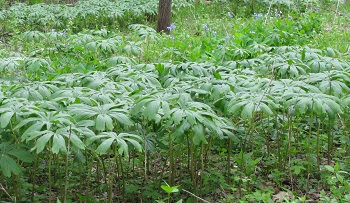
Mayapples spread by rhizomes.
Mayapples create a beautiful ground cover in open woods. They are easy to establish. Dig a few roots from a large patch and plant them under the trees. They’ll spread by rhizome.
by Winding Pathways | Apr 22, 2017 | Birds, Flowers/Grasses, Nature, Trees/Shrubs, Wonderment
Beautiful blossoms hide under the umbrella-like leaves.
First submission in! Hey all, on Facebook Winding Pathways invited folks to submit a favorite spring photo – tree, scene, flower, animal – with a short write-up of why you like that picture. And, Kansas readers Emily and Zach Hemmerling have already replied! Way to Go!
Now, I’d love to have about a dozen more so send them in to our email and I’ll continue processing and then post. These samples of spring pictures. Join in the fun and share your descriptions!
-
-
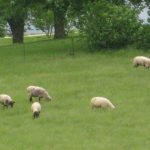
Photo of sheep in pasture
by Winding Pathways | Mar 21, 2017 | Birds, Nature, Wonderment
We’re lucky to have a pair of bald eagles nesting within walking distance of our home. Occasionally we clamber through the woods to check on the couple, but we’re careful to not disturb them. We stay a hundred yards away from their nest tree and spy on them through binoculars.
On March 12 Rich witnessed a remarkable trait of eagle parentage. Incubation is a female task with most birds. The male rarely sits. Not so with bald eagles. The soon-to-be father helps keep the eggs warm. Rich happened to be near the nest during the changing of the guard.
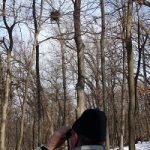
Watching from a distance.
He could see just the white crown of the sitting eagle’s head protruding from the huge nest built high in a white oak tree. Its mate perched on a limb about 50 yards away. Suddenly the sitting bird climbed off the eggs, spread its wings, and began circling the nest. Its mate joined the circling. After a few revolutions around the nest the recently sitting bird made a beeline north, presumably to look for dinner. The remaining eagle circled a few more times before settling down on a branch near the nest. After a minute or two it hopped into the nest and settled down over the eggs.
Who was who? Male and female bald eagles look alike, so Rich couldn’t tell if the male or female was the first incubator. It doesn’t really matter. Cooperation between the two is fascinating as this link shows.
Eagle parentage is an exercise in teamwork. The pair built the nest, take turns incubating, and both hunt for nestling food.
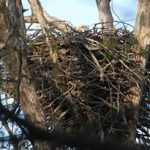
Eagles share parenting duties. Photo by M. Norlander
Eagle nests are becoming more common everywhere. The birds mostly feed on fish, so likely nest locations are near rivers, lakes, or the ocean. Nests are enormous piles of sticks, usually high in a tree and easy to spot. Bald eagles don’t seem bothered by roads, stores, or houses and often nests are within sight of heavy human activity.
Find a nest, dress warmly and sit some distance away with a pair of binoculars. You’ll be treated to examples of outstanding parentage. We plan to spy on our local eagle pair from a distance through the 35-day incubation period and as they raise their chicks.
by Winding Pathways | Mar 9, 2017 | Labyrinths, Wonderment
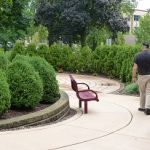
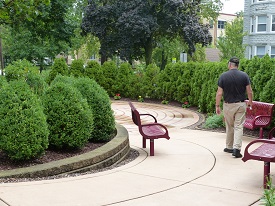
Set next to a busy sidewalk yet, discreet in location.
The world seems stressed now and yet, the tools we can use to help center and calm are sometimes gathering dust as we try to “figure things out.” In this time of Lenten Reflection and approaching Passover, Sheryl Crow’s song and lyrics resonate with me. “Out of Our heads”
And I remember the work of Ellen Bintz-Meuch in DuPage County Jails with women helping them find themselves and their way back to positive relations and productive lives.
Additionally, the Hampshire County Jail in Massachusetts sets an example of growth among inmates.
Let us reach out in compassion to help all be positive citizens. Indeed let us “get out of our heads and into our hearts.”
by Winding Pathways | Mar 8, 2017 | Children/Play, Wonderment
This blog from Community Playthings caught the eye of Winding Pathways. Indeed, today’s society is too concerned with correctness, cleanliness, and convention. A Buddhist saying goes something like this: spend twenty minutes outside everyday. If you think you are busy, spend an hour. At Winding Pathways we find this to be true. No matter the weather we try to get outside to see the sun or stars or clouds; to experience the wind or cold or heat; to feel the rain or snow on us. We keep our bearings, feel the roughness and gentleness of the environment and learn. Observe the changes of the seasons, find your Cardinal Points using the sun and structures, listen for the birds, watch the sky. Be. Above all, let kids be kids to slop around, spin, jump, tumble, get filthy dirty and then enjoy a warm bath and fresh clothes with a cup of hot chocolate and conversation. Go Outside and Play!