
We savor our quiet yard moments.
One of our favorite nature writers, Joseph Wood Krutch, remarked that anything people do creates noise. It seems that the clanks and roars of life are increasing since he wrote those words years ago. Quiet is a rare pleasure. Unfortunately, noise doesn’t respect property lines. It does trespass into yards and homes. It’s hard to avoid.
Life Before the Industrial Revolution
Imagine life before the Industrial Revolution. No cars, factories or trains and no power tools. A 1700 era ship could glide by with only the rustling of the breeze in its sails.
Prior to machines the loudest noise to assault the ears was a crack of thunder.
We cringe as motorcycles roar past our home and shake our heads when we hear booming music from neighboring cars as we wait for a traffic light to change. Some people adore noise. We don’t. Audiologists warn that noise exposure can lead to hearing loss, stress, high blood pressure, sleep disruption and lowered productivity.
We believe it. Rich was exposed to extreme noise in army training, followed by years running vacuum cleaners as a custodian and chain saws in the forestry industry. It eventually caught up with him with diminished ability to hear sound, especially high pitched ones. Tinnitus is his constant companion.
Because we treasure our ability to hear well, we’ve learned how to best enjoy quiet moments, create quiet places, reduce noise we produce, and use technology to enhance hearing.
A Week’s Quietest Hours
At Winding Pathways and almost everywhere else the week’s quietest hours happen early Sunday morning. Roaring motorcycles of the night before are parked, factories are in passive mode, and fewer trains chug along. On many Sunday mornings we’re up early to sip coffee on the porch and enjoy the gentle sounds of nature unmarred by human activity. These moments are delicious.
Creating Quiet Yard Places
Nature offers ways to lessen the din. The quietest parts of our yard are surrounded by vegetation. Leaves muffle noise. So does topography. Our home and yard are on an ancient sand dune. The north side of our property is the backside of the old dune. It blocks some of the din coming from a highway to the north, shielding about half our property from road noise. Our house, itself, reduces decibels. The side opposite the road is often quieter than the other side.
Our tall prairie plants, shrubs, and trees also muffle noise. A river birch tree in Marion’s labyrinth is close to the road. Its branches drape down over a bench surrounded by tall prairie plants. Vegetation offers intimate privacy and slightly muffled noise.
Using Technology to Reduce Noise and Hear Better
We’ve gone electric. Over the years we’ve replaced gas powered mowers, trimmers, chain saws and snowblowers with those fueled by batteries. The decibels they emit are a fraction of their gas counterparts but still make some noise. So do our vacuum cleaners. To protect our hearing we store sound dampening ear muffs near these tools and wear them when using them.
-
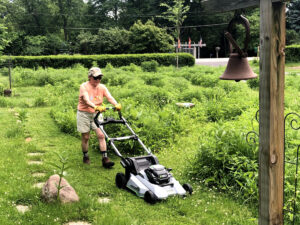
- Using an electric mower helps create a quiet yard.
-

- The electric chainsaw is quiet and efficient.

Fitting hearing aids is a process and building a relationship
Hearing Aids. Wow, they are expensive but miraculous. Hearing loss is a stealthy gradual condition. When Rich first bought aids he was amazed to hear the gentle sounds of walking in dry leaves, the creaking of the floor, birdsong, and better understanding of other’s speaking, music, and the television.
Audiologists usually provide a free hearing test. Rich’s advice – get a test and follow up with a pair of hearing aids if needed. The website of the American Academy of Audiology at members.audiology.org can help anyone locate a nearby professional who can help improve hearing.
Quiet Communities
Cities can do much to encourage quiet in their communities. Everyone benefits. Consider advocating with your local Council, law enforcement, and parks departments for developing a more quiet community.
Some people love noise but for most people it’s an annoyance. A quiet yard is a gem to create and enjoy.

My home in Shepherdstown was very quiet – I spent most of my time outside. The noise that was there – birds chirping and other beautiful natural sounds.
Paula, when we hear birds singing, we know all is safe. This vs. when we hear alarm calls from birds. Can be the blue jays screaming, or the wrens fussing. So, peace and goodwill are heralded by the birds.
What trees do you recommend for blocking road noise (near Cedar Rapids, Iowa), helping with dust from a gravel road, and strong to possibly withstand Iowa storms?
Give Rich a holler.
I’m enjoying a quiet moment in tribute to your thoughtful essay. Cathy
Thank you, Catheryn!