by Winding Pathways | Nov 3, 2022 | (Sub)Urban Homesteading, Chickens
Well, our Ninja Hen is at it again. A neighbor, watching the hens for us, entered the barn one morning to find the California White strutting around inside the barn but out of the coop! Looking around, our neighbor also found a small white egg in a depression in the sand in a tucked-away corner of the barn.
After some coaxing, Ninja Chicken hopped back into the coop through the door our neighbor had opened.
Reinforcing Didn’t Work
You may remember an earlier blog where we explained that Rich had blocked off all the areas he could see where she might be able to fly up to and escape into the barn. All was well for several weeks.
Meanwhile, Houdini Hen (aka Ninja Chicken) was figuring out how to “fly the coop” so to speak.
And she did. One morning, we too, found her again proudly prancing around the barn. She looked at us and seemed to say, “Haha. You can’t keep me in!” But, she could not quite figure out how to get back into the coop.
How in the world did she escape?
We looked around and found over in a far corner another gap between the chicken wire and the ceiling. The wire was bent down so we speculate that she worked at bending it when she landed on the wire and eventually had enough space to squeeze through and roam the barn at will laying eggs in that cozy little corner. The wire is straightened and the space is now plugged with plywood. Will she figure out another way to escape? We’ll know in the next few days.
Lesson
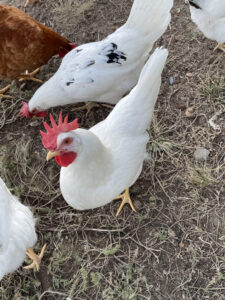
Our Ninja Chicken
This hen continues to teach us something. Chickens are not dumb clucks. This girl used intelligence to find an exit and demonstrated amazing athletic ability getting to and through a relatively small hole up high near the ceiling. And she is first in line for snacks, too.
by Winding Pathways | Oct 27, 2022 | Birds, Nature
Hi all: Many people either don’t have feeders for birds or have reduced their giving of seeds due to higher expenses. Yet, we still like to note birds around. We encourage you to join Cornell University’s Project FeederWatch. From the website click on “About” on the tab and read more details of how you can enjoy watching and documenting birds starting November 1st.
-

-
Bird watching is again a joy with hearing aids.
-

-
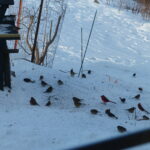
Bluebirds hang out on branches.
-
-
Birds flock to the seeds.
-
-
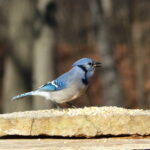
Usually jays come around only in winter.
by Winding Pathways | Oct 27, 2022 | Labyrinths
Editor note: Because of a glitch in the system and being uncertain if this blog was published at the original time, we are sharing now.
Guest blogger, Shari McDowell
I walked a labyrinth this afternoon. The one in New Bo, Cedar Rapids, Iowa, between the Bottleworks and the Bohemian. Usually, I walk the path as it’s laid out, stand in the middle, contemplate something that’s on my mind, take it all in, then walk the path out. this time I chose a no rules labyrinth walk.
No Rules Labyrinth Walk
Today was different. No rules, no expectations.
Approaching the labyrinth, I felt pulled from my center. I looked down at my feet on the ground and watched as I crossed all the lines and walked right straight through to the center. I stood there for a moment, then laid on my back and looked up at the clouds in the blue sky.

summer sky from the no rules labyrinth walk
The warmth of the sun settled on my face and body. The air around me danced between a breeze and full-out wind ensuring the sun didn’t get too hot while simultaneously whisking away a few tears.
It was a gentle release. A reminder that when I know where I’m going I can just go there. I don’t have to take the expected path. I don’t have to do it the way everyone else does and it really can be simple and straightforward.
Listening to Intuition
I can trust myself, trust my own process, and my intuition. No fluff, no ceremony, no hoops to jump through. Just take action. Do what I need to do. Stop when I need to. Rest. Breathe. Be.
I don’t know how long I stayed there. My head got “busy” brain. I became aware of passersby. The moment had passed and it was time to get up.
I don’t remember if I walked straight out or if I followed the path. It didn’t really matter. I was ready to go so I went.
While there are many things to be discovered by taking the long road or the scenic route, sometimes a direct approach is good.
by Winding Pathways | Oct 20, 2022 | (Sub)Urban Homesteading, Chickens, Garden/Yard
One of our 14 chickens is a true American Ninja Chicken. Most of us know the TV program American Ninja Warriors where athletes navigate extreme obstacles to beat the buzzer. Well, this gal, a California White, is right up there with the most athletic of them all.
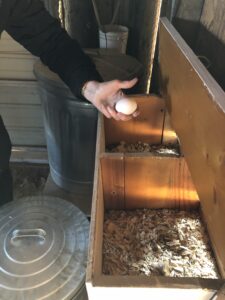
Our American Ninja Warrior Chicken begin to lay eggs at about 20 weeks.
Like most hens, when she reached about 20 weeks old, she laid her first egg in our coop. Then another a couple of days later. Then, none. And, none the next day. That’s unusual. When a hen starts laying, she’ll usually continue.
One evening, Rich counted the hens. There were 13. Hmmmm. Where’s the 14th? Had she met her fate? After recounting three times, checking the run, and scratching his head over this mystery, came a cluck from the attic of the barn. Could she have made the tortuous way up through the rafters into the barn’s attic? Naw. No chicken could do that. Then we remembered that another California White hen had laid eggs in the barn attic. So, Rich got the stepladder and checked anyway.
There she was up in the barn attic above the coop our second American Ninja Chicken proudly looking at her freshly laid egg.
Are Ninja Chickens Dumb Clucks? Not Really
A chicken myth is that they are dumb. Everyone “knows” that. Nope. Not true. To get into the attic our hen had to be both smart and athletic. Brains figured out a pathway through rafters, plywood, spools of wire, and stored items. Athleticism got her there. She negotiated an obstacle course like what we watch on TV’s American Ninja Warrior.
Once she reached the barn attic, she found the darkness and privacy hens appreciate when nesting. Unlike human ninjas,
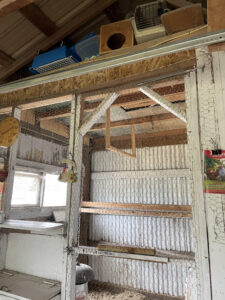
The American Ninja Warrior Chicken wormed her way to the barn attic.
there wasn’t a buzzer to ring when she got up there, but her clucks gave away her presence.
We admire her athleticism and smarts, but laying eggs up there won’t work. We need to easily collect them. So, we spent a morning plugging up any possible route to the attic.
We may have succeeded. Today’s egg was in the coop, but we’re certain she’s trying to figure out how to again reach the attic. She might outwit us.
When do Chickens Start Laying Eggs?
Female baby chicks usually start laying when they are 16 to 24 weeks old. Of the many breeds of chickens those that lay white eggs are relatively small, agile, and intelligent. They can worm their way into inaccessible places and fly like a pheasant. In contrast, most brown egg layers are heavy and cumbersome, and struggle just trying to get airborne.
Our American Ninja hen is a California White, a Leghorn hybrid. She’s small, fast, agile, and determined and lays white eggs – in the attic of the barn.
by Winding Pathways | Oct 13, 2022 | (Sub)Urban Homesteading
Home Upkeep!
From time to time, we post a blog about home care on Winding Pathways. Ways to upgrade appliances and refinish the structure. Although removed from our normal nature tips, home care is both important and interesting. One TV ad caught our attention about a low-maintenance polyaspartic garage floor. We checked it out and decided to pursue it.
Our realtor friends tell us that investing 3% to 5% of a home’s value annually for maintenance, modernization, and freshening helps the structure keep its market value. It also makes the house pleasant, safe, and efficient.
This year our improvements included replacing a 26-year-old furnace and a nearly as old air conditioner. Both were working but their age indicated possible failure, and we didn’t want the furnace to conk out on a 20 below Iowa night.
New Polyaspartic Garage Floor
Our garage needed attention. We noticed staining on the baseboards and the floor was, well, shabby. Likely installed in 1947 when the house was built the floor was old, pitted concrete. It was dusty and hard to sweep. Come winter the car brings in salt brine picked up on roads. It penetrates into the old concrete and is nearly impossible to remove.
This summer we hired the Hello Garage Company to install a floor of Polyaspartic. Before the workers came, we promised to remove the baseboards so they could apply the surface right up to the wall. While pulling off the baseboards we found a distressing problem.
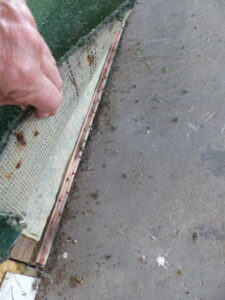
Years of seeping moisture had caused the bottom sill to rot. Nothing was holding up part of the wall. Fortunately, the rest of the wall was in good condition but the rotted area needed attention before the Polyaspartic could be applied. It became a DIY project.
Preparing for the New Garage Floor
- Removed baseboards and trimmed the wallboard higher to expose vertical 2X4s.
- Removed all rotted wood, which actually looked like topsoil.
- Cut off the rotted bottoms of the vertical 2X4s.
- Replaced the rotted sill with pressure-treated lumber, using shims beneath the verticals to give the wall solid strength.
- Screwed strips of ½” plywood onto the new sill to enable attaching the baseboard.
- Painted the baseboards but left them in storage for a while.
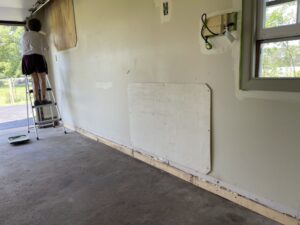
- Repainted the entire garage and installed sideboards to protect the walls from car doors banging against them.
- Washed shelves and containers before putting them back.
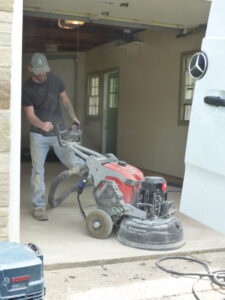
Hello Garage workers then ground down the old concrete floor, removing many of the potholes and unevenness. They then applied the Polyaspartic. We let it cure for more than two full days before bringing in the car or walking on it.
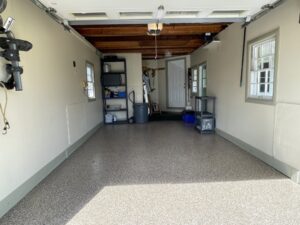
The final part of the job was screwing in the old refurbished baseboards and re-setting the garage with the cleaned-off shelves and containers. The garage looks great. Here are the before and after photos.
-
-
Noting areas to repair.
-
-
Repaired baseboard & wall protectors.
-
-
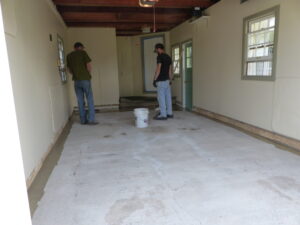
Hello Garage crew ground the old flooring.
-
-
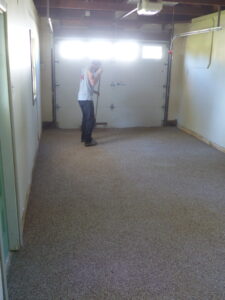
Working back to front.
-
-
Hello Garage crew Cleaning up excess
-

-
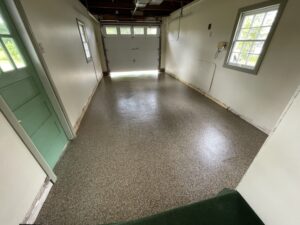
Applying sealer.
-
-
Curing
-
-
Garage Floor & Equip Inside.