by Winding Pathways | Aug 18, 2022 | Reflections/Profiles
We’re not normally pet people. Never had a dog or cat. When our children were growing up, we had bunnies. After they grew up and left home years ago, we cared for the bunnies left over from their youth and adopted a couple from Kirkwood Community College in the early 2010s. When the last bunny died in 2015, we were petless and had no intention of adopting an animal.
Oreo Comes to Our House
Then, a call came just as the pandemic gained strength in early 2020. A family was moving out of state and couldn’t bring Oreo, their pet rabbit, along. Would we take her in? It looked like we’d be confined to home to stay disease safe, so we said, “Yes”.
Oreo was an indoor bunny and came complete with the hutch, food, and supplies. Soon she settled into her comfortable hutch in our den near where Marion does office work. She did more. We quickly learned she’s smart, funny, clean, inquisitive, and a good friend.
Smart
She learned to go “Into the hutch” with some treats inside. Sometimes she led us on a merry chase around the den before she hopped in. Under the table, into her habitat, under the desk, under the heater, behind the trash bin, and back under the table. All along we said quietly, “Into the hutch.”
We tried to encourage her to chew on wood in the hutch (not furniture and doors!) by rubbing yogurt treats on the wood. Well, she learned to lick off the flavor instead of chewing the wood we gave her.
We often sat on the back deck in mild weather and even on nice winter days. To keep bugs out we hung a temporary screen at the back door that closed with magnets. Oreo quickly learned to nose under the screening to go in or out at will when we sat outside.
Clean Office Assistant
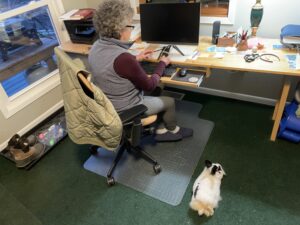
She’d roar out of her hutch in the morning and park by the computer grooming herself. She spent much of the day resting on the floor by the desk when Marion typed, and we soon called her our able office assistant. Every so often she’d stretch and want attention. She’d nudge Marion’s pant leg with her nose for a scratch behind the ears and rub under the chin. If that didn’t work, she’d scratch the pant leg. If THAT didn’t work, she’d thump. That usually got the attention she wanted.
Digger!
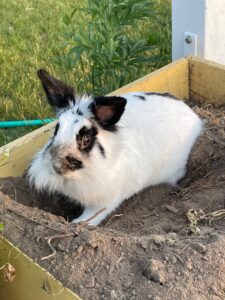
She’d romp around the deck while we were reading the morning paper and gleefully dig in a sandbox that we created for her. Rich would dangle his arm low and she’d come over for a rub. He’d switch hands to the other side of the chair and Oreo was right there for continued love. Each evening was “treat” time. A Russell’s Rabbit orange or green “cookie.” Rich broke it into pieces and Oreo would grab a piece and hope two feet away and nibble on it, then return for more pieces. We learned, don’t even think about patting her while she was eating!
Did You Know Rabbits Vocalize?
She vocalized with a growl if annoyed and when nervous or upset she squeaked.
Loyal Friend
This past year, when we left for a few days and neighbors watched her they reported that she stood up on her hind legs, looked around, and seemed to wonder, “Where are they?” Because she could see us go up and down the stairs evenings and mornings from her hutch, she learned we disappeared up there. So when we were gone, she even went to the foot of the stairs and looked up wondering, “Are they there?”
During the pandemic, she gave us laughs and companionship. She was a fun companion. So, fun that perhaps we didn’t recognize how much a part of our lives she’d become.
Saying Goodbye
Although only about five years old, one morning we found much blood in her hutch that came from urine and, perhaps, her intestines. Concerned, we took her to Bright Eyes and Busy Tails in Iowa City.
Their staff were kind and knowledgeable and confirmed that the blood was caused by an unknown internal problem. They could do tests and maybe take action. Surgery perhaps. “What did we want to do?” they asked. We talked it over and rejected intensive testing and possible resulting, expensive, and uncomfortable techniques. Actions that would ultimately result in the same ending. Sadly, we requested euthanasia for our friendly Oreo. It was done peacefully and painlessly while we held her and sang her special “Oreo Song” that Marion sang to her several times a day while scratching behind her ears and rubbing under her chin.
Part of the Prairie
That afternoon we buried Oreo beneath the wildflowers of our prairie, along with the other bunnies. But, sadness lingers. We miss her. We talk with her in the spot where her hutch once was. We visit her grave.
We know the sadness will fade over time and we’ll glance at her photos occasionally. Mostly we feel gratitude for the time she shared her life with us. And all the bunnies our family has had as friends. We posted a Salute to Bunnies on YouTube.
The Oreo Song
“Oreo the bunny, you’re so funny. Oreo the bunny 1, 2, 3.
Oreo the bunny, the black and white bunny, You came to live with Rich and me.
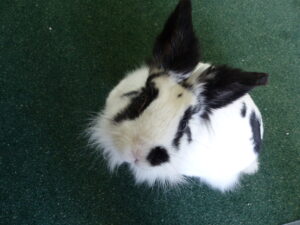
You have two black ears and two black eyes and black spots down your back.
You have a black and white nose and four white paws that go clickity clack
On the deck or on the dining room floor when you go to explore.
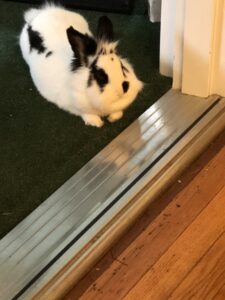
Oftener than not, you stretch right out by the threshold door.
You’re a good little friend. You came to our house. You came to live with us.
You run around. You “binky”. Sometimes you thump. Then, you’re quiet as a mouse.”
Be well, Spirit of Oreo, and all loved pets everywhere.
-
-
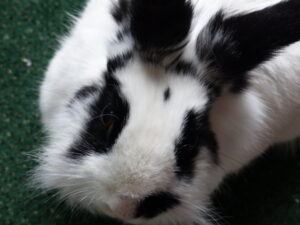
Part Lion’s Head and maybe rex
-
-
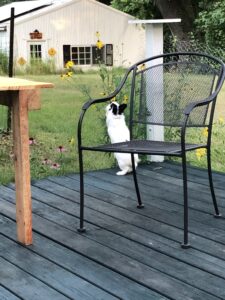
Nibbling coneflowers.
-
-
Digging outside.
-
-
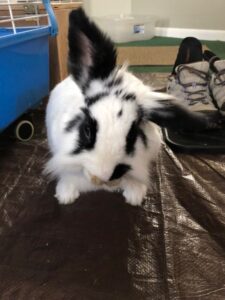
Cleaning up after.
-
-
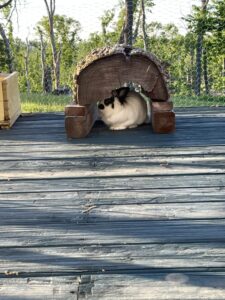
Making Derecho wood useful.
-
-
Oreo the Office Assistant.
-

-
Daily news.
-
-
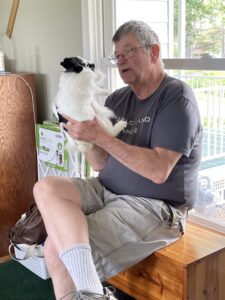
Oreo tolerated being picked up…
-
-
Waiting by the threshold door.
-
-
Oreo the bunny.
by Winding Pathways | Aug 11, 2022 | (Sub)Urban Homesteading, Bugs, Garden/Yard, Garden/Yard, Nature
Imagine how embarrassing it would be to be caught stark naked in public. Maybe that’s how the Walking Stick, a huge insect, felt that we spotted clinging to a shelf outside our house.
About 3000 species of Walking Sticks live worldwide. All love hiding. Their camouflage is almost perfect. No doubt the one we discovered would have been far more comfortable clinging nearly invisible on tree bark.
Although common and huge some species can be upwards of 20 inches long! They’re nearly impossible to spot as they lurk on twigs and bark. We likely walk right by many. They simply hide in plain sight. The name of their order is Phasmatodea, meaning apparition. It perfectly describes them.
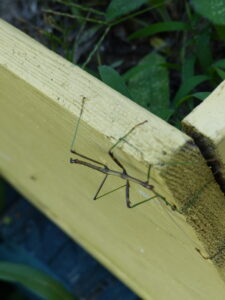
The one we spotted must have been lost. Rather than comfortably blending into the woods our gangly stick-looking insect contrasted against our shelf as naked as a jaybird. We couldn’t miss spotting it.
Herbivorous Walking Sticks spend nights munching on leaves and rest during daylight. Females are usually bigger than males and usually just drop their eggs to the ground. Growth is slow, and the babies can take three to 12 months to mature. That’s glacial growth for an insect, but they can live for two years if not devoured by birds, small mammals, or predatory insects. Insecticides devastate them.
Walking Sticks don’t bite or sting and are one of the thousands of nature’s wonders to discover in an ecologically healthy yard. They’re downright fascinating and fun to share with children.
-
-
Easy to see
-
-
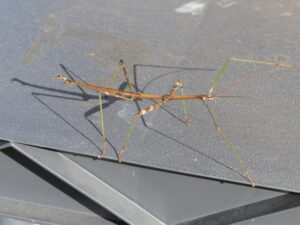
A large herbivore.
-
-
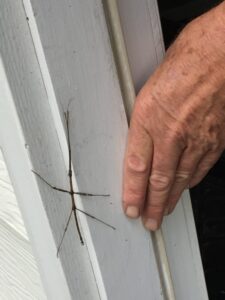
Walking Sticks are easy to spot on plain backgrounds.
by Winding Pathways | Aug 4, 2022 | Wonderment
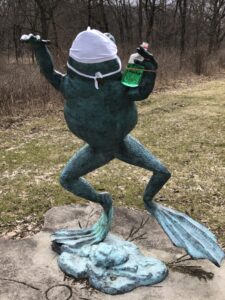
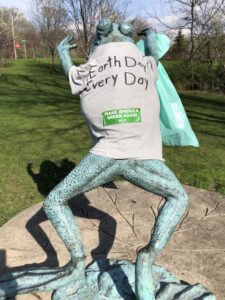
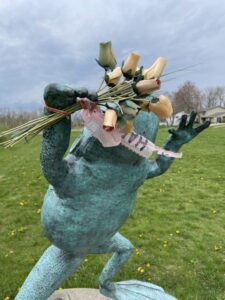
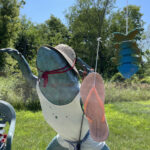
Near our home is a frog statue that a neighbor decorates seasonally and for special occasions.
Here are some photos I have taken over the years.
-
-
COVID-19 Protection
-
-
Earth Day
-
-
Mother’s Day
-
-
Summer Fun
-
-
Derecho Clean Up
-

-
Fall Raking
-
-
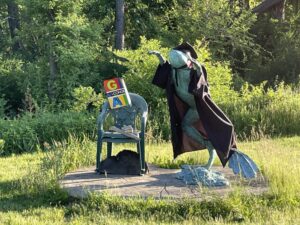
Pomp and Circumstance
-
-
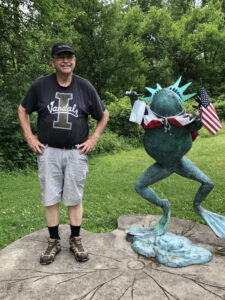
Fourth and Vandals (UIdaho)
-
-
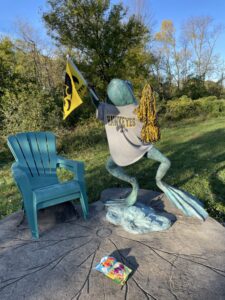
Fall Football!
-

-
Vote – Intelligently!
by Winding Pathways | Jul 28, 2022 | (Sub)Urban Homesteading, Birds, Nature
Views From the Recliner
Guest Blogger, Susan Fellows
My first-floor, corner apartment sits on the edge of a large green space and parking lot surrounded by a stand of pines, maples, and oaks. On one side is a complex of boutique stores, restaurants, and apartments/condos. Nearby and opposite the greenspace is a residents’ home for memory care. Last year I had placed outside my living room window a double shepherd’s crook feeder visible from my recliner. I am older and have some medical issues that restrict movement. So, a good view of the outside and the birds is important to me. They are entertaining! That first year I had what seemed like a million new sparrows that went through the wild bird seed like crazy. This year, I haven’t seen as many newly fledged sparrows.
Attracting a Variety of Birds
This year I put out several feeders on the double shepherd’s crook – one for black oil sunflowers and another for wild bird seed. Also on that post, I have a “cage” of suet and a sock of blick niger thistle seed. A couple of months ago I added a single shepherd’s crook with a mealy worm feeder. This spring and early summer I have seen pairs of the house and purple finches, house and chipping sparrows, several pairs of goldfinches, and at least one pair of bluebirds. They come to the sunflower and thistle seed, which the goldfinches seem to prefer. About a week ago, a mockingbird started coming and feeds entirely on the suet. Recently I put out wild bird food which hangs from the other hook on the double shepherd’s crook. I had put out mealy worms that I prefer the bluebirds have, but the house and chipping sparrows decided they own it. Flying over and calling from the grassy area are killdeer. With their shrill call, they are easy to spot as they hobble away with their fake broken wing act to lure predators from their ground nest. They nest in low vegetation, like the nearby grassy lawn.
-
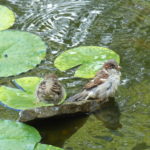
-
A water source helps attract birds.
-
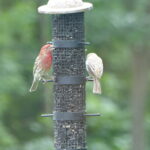
-
The house finches eat serenely.
Fledging Bluebird
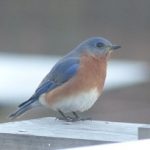
Male Bluebird
The memory home nearby has a bluebird nesting box on the quiet side of the building. I believe that is where the bluebirds come from.to feed. Several days ago I heard quite a racket from the feeding station. Looking outside, I spotted a fairly large bird with a highly streaked white breast, perched on the top of the single shepherd’s crook. An adult bluebird was also on the feeder. The bird making the racket had its beak open waiting for the adult to feed it. It didn’t. It was time for the baby to learn to eat on its own. At that point, I could see bright blue in its tail feathers. I was so excited! It was a baby bluebird!
Another day, I was looking out my window when suddenly a little, male chipping sparrow with his chestnut top on his head arrived bringing with him a smaller bird that landed close to him, beak open. Dad bird fed baby bird several pieces of seed and then showed baby bird how to do it, but as I watched baby still hadn’t got the hang of it.
Invasion by New Comers to the Feeder
A newcomer at the mealy worm feeder appeared recently – starlings. I was invaded by baby starlings. At least 15 had taken over the feeders. To lure them away from the hanging feeders, I put out a seed block on the ground at the base of the other feeders. Although I can’t see it, I expect the starlings may be happier at it than just eating crumbs from the open mealy worm feeder. I hope they will leave soon. They eat everything.
I have enjoyed sharing all these spring bird-related events with Winding Pathways. I expect to be inundated with newly fledged sparrows any time soon. Enjoy your birding adventures as I have enjoyed what I can see from my recliner.
by Winding Pathways | Jul 14, 2022 | Garden/Yard, Garden/Yard
Gardeners across the world proudly bring freshly picked vegetables and fruits into the kitchen. They’re lucky to have an amazing array of delicious plants to grow and enjoy. It wasn’t always that way.
Consider Native Americans. Prior to Columbus, many lived in cities and big towns surrounded by gardens and farm fields. They grew corn, beans, and a diversity of squash and pumpkins, but they knew nothing of many of today’s common vegetables. Residents of Asia, Africa, Europe, and Australia back then also farmed and gardened, but their crop choices were limited.
-
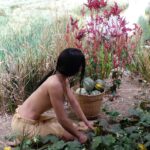
-
Many foods were cultivated by indigenous people.
-

-
Cahokia Mound
New World & Old World
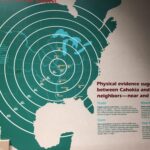
Indigenous contacts ranged far and wide.
It changed quickly following what’s called the Great Columbian Exchange. Shortly after Columbus set foot on Hispaniola people began deliberately and purposefully moving plants and animals around the world. Many were valuable and diversified the food chain on all continents. Others quickly became pests………most weeds infesting American gardens originated in the Old World.
Imagine Southern Italian cuisine without tomatoes! This delicious vegetable originated in South America and was unknown in Italy before the Columbian Exchange. Same with potatoes. The Irish potato originated in South America.
It went both ways. Today’s gardeners enjoy vegetables originating all over the globe. Here’s a brief list of where common foods came from:
NATIVE OF THE NEW WORLD
Pumpkins and squash, Beans except for fava, Corn, Potato, Sweet Potato, Tomato, Pepper, Jicama
-

-
Sweet potatoes are a healthy vegetable.
NATIVE OF EUROPE, ASIA, and AFRICA
Watermelons and cantaloupes, Onions, leeks, and garlic, Turnips, Carrots and parsnips, Yams, Radish, Celery, Asparagus, Beets, and Chard, are the same species, Cabbage, Cauliflower, Brussel Sprouts, Broccoli – all related, Endive, Lettuce, Rhubarb, Spinach, Okra, Cucumber, Peas.
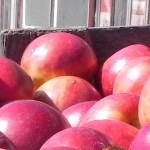
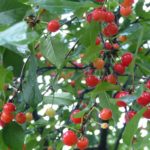
The Columbian exchange also included grains and fruit. Corn is American but wheat, barley, rye, and oats are from the Old World. Apples, peaches, pears, and cherries (except for the bitter American black cherry) are also Old World. Brambles and strawberries apparently lived in both the Old and New Worlds prior to Columbus. Grapes eaten fresh and used for juice and wine came from the Old World but several species also are native to the Americas.
-
-
A favorite fall harvest is apples.
-
-
Tart cherries come ripe in June.
Thanks to the movement of useful plants gardeners worldwide enjoy a diversity of plants to grow and eat.