by Winding Pathways | Jul 7, 2022 | (Sub)Urban Homesteading, Chickens, Garden/Yard, Nature, Weeds
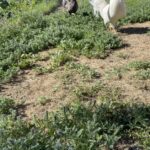
Chickens in run
A chicken run is one tough place for plants to live, and our run at Winding Pathways is even tougher than most.
Every day we let our chickens roam around the run. A bright baking sun broils the sandy soil all day long, so it’s hard to imagine that any plant can thrive there. And, chicken run plants face another challenge. The birds love greenery and usually devour every plant they find. As a result, most chicken runs are just bare dirt that’s either dusty or muddy.
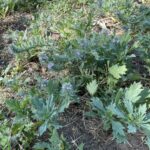
Flower and leaf
Big Bracht Verbena (Verbena bracteata), sometimes called Prostrate Vervain, is up to the challenge. It carpets our chicken run. We didn’t plant it. Verbena moved in on its own. Hopefully, our chickens enjoy viewing the plants’ tiny soft blue flowers.
Big Bracht Verbena is common across much of North America, but it’s easy to overlook. Rarely causing problems, it lives in the most difficult environments. The plant thrives in hot dry gravel soil along roads, in vacant lots, and in sidewalk cracks.
We like having this humble plant in our chicken run. It covers the soil, eliminating mud that follows rain. Chickens absolutely won’t eat it, but they love snatching the insects lured to the plant. It needs no human care, but we sometimes mow it if it gets a big shaggy by late summer.
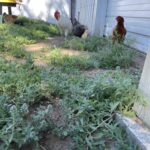
Foraging among verbena
One of nature’s mysteries is how plants have adapted to thrive in all sorts of environments, even harsh ones. Hats off to Big Bracht Verbena.
by Winding Pathways | Jun 30, 2022 | (Sub)Urban Homesteading, Garden/Yard, Garden/Yard
Varied Garden Produce
Midsummer. It’s the heart of gardening season as millions of Americans proudly bring tomatoes, beans, squash, and a host of other crops into the kitchen from the backyard garden.
Many don’t realize they ignore eating a typical garden’s hidden delightful food.
Most gardeners spend hours pulling and hoeing incredibly common and prolific garden weeds, only to toss them out. They make delicious food.
Here are our favorite “weeds” to eat
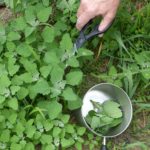
Lambsquarters. The young leaves of this persistent and fast-growing plant are delicious in salads. Or they can be boiled and used like spinach.
Amaranth or Pigweed. Sometimes called wild beet. Almost as common as lambs quarters, the young leaves can also be used similarly to spinach.
Purslane. This ground-hugging hot weather weed is a commercial crop in India. Young leaves and stems are delicious raw. They can also be boiled or even pickled. Grit tends to cling to purslane so rinse it thoroughly.
-
-
A full pot of raw Lamb’s Quarters cooks down to a few fork fulls of this nutritious potherb.
Crops with Rarely Harvested Edible Parts
Our favorites are
Beet greens. Beets are the same species as Swiss chard but the leaves tend to toughen as the plant grows. We use young beet leaves as we would chard.
Sweet Potato leaves. We haven’t tried these yet but will this summer. From what we’ve read they are delicious steamed and can be eaten raw.
Squash and pumpkin blooms. These plants usually produce more blooms than they need. We sparingly pick and steam them for a colorful yellow vegetable.
Carrot tops. Our master gardener friend thins carrots and uses the tops in pesto. We tried this in a pesto that a friend shared. Delicious!
Radish tops. Mix a few young leaves into salads. They’re spicy and add zest to other greens.
-
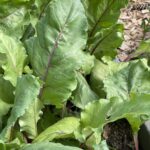
-
Beets are a cousin to Swiss Chard
-

-
Sautee or mix in a salad
-
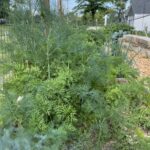
-
Add to pesto!
-

Resources
Whenever eating a new plant for the first time, make sure the identification is correct. It’s smart to identify a wild plant from at least three sources. These might include an Internet search, a wild foods book, or identification by a trusted wild food or garden expert. One online source is www.wildedible.com. Once you’re certain it’s edible, eat a small helping the first time to make sure you like it and it likes you.
by Winding Pathways | Jun 23, 2022 | (Sub)Urban Homesteading, Energy Efficiency, Home Improvements
Want to buy gas for a buck a gallon? Well, you can but you won’t find it at a service station. It’s available at the electrical outlet in the garage or shop.
Battery-Operated Tools
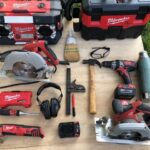
We switched to cordless tools gradually.
Nearly ten years ago we switched from plug-in carpentry tools to battery (cordless) equivalents. We loved them for their power, effectiveness, quietness, and ease of use. So, when battery-powered yard tools came on the market we gradually switched.
In 2018 we ditched our gas lawn mower and replaced it with a battery unit….with concern. Would it have the power of our gas machine to chew through tall grass and weeds? Would it have enough battery storage to mow the entire lawn?
Mowers
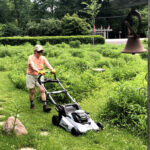
Maintaining the labyrinth is work. And a way to connect.
We quickly learned our concerns were false. The mower chewed through tough prairie grass and buzzed off our traditional lawn with ease. We liked it so much we bought another one so we could both mow simultaneously. Then came a trimmer, chain saw, and snow blower that all run on the same battery system. We love them all and believe gas-powered equivalents are on the road to obsolescence.
How about operating costs? Experts at our utility, Alliant Energy, told us that one gallon of gasoline has the energy equivalent of 33.7-kilowatt hours of electricity. As of mid-June 2022, gasoline average cost pushed to $4.60+ a gallon in Cedar Rapids. 33.7 kWh of electricity costs, on average in Iowa, $1.03.
Operating our battery tools costs a quarter of our old gas equivalents.
Benefits of Electric Tools
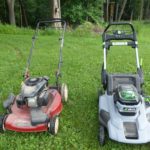
Comparison of a gas mower and the EGO cordless lawnmower.
But, there’s more than cost savings with battery-operated tools. Here are aspects we love about our mowers, trimmers, saws, and snowblowers:
- No rope to pull to start the machine. We save the shoulders! Just press a switch.
- No filters or oil to change.
- No need to buy and store gasoline. Fuel is always at hand at the electrical outlet.
- No fumes to breathe while operating.
- No noisy internal gas explosions. Battery electric machines are quiet.
- Easy to fold and store.
So, what are the downsides of battery-operated tools? We had to think about that and came up with only one thing. They may cost more than gas machines, and batteries are expensive. However, the batteries last a long time, perhaps as many as 2000 charge/discharge cycles.
The cost of electricity varies from place to place. Utilities print the kilowatt-hour charge on monthly bills. To calculate the cost of 33.7 kWh of electricity multiply that number by your per kWh cost and add in any taxes or service fees. Almost certainly it will cost less to charge a battery than to buy gas.
Have a cranky old gas mower? We suggest replacing it with a battery-powered equivalent.
by Winding Pathways | Jun 16, 2022 | (Sub)Urban Homesteading, Birds, Nature

We enjoy the haunting call of geese on the wing.
One of nature’s most alluring sounds is the song of flying Canada geese. Years ago, one had to travel to remote marshes to enjoy it. Not anymore, and a mother goose in Cedar Rapids shows she enjoys urban life.
Giant Canada geese were once nearly exterminated, but a small flock was discovered. Volunteer groups and biologists carefully transplanted geese to new locations, often to urban ponds. Boy, did the huge birds ever love them!
Favorite Foraging
Canada geese love dining on short mowed grass. Lawns surrounding ponds in golf courses and condominiums are perfect habitat. The big birds don’t mind human activity or noise and have expanded so much that many people consider them pests.
Nesting Preferences
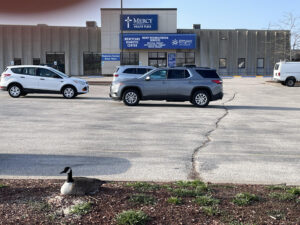
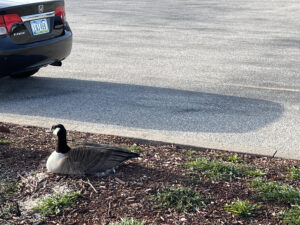
Usually, a goose pair chooses a hidden nest site. It may be near an urban area but often is in tall grass or bushes and is hard to spot. Not so one Cedar Rapids goose. She made her nest in a small island of woodchips and dandelions between a parking lot and road. Within sight is a movie theater, tattoo parlor, and medical building!
We are curious about how mom and dad plan to get the goslings to the nearest pond which is a distance away and through traffic.
-
-
The staff have been watching the mother for several weeks.
-
-
Geese are little bothered by traffic or noise.
Sitting, Hatching, and Raising
Goose eggs take about 35 days to hatch. Mom does the incubation but dad is normally close by and is a good protector. They mate for life and can live for decades. When the goslings hatch mom and dad lead them to a pond or river and teach them how to find food.
Our urban goose may be wise. The major nest threat is predation by dogs, raccoons, opossums, and skunks. They all avoid busy parking lots. So the goose couple may have chosen a safe nesting location…..or perhaps they just want to take in a movie, get a tattoo, or visit a doctor!
by Winding Pathways | Jun 9, 2022 | Nature, Trees
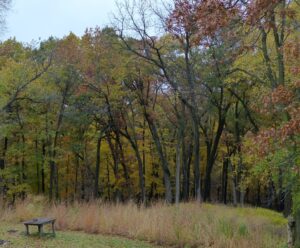
Harvesting Iowa Wood is sustainable.
When we tell people that Iowa is a major producer of some of the world’s most beautiful hardwood, they think we’re nuts. After all, we live in the corn state, where it’s possible to drive a hundred miles viewing only crops.
“Iowa is the sweet spot for the highest quality walnut lumber. Further north it’s too cold for the trees to get big enough and down south they grow so fast the logs contain much white sapwood and wide growth rings. Local walnut is of the highest quality, and it’s beautiful and abundant,” said Thomas Hunt as he led us through the Kendrick Forest Products Mill in Edgewood, Iowa.
Black walnut has been a favored hardwood for paneling, cabinetry, furniture, and gunstocks for hundreds of years. Its dark heartwood has a complex grain pattern that glistens with beauty. It is easy to work with, holds finish well, and is used to create furniture prized for generations.
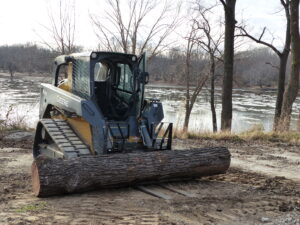
Log ready to be loaded.
Walnut trees are abundant in Iowa, especially in the tightly wooded valleys of the Driftless Area. Trees grow relatively quickly and produce annual nut crops that squirrels bury by the thousands each fall. They only find some for winter snacks. The rest sprout into new trees. When carefully logged walnuts, along with oaks, hickories, ashes, and basswoods produce crops at long intervals and just as sustainably as well-managed farm crops.
Logs are shipped to Kendrick’s mill and sorted by species. During our visit, workers were transforming sugar maple logs into boards. No doubt some will end up flooring beautiful and resilient basketball courts.
Logs enter a huge machine that removes the bark and any dirt clinging to it. They then enter a powerful bandsaw. We watched Zippy operate hand and foot controls that fed each log into the blade that squared off a side. He then flipped it over and cut three more times to create a massive squared-off hunk of maple that next moved to another saw. It cuts the log into one of many things. Sometimes they make railroad ties. We watched the saw create inch-thick lumber.
Boards then go to the “green chain”, a room where workers sort them by grade and stack them up. From there they are cured in the open air and eventually in a kiln that removes moisture.
Finished products are shipped to customers far and wide. Walnut is especially valued overseas. Anyone who loves finely-crafted cabinetry, paneling, or flooring may have Iowa-grown wood processed at Kendrick Forest Products. Iowa’s more than a corn state!
Want to see the mill in action? Kendrick’s offers tours. Information is on their website at kfpiowa.com/take-a-tour/. Can’t get to Eldridge? Enjoy a video tour on their website. And, learn about Monday Mulch!