by Winding Pathways | May 26, 2022 | (Sub)Urban Homesteading, Garden/Yard, Garden/Yard, Preparedness
Good Friday Tradition
On a cold April morning, we planted a row of potatoes at Winding Pathways. This plant has made an amazing long journey to reach our yard.
Potatoes are native to South and Central America and were cultivated by native people long before Columbus. Early Spanish explorers realized this humble American plant produces an enormous amount of food that’s easy to store. They brought potato sets back to Spain, and eventually, the plant was cultivated throughout Europe.
-
-
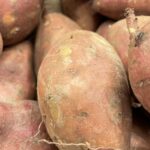
Sweet potatoes are a healthy vegetable.
-
-
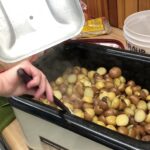
Potatoes are hardy and plentiful.
Productive Crop
Potatoes produce more human food per square foot than wheat, rice, corn, or nearly any other crop, so crowded Ireland embraced the plant. Potatoes thrived in Irish soil and were so productive they enabled the human population to flourish. Unfortunately, the entire crop was of just one or two varieties. Disaster hit. Between 1855 and 1859 blight killed most of the crop, which lacked resistance to the disease. It caused massive starvation and spurred huge immigration to the United States.
Early Europeans who colonized North America brought potatoes to plant in the New World. So, an American plant crossed the Atlantic Ocean twice in its long journey.
Vandals and Hawkeyes
We both hold degrees from the University of Idaho. It’s the potato state, and the plant loves the light volcanic soil along the Snake River in the southern part of the state. Iowa, where we live, is the corn state, but humble potatoes do well in our garden.
We buy seed potatoes in early spring, cut and cure them, and plant them in early April. They don’t expect much from us, and by mid-summer we carefully hand dig delicious new potatoes. Later, when the tops die back, we dig and cure a bushel, or so, for winter storage.
Expert Resource at Hand
We hedge our bets by planting a few potato varieties, and this year we’re fortunate to have a potato expert move to Cedar Rapids. Jean Contina earned his doctorate degree from the University of Idaho studying potato diseases. He’s a fellow Vandal! We’ll seek his advice on how to maximize our crop.
-
-
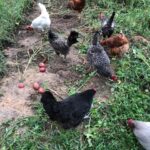
Chickens don’t seem to bother the potatoes.
-
-
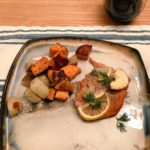
Beautifully presented dinner.
Inexpensive. Why Grow Them?
Store-bought potatoes are one of the least expensive foods. So why grow them?
We have two reasons. First, anything we grow seems more delicious than its store-bought counterpart. It may be our imagination but it is true. Second, they are an easy crop to grow and store well all winter without the need to can or freeze them. Having potatoes stored in a cool dark room in our house gives us a bit of food security in a crazy world.
by Winding Pathways | May 19, 2022 | (Sub)Urban Homesteading, Foraging, Garden/Yard, Weeds
Yes! The blossoms and leaves have vital nutrients and were cultivated by our European ancestors. In the modern world, every year homeowners spend money and elbow grease to poison their lawns all to try to rid their lawn of dandelions. They could sell the dandelions instead!
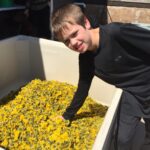
You can make money selling dandelion blossoms.
What? Sell dandelions? The Ackerman Winery in Amana, Iowa, crafts delicious dandelion wine. To make it they need thousands of the plant’s golden blooms and they pay $8 a gallon for them.
The dandelion season has faded for the 2022 spring, but we’ve seen lawns with many dollars’ worth of blooming dandelions that could have been sold. For information on how to buy dandelion wine or sell dandelions go on the Ackerman Winery website.
About Dandelions
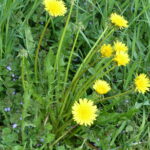
By mid-summer dandelion leaves are tough and bitter.
Dandelions are an amazing plant. Native to the Old World, their seeds were brought to America on the Mayflower. For thousands of years, people considered them a valuable resource. By late winter people often suffered from vitamin deficiency. Dandelion leaves are rich in vitamins and green up in early spring. People ate them to restore their health. They are as nutritious today as they were in the past.
Only in recent years have dandelions been considered pests. Because they are prolific, common, and easy to identify, chemical companies encouraged people to view dandelions as pests so they could sell herbicides.
How silly it is to spend money to kill plants that are good to eat and so nutritious. Thanks to Ackerman Winery they can even add to a family’s income.
How People Unwittingly Encourage Dandelions
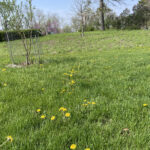
Mowing low encourages dandelions.
Observation reveals a dandelion secret. They thrive on mowed lawns and rarely grow in prairies, woods, or wetlands. Mowing invites dandelions to move in, and chemical companies are ready to sell potions designed to kill a plant with a remarkable relationship with people. A natural way to reduce dandelion numbers in a lawn is simply to set the mower to cut at its highest level. It leaves the grass a big shaggy but their leaves shade the ground and discourage dandelion growth.
We enjoy dandelions at Winding Pathways and steam young tender leaves every spring.
by Winding Pathways | May 5, 2022 | (Sub)Urban Homesteading, Birds, Nature
When recently walking for exercise at a cemetery our ears and then eyes alerted us to an amazing urban sound and sight.
Like most people, while walking we mostly watch the ground in front of us with occasional glances to the side and way forward. We don’t LOOK UP often enough, but the high-pitched cry was fascinating enough to stop us in our tracks to enjoy an upward view of a pair of ospreys circling their nest on the top of a cell phone tower.
We weren’t out in the country where we might expect a large raptor to nest. Rather the nest was above a lumber yard, restaurants, a liquor store, and a busy road.
Osprey
Ospreys are sometimes called fish hawks for their ability to catch and dine on fish. The nest we discovered was near a fish-swarming stream. People worldwide can enjoy this beautiful aerialist, as it has one of the largest ranges of any bird. It’s at home in Europe, Asia, Australia, Africa, and both North and South America.
Other Large Migrating Birds
LOOK UP. When we sit on our back deck LOOKING UP lets us spot migrating geese, pelicans, vultures, and even swans that we’d never see at ground level on our property. LOOKING UP lets us watch a pair of turkey vultures nesting in a huge hollow basswood near our house. LOOKING UP helps us spot massive bald eagle nests in the country and even in town. They seem to prefer nesting at the top of tall cottonwoods relatively close to water.
Ospreys are huge raptors and adept aerialists able to swoop down and pluck a fish from the water. They are pointy winged birds colored in black and white. Bald eagles are even bigger and also fish lovers. Supposedly our national bird sometimes hassles a fish-carrying osprey until it drops lunch that’s quickly recovered by the eagle.
National Bird
We’ve not seen this happen but apparently, our national bird is a skilled thief. Watch this video and note how the fishermen first hear the bird cries, spot the birds, put down their poles and catch the action on their phones. Listen, Look, Enjoy!
So, when walking or even sitting on the deck LOOK UP!
by Winding Pathways | Apr 28, 2022 | (Sub)Urban Homesteading, Chickens, Foraging, Garden/Yard, Garden/Yard, Weeds
We are shocked by the rise of many prices, especially food. Fortunately, we mute the cost by finding or growing groceries here at Winding Pathways. We’re lucky to own two acres, but folks living on tiny lots can produce an amazing amount of food, even if they aren’t passionate gardeners.
In a nutshell here’s what we do to tame grocery bills:
Foraging
It’s ironic that many people consider the most delicious and easy wild foods pests and spend time and money trying to eliminate them. We eat ‘em. Books and websites, including Winding Pathways, share tips on finding, identifying, harvesting, cooking, and eating wild foods. Caveat: ALWAYS check that you have the correct plant, gather from unpolluted places, and consume only a small amount initially to be sure your body accepts the wild edible.
Here are our favorites:
Gardening
We’re not passionate gardeners and we don’t can or freeze vegetables, so here’s what we do:
- Succession plant: Our small garden yields an enormous amount of food. We don’t let a square foot be idle. When summer’s heat turns lettuce bitter, we pull it, feed it to our chickens, and plant beans or another heat-loving crop. Same with other crops that grow quickly and then fade.
- Use vertical space: Pole beans, for example, produce much more food per square foot than bush beans, so we choose climbers and use vertical space. We have the pole high enough to reach up and pull off the beans.
- Grow dwarfs: Some cucumber varieties, for example, are “bush” type, meaning they produce a crop without long vines that consume plenty of space.
- Think of winter eating: Because we lack freezer space and don’t can food, we plant vegetables that need little care during the growing season and store them until late winter without being canned or frozen. Here’s our list:
-
- Winter squash. Pick them, let them curet, and store them in a cool spot. They keep for months. Same with pie pumpkins.
- Carrots and parsnips. In late fall we smother the plants with a thick blanket of dry leaves or straw that keeps the ground from freezing. We’ve harvested carrots in January by brushing away snow and peeling back the mulch and pulling them.
- Sweet potatoes. They love the South’s climate yet grow well up north.
We carefully dig them in the fall, cure them, and store them like winter squash.
-
-
Sweet potatoes are a healthy vegetable.
-
-
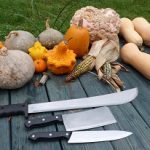
Winter Squash vary in color, texture, shape and size.
Chickens
We can’t imagine living without a small chicken flock. Our six to 12 hens gift us a couple of dozen eggs a week. Their manure fertilizes the garden and garden weeds are a great hen chow. During warm months our hens forage in their large run eating bugs, worms, and weeds and transforming them into eggs. Sometimes we even stew down an old hen.
-
-
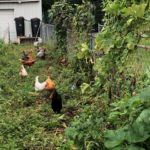
In the summer hens find plenty to eat.
-
-
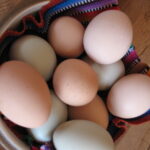
The chickens kept on laying eggs.
Wildlife
Lots of folks don’t like hunting. For us harvesting a deer is a form of food gathering, not recreation. After all, deer are free-ranging, local, and organic. Fortunately, we’re able to hunt on our property and convert a deer into delicious meat. We also enjoy eating panfish.
Like most folks, we can’t grow or forage all our food but much comes from the yard and area. It takes knowledge and investment in elbow grease but trims the food budget. Perhaps even better, knowing how to find and grow food makes us feel less vulnerable to national disruptions that make food either hard to get or expensive.
by Winding Pathways | Apr 21, 2022 | (Sub)Urban Homesteading, Chickens, Hoover's Hatchery
Frigid April weather threatened the lives of 90 baby chicks.
We had agreed to brood 75 rooster chicks for the Rodale Institute. In past years we have brooded a dozen to 25 chicks for our own flock. That was easy. We could brood them in a big cardboard box, and if it was cold we situated the brooder in the basement where the temperature was already warm. A heat lamp easily boosted it to the nearly 100 degrees hatchlings need.
We’d ordered Rodale’s chicks and 15 pullets for us from Hoover’s Hatchery to arrive on April 7. That’s usually an ideal time, as spring’s temperatures rapidly rise. So, by May, chicks can go out into the non-heated coop with only a heat lamp to take the chill off on cool nights.
-
-
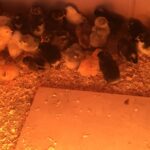
When temperatures too cool, chicks huddle to stay warm.
-
-
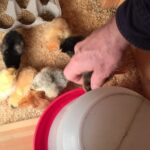
Dip the chick’s beak in water so it knows where to drink.
-
-
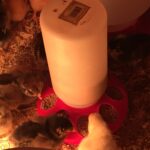
Chicks eat, drink, sleep and poop.
Wind and Cold
This year a cold front brought snow and wind the day before Kelsey Spotts was to deliver the chicks from Hoover’s Hatchery. Because we were brooding 90 chicks, we made a big brooder in the unheated barn. The weather was so cold that even with three heat lamps it was just too cold in the big brooder. With just a day before the babies were to arrive, we had a crisis.
Nature’s Way Is More Simple
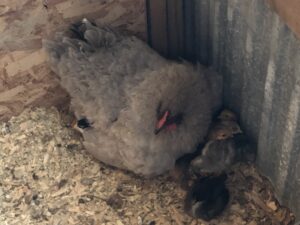
Mama hens are the natural way to brood and raise chicks.
For thousands of years, broody hens patiently sat for 21 days on fertile eggs. Then, on that magical day when they hatched, mamas hover over them to keep them toasty warm from their body heat. Even if a cold snap arrived hens keep their babies warm. Today, most chicks lack a mother. A brooder keeps them warm but ……. ours was too cold.
We scrambled. Fortunately, we had scrounged crates from a wood scrap pile outside a business that welcomes people to take and recycle their discarded wood. We used the wood to craft a temporary brooder in our wood stove heated cabin and installed two heat lamps. Presto, the temperature hovered just at the 100 degrees the chicks need.
The next day Kelsey delivered all 90 chicks. They moved right in and immediately started eating, drinking, peeping, and pooping. Now, a week later, the weather hasn’t warmed much, and the chicks remain in the temporary brooder in the cabin. They’re growing and feathers are forming.
Warming Trends and Chick Growth
The forecast next week promises a warming trend. So, as soon as the barn brooder comes up to about 90 degrees the chicks move there. Why 90 instead of 100? When chicks hatch, they need the full warmth but as they age their temperature needs drops by about five degrees a week. So, by the time they are six weeks old, they will be comfortable at a balmy 70 degrees, and that’s a common May temperature. No more need for artificial heat or a brooder.
-
-
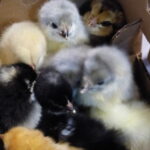
Hoover’s Hatchery keeps chicks safe….
-
-
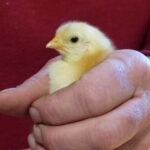
Handle chicks delicately.
-
-
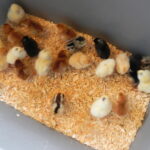
Chicks move around freely.
Rodale will use their chicks for a research project at Etzel’s Sugar Grove Farm. Researchers will learn if chickens foraging in corn can eat enough insect pests to eliminate the need for pesticides, and their poop will fertilize the crop.
Watch for future blogs about the chicken in corn project.