by Winding Pathways | Feb 3, 2022 | Birds, Garden/Yard, Nature, Uncategorized
Millions of families love watching chickadees, nuthatches and woodpeckers visit backyard feeders. A joyful daily task is bringing them a day’s supply of sunflower seeds, millet, or even cracked corn. But, often an important part of their diet is ignored.
Birds lack teeth so never need dental care. Instead, they must eat rocks! Small rocks humans call sand. Often birds forage along snowy roads gleaning grit spread to give cars traction. It goes into their gizzard where powerful muscles grind seeds into a digestible slurry that then moves on to the stomach.
During most of the year, birds find all the grit they need on their own, but when snow and ice seal off the soil they can’t find it. People sometimes scatter sand on slippery spots to provide human traction. Birds will glean some of it.
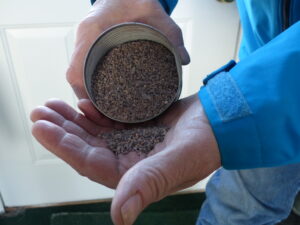
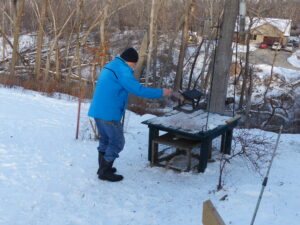
It’s helpful to sprinkle a handful of sand around feeders once a week during the snowy season. At Winding Pathways, we buy a 50-pound bag of chick grit at a local store that sells chicken feed. It’s fine ground hard rock that is ideal for both traction and bird digestion but plain old sand works.
Wild Turkeys often visit our feeders, so once in a while, we toss out large-sized grit, designed for laying hens. It helps their gizzards grind up hard corn kernels that they love snacking on.
An outstanding source of bird information is the Cornell University Laboratory of Ornithology.
-
-
Chick grit is small.
-
-
Sprinkle grit once a week to help birds in the snowy season.
-
-
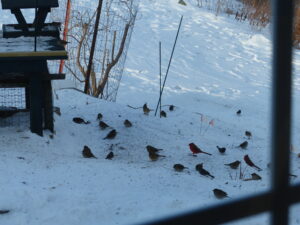
Birds flock to the seeds.
by Winding Pathways | Jan 27, 2022 | Reflections/Profiles
2021 Retrospective
At the end of last year, I regarded 2021 with a jaundiced eye. Then, I read the little gratitudes I had kept in the jar all year and realized the good that did happen and that we created. Below is a summary.
Labyrinths
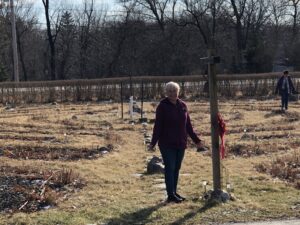
The year 2020 ended with the last night walk and 2021 started with a pilgrim smudging the labyrinth bringing in good energy. That lasted all year with regular walkers in all seasons and weather and a surprise pilgrim who had found the labyrinth on the World Labyrinth Locator. The pilgrim explained she was taking on 50 new activities and adventures through her 50s years. She had learned manual skills from her dad, set out to travel safely, and now was taking in labyrinths on her cross-country trip. The Phoenix Harmony Labyrinth was one of her Iowa connections!
-
-
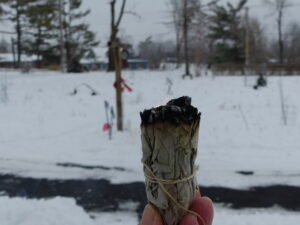
Teri blesses the labyrinth
-
-
January – Smudging for the new year.
Light One Candle 2.0: To honor the new administration colleagues in the Labyrinth community held a virtual service of renewal and blessing.
Church:
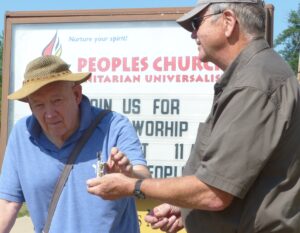
Peoples Church Unitarian Universalist has continued to flourish during this year of transition. People have stepped forward to serve. Board meetings run smoothly with thoughtful discussion and positive action. Members have generously contributed to projects such as the endowment that provides secure, long-term funding for our mission and the solar installation. Before the solar, we upgraded fixtures, replaced inefficient bulbs, and re-roofed. Even in the dark of the year, the electric bill plummeted from $300 in one month to $20 the next month.
-
-
Peoples church installed solar panels after roof repairs and upgrading lights and HVAC.
-
-
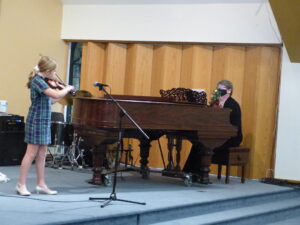
Peoples offered performance opportunities for young musicians.
Friends:
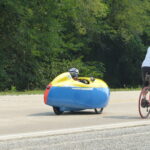
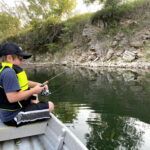
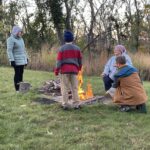
Once we figured out how to socialize safely, we had occasional outings with friends, over for an outdoor meal, helping with bucking up wood. Rich took our young friend P fishing. They completed a survey at Big Dick Lake and submitted a report/scientific paper to Dr. Morris at ISU. Pretty cool for an 11-year-old. P helped place the solar lights in the labyrinth. N decided the plastic flamingos made terrific steads to ride. Periodically, I would find the “birds” in different locations around the labyrinth and knew that N and O had come by with their mom. She hiked over on snowy days, too pulling the Littles on the sled. Intrepid! We visited in MN with cousins a couple of times being careful about health protocols and enjoying Immersive Van Gogh in the fall. ZOOM calls, Firepit Fridays, Polar Pizza, Potpie Parties….we made good things happen safely. RAGBRAI at big Dick Lake was fun to see the crazy outfits people wore as we waved them on.
-
-
Lu intrepidly visited with the Littles
-
-
You see everything on RAGBRAI
-
-
P helped document fish at Big Dick Lake
-
-
In all weather friends gathered around the fire pit.
Weather: Hot and dry. We ended with a 15” deficit so the Gratitudes of the occasional, “Quiet, drippy day” were welcome.
Long Trips, Day Trips, and Writing:
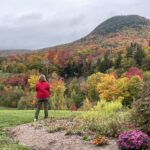
Wow! In spite of all, we managed a trip to Alaska to see N and B. Overnighting in the Hytte, birding, Turnagain Arm, the ski slope, great food, walks, the Museum all in lovely weather. Clear, calm, frosty at night, and warm in the day. Two trips east – June and Late September early October – found us exploring new areas like the Meadowcroft-Rockshelter and Flight 93 Memorial in SW Pennsylvania. A stay at Jay Peak in northern Vermont brought New England back home. New camping areas and a wonderful meal at Punderson Lodge in a terrific rainstorm. We covered a lot of ground in Iowa exploring and writing about museums, the Cassville Ferry, Sprint Cars, cemeteries, parks, and taking in amazing wall art in Dubuque.
-

-
A Dubuque must see.
-

-
Dubuque boasts many wall murals.
-

-
Wrestling Hall of Fame
-
-
Northern Vermont’s foliage season is a must see.
-

-
After a short 15 minute ferry visit Cassville, WI.
-
-
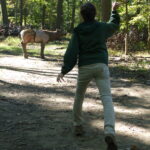
Testing skills with atlatl.
-

-
A somber experience
-
-
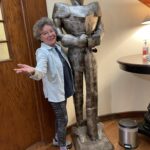
Oh What a Knight!
Animals:
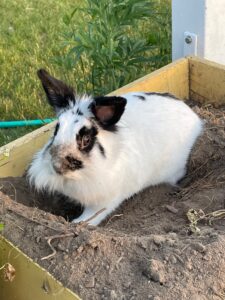
Readers know we have chickens and produce FB Live each month with Kelsey Spotts from Hoover’s Hatchery. These are fun and we have great conversations and share a meal after the FBLive shows. We also have a rescue bunny, Oreo, who loves to dig in the sandbox we placed on the deck. She is a mess and ten minutes later she is all cleaned up. Oreo knows to nose under the mosquito netting to get onto the deck, she is Marion’s “office assistant” faithfully sitting by the desk during computer time. She ever has a song made up for her!
-
-
Oreo gets all dirty and 10 minutes later she is clean as a whistle.
We are well and 2021 although stressful, also had bright spots. These we remember to help us keep balance.
Welcome, 2022!
by Winding Pathways | Jan 20, 2022 | (Sub)Urban Homesteading, Energy Efficiency, Garden/Yard
Back in October, we took a gamble. We bought an electric snowblower. Our driveway at Winding Pathways is about 440 feet long, and Iowa gets plenty of snow. It’s too much to shovel, so years ago we bought a gas snow blower. It worked for the first winter but then it started throwing belts off the drive wheels. Fixing was tedious and tenuous. So, we sold the beast and bought an EGO battery-powered two-stage snowblower.
We hoped it was a good decision. Would the blower be up to clearing such a long driveway? Would it hold up to hard use?
A heavy wet snowfall on December 28, 2021, gave us a chance to test the new machine. It did just fine. After clearing the entire driveway, the batteries still had charge to them. We could have done more.
It’s our prediction that gasoline-powered lawnmowers, hedge trimmers, blowers, chainsaws, and snow blowers are becoming obsolete. They’ve already been banned in California because they pollute the air more than cars.
Here are aspects of battery tools we like:
- They run quietly and are lightweight.
- No need to risk shoulder injury by pulling a rope to start it up. Just push a switch.
- No need to store gasoline.
- Maintenance is easy. No filters or spark plug to change.
- No fumes.
- Inexpensive to run. It costs less to recharge the battery than to buy an energy equivalent amount of gas.
It looks like our decision will pay off. We’ve now replaced all our gas-burning outdoor equipment with battery equivalents……except for one chainsaw. That may go soon.
Note: Winding Pathways paid the full retail price for this machine.
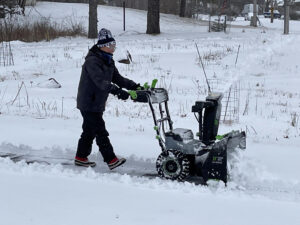
The EGO snowblower cut through the heavy snow easily.
by Winding Pathways | Jan 13, 2022 | Reflections/Profiles
One-Room School Houses
Readers’ Reminisce
Note: The original article appeared in the Cedar Rapids Gazette, Sunday, December 19, 2021. We invited readers to share their reminiscences and included here some that were in the original feature. We begin this blog with the background that was part of the Gazette feature.
Country Schools Across America
“For about a century after statehood (in Iowa), families, often with many children, lived on 160 acres in rural places. Although few kids went to college, parents valued learning and these schools were once the foundation of America’s free, public, education. Schooling in rural Iowa posed challenges. Depending on the season roads were either mud or dust with cars and school busses in the future. Towns were a distant trek, so one-room schools were built, usually within walking distance – two miles – of home.
“Often the sole teacher was an unmarried woman. What she taught was decided by the citizens of the township where the school was located. These teachers did many tasks, including teaching reading, writing, and math, sweeping the floor, and feeding wood into the potbellied stove. Some teachers even lived in the school! Others boarded with nearby families. That must have been something to teach kids all day and then board with them in the evening!
“A typical American one-room school featured George Washington and Abraham Lincoln’s portrait upfront, rows of wooden desks, a potbelly stove, and a privy or two outside. Although facilities were humble, pleasant memories linger in the minds of older people who launched their learning careers in tiny schools.
Fond Memories
“Several of our older friends attended one-room schools as children across the country and in Iowa. All remember funny incidents from the past and believe their school experiences launched them to success in many occupations.
““I remember the Veteran’s Day Blizzard of 1940. It was a beautiful morning but clouds rolled in as the wind picked up outside Flanagan School. We had a car by then, but my school was on a dirt road. Dad thought the car would founder in drifts but horses might get through. So, he picked me up with the team with the wind howling on the way home,” said John Regan who attended the one-room school between Holy Cross and Rickardsville in Dubuque County.
““My teacher was Miss Regan, Dad’s cousin. She was wonderful, and in that small building I learned education basics,” continued Regan. He went on to serve a successful hitch in the Army, repaired typewriters in New York City and became a John Deere equipment dealer in Newton, NJ. Before retiring he rose to executive VP of the company. John now lives in a New Jersey senior residence but often reminisces about his Iowa childhood.
Quality Depends on Cooperation
“Idahoan, Bob Pratt, Rich Patterson’s former college roommate, drawled, “I didn’t go to a one-room school. Mine was a two-roomer in rural Idaho. Grades one through four were in one room and five through eight in the other.” His school had but three employees: two teachers and a person who both cooked and cleaned. After eighth grade, Pratt attended a tiny high school and later earned a degree from the University of Idaho. During a long career in tiny high schools, he taught practical farming and mechanic skills and math and biology.
“Both Iowan Regan and Idahoan Pratt told us, “The education I received in tiny schools was superb. Maybe better than I’d have had in a big school. My classmates and I were well prepared for life and led successful careers in many areas.” Pratt continued, “I taught in high schools with just a few students in each graduating class, but they went on to great success. One is a cardiac surgeon. Another is a skilled cabinet maker. It’s the quality of the teachers and the cooperation of parents that make students excel, not the size of the school,” he emphasized.
Antics and Airplanes
One friend recalled her mother getting a piggyback ride to school after losing her boots in the mud. Pam Tegler Geraghty, a retired Cedar Rapids special education teacher, admits to being a “holy terror!” as a kid at the Lamont, IA, school in the 1950s. She slopped in a creek on the way home and once locked a classmate in the outhouse.
Pat Maas, a retired teacher and health secretary at Cedar Rapids’ Grant Wood Elementary, remembers rushing outside to watch an airplane zoom overhead when planes were a new wonder.
-
-
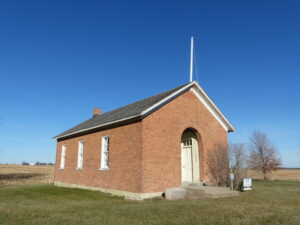
We sat on the stoop of took in the memories of by-gone days.
-
-
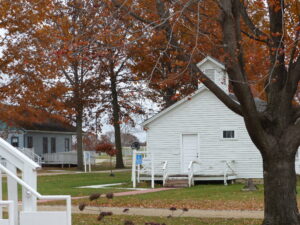
Ushers Ferry village complete with a school.
Quite the Career
Jack Neuzil of Solon, Iowa, reminisced about his country schooling days back in the mid-1930s. “I remember the first day the hired man took me on horseback.” After that, he and the other kids walked to school.
Practicing Life-Long Skills of Helping as Needed and Sanitation
Kids picked up sticks for the woodstove, pumped water from the well and used a dipper to drink from, and clapped chalk dust off erasers outside. They practiced sanitation. After using the outhouse, they would wash their hands and dump the water outside.
Stories, Games, and Pranks
“We would sit around the teacher who would read stories,” Neuzil shared. Popular recess games were Annie-Annie Over (or Andy Andy Over) and Kick the Can. Kids showed their daring-do by balancing along the wooden fence. He chuckled that adults would guard the outhouse around Halloween to prevent pranks.
Into the Future
As Pratt and Regan shared, the quality of education can be high in country schools. After his couple of years in the one-room school with eight or nine kids, Neuzil attended the University of Iowa schools and on to college. “I didn’t realize how good a student I was until I went to Northern Illinois College.” Attending on a work-study plant, the equivalent of a basketball scholarship, he held a job in maintenance. “The head custodian respected my work so much he eventually had me clean the president’s office, “Neuzil reflected proudly.
Creative Career Paths
Neuzil attended officer candidate school in Newport, RI, served in the tail-ed of Korea and the beginning of Vietnam, helping refugees find safe haven, taught high school at Eldora, and started the skills programs at Anamosa. “…so they could get a job when they got out of prison.” He went on to create and teach in the trade industry program at Kirkwood Community College for 25 years.
Neuzil holds patents on two heat exchangers, worked with Dick Schwab on the round buildings in Solon, and created a program of building and taking wood dinosaurs to schools around the area. “We did this to promote reading as we talked to kids. You have to be interested in order to learn,” he observed. After a time, believing that “free is no good” Neuzil began charging schools a book for each program. The kids wrote their names in the books which he donated to the Solon Public Library.
Now in his 90s, Jack Neuzil continues to share his wit and wisdom with others, demonstrating that the expression, “From here you can go anywhere,” holds true. Country schools were indeed a bedrock of America’s education.
-
-
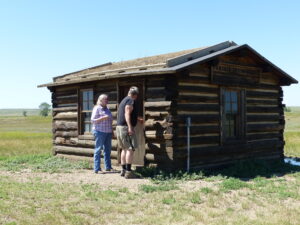
Betty and Rich check out the small school house on the American Prairie Reserve in Montana.
-
-
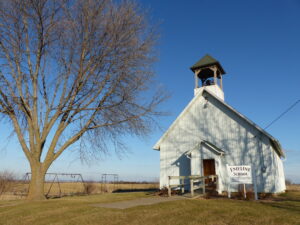
1848-1966 Emeline School is now a community center.
One of our favorite one-room schools involves a long drive but is completely fascinating. It’s set in the vastness of the Eastern Montana prairie and is part of the American Prairie Reserve. Local ranch kids attended from 1942-1957. The sole teacher lived and taught in the same tiny school surrounded by sprawling open spaces and occasional resident rattlers. Visiting it is a trip back in time, and a reward might be staying in one of the Prairie Reserve’s luxurious nearby yurts.
by Winding Pathways | Jan 6, 2022 | Birds, Nature, Pests
Artful Dodgers
Walking one of Cedar Rapids’ trails sometimes is like a skier racing a slalom course. Instead of weaving between flags, pedestrians must dodge piles of goose poop.
It wasn’t always that way. Before the mid-1980s few geese lived in town. Cedar Rapids began restoring them. About 125 of the giant birds were released near downtown. Few predators pester them and are they prolific! A goose couple can live for decades and raise upwards of a dozen goslings a year. That is a lot of geese!
Geese Mixed Blessing
Canada geese are a blessing. We love hearing “goose music” as they wing over our house. Watching such attentive parents teach their babies to swim and find food is great fun.
Canada geese are a curse, mostly because there are so many of them and they enjoy living, and pooping, in town. Their droppings are more than a walking nuisance. Loaded with nitrates and bacteria, they stimulate algae growth, lowering water quality.
-
-
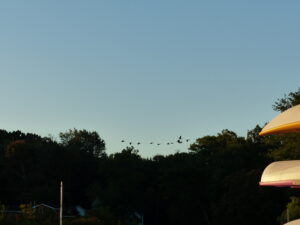
We enjoy the haunting call of geese on the wing.
-
-
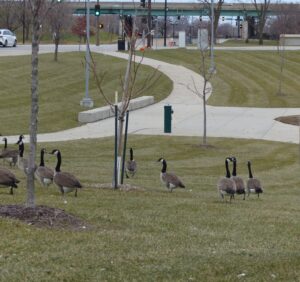
Geese love short grass
Geese Requirements
Geese love water but don’t need massive remote lakes. They prefer the dozens of small ponds at golf courses, corporate and school campuses, and parks. A lawnmower is a goose’s best friend. Well, maybe not a mower, but close-cropped lawns have tiny tender grass shoots that make fine goose dining. Running a mower down to a pond’s edge creates goose paradise. And problems for landowners.
People sometimes put snarling coyote mannequins near their pond to scare the big birds. It might work for a minute or two, but geese are smart. They figure out it’s a fake and nibble tender grass right under the phony predator.
How to Discourage Geese
Some cities reduce goose numbers by locating their nests, shaking the eggs to kill the embryos, which is called addling, or coating the eggs with oil so they won’t hatch. It may work to reduce flock size, but geese are protected by federal and state laws. Destroying eggs without a permit is illegal.
Legal Tricks
Here are less lethal and legal tricks that work, at least to some degree to discourage geese:
- Hold the chow. Folks love tossing stale bread to waterfowl, but it just encourages the crowding of the pesky birds.
- Stow the mower and let the grass grow. Geese shun tall grass. Even better, plant tall prairie grasses near the water’s edge.
- Fence ‘em out. For some reason geese don’t usually cross even small low barriers they could hop or fly over. A fence of lightweight plastic pipe set parallel to the edge of the water may discourage them from entering small areas.
We’ve got them. Geese are fellow city residents. We need to coexist, but a few simple tricks can discourage them from certain areas while still letting us enjoy delightful goose music as they wing overhead.