by Winding Pathways | May 3, 2020 | Birds, Nature
Can you introduce kids to bird watching and get “outside” during novel coronavirus times?
We read a short article written by a diehard baseball fan. She had bought season tickets to her beloved St. Louis Cardinals just before the pandemic hit. When the virus shut down baseball she said, “I’m not watching the Cardinals but I am loving the cardinals……the ones that sing in my backyard.”
Like the baseball fan, many people are enjoying birds in their yards and neighborhoods – often for the first time. Birding is an outstanding hobby and this spring is an outstanding time to start. Being confined to the house and yard is a great opportunity to introduce kids to birds. Also, usually, the best birding of the year is in early May when avian migrants move through and visitors from the far south nest nearby.
Birding requires no license. There isn’t a closed season. Enjoying birds is free and can be done everywhere, even in the biggest cities. It’s a hobby that can be started simply and may evolve into a lifelong passion.
Basic Homebound Birding with Kids

Bird watching is again a joy with hearing aids.
Cost: nothing.
Special equipment needed: None, but a pencil and a few sheets of scrap paper can help record observations.
Encourage kids to watch birds in the yard. Most can identify cardinals, blue jays, and house sparrows but distinguishing species for a beginner isn’t essential. Just have kids note how one type of bird looks and acts differently than others. Essentially how a cardinal differs from a sparrow. Maybe have the kids sketch the birds they see.
The Next Step
Cost: Around $125 for entry-level binoculars and a basic bird book.
Equipment: Binoculars and a bird book and bird apps:
At this stage begin identifying and recording species seen. Read with a child descriptions of the life history, migration patterns, and habitat of different species.
List all the birds seen in the yard. This is the start of a “life list”.
A Little More Advanced
Cost: Not much. The basic equipment listed above works but add in a few dollars for gas to visit nearby habitats.
After a child can distinguish between backyard bird species and has used a bird book or app it’s time to search for more species. Bring along binoculars and a pad and pencil. Visit nearby wetlands, woodlands, and grasslands. Even with novel coronavirus shutdowns, most places allow people to visit parks and natural areas. Each will feature new bird species. Take note of them and read about each. Add new species to the list started with backyard birds.
Igniting a Passion
Most children are curious about nature and seeing just one or two fascinating birds can ignite a lifelong passion that may become a delightful hobby or even a professional career. Advanced birders purchase sophisticated optics and travel the world to see new species and learn more about these fascinating animals. Hopefully, the novel coronavirus will pass soon and the world opens to a youngster with a new birding hobby. It all can start by spotting a blue jay in the backyard.
Where to Get Information
At Winding Pathways, we have many paper bird books produced by several companies. We don’t favor one over the other but often refer to several when we’re trying to identify a bird new to us. Increasingly we rely on the Merlin App created by the Cornell Laboratory of Ornithology. The descriptions of hundreds of bird species, along with photos and calls, is at the tip of our fingers on our iPhones. It’s free. Simply go to the App Store and search for Merlin. The Lab of Ornithology has many other fascinating resources that can be accessed from a computer or smartphone, and we love their paper magazine Living Bird.
The National Audubon Society is highly bird-oriented and has local chapters. Attending a meeting or going on a birding excursion with members is an outstanding way to connect with people who share a bird passion. Some chapters may offer ZOOM meetings. Others hold online excursions to help people get and stay connected. Earth Day saw a host of events online.
We also enjoy reading Bird Watcher’s Digest, a small format magazine that features articles about individual species and places to enjoy them in every issue. The Internet is loaded with many other bird resources.

Alpen optics are good quality with good value.
We are often asked what type of binoculars we use. None of our optics is high end. Rich prefers 8X42 power while Marion’s are 10X42. The first number is the magnification and the second indicates how much light enters the optic. Eight or 10 powered binoculars that give a clear view and fit well in someone’s hands are ideal for a budding birder. Tiny micro binoculars are great for travel but we find them much harder to use than larger ones.
Spring is the best time to see migrating birds, and the novel coronavirus is confining people to yards. It’s an opportunity to take notice of the colorful and interesting wildlife that comes to us. This is a wonderful time for a child to launch a birding hobby.
by Winding Pathways | Apr 30, 2020 | Uncategorized
With Kathleen Horan,
president and CEO of AbbeHealth
We are all now several months into coping with the novel coronavirus pandemic and subsequent COVID-19 disease.
It’s felt like having to walk across a high wire above Niagara Falls with no safety equipment. That stunt was done in 1859 by Jean-Francois Gravelet, also known as Charles Blondin. Totally dangerous. Crazy. Yet, Blondin understood the dangers and had prepared for many years ahead of time.
A salient lesson for today.
While initially, everything seemed topsy turvy in our world, many have found a semblance of a routine that has helped keep insanity at bay. Yet, as this wears on, we find we are wearing out.
Now is exactly the time to remain mindful. And, remember we do have individual and communal safety nets. So, let’s take a look at these.
The Importance of Routine
Kathleen Horan, director of AbbeHealth, points out that “Most people find comfort in routine and predictability. These fundamental comforts have been disrupted leading to anxiety and stress and sometimes a sense of helplessness because it feels like everything is out of control.”
While some compare the coronavirus pandemic with stressful and location-specific disasters such as floods, wildfires, hurricanes, or plane crashes, these disasters are different and require different responses.
“With the 2008 Epic Surge of floodwaters in Eastern Iowa, the lead up was relatively short-lived, the surge came and was devasting, and then we quickly moved in to clean up and recovery stage. We had things to do to start moving back to what we considered ‘normal’.
“With the novel coronavirus and the COVID-19 disease, the anticipation of what might be coming and the unknowns about what lies ahead are very difficult because it feels so out of our control.”
A joke going around is that while the Greatest Generation was called to go to war (WWII). We are called to the couch. We have developed “new” routines and habits. Let’s continue the positive ones after the pandemic has passed.
Revisiting the Grief Cycle and Spiral
With no obvious end in sight, many feel stuck. Spring’s warm weather is coming in the Northern Hemisphere. Fall’s coolness is settling below the Equator.
For those who don’t personally know anyone who has been sick or died, there is even a sense of unreality. Kind of “What’s it all about?” Then, something happens that jars us into the reality of the time. We sink into the sadness of grief.
Remember the cycle comes and goes. Sometimes we are up! Sometimes down for no discernable reason. And, random events trigger a re-visit to the anxiety of an event or time.
It helps to remember that the trigger was NOT the event. The memory is just that. A memory.
Horan reminds us, “Understanding the phases of grief can be helpful for managing the feelings you may be experiencing. There is no special order to the phases of grief that tend to flow back and forth.
- An early phase is Denial & Isolation. It may include a feeling or belief that this isn’t real or that what is happening does not affect us.
- Another phase is Anger. Often this stems from fear and focusing on what has been lost or the things we can’t do right now.
- Bargaining is sometimes referred to as “What If” or “If Only.” “What if I am careful to wash my hands, then I can go out and be safe.” “If only I had….”
- Sadness or Depression is another phase and can include feelings of hopelessness or helplessness.
- Acceptance tends to be an end phase. The recognition that the current situation simply is, and we can figure this out.
Moving back and forth between different phases is normal.
What is in Our Control?

A pet can help us stay calm.
Horan reminded us we DO have safety nets. “Now is a great time to practice self-care. That old adage ‘Put on your own oxygen mask first’ really applies. That we all take care of ourselves is essential. This isn’t selfish; it is important.” Care for yourself physically, emotionally, socially, and spiritually. Engage your mind and your heart. Then, we find we can reach out and support and inspire others.
- Exercise. If you haven’t had a routine or have fallen away from one, break activities into small chunks a few times a day. By the end of the day, you will have exercised more than you realize. This technique breaks up the monotony of being at home most of the time and improves your fitness which can boost your immune system.
- Practice deep calming breaths. Allow your ribs to expand, the diaphragm to drop down and the belly bulge out. After a few times, return to regular and mindful breathing.
- Mantra and mudra. The first is a short saying that helps focus your mind. Some examples that accompany a four-count breath are:
“I am all right.” “I am here now.” “I am calm now.” “I am safe here.” A mudra is a hand gesture. Again, with a four-count breath touch your thumb to each finger as you say a mantra. Together, the breathing, mantra, and mudra help focus your mind and allow positive hormones to counter stress.
- Release tension from various parts of your body starting with your face and shoulders. Mentally move through your body to your feet.
- Other ways to help quiet your mind include: Meditate, journal, read or listen to inspirational music or words, and notice and appreciate the beauty of nature are all.
- Take care of a pet. Caring for another sentient being can give a sense of purpose and calm our nerves.
Horan points out that these simple activities center you in the reality of what is happening now, in this moment.
She adds, “Another great way to calm anxious thoughts is to focus on those things for which you are grateful. Start and end each day identifying five things that make you feel thankful. Write them down. Look at them when you feel distressed. This will help re-center you in gratitude.” And, gratitude produces side benefits.
Reach Out
The free, on-line Yale Class, The Science of Well Being with Dr. Laurie Santos, points out that when we do kind acts for others, we elevate both them and ourselves. Recently we found some flamingos in our yard and a note with homemade chocolate on our porch. My friend and I were bummed out that events we had planned got canceled. So, she and her husband cheered us both up with this hilarious and kind gesture.
The upshot
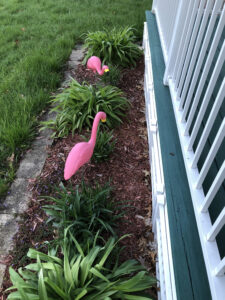
Make friends laugh!
In this “dangerous opportunity” time, doors do actually open for us.
- We can choose to follow current safety guidelines – stay home and wear protective gear when out. We can reach out by phone or other digital means to check on those we love, our neighbors, and our friends.
- We can work on those projects at home that we never get to but now have a little time.
- We can spend that extra time reading to or playing with our children.
Chris Klug, a skilled practitioner gently guided class members through a difficult week. He reminded us that life is like a spiral. We may remember an event or situation. The memory might trigger an emotion. Yet, we have moved from that actual time. It is OK to be with the feeling of grief. Then, as you can, practice the self-care techniques.
Lots have changed and returning to “normal” will not happen. We can right” this topsy-turvy time, adjust, adapt, and form new ways to live and create meaningful lives.
by Winding Pathways | Apr 23, 2020 | Mammals, Nature, Reflections/Profiles, Uncategorized, Wonderment
A few months ago, we posted a blog honoring Smokey Bear on his 75th birthday. Smokey was created by the United States Forest Service in an effort to encourage people to be careful with fire. His was one of the most successful marketing campaigns in history.

The allure of Smokey Bear.
Smokey is adorable yet commanding. When he said to drown campfires and snuff out cigarettes you did it without question. Today, we know that forest fires are a natural phenomenon with beneficial ecological impacts, but Smokey’s message still resonates.
Two Winding Pathways readers shared their memories of Smokey Bear.
Tracy McPartland of Cedar Rapids sent us a photo of her with Smokey taken at the Smithsonian. “I loved Smokey Bear as a kid. I used to voice imitate him even though I don’t know what his voice was like.”

Smokey has been well-loved.
Jim Rainey is a retired US Army LTC who lives in Pennsylvania. Recently, he told us he received a Smokey doll from Santa in the early 1950s when he was four or five years old. “I was enchanted by Smokey. And, my doll still sits on the chair in my office. Sometimes my dog uses him as a pillow. At age 65, or so, he has patches on his jeans, is missing some hair, and part of his nose is gone. A few years ago, we asked our three daughters what they wanted of our stuff and was surprised when our oldest daughter said she wanted Smokey. Before then I was thinking of having him put in my casket, but I really didn’t want him locked in a box for eternity. I’ll let my daughter enjoy him and think of me,” he said.
Rich also has pleasant memories of Smokey and passed his image whenever he entered the Boise, Clearwater, or Idaho Panhandle National Forests during his college years. In 1974 he was a US Forest Service Hot Shot and fought three wildfires in Idaho. He’s kept a Smokey poster on his office wall for years.
There is confusion. Technically he’s Smokey Bear, not Smokey THE Bear.
A former college contact, the Fazio Family, owns Woodland Catalog Smokey Bear Gifts and has a store in Moscow, Idaho. Anyone wanting Smokey items can order it online. There’s a Smokey Bear museum in a state park in Capitan, New Mexico. You can take a brief virtual tour at
Smokey endures for the ages. His message is clear, and his presence is endearing.
by Winding Pathways | Apr 16, 2020 | (Sub)Urban Homesteading, Garden/Yard, Nature, Pests
Lyme Disease is something you just don’t want. Rich has had it twice. It was no fun, and he was lucky. Nearly as soon as symptoms appeared, he visited our family physician. She prescribed a powerful antibiotic that worked wonders and left him with no lingering problems. Unfortunately, many Lyme Disease victims suffer pain and fatigue for years. It’s serious.
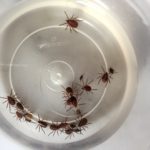
Collection of ticks
Lyme is often transmitted to a human from a bite by a tiny tick that picked up the disease bacteria from an infected white-footed mouse. It once was thought that deer were the primary carrier but mostly they are host to a tiny larval tick that infects a mouse that allows another tick to infect a person.
In theory, eliminating white-footed mice from a yard and home will greatly reduce the odds of transmission of this disease to people. Killing all of them isn’t feasible but reducing their numbers is.
About White-Footed and Deer Mice
White Footed and Deer Mice are amazingly common across much of North America. They’re the cute, native mouse, not to be confused with the common house mouse that originated in the Old World.
White Footeds naturally live in dry temperate forests with brush. That perfectly describes suburban landscaping. It’s likely that five to 20 white-footed mice live in close proximity to most suburban families. They’re nocturnal and rarely seen.
Here are some characteristics:
- They’re hoarders. Find a cache of corn, dog food, or acorns in a shoe or empty can and you’ve found a white-footed mouse cache.
- They reproduce like crazy. A 44-day old female can become pregnant and bear a litter after 22 to 28 days. Babies become independent in three weeks and soon begin having their own babies. Mom often has two to four litters a year.
- They don’t live long. A year-old mouse is elderly.
- Foxes, weasels, hawks, owls, coyotes, and many other predators love dining on mice.
- White Footed mice enjoy coming into homes, where they often find food and enjoy a furnace’s warmth. They can bring with them disease-bearing ticks.
Prudent homeowners carefully manage ticks, in part by reducing white-footed mice numbers. The fewer mice that live near people the lower the odds a person will contract Lyme Disease. So, managing mice and ticks makes for a healthier home and yard. Here are a few tips:
To reduce mouse populations and entry to homes:
- Welcome mouse predators. Karla Bloem, Executive Director of the International Owl Center says, “Two actions people can take to encourage owls are to protect large dead trees that aren’t a threat to people of buildings should they fall. Owls love them. Also, building and erecting an owl house can welcome owls to live near a home and catch and eat mice.” Barred owl nest box plans, and plans for many other birdhouses, can be found at www.nestwatch.org.
- Plug up holes that allow mice to enter a home and replace worn or broken weatherstripping. This is an important fall maintenance that also keeps cold drafts outside and reduces heating bills.
- Avoid feeding mice. They love dining on dog or cat food left in a dish overnight or birdseed left under a feeder. Only feed pets and wild birds what they can eat in a short time. Then, pick up and clean the pet bowl.
- Use snap traps to kill mice in the house. Avoid poison. A poisoned mouse can stagger outside to be caught and eaten by an owl, which can sicken or die from the poison.
A Few More Ways to Reduce Lyme Disease
In addition to reducing mouse numbers and applying a vaccine to keep survivors free of Lyme Disease bacteria here are a few other ways a person can do to reduce odds of infection:

Pants, boots, gaiters and insect repellents help protect from ticks.
Use Permethrin: When applied to clothing, not skin, this chemical repels and kills ticks. Rich purchased several sets of clothing from the Insect Shield Company that are impregnated with permethrin. Supposedly the tick-killing effectiveness lasts for 70 washings. The chemical is also available in spray cans to apply to any clothing.
Do Tick Checks: After being outside, strip down and check the body over for ticks. Then take a hot sudsy shower. Ticks usually crawl around on a person for several hours before biting. A tick merely walking on the skin can’t infect a person.
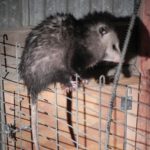
Opossums groom themselves carefully.
Thank and welcome opossums: New research indicates that opossums are tick vacuum cleaners. Ticks climb on them, but these primitive mammals groom often and eat the ticks they remove from their fur and skin. If you have a possum living in the yard be happy.
An Emerging Tool in the Battle Against Lyme Disease
A new product is being developed and tested by a major research company. It is an oral nontoxic vaccine placed in small baits. When strategically positioned around a yard, mice not yet infected with Lyme bacteria eat it and become resistant to the bacteria. Mice uninfected by Lyme can’t spread the disease to a person. If all goes well this product will be on the market by 2021 and may be a major help in reducing human cases of Lyme Disease.
Lyme Disease is an awful condition. Taking precautions to reduce the odds of being infected makes sense.
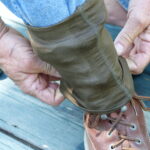
gaiters with tick guard help repel ticks.
by Winding Pathways | Apr 9, 2020 | (Sub)Urban Homesteading, Energy Efficiency
Sunshine On Our Shoulders, Makes Us Happy!
We love John Denver’s famous Sunshine song almost as much as we appreciate sunshine! After a long gloomy winter, the sun finally appeared toward the end of March. We welcomed it into our home and went outside to soak it up.
Although 93 million miles away, the sun constantly sends cheery energy to earth. Without it life couldn’t exist, so we celebrate the sun. Here are some sunny things to be thankful for:
It’s a Vitamin D engine. Sitting in the sunshine helps our body beef up its Vitamin D. This means strong bones for us! And Vitamin D boosts our immune system so we fight infections more easily.

Sunshine benefits us in many ways.
It brightens our house. We are amazed at how many people keep their blinds closed, even in the winter, when they could open them and let natural light warm both the human soul and interior temperature. Sunshine can significantly reduce heating and lighting utility bills, and our nearest star never sends a bill!
It energizes plants. In early April we planted radishes and lettuce in a cold frame on the south side of our home. Sunshine warms those tiny seeds and fuels the miraculous process of photosynthesis that enables plants to grow. Soon we’ll be eating spring greens and enjoying the snappy taste of fresh radishes.
It is one of the best sanitizers. Sunshine can kill bacteria and some viruses. So, we sometimes leave things we want to sanitize in the sunshine before bringing them into the house.
But mostly we savor the way early spring sunshine brightens our mood as it stimulates the winter dormant world into glorious life.