by Winding Pathways | Apr 2, 2020 | (Sub)Urban Homesteading, Foraging, Garden/Yard
Our Yards Offer Nutrition
Every spring we look forward to eating delicious, free, wild greens that grow in our yard and just about every place people live. Having an ability to identify, pick, prepare, and eat wild foods gives us some comfort in this age of uncertainty.
We encourage everyone to boost their backyard food production through gardening, backyard chickens for those who can keep them, and foraging. Here are a few things to consider before picking and eating any wild plant.
- Make sure you’ve identified the plant correctly. Use two sources to confirm identification. These might be an expert forager and a book or Internet source or a combination.
- Make sure the plants have not been contaminated by pesticides, animal feces, or vehicle exhaust. It’s best to forage away from busy roads. Wash plants thoroughly before preparing.
- Eat just a small portion the first time. Although it might be fine food for most people there’s a chance you might be allergic to it.
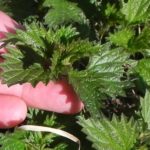
Carefully pluck the top three leaves off.
The key to enjoying all wild greens is to harvest them when they are very young. Many edible wild plants are tender and delicious shortly after they sprout but soon get coarse and bitter as warm weather stimulates their growth.
Nettles, sometimes called stinging nettles, live in moist places near streams, ponds, and woods, where they seem to prefer light shade. We have a couple of patches in our yard. They green up early in the spring, and we pick them before they are ten inches tall. We carefully pick just the top three or four small leaves. Remember these are stinging nettles. Wear light gloves or carefully pinch the top growth off the plant between the thumb and index finger. About a hundred leaf clusters make a great dish for the two of us. Rinse the nettles and boil them for a few minutes. The stinging part is a protein that dissolves in boiling water. We put a dab of butter on the drained cooked nettles and drink the water as a delicious spring tea.
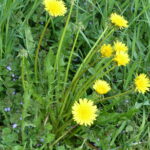
By mid-summer dandelion leaves are tough and bitter.
Because of herbicide companies’ promotions, just about everyone dislikes dandelions. Some have heard that dandelions are edible. It is true and, we need to thank our European ancestors for bringing dandelions to the New World. Otherwise, they might not have survived. They are high in vitamin A, folate, vitamin K, and vitamin C and a good source of calcium and potassium. Today, folks from Mediterranean countries grow and harvest dandelions as crops. They are a popular dish in Italian communities.
The few people who have tried eating them make the mistake of picking mature leaves in mid-summer. By that time, they are bitter and inedible. The best dandelion leaves are those picked in early spring and have been under a blanket of leaves. They’ll be partially blanched and delicious. It’s fine to pick small young leaves that can be added to salads if they are not too bitter. If they are bitter, boil two pots of water. Put the leaves in one pot and boil for a couple of minutes. Drain and put them in the second pot of boiling water and boil for another minute or so. The boiling removes the bitterness. Drain and enjoy with butter and salt and pepper.
This is a year of great anxiety and having some knowledge of how to find free food nearby can remove some of that concern.
by Winding Pathways | Mar 26, 2020 | (Sub)Urban Homesteading, Birds, Nature
*Note: Our assessment of WindowAlert is based on our experiences both from purchasing the company’s product and a complimentary set of decals to try.
Last fall as Rich was walking along the outside of the Cedar Rapids Public Library and found a tiny dead warbler on the sidewalk beneath a large window. Fall warblers are tough to identify but it was a blackpoll. Why did the bird hit the window?
This amazing bird has an enormous migration from the far north of the continent to the south each fall, with a reverse trip in the spring. The bird Rich found probably was only halfway through its autumnal journey. Its death was sad and probably could have been prevented.
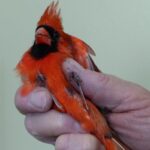
Cardinal
Occasionally we have a bird crash against our windows at Winding Pathways, and a male cardinal persists in cracking his head against a window at our church in Cedar Rapids.
Bird numbers are declining at an alarming rate for many reasons. Certainly, habitat loss and climate change are taking a toll. Feral cats and windows also kill millions of birds every year. Some of that loss can be prevented.
Why Birds Are Killed by Windows?
According to Spencer Schock at WindowAlert, birds are impacted by windows for two reasons. First, all year, but especially during migration, birds simply don’t see the glass and assume they can fly right through it. That’s what happened to the warbler. Second, it’s springtime rivalry. The cardinal banging on the church window sees his reflection, assumes it is a rival and tries to chase it off or intimidate it. This behavior is common, especially among cardinals, and usually happens from late winter into early spring. It’s rarely fatal to the bird but can annoy humans inside the building.
How to Reduce Bird Strikes on Windows.
The simple solution for both types of bird strikes is to do something so the animal recognizes it is glass. Here are some ways to reduce window strikes:
- Close Drapes. But then people can’t see out and sunshine can’t enter.
- Put something over the exterior window that looks to birds like a barrier or physically keeps them away. Draping the mesh netlike material made to protect cherry trees from birds trying to steal fruit works. The downside is that sometimes birds get tangled in it.
- Put decals on the windows to help birds identify a glass barrier. We like the many designs sold by WindowAlert. They’re easy to apply, attractive, inexpensive and work well.
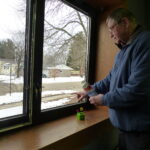
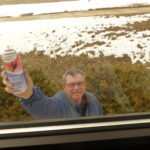
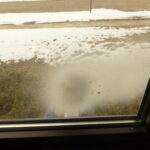
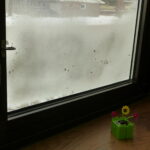
- Eliminate reflection to keep cardinals and other territorial birds from attacking their own image. WindowAlert has a material called Stop Bird Attack. It comes in a spray can that’s sprayed on the outside of the window. The material looks like white flocking put on Christmas trees to imitate snow. It eliminates reflection and can be easily cleaned off the window after the mating season.
-
-
Check the windows first.
-
-
Ready to spray
-
-
The spray makes the window opaque.
-
-
The BirdStop spray resembles Christmas tree flocking.
What to Do When a Bird is Found under a Window
A few times we’ve been sitting in our home and hear a bang as a bird strikes a window. We sadly find the poor animal lying still under the window. There are two likely outcomes.
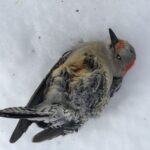
This bird broke its neck hitting a window.
The bird is either dead or dying and there’s nothing we can do to alter that unhappy outcome. e bury the poor creature and add more visibility items to the window.
The bird has been stunned and will soon recover and fly away. Often a bird will recover, but while it is stunned it’s vulnerable to cats and other predators. Spencer advises gently putting the bird in a closed cardboard box or large paper bag. As soon as it has recovered, release it outdoors.
Probably the best thing a homeowner can do to help songbirds is to plant a diversity of native grasses, flowers, shrubs, and trees to create habitat. The next best action is to keep cats indoors and reduce the odds of collisions with glass using the methods described above.
by Winding Pathways | Mar 19, 2020 | (Sub)Urban Homesteading, Garden/Yard, Nature
Stuck at home? A tiny microbe is sure changing the lives of people worldwide. Unexpectedly, meetings and schools have closed and transportation is disrupted as uncertainty runs rampant. With every challenge comes an opportunity. We’re sticking close to home at Winding Pathways but are using more time around the house to do fun things and accomplish projects ignored during normally busy lives.
In the midst of uncertainty, it’s easy to be overwhelmed by events and suffer from lethargy and fatigue. That comes with the turf. So, being physically and intellectually active helps ward off melancholy.
With millions of kids now home with parents and other workers and retired folks staying closer to home and in apartments, here are a few productive activities we suggest. Anyone anywhere can engage in at least some of these activities. And, Winding Pathways invites you to create your own generative ideas to boost your immune system and help us all through this challenging time.
Attune to and with nature.
- Research affirms that contact with nature is calming and healing. Shinrin yoku also known as “forest bathing” is a way to connect with calming elements in nature. This concept extends far beyond the literal interpretation of a forest. Any natural area of any size can provide healing benefits. John Muir wrote it well:
“Climb the mountains and get their good tidings. Nature’s peace will flow into you as sunshine flows into trees. The winds will blow their own freshness into you, and the storms their energy, while cares will drop away from you like the leaves of Autumn.”
By connecting with nature wherever we are, we can learn and have a good time, too.
-
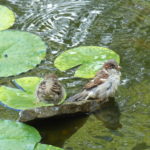
A water source helps attract birds.
Birding: Even in the biggest cities birds abound. Sparrows and pigeons are fascinating. Look closely at a group of birds hanging around the balcony or out the back door and soon you will note individual differences. Size. Shape. Behaviors. One sparrow, for example, may have an unusually colored feather while another has a twisted beak. Once you can identify individual birds, it’s possible to conduct simple research. Do the birds seem to hang out with their friends?
If odd feathered sparrow #1 seems to like being with crooked beak sparrow #2 maybe they are friends……or perhaps mates. How many different species of birds come to the Balcony or yard? You might be surprised. Look up. Spring is migration season and millions of big birds are heading north. Often their route takes them even over big cities. They often fly high so look with “soft eyes” for undulating strings of birds aloft.
Experiment. Put a birdseed mix in a feeder or even on a backyard table or the ground. What seeds do birds prefer?
- When the virus appeared, plants remained in winter mode across much of the country, but spring is fast approaching in the northern hemisphere. Now is a great time to keep a journal, or a simple list of the order in which buds swell and leaves emerge.
Gardening
-
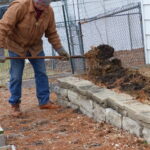
Work the garden to connect with the earth.
Gardening is a great remedy for stress, and it can yield a surprising amount of food, even in a tiny space. One of the best vegetables for kids to plant is the humble radish. These cold, hardy, spicy roots can be planted very early in the spring and often harvest comes in just a few weeks. Lettuce, chard, spinach, and other greens also can be planted early, but beans, tomatoes, corn, okra, squash, and many other veggies need to wait until winter’s frost is just a memory.
Take a walk
- Nature is pretty safe from Coronavirus. It doesn’t lurk in the woods. Poke around the yard. And, a ramble in a nearby park, woods, or along a trail is a stellar way to spend a few hours.
- Another option is to find a labyrinth outside to walk. The World Labyrinth Locator lists labyrinths across the world. A labyrinth is different from a maze. Labyrinths are designed to help people center, release what is on their mind or in their heart, receive inspiration, and reunite with their community in a positive way.
Connect Virtually
- Isolation isn’t fun. Call friends. A phone call is a great way to cheer a friend. And, check in with neighbors you rarely see. Think of ways to direct the conversation to the positive. Live the positive through regular practice. What does this do? Read below.
Practice Mindfulness
-
- Mindfulness is the ability to be present and aware of our thoughts with curiosity and kindness. Jon Kabat-Zinn provides excellent guidance on this. We practice this with adult students at Kirkwood Community College. To a person, they find benefit in reducing blood pressure, anxiety and heart rate, while their sense of calm increases.
- Another form is HeartMath which helps people focus first on breathing, then on creating a peaceful place in their mind that they feel in their heart and can return to anytime when under stress.
- Reduce time on social media and listening to reports on radio or television. Keep abreast as needed and avoid perseverating on the negative.
- Think and behave positively. Norman Vincent Pearle was a master at helping us shift into the positive.
- Laugh! Laughter releases positive hormones and neurotransmitters. An easy way to remember this is to give yourself a good DOSE of levity and positivity. Dopamine, Oxytocin, Serotonin, and Endorphins. These counteract the stress hormones. How can we do this? Read jokes, watch funny films or old TV shows that make you laugh.
-

Healthy foods are important in this time of stress.
Eat Healthily. When we are under stress, we tend to eat more and the wrong foods. So, mind what you eat, drink water, and try some of these activities above and add your own.
-

Reading positive literature will help us.
Read Entertaining Materials. From Comic books to graphic novels to non-fiction, engage your brain, learn and go lightly through this time. Share an engaging article, book, poem or song with someone. Recently The Gazette featured a woman, Mary Fannie Woodruff, from Virginia who continues to bake pies at 103 years old! How cool is that? The article was a great read we shared with family in Virginia.
We have many ways that we can all move through this uncertain time and help each other out on this winding path of life.
by Winding Pathways | Mar 12, 2020 | (Sub)Urban Homesteading, Garden/Yard, Garden/Yard
Like millions of Americans who live in rural or semi-rural areas we don’t have access to a city sewer and rely on our septic tank to safely dispose of waste. We’re lucky at Winding Pathways. Our home is built on an ancient sand dune with steep topography. It’s perfect for a septic system.
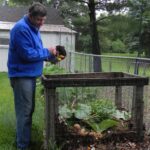
We put scraps that chickens will not eat into the compost bin.
As a review, we’ve been spared septic tank problems because we treat our system carefully. Here’s what we do:
- Only human and sink waste goes down the drain. Potato peels, apple cores, and all other food waste go either to our chickens or into the compost bin. Spring and fall, we work the compost into the garden soil.
- Have our tank pumped every three or four years.
- Avoid draining harsh chemicals, like bleach and solvents, into the tank.
- Use water-efficient toilets, showerheads, and sink aerators to limit the amount of water going into the tank.
In August 2019, we blogged in detail about maintaining a septic system. Since then, many readers have come to that blog. Especially this winter. So, we are curious.
What brings you to Winding Pathways? What topics interest you most? Why? What else would you like to read about?
Thanks for keeping us company on Winding Pathways and happy reading as winter winds down and spring manifests itself across the Northern Hemisphere.
by Winding Pathways | Mar 5, 2020 | (Sub)Urban Homesteading, Chickens
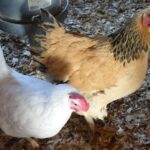
Even healthy-looking chickens can die suddenly.
Our chickens aren’t really pets. We don’t give them names and every once in a while, we sell or give away a few. Even so, we get attached to our hens as we recognize their individual personalities and enjoy their antics.
Maybe it’s silly but we feel sad when one dies. That happened recently when we went into our coop to find one of our Buff Brahmas moping. She was huddled in a corner crouched down into the sawdust litter. The next morning, she was dead.
We carefully examined her and learned she was well fleshed and had no obvious signs of either disease or injury. We’ll never know what caused her untimely death but over the years we’ve developed a procedure we use when a chicken dies. Here’s what we do:
- Carefully remove the dead bird and dispose of its body. We usually either bury it or gently carry it down in the woods and let nature recycle it. Often a raccoon makes a meal of her the first night. Most municipal waste disposal companies will allow putting an animal carcass in the trash if it’s bagged in three layers of plastic.
- Watch the flock for any sign of disease. If more than one bird dies in a short time, we suspect a disease. We would quickly change out litter, sanitize feeders and waterers and consider taking a bird to the vet. But actually, we can’t remember ever having a disease take a second bird.
We’re careful to protect our flock from disease and practice bio sanitation. Isolation is the best way to keep disease at bay, so we rarely introduce an outside bird to the flock. Because we don’t want to introduce disease, we change clothes and wash up after visiting another flock and before going to our chickens.
Remember to always wash carefully after handling chickens, eggs, feed, or even visiting the coop.
Given nutritious food, protection from dampness and drafts, and practicing biosecurity makes it likely that a backyard flock will stay disease-free, but occasionally a chicken dies. Yup, it’s always sad and it’s part of keeping a flock.