by Winding Pathways | Oct 3, 2019 | (Sub)Urban Homesteading, Energy Efficiency, Reflections/Profiles
Greta Thunberg, the 16 year old Swedish girl, overcame challenges posed by autism to sail across the ocean and encourage people everywhere to work to reduce damage to the atmosphere and resulting climate change. She is inspiring, but is she wrong?
Greta’s commitment reminds us of the youthful energy of the late 1960s that led to great progress in environmental protection and civil rights. It is our hope that she’s energizing both young and older people to make our planet’s future safer and fairer.
After Greta spoke at the United Nations critics attacked her for advocating governmental action worldwide to reduce emissions yet didn’t say much about individual action.
Is she wrong? Absolutely not. This young woman crossed the ocean in a sailboat to avoid burning fossil fuel. She advocates government action while demonstrating personal actions to keep carbon out of the air.
Winding Pathways encourages homeowners to heed Greta and enhance the health of the atmosphere, water, and land by living lighter on resources. Here are a few steps we all can do to follow the inspiring actions she advocates:
Reduce Emissions
- Replace the lawn, or part of it, with native plants that don’t require mowing.
- Use a battery-powered, cordless lawnmower to mow the lawn less frequently and to grow higher. This allows, roots to penetrate deeper into the soil and absorb rain.
- Insulate and caulk the house. Few actions are as inexpensive as insulating walls and attics, and caulking holes and cracks that let cold air in. These simple steps cut fuel use.
- Many towns have built safe, pleasant bike trails. Try commuting and shopping by bike instead of by car.
- Fleece is made from recycled plastic bottles and is toasty warm. Wearing a comfy fleece outfit enables turning the thermostat down a few degrees.
Keep Water on the Property
- Replace the lawn, or part of it, with native plants that don’t need irrigation or chemicals.
- Mow less frequently, allowing grass roots to penetrate deeper into the soil.
- Install rain barrels. They harvest rainwater handy to use to irrigate garden plants, fill chicken waterers, or wash hands outdoors.
- Install a rain garden to channel downspout water into the ground instead of to a storm sewer.
- Avoid lawn and garden chemicals. Most lawns and gardens do just fine without them.
- Compost kitchen waste. Vegetable peels, corn cobs, coffee grounds, and even many paper plates and cups readily compost into humus that lawns and gardens love.
Greta’s right. Governments should take action to reduce emissions. So should you and I in our everyday lives.
by Winding Pathways | Sep 26, 2019 | (Sub)Urban Homesteading, Energy Efficiency, Home Improvements
Note: Winding Pathways received no discount or special consideration for selecting DeNeve Construction and writing this blog about class 4 rubber shingles. This reflects our personal experience and research.
Most of our Winding Pathways blogs are about managing a yard for beauty, health, and to attract fascinating wildlife. Sometimes we share house tips, especially about energy savings and photovoltaics.
We just learned something new. Our roof’s shingles had been put in about 20 years ago. They were supposed to last longer but were stiff, beginning to curl, and some nails were poking out above the shingles. It was time for a new roof.

The crew were fast, efficient and friendly.
We received three bids from local roofers and hired DeNeve Construction to do the work. Owner Rick DeNeve met us and said, “I suggest you use Class 4 shingles. They are a little more expensive but resist hail and wind and last longer than normal ones. Give your insurance company a call, and you may get a discount if you use Class 4s.”
We did and learned that we’d receive a whopping 26% reduction in home insurance premium cost by using Class 4 instead of less expensive and durable shingles. That’s a savings of about $260 a year in insurance cost.
“Most shingles have a fiberglass base layer. Every spot hit by a large hailstone suffers damage, and this greatly shortens the life of the roof. Class 4 shingles have a rubber base, and hailstones bounce off without damage,” continued DeNeve.
Life Cycle Cost

Men putting on shingles
Whenever we buy anything for the house, we consider life cycle cost. Simply put, that is the cost of the item based on its average annual cost determined by its expected life. Some examples are the roof, paint, refrigerator, and just about everything else people buy.
In this case, cheap shingles would have saved us about $2,000 on our rather large roof but we could expect to change them within 20 years. Class 4 shingles are likely to last at least 30 years. The upfront cost is a little higher but the long-term cost is lower.
That seems to be a common situation. Anything that’s durable is likely to cost more to buy than a cheap counterpart, but in the long run, it is less expensive and saves money, time and inconvenience of replacing the less expensive product. In addition, durable high-quality items often look and function better than cheapies.
We’re probably not going to be around to ever need to reroof our house, but in coming years we’ll enjoy our insurance discount and a beautiful roof that will resist Iowa’s notorious sleet, hail, and heavy rain.
-

-
The sheathing has no rot.
-

-
Lawn magnet to pick up nails.
-

-
The roof blends well with our landscape.
by Winding Pathways | Sep 19, 2019 | (Sub)Urban Homesteading, Foraging, Nature, Trees
Delicious, Erratic Acorns
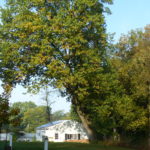
Our back deck at Winding Pathways is an outstanding vantage point for watching butterflies, birds, and even our evening aerialist bats. The deck is perched over a deep, cool ravine with a stately black oak hovering above. That can be a problem.
In most autumns our black oak cascades acorns down to the ground and our deck. Removing them takes aggressive sweeping. Despite the hassle we love acorns.
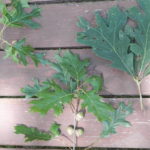
Acorns are, of course, the seeds of oak trees. Hundreds of oak species live across much of the northern hemisphere. They can be a little tricky to identify since oaks sometimes hybridize and look like a blend of two or more species. Many people use leaf shape to identify trees, but oaks may throw a curve. Often leaves, called sun leaves, up on the top of an individual tree are smaller and may have a somewhat different shape than those down lower on the same tree. It can be confusing.
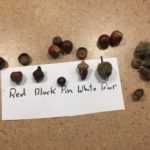
There are two general oak types, the white and red oak groups. White oak type trees include species commonly called white, swamp white bur (sometimes spelled burr), chinkapin also spelled chinquapin, and chestnut oaks. Their leaves have rounded lobes and they produce large acorns with low acid content. Red oak type trees include species commonly called red, black, and pin oaks. Their leaves have pointed lobes and their acorns are usually small and laden with bitter acid.
-
-
Acorns from the black Oak are small and bitter.
-
-
Oaks have different shaped leaves
-
-
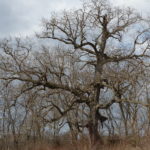
Century Oak Tree
-
-
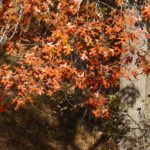
Oak leaves turn russet in autumn.
Acorns
Acorns are nature’s gift to many wildlife species and people. Few seeds are as abundant, large, and nutritious as acorns. Squirrels, chipmunks, muskrats, woodchucks, deer, bears, blue jays, wild turkeys, and a host of other animals gorge on them. The calorie-rich nuts help wildlife put on fat that helps them survive the coming winter.
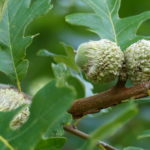
But, there’s a problem. Oaks are erratic acorn producers. As a general rule, the white oak types only create a heavy crop every few years. Red oak type trees are more reliable but still sometimes skip a year of seed production. Sometimes few oaks in a vast area will produce acorns while an individual tree here and there will be loaded. Find a heavy acorn bearer in a scare year and you’ll have the company of many animals feeding on the nutritious nuts. Part of the reason for erratic crops stems from pollination. Oaks are wind-pollinated and a long spell of rain when they bloom in the spring can dampen pollination and eliminate a crop that autumn.
-
-
Acorns set up in the spring
-
-
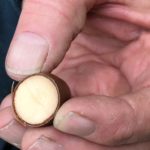
The white meat of an acorn.
-
-
Two kids check out the acorns on a branch
-
-
Iowa has many types of oaks
Acorns are a delicious human food that was relished by native people across the globe. To learn more about acorns and how to process them into food check out the Winding Pathways blog of August 2014 called Delicious Acorns.
by Winding Pathways | Sep 12, 2019 | Birds, Nature
Swapping Birds
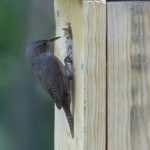
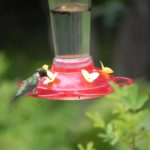
All summer we’ve watched and listened to wren couples who built nests and raised young in our yard. An Indigo Bunting welcomed each summer morning with his song and serenaded the evening until dark. Early this spring, we marveled at the brilliantly colored orioles and grosbeaks who visited. During warm months, hummingbirds flitted up and down and all around outside our windows.
When a long-absent bird suddenly makes its springtime appearance in full breeding color, it’s exciting and easy to spot. We greet spring’s migrants after their long journey north with a hearty, “Welcome Home!” and some seed.
With fall now in the air, our vivacious summer bird friends are drifting away, pushed southward by vigorous north winds. Departure is different from arrival. When they appear in spring, birds are in their glorious mating colors and sing with gusto. They’ve been absent for months until one morning we look out the window – and there they are! It’s magical.
Indigo Buntings and Wrens Leave…
Arrivals are easy to mark. No so departures. By fall many birds have molted into their more subtle nonbreeding colors and just seem to evaporate. No singing marks their departure and figuring out just when they leave is challenging. More often we just say, “Gee, I haven’t heard the indigo buntings for a few days. I bet they’ve gone.”
…and Juncos Arrive
We wish we could help migrants on their departure evening by saying, “Have a safe trip and pleasant winter. See you next spring!” Since we don’t know exactly when they’ll be winging south, they depart without our good wishes. The parting is sad, but we know we’ll soon look out the window and almost miraculously spot the fall’s first juncos nosing around on the ground looking for a few seeds to enjoy for breakfast.
-
-
Wrens busily feed their young and sing all summer
-
-
Hummingbirds zoom up, down, and sideways all summer. Then, head south.
-
-
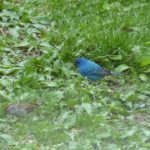
Indigo Bunting and Chipping Sparrow feeding.
Orioles and grosbeaks drift south starting in late summer and our bunting was gone by August 20. Hummingbirds and wrens disappear by late September. Juncos usually appear from northern breeding grounds in October and stick around until April. Then they seem to vanish overnight. But, that’s just before spring’s colorful songsters arrive
by Winding Pathways | Sep 5, 2019 | Nature, Pests
Sometimes the best of intentions turn into a nightmare. A plant down the road from Winding Pathways is proof.
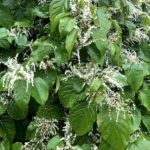
Beware the beauty of Japanese Knotweed.
In the 1840s Philipp Franz von Siebold was in Nagasaki, Japan, and believed a common native plant was so useful and interesting that it should be shared with the world. He shipped cuttings to the Netherlands. The plant thrived and soon gardeners were planting it because of its attractive reddish young leaves, hollow stems somewhat like bamboo, and its showy white flowers that bloom in September. Young shoots are even edible somewhat like asparagus in early spring.
Von Siebold thought he was doing a good thing by bringing this plant to Europe, but soon gardeners realized it was a rapidly spreading monster that crowded out more valuable vegetation. The World Conservation Union calls it one of the worst of the invasives.
It arrived in the United States in the late 1800s as a desirable garden plant, and soon it was found wild in at least 39 states. It’s an invasive problem in England, New Zealand, the United States, and many other countries.
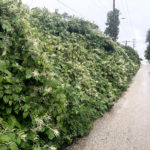
Knotweed forms dense patches and spreads with rhizomes.
Japanese knotweed forms colonies so dense they crowd out all other plants. Rhizomes spread horizontally under the soil surface and soon new plants pop up from them. Early spring shoots have a reddish cast. Leaves are triangular, and the plants quickly grow to four or five feet tall. They are amazingly abundant along streams and lakes. In Iowa, we often see them along roads. They are especially easy to spot when their showy white blooms form in late August and continue into September.
Knotweed is an edible plant in early spring, but anyone with a garden or natural area should be cautious about bringing it home. Drop a node on the ground and it will soon sprout and grow and grow and spread and spread.
Once established Knotweed is hard to control, although continuous mowing should knock it back. It’s something to keep out of the yard, and so far, we’ve been successful at Winding Pathways.