by Winding Pathways | Dec 6, 2018 | Geology/Weather, Preparedness
- Note: Our comments are personal observations. We have not been paid by any company to review their products.
Wildfires in California. Hurricanes along the coast. Blizzards and tornadoes everywhere. In this era of climate change every household should prepare for long stretches without electrical power or even the possibility of evacuating at short notice. And the recent earthquake in Alaska reminds us of the importance of being prepared especially in cold months when food, water, and shelter are critical.
Fortunately, many families have assembled emergency kits that include a mix of essential items useful when the lights go out. For detail see the Winding Pathways article on important items to stock in the kit. Emergency kits can be quickly grabbed if evacuation is needed and the contents help make life more comfortable should there be no need to leave but the house has no electricity.
Two items often are forgotten but become critically important during a widespread emergency. Be sure to keep these on hand:
CASH:
When the power goes out credit and debit cards probably won’t work. Cash always works. Keeping a couple of hundred dollars in small bills makes buying necessary items during a power outage possible. It’s a good idea to hide money somewhere in the emergency preparedness kit.
CHARGING:
When Hurricane Sandy left millions of people without electrical power for weeks a critical problem was the inability to charge cell phones and other electronic devices. The cell network was operating since companies have backup generators. But most people’s phone batteries discharged, and they had no ready way to recharge them. Fortunately, there are several options for charging. Here are two that work well:
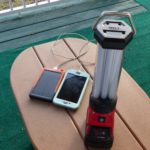
Solar chargers help keep people connected when the power goes out.
Solar chargers: Small inexpensive solar powered devices charge phones when placed in the sun. These are sold in camping and electronic stores. They will work on cloudy days, although charging will be slower than when the sun shines.
Battery chargers: For many years we’ve used Milwaukee brand drills and saws for projects around the house. The company recently sent us an ideal product to solve two problems posed by power failures. It is a light powered by the same lithium-ion batteries that run power tools. The light has a port enabling connection with cell phones. It charges them up quickly. We always keep four batteries fully charged, and each battery will run the light for many hours and recharge a phone several times. The light is surprisingly bright, and we’ll bring it on future camping trips instead of our old gasoline lantern. This device fills two emergency needs-light and charging.
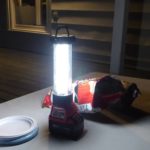
The lantern throws excellent light after dark.
When buying cordless power tools and other accessories it’s a good idea to purchase ones that can both run the tools and charge a phone.
Potable Water:
There is a third item that’s also often forgotten. That’s drinking water. We keep in storage 25 gallons of clean water in five-gallon containers. Should that run out we have two backpacker style filters that remove bacteria and viruses from water. If we need even more water, we keep a few tiny jars of water purification pills in our emergency bin. Water filters and purification tablets are sold in camping stores and are usually marketed to backpackers. These enable purifying water from nearby ponds and streams.
Hopefully, the power won’t ever go out, but the reality is that storms are increasing. Along with them comes higher odds that the power will go out. It’s best to be ready.
by Winding Pathways | Nov 29, 2018 | Garden/Yard, Mammals, Pests
After a balmy fall, the television weather report promised near record cold and snow in three or four days. Mice don’t have televisions but somehow, they knew this because several of the tiny mammals successfully entered our house just before cold arrived. One scurried across the floor as we were reading the morning newspaper.
Years ago we read our then young children a delightful book about a mouse in the house. The story goes: “There is a mouse in the house. It is a very nice mouse. It has a long, long tail and shiny eyes. My mother likes the mouse. But, she says, ‘A mouse does not belong in a house.’”
We agree and have developed a strategy to keep them out – at least most of them.
One tactic we do not do is poison. Karla Bloem of the International Owl Center in Houston, MN, reminds us that poison spreads. When a predator eats a poisoned mouse, it absorbs the poison. Over time, the poison builds up and kills the predator. People end up with more mice that can cause problems.
Here’s what we do at Winding Pathways:
- Encourage predators. We love to hear the barred owls call on dark evenings, and occasionally we spot a red-tailed hawk in a tree out the window. Both are outstanding mouse catchers. Owls work the night shift and hawks the day.
- Keep food secure. If mice smell dinner they’ll come right in uninvited and help themselves. It’s important to never leave food out unprotected. We store grain, flour, pasta, cookies and other foods in metal or stout plastic containers with tight-fitting lids. We don’t leave fruits and vegetables on countertops.
- Tighten up the house. Before it gets cold, we check our house over carefully. Any narrow cracks get filled with caulk. If we find a wider crack, we fill it with expanding foam. Often entry points for mice and insects are around pipes and wires leading into the home. Caulk and expanding foam help seal off the entry. Drain pipes sometimes are entry points. “Chore Girl” type metal cleaning pads work great for filling pipes where liquids or air needs to come and go. Wad up the metal pads and jam them into the pipe. Spaces in the cleaning pads let air and moisture enter or leave but keep mice out.
- Bring out the traps. Despite our best efforts, some mice make it into the house. Usually, we don’t see them but do see their calling cards – their tiny black droppings.
Effectively setting traps
Old fashioned mouse traps still catch mice efficiently, but a few tricks make success more likely. (With the exception of the poison information in this website, we have found this information to be appropriate.)
Bait. Probably the best bait is peanut butter. It just takes a tiny dab on the trigger to work.
Placement. Where you set traps is important. Mice naturally run along walls and dart under counters if they can. Traps set in the middle of a room are less likely to catch mice than those set along a wall with the trigger on the wall side.
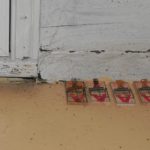
Place several mouse traps where mice tend to enter.
Double up. It’s usually most effective to set several traps in the same spot. So, set two or three touching each other. The first trap or two might not catch the mouse. Usually one will
Keep setting the traps until you catch no more mice. Often people assume they have one mouse, but likely, there are more. Keep trapping until they’re all gone. We dispose of dead mice by simply tossing them outside for our local opossum to eat. They can be flushed down the toilet. Always be sure to wash your hands after handling mice or traps.
by Winding Pathways | Nov 22, 2018 | Garden/Yard, Geology/Weather, Nature

Glacial rocks arrive at Winding Pathways.
A modern glacier visited Winding Pathways in October.
Our area of Iowa doesn’t have much rock. There’s limestone bedrock in some places. Over the top is a thick layer of subsoil and topsoil with one exception. Glacial erratics.
Thousands of years ago the Upper Midwest was a cold world. Summers were so frigid that the previous winter’s snow didn’t melt. It packed down on top of previous winter’s snow and formed ice. Thick ice is fluid. It moves. Slowly. But it moves. Up in today’s Minnesota, glaciers scooped up granite and other rocks and gave each one a grand, if pokey, ride. As the ice inched forward, often southward, it carried rocks. Often they churned along the bottom of the ice, gradually rounding off like pebbles in the ocean surf do.
Fifteen or twenty thousand years ago the climate warmed. Ancient climate change. Instead of expanding, glaciers shrank, leaving their stone cargo in place, often hundreds of miles from where they were scooped from the ground.

This massive erratic is the centerpiece of a new Marion, IA, park.
It’s complicated because there were several glacial periods of warming and cooling. Sometimes a new glacier picked up and moved rocks left by earlier ice sheets thousands of years earlier. The last glacier to visit Iowa melted about 12,000 years ago, leaving erratics here and there in the prairie that was converted to farm fields. Two of the most renowned glacial erratics in Eastern Iowa are Waldo’s Rock in Marion, and Bever Park’s boulder that generations of kids have climbed.
At Winding Pathways, we needed a retaining wall and first considered using manufactured concrete blocks. Then, we met Cody Rossman of Hardscapes. His business crafts glacial erratics into retaining walls. It’s not easy. Those hunks of rounded granite are heavy.
Cody’s crew brought truckloads of erratics to our yard from where the last glacier abandoned them near Troy Mills, Iowa. It took a husky truck about 45 minutes to bring the rocks 24 miles. That’s nearly 30 miles an hour.
It’s not certain how fast glaciers moved rocks, but it was slow. It could have taken years, decades, or even centuries for ice to move our rocks 24 miles. A speedy glacier might move a rock a mile a decade. Maybe a mile a century. Cody’s method was faster.
The wall’s in place. Every time we look at the rocks we wonder about their travel. Probably they originated in Minnesota hundreds of thousands of years ago to end up preventing erosion in our yard. What stories they could tell? Winding Pathways will find out in a few weeks when retired geologist, Ray Anderson visits and inspects the rocks and shares their stories.
Our wildlife also loves the rocks. A chpmunk popped up between two rocks as soon as the work crews left for the day. The uneven rock surfaces and the nooks and crannies between them provide safe living spaces for our chipmunks and garter snakes.
-

-
View of the old wall.
-
-
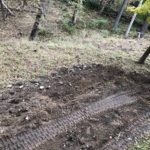
The old retaining wall material was removed first.
-

-
Glacial rocks arrive.
-

-
Sorting the rocks.
-

-
Bobcat moves rocks.
-

-
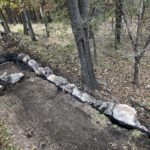
The rock wall takes shape.
-
-
After excavating, geotextile is placed and glacial rocks arranged.
-

-
Hardscapes crew surveying the project.
-

-
The rock wall is firmly in place.
-

-
Limestone slabs are perfect for making steps.
-

-
Milestone steps into the natural area.
-

-
Straw protects grass seed and soil from eroding.
by Winding Pathways | Nov 15, 2018 | (Sub)Urban Homesteading, Bugs, Flowers/Grasses, Garden/Yard, Garden/Yard, Nature

Butterfly on plant
This past summer we enjoyed watching many monarch butterflies flutter over our prairie labyrinth. Numbers were way up from last year.
These intrepid insects are now en route to wintering grounds in Mexico. We look forward to their return next year.
Monarchs suffered huge population declines due to varied stresses on their lives. In farm country, most fencerows, waterways, and pastures that once harbored milkweed and wildflowers that provided both caterpillars and adults with food have disappeared. Today’s farmland is a pesticide-laced monoculture of just a few crops.
In town, manicured and sprayed lawns are as devoid of diversity as a cornfield and can’t sustain beautiful wildlife like butterflies.
The news would be more distressing had people not responded with enthusiasm to the monarchs’ decline. This summer we were delighted to see dozens of homeowners in Cedar Rapids and other towns let their lawns grow taller. Many planted pollinator patches in even tiny yards that include a diversity of native plants, including milkweeds. We took joy in seeing a small patch of milkweeds nurtured by the staff of a convenience store in a tiny patch of dirt near the gas pumps.

Grow a wild patch on your lawn to encourage butterflies.
Every pollinator patch, even if tiny, adds beauty and diversity to our world. We urge everyone to assist wildlife by creating natural plantings, even in urban areas.
Many Iowans have been inspired by the Monarch Zones Project. Founded by Clark McLeod, the Project provides workshops, encouragement, equipment, and seeds to help people assist this beautiful insect and hundreds of other beneficial species that add richness to our lives and health to the environment.
Next spring’s planting season isn’t far off. Now’s a fine time to plan to expand or create a pollinator patch in the yard. For help contact Monarch Research Project. Let’s continue to work together to create wondrous yards.
Bon voyage, Monarchs!
by Winding Pathways | Nov 8, 2018 | Birds, Nature, Reflections/Profiles, Travel/Columns
A tiny migrating warbler changed my life. As I sat on my back deck a few springs ago a tiny bird landed on a twig about ten feet in front of me. I could see it singing but couldn’t hear a thing.
Military Training and Hearing Loss
My hearing loss probably started as an Army trainee in the late ‘60s guiding 50 caliber shells into a machine gun. Every time the gun spit a bullet downrange a massive blast of noise and pressure hit my skull. In later years I spent hours running chainsaws, vacuum cleaners, and lawn mowers. All to the detriment of my hearing.
Hearing loss is an insidious stealthy condition. It crept up on me so slowly and gradually that I never noticed it. My wife certainly knew something was going on as I increasingly asked her, and everyone else, to repeat sentences. Conversation in restaurants became challenging and tinnitus, or ringing in the ears, became my constant companion. Night and day my ears never stop buzzing.
Call to Action

Fitting hearing aids is a process and building a relationship
Seeing, but not hearing, the warbler spurred me to call Dr. Jennifer Reekers at Heartland Hearing Center in Hiawatha, Iowa. Soon I was sitting opposite her in a hearing test booth that confirmed what I already Low-frequency sounds were easy to distinguish but my ability to detect other sounds dropped as high frequency increased. Dr. Reekers shared good news. Thanks to modern technology she could improve my ability to hear and reduce the pesky tinnitus.
Shortly after receiving my new hearing aids I hiked a six-mile trail to Hanging Rock overlook at Effigy Mounds National Monument. Along the trail, I was serenaded by warblers and Orioles. In a moist trailside valley nature’s most beautiful sound brought me joy. It was the first time I’d heard a wood thrush since my hearing declined.
Everyday Sources of Hearing Loss
Millions of Americans suffer hearing loss, often caused by loud noise exposure. Although most people realize that gunshots and fireworks can cause hearing problems, few recognize that exposure to common everyday lower intensity noise causes gradual hearing loss. Vacuum cleaners, blenders, coffee grinders, lawn mowers, leaf blowers, and the dreadfully loud hand dryers in public restrooms can contribute to a permanent hearing loss. Damage is cumulative.
Prevention!
Solutions exist! The best, by far, is to prevent hearing loss by protecting the ears from loud noise. Inexpensive muffs and plugs mute the scream of vacuum cleaners and power tools. I keep a pair by every noisy machine and always put them on before pushing the start button. Rather than allowing a restroom hand dryer I keep a clean handkerchief in my pocket and use it to dry my hands. Parents should be especially careful to protect their children’s hearing by choosing quiet toys over shrill ones and making sure kids wear muffs when exposed to noise.
Ironically enjoying music can contribute to hearing loss. Many concerts are at such a high decibel level that even short exposure can lead to lifelong hearing problems. Fortunately, devices are available from audiologists that reduce the volume of noise entering the ear while retaining sound quality. They enable enjoyable safe listening.
Technology to the Rescue
By the time I recognized my hearing loss, it was too late to prevent it, but the hearing aids restored my ability to distinguish sounds. I will probably always have tinnitus, but technology has diminished its impact. These days I’m careful to muffle loud noise to avoid further damaging my hearing.
Thanks to Dr. Reekers my hearing aids help me enjoy conversation, birds, music, and more of life’s delightful sounds. I encourage everyone to protect their hearing from loud noise and to seek the help of an audiologist to improve their ability to distinguish sounds.

Birding again is a joy with hearing aids, thanks to Heartland Hearing