by Winding Pathways | Feb 15, 2018 | (Sub)Urban Homesteading, Chickens, Garden/Yard, Garden/Yard
Americans Waste Food!
We were astounded to read a news story stating that 20% of Iowa’s trash is food waste. That’s about 556,000 tons of food tossed out by our state’s people, and Iowan’s aren’t unusual. Americans everywhere discard food into the trash or grind it in the garbage disposal and send it off to the sewer plant. Other solutions exist!
Winding Pathways isn’t a contributor to this vast waste because we manage our family food carefully. Our main way of reducing waste is buying carefully so we don’t end up with more perishables than we can eat in a reasonable time. It saves money at the market, but still, a lot of scraps result from meal preparation.
Save Money. Create Soil.
Instead of tossing out potato and carrot peels, bits of rice that get caught in the sink strainer, onion skins, shrimp tails, egg shells, coffee grounds, and a host of other organic matter we separate it into two bowls that we empty daily.
Our first bowl becomes chicken treats. Our 14 hens love shrimp tails, wilted lettuce, bread crusts and other items we can’t eat. When we approach the coop with our scrap bowl our hens rush to meet us and devour the treats with considerable enthusiasm. In a day or two they return the favor by presenting us with delicious eggs.
Our second bowl is everything the chickens won’t eat or we don’t want them to eat and includes potato peels, egg shells, coffee grounds and filters, avocado skins, citrus fruit skins and other relatively course organic items that most folks toss in the trash. These become the ingredients for rich compost.
Our composter is gradually filled overwinter. We create a layer of food scraps a couple of inches thick and then add a layer of chicken manure mixed with wood chips from the coop and ash from the woodstove. Manure is another gift from our hens that speeds up the composting process. The layers gradually decompose, and by spring we harvest outstanding rich compost to dig into our garden.
Return on Our Dollar
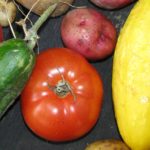
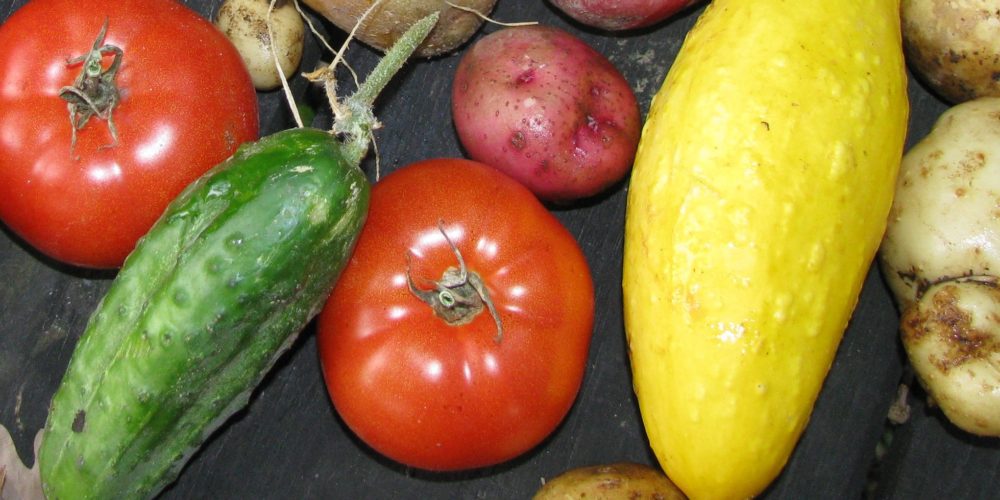
Summertime meal from the garden.
We don’t buy fertilizer. We make it from food scraps. Beans, squash, carrots, okra, chard, kale, lettuce, and tomatoes seem to jump from the compost-enrichened soil, and on many summer days everything we eat comes from the yard.
Then we return the little scraps from our garden vegetables to the chickens or compost pile, completing a cycle of abundance. We save money and spare the landfill unnecessary waste.
by Winding Pathways | Feb 8, 2018 | Geology/Weather, Nature
Ice is a miraculous substance. Actually, it is water that is so amazing. Ice is just one of its three phases.
Water is essential for life and one of its unusual characteristics is how it behaves when its temperature drops. Like most substances water contracts as it gets colder, but unlike other substances, it reaches maximum density at 39 degrees Fahrenheit and then expands as it gets colder. Finally, when it freezes at 32 degrees Fahrenheit it expands.
That’s huge! If Ice were denser than water, it would sink to the bottom of a lake or pond. The surface would continue to freeze and sink until by mid-winter the lake would be all ice. Few creatures could live there.
Instead, when water freezes it expands and gets lighter. It floats on the colder water beneath and insulates the water, so it doesn’t freeze all the way to the bottom. Ice is merely a veneer floating on water, enabling life in the liquid below it.
It might be 20 below zero in the air above the ice but down in the water a fish basks in the relative warmth of water in the 30s.
When lake ice gradually cools as fall’s temperature drops a beautiful result happens in some years. On one cold, clear, calm night the lake will form a layer of crystal clear ice several inches thick. It’s hard and usually safe to walk on.
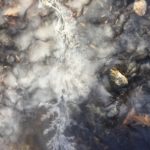
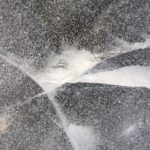
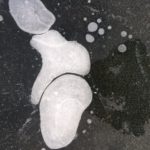
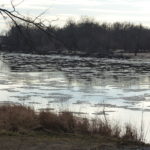
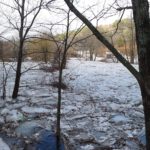
The walk reveals amazing patterns of cracks and fractures. Clear ice gives a lake walker the sensation of striding on air with a clear view to the bottom beneath the feet. For an idea of the beauty of ice, enjoy these photos taken at Cedar Lake, Denville, New Jersey, in January 2018.
-
-
Bald Hill Ice
-
-
Ice Fractures
-
-
Fascinating patterns in the ice.
-
-
Ice expands as its temperature drops, so it floats!
-
-
Photo by Bob Fehsinger
-

-
Learn to enjoy lake ice safely.
by Winding Pathways | Feb 3, 2018 | (Sub)Urban Homesteading, Garden/Yard, Garden/Yard
Each winter we love discovering colorful seed catalogs in our mail. The landscape may be snowy and the air frigid but flipping through catalogs and savoring photos of flowering prairies and ripe tomatoes makes us think spring.
We buy many types of seeds for our prairie and woodland restorations, the chicken run and the vegetable garden. Often, we order from several companies and buy some seeds in local garden supply stores.
Like many wildflower enthusiasts, we prefer buying seeds grown as close to our Iowa home as possible. They are well adapted to our climate and soil. Googling NATIVE PLANT SEED SOURCES will steer anyone to seed companies close to where they live, even if that’s Australia!
Here are some of our favorite sources:
SEED SAVERS EXCHANGE, 3094 North Winn Road, Decorah, IA 52101. www.seedsavers.org. This is our favorite source for garden vegetable seeds. The catalog lists hundreds of varieties. Many are heritage types hard to find anywhere else. It’s where we buy seeds for Silver Bell winter squash, our favorite. Seed Savers is a fun place to visit located near the college town of Decorah, Iowa.
ALBERT LEA SEED HOUSE, 1414 West Main Street, Albert Lea, MN 56007. www.alseed.com. We’ve bought prairie wildflower seeds and a few pounds of turnip seeds that thrived in our chicken run from this company, and we enjoy visiting their fun store.
ERNST SEEDS,8884 Mercer Pike, Meadville, PA 16335. www.ernstseed.com. A few years ago, we were looking for buckwheat seed to plant in our chicken run. We found it at Ernst Seeds, and it thrived. Ernst sells a wide range of seeds.
ION EXCHANGE, Harpers Ferry, Iowa, www.ionxchange.com. Ion Exchange sells both seeds and started plants for prairie and woodland restorations.
PHEASANTS FOREVER, www.pheasantsforever.org. This conservation organization sells seed mixtures especially developed to provide wildlife habitat and food. It is an excellent source of reasonably priced seeds for planting large areas.
Seeds are one of nature’s miracles. Given the right care and location each tiny and seemingly dead seed brings life to the land that is a feast for the eye and palate.
by Winding Pathways | Feb 1, 2018 | Nature, Reflections/Profiles
Winter is the season of cold and darkness but there’s no reason to stay inside. It’s an outstanding time to enjoy the yard, a wetland, or a nearby woods, and these places are even more fascinating after dark than they are by day. Just use your night vision.
Winding Pathways encourages everyone to bundle up and go outside, especially after January or February’s darkness descends. Perhaps coyote songs or the haunting call of a barred owl will greet an intrepid nighttime listener.
There are some ways to best enjoy the darkness. Forget the flashlight. Well, maybe tuck it into a pocket but mostly keep it off. The best way to degrade night vision is using artificial light. Better to learn how to see in the dark.
Color Deficiency Can Help with Night Vision
Rich Patterson, a co-owner of Winding Pathways is lucky, sort of. He is unable to see the color red well. He’s not color blind as he can see blue, yellow, green, and some red shades, but he doesn’t see red as people with normal color vision so. For some reason, folks with color deficiency vision often have an outstanding ability to see after dark, and Rich enjoys his night vision, is often outside after dark, and hardly ever uses a flashlight.
There’s more to seeing after dark than having a color deficiency and better than average night vision. Everyone can use these techniques to negotiate the night and their homes at night without a flashlight.
Relax the eyes. Forget peering for detail, like the texture of a tree’s bark. Rather look out of the edges of the eyes for patterns that indicate a tree, rock, lawn, or some other object. Once the eyes are trained to work well at night it’s amazing how easy it is to walk a forest path, without a flashlight on a dark night. Or navigate your home in the dark and when the electricity goes off.
Foot Gear for Outdoor Walking
When outside, wear soft-soled shoes or in warm months, go barefoot. Thick hard-soled shoes, like hiking boots, make it impossible to feel the ground’s texture. Softer, pliable soles help a walker feel the trail. Native Americans knew this well and felt their way through dark forests through the soles of their moccasins.
It helps to mute electric lights in the house before venturing outdoors after dark. It takes a few minutes in darkness for eyes to adjust and allow more light to strike the retina.
Moon Shadows
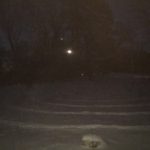
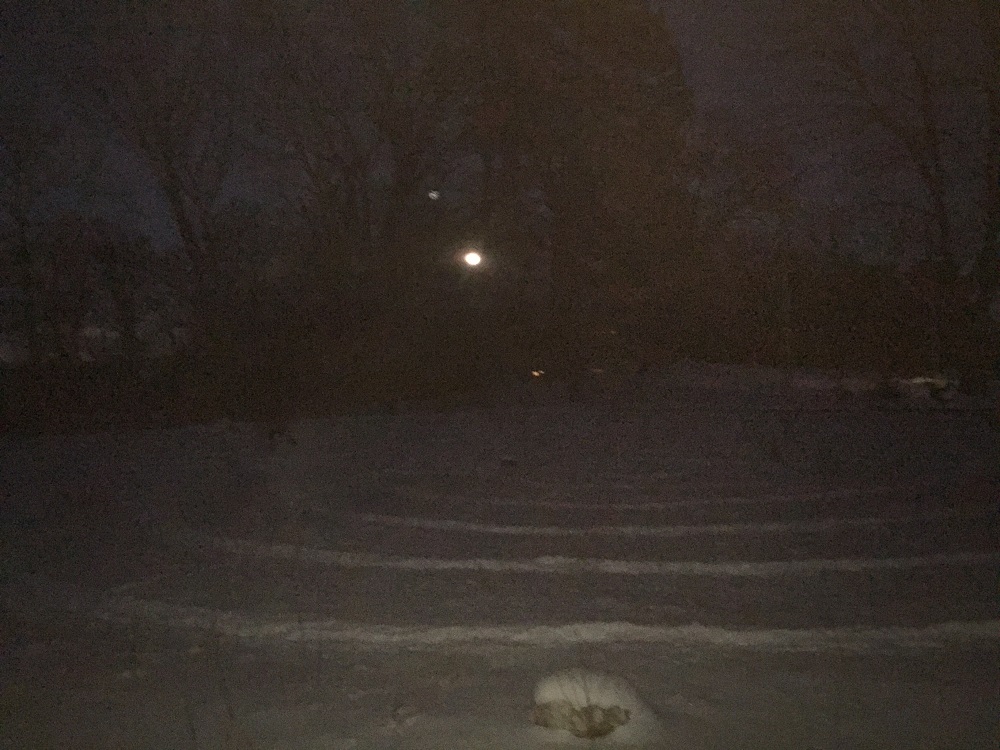
Full Moon Walk New Year’s Night
There is a surprising amount of light on a dark night especially in winter with snow on the ground. Even in the dark of the moon, stars cast enough light on a clear night for an adept human to walk without a flashlight. With a waxing or even waning full moon, plenty of light is cast on the ground for us to see. The moon’s reflection even casts shadows: Moon shadows!
Pre-Dawn Labyrinth Walking
Since late December 2017, Marion has walked the Phoenix Harmony Labyrinth every day and mostly in the early morning. In cold, wind, full-moon and dark of the moon, fog, and snow, she has quietly trod through the snow, watched the stars, noted animal tracks and generally enjoyed this interlude in the dark.
Cave Dark is Real Dark
An interesting experience is taking a cave tour. Visit Carlsbad Caverns, Mammoth Cave, or nearly any other cave and invariably the guide will gather everyone and turn off the lights. Down in a cave there is no light at all. When there’s no light it’s impossible to see, but fortunately, a backyard or woods at night is much lighter than the depths of a cavern, so seeing is possible.
Go outside after dark and have fun.
by Winding Pathways | Jan 25, 2018 | Mammals, Trees/Shrubs
Winter is the best time to spot dens and nests. Usually, we think of bird nests, and we see abandoned ones topped with mounds of snow along roadsides and in shrubs. When we look up, we also spot large clusters of leaves and sticks – squirrel nests.
Squirrels make two types of nests: dens and dreys. Dens are cavities in trees and dreys are the large balls of leaves and sticks that squirrels fashion. From the ground, these dreys look small, but they are really good sized.
Dens
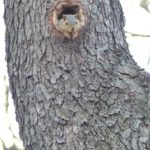
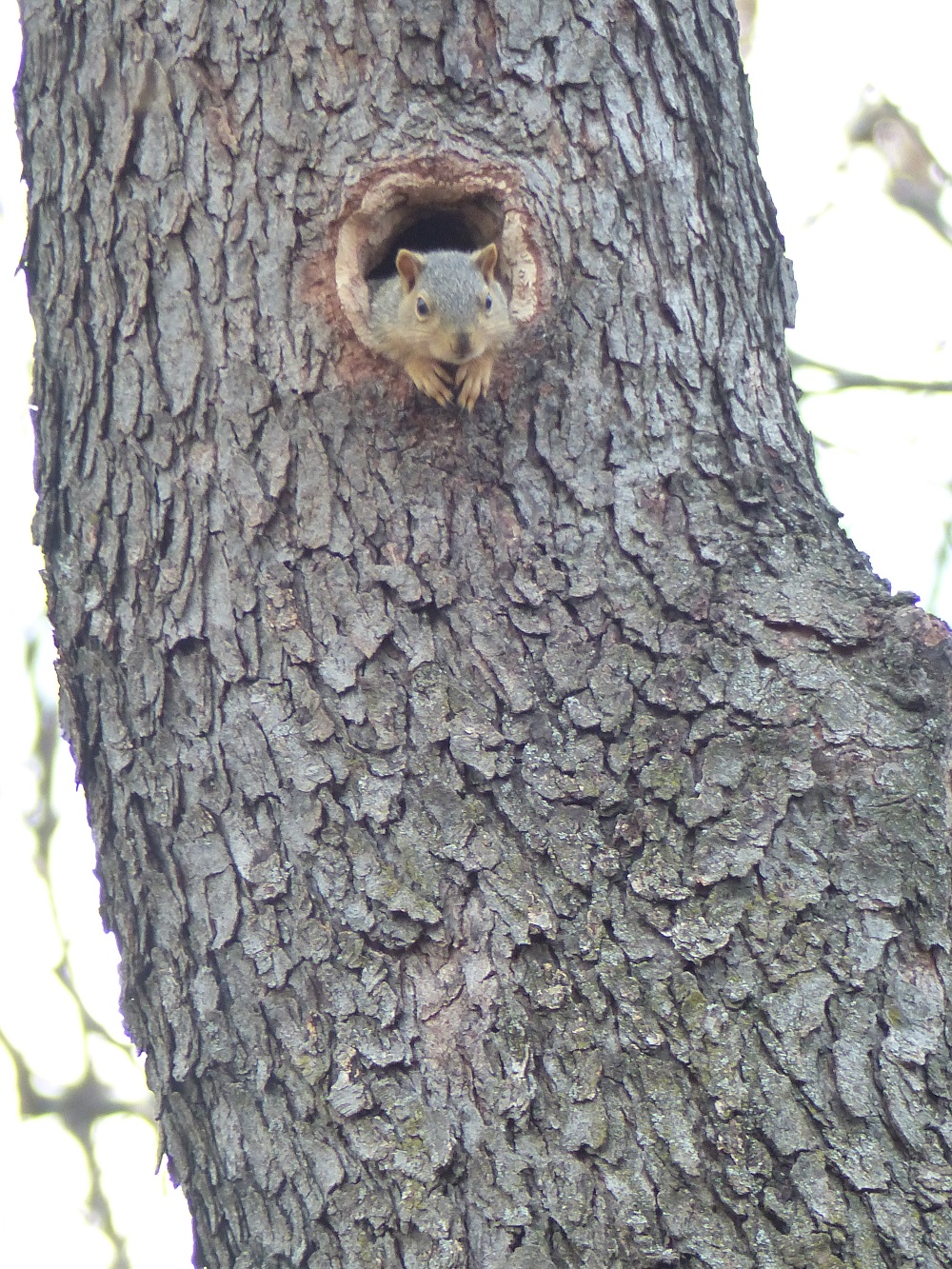
Taking in the view from the safety of a tree den.
When squirrel families mature in late summer, the young venture forth to find new lodgings. If the population of squirrels is low and the availability of hollows in trees is high, then squirrels take the dens. These are hollow spaces inside the trunk that squirrels line with leaves and bits of fur and bark. Squirrels do not create these hollows but use them. Wood rot and woodpeckers create the spaces and squirrels make the most of them. Dens offer great protection from the elements and predators and they are warmer. So, squirrels conserve their energy when they must “hole up” during winter storms. When the worst of the harsh weather passes, squirrels begin to stir, digging for nuts and raiding bird feeders.
Dreys
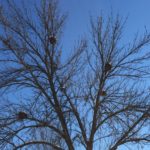
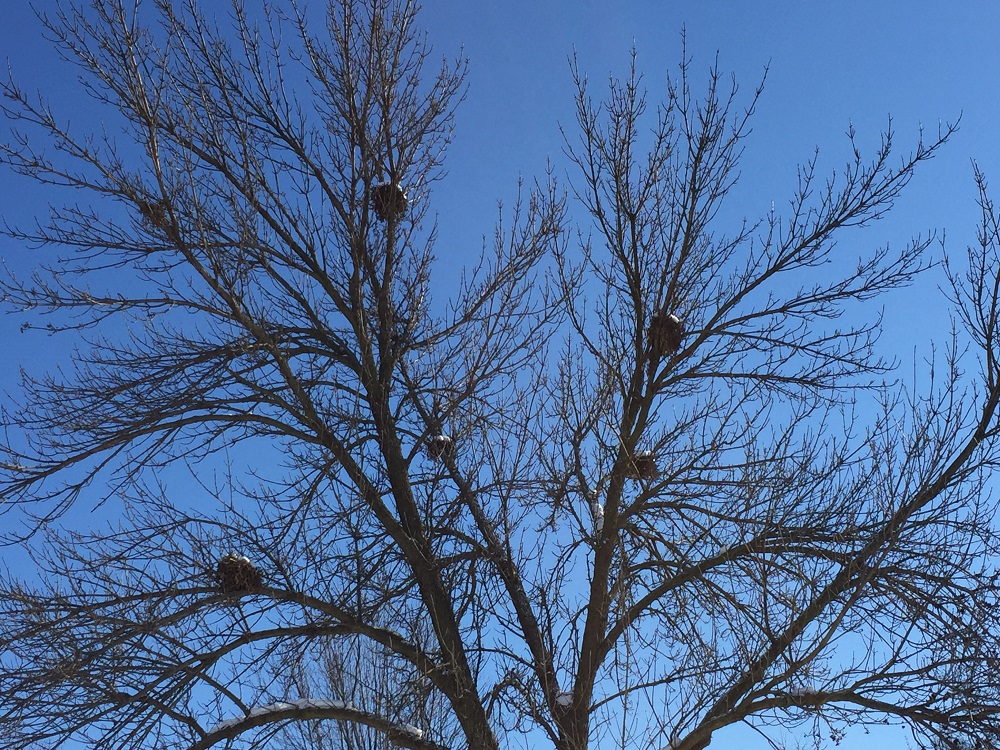
Squirrel Condominium
Squirrels make their dreys near sturdy forks in branches or close to the tree trunk. They will be high up for protection from predators. Usually, a tree might support one or two squirrel nests, but occasionally, we see half a dozen scattered throughout a wide-branching deciduous tree. Squirrel condominiums. These might be secondary homes or extensions of families. Secondary homes tend to be more loosely constructed and are scattered near the main home tree and serve as shelter in case a squirrel gets caught out in the elements or is being chased by a predator.
Each nest begins with a study base of twigs. Scientists have discovered that sometimes squirrels weave grapevines into the structure along with leaves, bark, moss, and twigs for added support. After all, the nest sways in the branches and get buffeted by winds, rain, and snow, so it needs to be strong. Inside, the nest is dry and warm.
When you are driving or walking look up and spot the nests of one of our most industrious small mammals. Squirrels mate in January and soon the young will be born – in the bleak mid-winter maybe in a squirrel condominium near you!