by Winding Pathways | Mar 8, 2017 | Children/Play, Wonderment
This blog from Community Playthings caught the eye of Winding Pathways. Indeed, today’s society is too concerned with correctness, cleanliness, and convention. A Buddhist saying goes something like this: spend twenty minutes outside everyday. If you think you are busy, spend an hour. At Winding Pathways we find this to be true. No matter the weather we try to get outside to see the sun or stars or clouds; to experience the wind or cold or heat; to feel the rain or snow on us. We keep our bearings, feel the roughness and gentleness of the environment and learn. Observe the changes of the seasons, find your Cardinal Points using the sun and structures, listen for the birds, watch the sky. Be. Above all, let kids be kids to slop around, spin, jump, tumble, get filthy dirty and then enjoy a warm bath and fresh clothes with a cup of hot chocolate and conversation. Go Outside and Play!
by Winding Pathways | Mar 7, 2017 | (Sub)Urban Homesteading, Flowers/Grasses, Foraging, Nature, Weeds
As soon as a few warm days arrive early each spring we search our yard at Winding Pathways for two of our favorite plants – Stinging Nettles and Dandelions.
To most people they’re weeds. To us they’re delicious yard gifts.
STINGING NETTLES
Stinging nettles are one of the tastiest of all wild greens. They begin growing very early each spring and are usually ready to pick about the time when gardeners plant spinach and lettuce. In Iowa that’s sometime in April. Nettles love moist soil at the edge of woods where they receive partial shade. Often they’re common on yard edges. Nettles are well named, because they can sting! Another name for the plant is “three minute itch”, because the slight stinging sensation is just temporary. There’s a way to avoid the “itch.”
We pick nettles when they are only a couple of inches tall. To avoid the sting, we either wear light gloves or carefully pluck off the top few leaves between the thumb and forefinger. About 100 leaves are plenty for dinner for the two of us. We bring the plucked nettles into the kitchen, rinse them well, and boil them for just a few minute. It’s really more like steaming them as we only put about a half inch of water in the pan. Once steamed the sting disappears. Put a dollop of butter on them with a sprinkle of vinegar and enjoy as the year’s first green crop.
We continually pick from the same nettle patch and each plant constantly creates new leaves at the growing tip. This extends the picking season for over a month, and by then our spinach is ready to harvest from the garden. For the rest of the growing season, foraging insects enjoy the nectar of the nettles.
DANDELIONS
Almost everyone knows that dandelions are edible but most people who try them quickly toss the bitter plants out and never try again. Take heart and try again! Dandelions are revered in many eastern cities where Italians live. Festivals abound across the country “…from the Redwood forests to the Gulf Stream waters….” (apologies to Woody Guthrie) and the Amana Colonies in Iowa are known for their dandelion wines. Google Dandelion Festivals to find one near you. One coming up for St. Patrick’s Day is Dandelion Days in California.
Dandelions are delicious but there’s a trick to enjoying them. The best ones are picked in very early spring when the leaves are brand new. Those poking out from under leaves are semi blanched, lack bitterness, and are delicious and packed with vitamins. As soon as dandelion leaves are full size they are too bitter to eat without special processing. Young blanched leaves can be eaten raw in salad or steamed.
A CAUTION
Before eating any wild plant for the first time make sure you correctly identify it, using at least two sources for identification……….an expert forager and a wild food book, or a wild food book and a credible website, for example. Our all-time favorite source for wild food information is Euell Gibbons’ classic book STALKING THE WILD ASPARAGUS. If you spot one at a used book sale snap it up as quickly as you do fresh nettles. Some helpful websites include Eat the Weeds , Eat the Weeds You Tube Videos, and Food52. Episode 134 of Eat the Weeds features neighborhood foraging. At about six minutes, Green Deane, the host, shows and talks about dandelions.
by Winding Pathways | Mar 6, 2017 | (Sub)Urban Homesteading, Preparedness

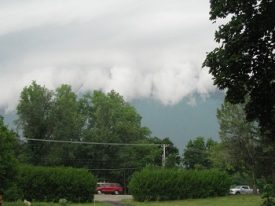
Thunderstorms carry the risk of wind, lightning and power outages.
The United States seems to have one storm season followed by another. The year starts with blizzard threats and then transitions into tornado season. That’s followed by hurricane season until blizzards again become possible in late fall.
Many people have prepared for loss of utilities caused by a huge storm. They have food, water, and emergency lights ready, but Hurricane Sandy revealed that many had forgotten one important modern survival need.
When Sandy shut down electrical service to millions of Americans cell phone companies turned on their back-up generators and the system continued to work. But, most cell phone owners had no way to recharge their phones and other electronic devices. Being unable to use their phone caused anxiety. After a few days many towns set up charging stations in public buildings powered by big generators, but to use one involved a drive and wait.
An outstanding item to add to an emergency pack is a back-up battery and emergency cell phone charger. Many solar powered chargers are on the market. Often they are marketed to backpackers and wilderness trekkers, but they work just as well in the city. Simply plug the charger into the phone and put it in sunshine and it will recharge the phone’s battery.
Another solution is to keep handy a back-up battery that will charge a phone. Many are on the market, and even cordless tool batteries often have a port that enables power to flow from the tool’s battery to the phone. A spare battery will often recharge a phone a couple of times. Solar chargers are limitless but the sun needs to shine.
- Winding Pathways does independent, unpaid reviews of products.
FOR DETAILS ON HOW TO STOCK A PREPAREDNESS KIT SEE THE WINDING PATHWAYS BLOG.
by Winding Pathways | Feb 28, 2017 | Birds, Nature
Nearly everyone who feeds birds across the eastern United States enjoys luring

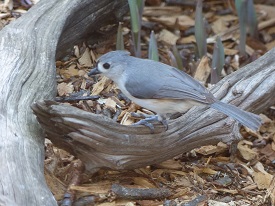
The tufted titmouse is a year round resident in much of the Eastern United States. It’s late winter call is a sure sign of spring.
the black capped chickadee, white breasted nuthatch, downy woodpecker, goldfinch, and cardinal to the yard. All are fascinating nonmigrating birds of deciduous forests and suburbia. We love all these birds but especially enjoy the tufted titmouse.
The titmouse also loves living in suburban areas and wooded places. It’s a homebody that doesn’t migrate, so they can be seen all year. However,titmice are most commonly spotted when visiting feeders for meals of sunflower seeds.
The titmouse has a more limited range than chickadees or nuthatches. At Winding Pathways in Eastern Iowa we are near the northern and western edge of their range. From Iowa they range east to the Atlantic Ocean and south from New England to the Gulf of Mexico.
A titmouse has a surprisingly loud voice for such a small bird. We enjoy hearing them as we walk in our yard. To learn more about this beautiful bird, and to enjoy its song go to the Cornell University Laboratory of Ornithology’s website.
by Winding Pathways | Feb 20, 2017 | Birds, Nature, Pests
A recent article in LIVING BIRD Magazine reported that cats kill more than 2.4 billion birds each year in the United States. Their numbers came from the book, CAT WARS, by Peter Marra and Chris Santella.
use cats are fascinating animals that are loved by 600 million people worldwide who keep one or more as pets. They’ve been part of the human experience since at least the dawn of agriculture. Descended from a species that remains wild in Saudi Arabia, Israel, and other Middle Eastern countries, cats were informally domesticated as early as 10,000 years ago. Probably the earliest semi tame cats were wild individuals who lived near cultivated fields and hunted mice and other pests. At some point people began taking them into their homes as pets.
House cats followed humans as they spread around the globe and today are common wherever people live. Unlike many domestic animals that long ago lost their ability to survive in the wild, cats often go wild. These “feral” animals have a high reproductive rate and can create a large wild population in a relatively short time. Often these colonies of feral cats prey on animals that have no defense against them.
Cats never lost their ability to hunt and continue to catch animals, especially mice and other small mammals. Unfortunately they are also effective bird predators. Cats kill more birds than collisions with buildings, power lines, and wind turbines combined. They pose a serious threat to some bird populations.
There is a simple way that cat lovers can enjoy their pet while reducing the impact of these fascinating animals on birds…….keep them indoors.
For more information:
Cat Wars: The Devastating Consequences of a Cuddly Killer. Princeton University Press.
The Cornell University Laboratory of Ornithology.
*Note: Winding Pathways is not paid by companies we feature.