by Winding Pathways | May 2, 2017 | (Sub)Urban Homesteading, Preparedness
At Winding Pathways we wrote periodically about preparedness. Usually, it’s related to the potential for seasonal weather-related events. Almost every day someone somewhere suffers damage from a tornado, hurricane, ice storm, blizzard or some other natural disaster. Sometimes we simply discover an alternative use for emergency equipment. Sterno is one! It’s as simple as a quick way to heat water for tea or coffee while working in the cabin or out camping.
We all realize that when the power goes off it’s helpful to have back up lighting and cooking equipment on hand. Propane and liquid gas stoves designed for camping are ideal for emergencies when the power goes off, but they are pricey. A lower cost alternative is a “Sterno” stove or equivalent. These are inexpensive lightweight stoves that fold flat and take almost no storage space. They are sold in big box stores that stock camping equipment.
The common fuel for these stoves is “Sterno”, a gel made from alcohol and contained in a small aluminum cup. You pry off the lid, stick the fuel cup in the stove, light it, and it’s ready for cooking. Sterno stoves cook slowly. They’re not the best for elaborate cooking but are perfectly suited for a few days of light meal preparation until the power comes back on.
We’ve found that fuel cans sold in restaurant supply stores and called “Chafing Fuel” are less expensive than buying fuel in a camping store. These are mostly used by caterers for keeping food warm at buffets, and they work great for emergency cooking, too! For information go to Sterno Products.
Please note that Winding Pathways has no connection with the Sterno Company. We like their products but have not received money or materials from them.
by Winding Pathways | Apr 18, 2017 | (Sub)Urban Homesteading, Birds, Nature
At Winding Pathways, we venture into our yard nearly every day, even if it’s raining, windy,

Some birds homestead at Winding Pathways.
or frigid out. Of all the times, early May is our favorite to linger outdoors. Why? It’s the best birding.
Very late April and the first couple of weeks of May boast normally glorious weather, blooming flowers and birds. Lots of birds, including those we can only enjoy for a fleeting week or two.
Here’s how we group the birds that we enjoy in our yard. Odds are the same or similar species follow this pattern in backyards with good habitat across much of the continent.
THE HOMEBODIES
Some birds don’t migrate. They brave the cold and grace winter feeders. In summer, they often raise broods of babies on the edge of the yard. These include titmice, chickadees, cardinals, nuthatches, house sparrows, and many woodpeckers.
THE NORTHERNER
Juncos are almost always under our feeders all winter gleaning seeds. To a Junco Iowa is the balmy south with a “warm” winter. Around mid-April they head north to nest in the boreal forests of Canada and Minnesota. We won’t see them again until around Halloween.
THE LOCALS
Many people consider the first sighting of a Robin to be a sign of spring. They assume the birds just arrived from the south. Robins, and closely related bluebirds, aren’t ambitious migrants. As the weather cools each fall, they abandon suburbia and move to nearby brushy areas for the winter. Winter Robins are common in orchards, the edges of farm fields, and wherever they can find dry and frozen fruit. These much-admired birds do a dietary switcheroo each year. Robins are famed worm eaters, and during warm months, they mostly eat insects and other invertebrates. In winter, they’re mostly vegetarians and dine on frozen berries. In years when fruit is scarce they’ll move south until they find suitable foraging.
THE HOMESTEADERS
Many birds are true migrants that winter far to the south but return north to raise a family. Among these true migrants are house wrens, rose breasted grosbeaks, orioles and indigo buntings. The homesteaders that nest at Winding Pathways have reached their northernmost destination but many of the same species simply rest and eat for a day or two before flying further north to nest. They are mere passersby.
THE AMBITIOUS MIGRANTS
Many birds are serious migrants that winter in South or Central America or the southern US and wing north to Canada and even Alaska to nest, only stopping to rest and eat for a day or two on their long journey. Many are warblers, although dozens of other bird species only use Winding Pathways as their “quick stop” on the way north. We can only enjoy the procession for a week or two in early May as the migrants stock up and then catch the next southerly winds to propel them to their nesting areas.
BIRDING AT ITS BEST
What’s remarkable about early May is the sheer diversity of birds that visit yards. It’s the best time to bring a cup of coffee and pair of binoculars outside. Sit quietly and look and listen to discover the amazing array of birds not possible observe in other seasons. A good bird book helps with identification but we often use the resources of the Cornell University Laboratory of Ornithology to help us identify and learn about birds. Their website at includes outstanding information that helps us determine species by both sight and sound and we frequently use their MERLIN phone app when we’re hiking or camping.
by Winding Pathways | Mar 7, 2017 | (Sub)Urban Homesteading, Flowers/Grasses, Foraging, Nature, Weeds
As soon as a few warm days arrive early each spring we search our yard at Winding Pathways for two of our favorite plants – Stinging Nettles and Dandelions.
To most people they’re weeds. To us they’re delicious yard gifts.
STINGING NETTLES
Stinging nettles are one of the tastiest of all wild greens. They begin growing very early each spring and are usually ready to pick about the time when gardeners plant spinach and lettuce. In Iowa that’s sometime in April. Nettles love moist soil at the edge of woods where they receive partial shade. Often they’re common on yard edges. Nettles are well named, because they can sting! Another name for the plant is “three minute itch”, because the slight stinging sensation is just temporary. There’s a way to avoid the “itch.”
We pick nettles when they are only a couple of inches tall. To avoid the sting, we either wear light gloves or carefully pluck off the top few leaves between the thumb and forefinger. About 100 leaves are plenty for dinner for the two of us. We bring the plucked nettles into the kitchen, rinse them well, and boil them for just a few minute. It’s really more like steaming them as we only put about a half inch of water in the pan. Once steamed the sting disappears. Put a dollop of butter on them with a sprinkle of vinegar and enjoy as the year’s first green crop.
We continually pick from the same nettle patch and each plant constantly creates new leaves at the growing tip. This extends the picking season for over a month, and by then our spinach is ready to harvest from the garden. For the rest of the growing season, foraging insects enjoy the nectar of the nettles.
DANDELIONS
Almost everyone knows that dandelions are edible but most people who try them quickly toss the bitter plants out and never try again. Take heart and try again! Dandelions are revered in many eastern cities where Italians live. Festivals abound across the country “…from the Redwood forests to the Gulf Stream waters….” (apologies to Woody Guthrie) and the Amana Colonies in Iowa are known for their dandelion wines. Google Dandelion Festivals to find one near you. One coming up for St. Patrick’s Day is Dandelion Days in California.
Dandelions are delicious but there’s a trick to enjoying them. The best ones are picked in very early spring when the leaves are brand new. Those poking out from under leaves are semi blanched, lack bitterness, and are delicious and packed with vitamins. As soon as dandelion leaves are full size they are too bitter to eat without special processing. Young blanched leaves can be eaten raw in salad or steamed.
A CAUTION
Before eating any wild plant for the first time make sure you correctly identify it, using at least two sources for identification……….an expert forager and a wild food book, or a wild food book and a credible website, for example. Our all-time favorite source for wild food information is Euell Gibbons’ classic book STALKING THE WILD ASPARAGUS. If you spot one at a used book sale snap it up as quickly as you do fresh nettles. Some helpful websites include Eat the Weeds , Eat the Weeds You Tube Videos, and Food52. Episode 134 of Eat the Weeds features neighborhood foraging. At about six minutes, Green Deane, the host, shows and talks about dandelions.
by Winding Pathways | Mar 6, 2017 | (Sub)Urban Homesteading, Preparedness

Thunderstorms carry the risk of wind, lightning and power outages.
The United States seems to have one storm season followed by another. The year starts with blizzard threats and then transitions into tornado season. That’s followed by hurricane season until blizzards again become possible in late fall.
Many people have prepared for loss of utilities caused by a huge storm. They have food, water, and emergency lights ready, but Hurricane Sandy revealed that many had forgotten one important modern survival need.
When Sandy shut down electrical service to millions of Americans cell phone companies turned on their back-up generators and the system continued to work. But, most cell phone owners had no way to recharge their phones and other electronic devices. Being unable to use their phone caused anxiety. After a few days many towns set up charging stations in public buildings powered by big generators, but to use one involved a drive and wait.
An outstanding item to add to an emergency pack is a back-up battery and emergency cell phone charger. Many solar powered chargers are on the market. Often they are marketed to backpackers and wilderness trekkers, but they work just as well in the city. Simply plug the charger into the phone and put it in sunshine and it will recharge the phone’s battery.
Another solution is to keep handy a back-up battery that will charge a phone. Many are on the market, and even cordless tool batteries often have a port that enables power to flow from the tool’s battery to the phone. A spare battery will often recharge a phone a couple of times. Solar chargers are limitless but the sun needs to shine.
- Winding Pathways does independent, unpaid reviews of products.
FOR DETAILS ON HOW TO STOCK A PREPAREDNESS KIT SEE THE WINDING PATHWAYS BLOG.
by Winding Pathways | Feb 19, 2017 | (Sub)Urban Homesteading, Energy Efficiency
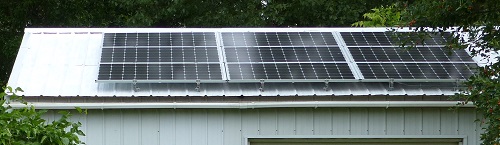
Sunlight hits our solar panels at a different angle in the fall and winter.
To: Robert Dix, Brad Duggan, and Lisa Henderson (all helped us with photovolotaic)
What we’ve learned from our PV System
This week our photovoltaic system has given us a great learning opportunity. We’ve now had several crystal clear days and the envision monitoring system clearly shows the electric production hour per hour. It’s fascinating to me to learn that our peak power comes at 12:30 p.m. and when I go out and look at where the sun is this is when it is precisely pointing at the PV system.
The PV system and the monitor have encouraged me to observe how the sun moves throughout the day and over the seasons. This education is a strong positive side benefit of PV.
by Winding Pathways | Dec 20, 2016 | (Sub)Urban Homesteading, Preparedness
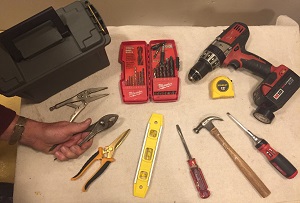
We keep an array of hand tools for small projects around the home and yard.
Our home at Winding Pathways shares needs familiar to every homeowner or renter. Things break, new items need to be assembled and pictures need to be hung. A basic set of household tools makes common tasks easy, even for people not particularly handy.
We have dozens of tools. Many are specialized, and only occasionally used but our list of frequently used tools are ones that will prove useful in every home. *Here are our favorites:
Pliers. Three types. One is a simple pair of gripping pliers used whenever something needs to be held tightly. A second is needle nosed (or long nosed) pliers used to grab and hold small items. They make fishing small items that fall into crevices easy. The third is a pair of locking pliers, often called “Vice Grips”. They make it easy to tightly grip something using only one hand, leaving the other free to do work.
Screwdrivers: A quality, old fashioned slotted screwdriver is invaluable around the house. We use ours for all sorts of things that have nothing to do with driving a screw. Prying and scraping are only two of dozens of uses. A few years ago we bought a much more useful screwdriver for inserting and removing screws. It’s actually a multi screwdriver all-in-one tool. If you have ever climbed up a ladder to remove a screw only to discover that the screw’s head is different from the screwdriver in hand, you will find this tool the best! Our new one has six different bits, all designed to fit different types of screw. Various bits are stored in the handle, making it almost certain the tool will work no matter what type screw is encountered.
Cordless Electric drill: The only power tool on our list is an amazingly versatile tool. Drilling holes is only one of many tasks it completes with ease. In addition to a case of drill bits of various diameters other bits are actually screwdriver tips or sockets. They make fast work installing or removing screws, nuts, and bolts. Many other attachments fit on a drill, including buffing and sanding wheels. We can’t imagine not having this tool. Corded drills need to be plugged in, making them much less convenient. Cordless models come with rechargeable batteries that provide much power before needing to be put back on the charger.
Ear Muffs: Loud noises lead to gradual hearing loss. We wear muffs whenever we are around loud machine noises – blenders, vacuum cleaner, lawn mower, power tools, and this time of year snow blowers!
Utility Knife: Useful for cutting cardboard boxes and most anything else. Most hold spare sharp blades in the handle.
Adjustable Wrench: These come in many sizes but we’ve found the eight inch models best for common household uses. The tool adjusts to fit nuts of various sizes.
Level: A small compact torpedo type level is amazingly useful for hanging pictures, or leveling a table or desk.
Hammer: Hammers aren’t really obsolete. We use ours to drive nails but also to tap the screwdriver when prying or scraping and for many other tasks around the house. Years ago, Marion’s mom standing at a towering 4’9” willed her tiny hammer to us that works amazing well for light projects.
Scissors: These aren’t office scissors but heavy duty shears that easily cut through heavy packaging materials, thin metal, and cardboard.
Black Tape: Sometimes called electricians tape, this isn’t strictly a tool but it’s amazingly useful in holding things together or temporarily patching a dripping pipe or exposed wire.
HOW TO ACQUIRE TOOLS
Quality hand tools are a joy to use and so durable they can last for generations. We are using wrenches, screwdrivers, and a hammer that are as functional today as they were to our grandfathers purchased them 80-some years ago. New quality hand tools can be purchased today – but beware! Many poorly made models are on the market and sold mostly in discount and big box stores. They are less expensive than good ones but aren’t as reliable and probably won’t be around to pass on to the next generation.
We buy our tools in two places – garage and estate sales that often include vintage hand tools. They may be a bit rusty, but we’ve bought quality tools for pennies. After refurbishing they are as good as new. When in the market for new tools we head for a specialty tool store. These are where professional carpenters, plumbers, electricians, and other craft people buy their tools and equipment.
Our favorite store in Cedar Rapids is Acme Tools. They only sell quality tools made by many manufacturers and we’ve never been unhappy with any tool purchased there. In recent years we’ve been purchasing Milwaukee brand tools at Acme and have found them top notch. “We only sell high quality tools, and our sales people are experts always happy to help customers select the right tool for their needs and show them how to safely use it,” said John Guidinger, General Manager.
Quality tools are more than just tools. They are well designed and crafted instruments that feel good in your hands and help making tasks a pleasant experience.
*Blogger Note: These are independent, unpaid reviews.