by Winding Pathways | Oct 16, 2025 | Amphibians/Reptiles, Garden/Yard, Nature, Water Resources
Wildlife Parade
Of all the wildlife attractions we’ve created at Winding Pathways nothing beats our tiny pond’s wildlife parade. Hardly the size of two king beds, it proves that even a miniscule water feature is one of the best ways to lure fascinating animals into a yard. How and why do ponds attract wildlife?
Simple: Animals need water. For shelter and nurishment.
We actually didn’t create our pond. It was here when we bought the property, but we’ve spiffed it up. At about 80 square feet and less than two feet deep its but a speck of water set beneath our dining room window.
A Pond Out of Place

Wildlife attractant
It shouldn’t even exist. Our house is built on an ancient sand dune. Water percolates quickly into the soil and no natural pond or stream would have a chance of staying wet here. Fortunately, the previous owners had a hole dug and lined with a waterproof membrane. They then had it lined with stones and planted water lilies in a shallow bit of mud over the membrane. We’ve added native vegetation and domestic flowers that attract insects, birds, mammals and amphibians.
Wildlife Attractant
While eating every meal we watch the pond. Wild turkeys, cardinals, titmice, nuthatches, and house sparrows, are among the regular residents that come to drink within a few feet of where we sit. This spring a mallard pair swam in tiny circles during the two weeks they rested on their way north, and a few times wood ducks have settled in to rest. Each summer and fall hummingbirds forage on the succession of plants like Solomon Seal, Purple coneflower, Obedient Plant and other seasonal flowers. Although there is plenty of nectar, they also seem to prioritize “scuffling” with each other. Insects routinely make their rounds to the flowers.
-
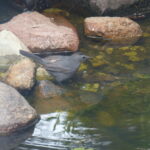
-
A catbird drinks by a pool.
-

-
Birds stop for a drink and to fill up on the berries nearby.
-

-
Keeping a wary eye, the robin cautiously gets a drink.
Squirrels, chipmunks, and deer visit routinely. Once a mink jumped in for a quick swim. Cagey woodchucks sip and scoot off when they spot any movement inside.
We can figure out how all these animals make their way to the pond’s edge.
Baffling Visitors
However, some visitors and temporary residents baffle us. Every spring toads and tree frogs call from the pond’s edge and lay their eggs in the shallow water. Where did they come from and how far did they have to hop? Do they use a “hop-ometer” to measure their hops?
-
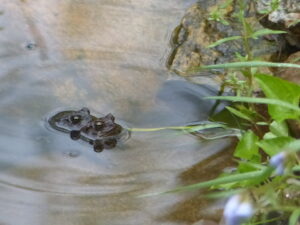
-
Toads need water to mate.
Unusual Visitor Returns

Safe from predators
In the summer of 2020 an amazing visitor arrived at our pond unannounced. That same year, COVID-19, the Outdoor Writers Association of America held their conference virtually and sponsored the photo hunt with the theme “home.”
Marion’s photo of a frog sheltered in the pond’s egress won third prize!
That was the last we saw of frogs until this summer. Then, while we were eating lunch we spotted a bullfrog sitting on a rock at the pond’s edge. Frogs and ponds go hand in hand but what’s puzzling is, like with toads and tree frogs, how this frog knew our pond was there and how it found its way to it. Our home and pond are about a half mile from Indian Creek, the nearest body of water. And, we’re almost 200 vertical feet above the creek!
Long Way to Hop
To reach our pond the frog had to hop a long way through thick woods and prairies filled with animals that would love a frog dinner. Hawks, owls, snakes, coyotes, raccoons, opossums, and skunks live in the area and would quickly convert a hapless frog into lunch. Somehow our frog survived the gauntlet of predators and a long hop.
Our frog gives us joy watching it and we marvel at how it was able to hop into our lives.
-

-
Sunning
Opportunities To Create A Pond
Many wildlife lovers set up bird feeders and create diverse plantings to lure wildlife into their yard. They might consider taking it a step farther and building a tiny pond to entice a stream of wildlife to visit. Wonder how to do it? Check out thisoldhouse.com/yards. Scroll down for a good read. There are also several credible YouTube videos that show how to create a tiny yard pond.
by Winding Pathways | Oct 9, 2025 | Birds, Nature
Consecutive Walks Turned Somber
While on different hot September morning walks my day was saddened by the death of a warbler, a nighthawk and pelican.
I (Rich) often walk around Cedar Rapids’, (Iowa) Cedar Lake. It’s near downtown, an interstate highway, and train track. While noisy and industrial it is close to home and sports a paved trail that makes a heart pumping pace easy. Usually, it’s a pleasant 30 minutes to round the lake, sometimes with pauses to watch geese and pelicans silhouetted against nearby factories.
What Could Have Caused its Death?
On different fall mornings I found recently dead birds in the trail. First a warber and another time a white pelican. As I gently picked up the warbler, I looked above me to find a high overhead power line. September is migration season and likely the bird was unable to see the wire and crashed into it in darkness. A couple of days later, the same thing happened. This time the dead bird was a pelican.
Identifying the Species
Fall birds, especially warblers, have recently molted and their fall/winter plumage is often far drabber than their bright springtime breeding wardrobe. What had I found? It looked like a warbler but many fall warblers look similar. It takes an experienced birder to make a positive identification. I didn’t know the species so I took a photo and emailed it to Dr. Neil Bernstein, a good friend, ornithologist, and professor of biology.
Then I gently placed the bird under a nearby shrub to let decomposers do their work and went home. Neil asked me to return and attempt to recover the bird to help with identification. So, I strapped my walking shoes back on, walked the lake trail and recovered the bird’s body and took another photo. “It’s a warbler. Probably an immature Nashville,” he said.
I also emailed the photos to Jim Berry, another friend and retired director of the Roger Tory Peterson Institute in New York. Both he and Neil eventually agreed it was a Nashville Warbler.
Barriers to Identifying Certain Birds
It made me feel better that it took two experts’ close inspection to identify it. I struggle telling one warbler species from another, partly because many look so similar and partly because I have a red/green color deficiency. That makes it hard to see plumage the way most folks do.
High Wires Are Problems for Pelicans
Cedar Lake is a perfect stop over for pelicans both spring and autumn. But, the high wires on one side of the Lake create flying harzards as these large birds attempt to take off or land. Surely a way can be found to reduce hazards for migrating birds.
-

-
Pelicans rest on Cedar Lake.
-

-
High wires are one hazard for these magnificent birds.
Somber Way to Start Church
A few days later on a Sunday, again, we found another bird that apparently had a high wire encounter and came out on the losing end. A beautiful nighthawk lay crumpled and dead in the church parking lot. Right overhead were long, thick wires strung across an open space.
-

-
High wires over chuch.
-

-
Dusk is nighthawk time.
People Inadvertently Kill Birds

A collision with the overhead wires may have caused the Nashville Warbler to die.
Industrialization created hazards that birds never needed to face throughout their long evolutionary journey. Combined these hazards cause millions of birds to needlessly die.
In the week since I wrote the above blog and before Marion could post it we found a dead nighthawk under power lines and a dead pelican under lines near where I’d found the dead warbler.
Overhead wires and towers: Birds don’t see them in their flights on dark nights and crash into them. Unfortunately, there’s not much a casual person can do about it. It’s estimated that powerlines kill upwards of 64 million birds a year. We can advocate with utility companies and communities to reduce bird kills. Creative ways do exist.
Lights: Lights left on after dark confuse migrating birds. Here’s our big and simple opportunity to help them. Turn off your home’s exterior and yard lights. The dark helps birds migrate.
Cats: Well, cats aren’t technology but they are major unnatural bird predators if they’re allowed to run free. A solution is to let the family tabby outside in a Catio that keeps it away from birds. See our earlier blog on catios.
Helping Birds and Plotting Migration
Marion and I help birds by diversifying the vegetation in our yard, and we’re cautious about lights. We rarely have outdoor lights on after dark. If we need to walk outside, we carry a flashlight. We never leave them on overnight. It wastes electricity, gobbles up money needlessly, and outdoor lighting does not necessarily “prevent” crime.
Modern technology creates bird hazards but also helps anyone track migration. Especially during the fall and spring migrations we check the Cornell University’s Laboratory of Ornithology’s Birdcast Migration Dashboard at birdcast.info.
It’s free to anyone. Simply access the site and type in a county and the site will tell how many birds flew over the night before, approximately when the heaviest migrations took place, and the direction and altitude of flight. Data are gathered by precise radar and the information is truly fascinating.
Why be concerned about birds? Fish eating birds like pelicans can rid waters infested with “trash fish”. Nighthawks patrol the evening skies and gobble up insects like mosquitoes that bite and can cause diseases such as West Nile Virus, common in the autumn. Warblers feast on tiny insects in trees helping to keep the trees pest free. Birds add color to our lives. And, remember, when you are outside and hear soft bird song, your surroundings are safe. When danger is abroad, either the area is silent of bird calls or the “alarm birds” like crows and blue jays, let you know to be alert with loud squaks.
May companies and communities work together to reduce dangers and help the avian wildlife that quietly helps us.
by Winding Pathways | Sep 18, 2025 | (Sub)Urban Homesteading, 1080 Labyrinth Blog, Flowers/Grasses, Garden/Yard, Nature

Dancing in autumn’s breezes.
An autumn pleasure is sitting on our front porch watching Maxmillian Sunflowers – Summer’s Goodbye wave as they dance in September’s breeze.
Our yard is a seasonal progression of color from spring’s delightful dandelions that grace our mowed yards to Maxmillion’s final wave. In early summer our porch view is of pale purple coneflowers that gradually yield to common purple sunflowers. Then yellow coneflowers, purple prairie clover, compass plant and rattlesnake master make their appearance as white clover looks like sprinkles on the lawn. We can tell the month by what’s blooming.
Autumn’s Hello
Fall’s a time for both joy and sadness. As summer’s warmth diminishes we know we won’t see our flowery color for months, but three blooms give us late summer gladness.
First comes the goldenrod of many species. We spot their earliest blooms on the final days of July but they come into full glory in late August and September. Then they’re joined by asters of several species. Our favorites are tiny flowered heath asters and deep lavender New England asters. And the surprise pink petaled New England aster.
-

-
Important pollen producer. NOT an allergenic.
-

-
New England Asters and goldenrod blooming
Final Actor
The final actor to appear in the season’s progression of blooming color is the Maximilian Sunflower. Ours thrive in the south part of our labyrinth prairie and stretch higher than prairie grasses. Even a slight breeze entices their golden blooms to dance above the prairie as if to say, “thanks summer for your warmth and water.”
They are stalwart and resist early fall’s frosts and keep dancing. Their final bow of color coincides with a hard freeze.
About Maximillian Sunflowers
Maximilian sunflowers are true sunflowers with many relatives. They are a perennial native to the Great Plains and tallgrass prairie, but people have planted them all over the world. Tall and vigorous, they make a delightful backdrop to a prairie or flower garden.
Supporting Actors

Goldfinches show up in the yard when various sunflowers bloom and turn to seed.
As a final delight our resident goldfinches love dining on any nutritious sunflower seeds. They start with cupplant and move on to Maximillian Sunflowers.
We delight that the blooms are exactly the same yellow hue as late summer male goldfinch feathers.
Brightening Autumn’s Days
Dancing sunflowers are a delight. Perhaps it’s sad that they herald an approaching winter, but they brighten fall’s gorgeous weather and lure us to sit on our porch
by Winding Pathways | Sep 4, 2025 | (Sub)Urban Homesteading, Nature
Blog by guest authors, Peg and Angus!
Our dog, Angus, and I were sitting on the deck one summer afternoon. I was reading and Angus just looking around. Suddenly, I heard a commotion.
Angus got all excited and started barking. It turns out, a bear commotion!
I looked up and there was a big (200-300 lb) black bear climbing the maple tree beside us. About 40 feet away.
Fortunately, Angus was on his run and close to me so I could get hold of him and hurry us both into the house. He was not a willing participant in this process! The bear just watched us the entire time. It took quite a while before my hands stopped shaking enough for me to take pictures.
I think what scared me most is that Angus showed no fear and kept barking at the bear. I wasn’t sure how the bear would react to him but it totally ignored us. As much as I like to be outside I was very happy to be in the rest of the afternoon. No more bear commotion for me or Angus.
-

-
Boots and dog
-

-
A fierce character
From safe inside, my husband, Bruce, and I watched the bear as he (just guessing) relaxed on a large limb and munched away. Eventually he climbed down, lumbered across the yard, found our dwarf apple tree and stopped for dessert of green apples. Eventually he wondered off into the woods.
I love seeing wildlife but he was too close and way too big for me!
Click on the links for other bear encounters in the East. One in Virginia and another in New Hampshire. Of course, in Alaska, bears are common. And troublesome.
-

-
Bear standing tall.
-

-
Deck in foreground
-

-
Curious
by Winding Pathways | Aug 28, 2025 | (Sub)Urban Homesteading, Bugs, Garden/Yard, Garden/Yard, Nature
Early one humid summer morning we discovered lawn lace in the yard. Dozens of laces were scattered on the grass and mulch we’d put around trees. Dew drops on their tiny filaments sparkled in the early morning sunshine. What had we found? Who made them?
As kids we called them fairy rings and marveled at their delicate nature.
-

-
Fairy rings.
-

-
A delicate lacing on evergreen shrub.
Shelf Spiders

The hole reveals the entrance to the web.
They were crafted by industrious hungry spiders overnight. We call them shelf spider webs because they are positioned horizontally. Others call them funnel or tunnel spiders. Look closely to find a hole, usually toward the side, where the spider lurks.
The web isn’t sticky but has so many tiny filaments that a wandering insect often gets its feet tangled there, slowing it down. In a flash the fast-moving spider is out claiming its breakfast.
What Are They?
There are many species of shelf spiders found throughout the world in the genus Aselemidae. Some 111 species live north of Mexico. They pose no threat to people, but may pose a major threat to bugs, who often see the conspicuous webs but not their builders. The web’s architect and builder stay hidden. By late morning sunshine has usually evaporated the dew, making the webs hard to spot. They’re best enjoyed when the world is cool and fresh at dawn.
We usually think of shelf spiders as a September yard feature but in 2025 we began seeing them in July. We like them. Their dainty webs are as intriguing as they are beautiful. Perhaps more important, the presence of these spiders indicates that the lawn is healthy. It’s not been poisoned with insecticides. This allows harmless insects to thrive in the turf to feed the spiders.
Surrounded by Spiders
Many people consider spiders threatening, ugly, and undesirable animals. Come Halloween some even stretch fake webs in their porch to scare trick or treaters. A few spider species can inflict a painful and dangerous bite, but most species are tiny and hardly ever seen by people. They cause no problems and live in lawns, gardens, prairies and trees. They are beneficial.
Want to learn more? An interesting resource is spidermentor.com.
We enjoy watching brown creepers, nuthatches and warblers climbing tree trunks or flitting around branches. They’re often foraging for tiny protein-rich spiders. Even in the depths of winter dormant spiders provide food for hungry songbirds.
Be happy if some morning you spot lawn lace. Shelf spiders have been at work setting their intricate traps to catch a breakfast of tasty insects.