by Winding Pathways | Aug 21, 2025 | (Sub)Urban Homesteading, Birds, Garden/Yard, Nature, Reflections/Profiles
We savor our quiet yard moments.
One of our favorite nature writers, Joseph Wood Krutch, remarked that anything people do creates noise. It seems that the clanks and roars of life are increasing since he wrote those words years ago. Quiet is a rare pleasure. Unfortunately, noise doesn’t respect property lines. It does trespass into yards and homes. It’s hard to avoid.
Life Before the Industrial Revolution
Imagine life before the Industrial Revolution. No cars, factories or trains and no power tools. A 1700 era ship could glide by with only the rustling of the breeze in its sails.
Prior to machines the loudest noise to assault the ears was a crack of thunder.
We cringe as motorcycles roar past our home and shake our heads when we hear booming music from neighboring cars as we wait for a traffic light to change. Some people adore noise. We don’t. Audiologists warn that noise exposure can lead to hearing loss, stress, high blood pressure, sleep disruption and lowered productivity.
We believe it. Rich was exposed to extreme noise in army training, followed by years running vacuum cleaners as a custodian and chain saws in the forestry industry. It eventually caught up with him with diminished ability to hear sound, especially high pitched ones. Tinnitus is his constant companion.
Because we treasure our ability to hear well, we’ve learned how to best enjoy quiet moments, create quiet places, reduce noise we produce, and use technology to enhance hearing.
A Week’s Quietest Hours
At Winding Pathways and almost everywhere else the week’s quietest hours happen early Sunday morning. Roaring motorcycles of the night before are parked, factories are in passive mode, and fewer trains chug along. On many Sunday mornings we’re up early to sip coffee on the porch and enjoy the gentle sounds of nature unmarred by human activity. These moments are delicious.
Creating Quiet Yard Places
Nature offers ways to lessen the din. The quietest parts of our yard are surrounded by vegetation. Leaves muffle noise. So does topography. Our home and yard are on an ancient sand dune. The north side of our property is the backside of the old dune. It blocks some of the din coming from a highway to the north, shielding about half our property from road noise. Our house, itself, reduces decibels. The side opposite the road is often quieter than the other side.
Our tall prairie plants, shrubs, and trees also muffle noise. A river birch tree in Marion’s labyrinth is close to the road. Its branches drape down over a bench surrounded by tall prairie plants. Vegetation offers intimate privacy and slightly muffled noise.
Using Technology to Reduce Noise and Hear Better
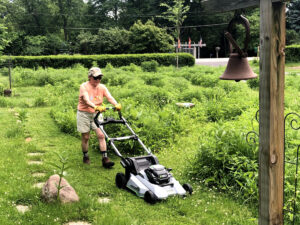
We’ve gone electric. Over the years we’ve replaced gas powered mowers, trimmers, chain saws and snowblowers with those fueled by batteries. The decibels they emit are a fraction of their gas counterparts but still make some noise. So do our vacuum cleaners. To protect our hearing we store sound dampening ear muffs near these tools and wear them when using them.
-
-
Using an electric mower helps create a quiet yard.
-

-
The electric chainsaw is quiet and efficient.

Fitting hearing aids is a process and building a relationship
Hearing Aids. Wow, they are expensive but miraculous. Hearing loss is a stealthy gradual condition. When Rich first bought aids he was amazed to hear the gentle sounds of walking in dry leaves, the creaking of the floor, birdsong, and better understanding of other’s speaking, music, and the television.
Audiologists usually provide a free hearing test. Rich’s advice – get a test and follow up with a pair of hearing aids if needed. The website of the American Academy of Audiology at members.audiology.org can help anyone locate a nearby professional who can help improve hearing.
Quiet Communities
Cities can do much to encourage quiet in their communities. Everyone benefits. Consider advocating with your local Council, law enforcement, and parks departments for developing a more quiet community.
Some people love noise but for most people it’s an annoyance. A quiet yard is a gem to create and enjoy.
by Winding Pathways | Aug 14, 2025 | (Sub)Urban Homesteading, Nature
We were astonished to discover a chicken of the woods close to our home at Winding Pathways. We have about a dozen laying hens in our backyard coop, but what we found wasn’t an escaped chicken.
Fungus
It was an amazing fungus. We’d not seen one before and think our woodsy chicken resulted from a series of weather events. Five years ago, derecho winds of 140 miles an hour knocked down or broke off most of our trees. Following were a series of dry years. That changed in late June 2025 when several bands of heavy rains soaked our area and high humidity filled the air for weeks. The combination of plentiful dead wood, moisture, and a spore landing in the right place created our woodland treasure.
Edible
A Chicken of the Woods is a large edible fungus that loves moisture and feeds on dead wood, especially wood from hardwood trees. The two chickens we found presumably are feeding on the roots of a derecho-killed cherry tree. The fungus is well named. Take a look at the photo and notice the scale-like appearance of the plant and its bands of color. It reminds us of the lacy coloration and markings of our Delaware chickens, one of our favorite breeds.
-

-
Colorful edges
-

-
Pair of fungi.
-

-
Size comparison
The fungus Chicken of the Woods (or Wood as found in some resources) is a large fungus sometimes called a shelf fungus. Many species grow worldwide.
Mushroom enthusiasts consider them, along with morels, one of the tastiest of fungi……….so will we eat ours?
Caution
Well, no. We’ve taught classes on foraging and encourage people to eat only wild plants that are easy to identify and hard to mistake for toxic counterparts. We always caution anyone planning to eat something for the first time to follow these guidelines:
- Positively identify the plant from at least three sources. These could include a paper field guide, a credible Internet website, or a real-life human expert.
- Eat only a small portion the first time. A particular plant may be perfectly edible for most people, but a few people may be allergic to it. Assuming there’s no negative reaction and the plant is positively identified, one can consider adding it to a diet of delicious wild foods.
We are certain that our mushroom is edible, but we remain somewhat skeptical. Not quite sure.
So, for now, our Chicken of the Woods will stay down in our woods feasting on the wood of an unfortunate cherry tree.
A Daily Walk Reveals Serendipitous Treasures
Nature’s always changing. Each day brings new and delightful surprises. We have created pathways through our small woodland and prairies and traverse them at least every other day. We usually spot something new and fascinating on every walk.
by Winding Pathways | Jul 31, 2025 | (Sub)Urban Homesteading, Birds, Nature
Every summer, we are surrounded by wrens. When we sit on our back deck, the loud call of the Carolina Wren serenades us. It’s a tiny bird that stays back in the woods and vines. It’s hard to spot. It’s surprising how such a smidgen of a bird can sing at high volume.
Different Wrens
Most of our wrens are more common House Wrens. Where Carolina Wrens stay away from our deck, House Wrens love living and nesting close to us. They’re easy to see and observe. Serious birders aren’t crazy about them because they sometimes take over the nests or destroy eggs of other native species, but we like them.
Our wrens winter down south toward the Gulf of Mexico. We look forward to their arrival in mid-April, just when our winter juncos head north. It’s like the changing of the guard. The switch happens again each fall when wrens leave as juncos arrive in October.
Early each April, we set up several wren houses near our house. They’re easy to make from scrap wood. An entrance hole of 7/8ths or 1 inch lets tiny wrens in while barring larger House Sparrows.
Industrious Birds
When wrens first arrive, we hear their near-constant chatter coming from the woods, but by early May, they’ve moved close to the house and start housekeeping. The male brings sticks into the nest box. Sometimes his stick is too long to fit into the small hole, but eventually he figures it out and pokes it through from the end. The female lines the nest with feathers and whatever soft items she can find. Soon she’ll sit on three or four reddish spotted eggs that hatch in about two weeks. Then we enjoy seeing a constant stream of wren parents bringing tasty and nutritious bugs to their nest to feed the kids.
Within two weeks, they fledge. We clean the old nest out of the box, and often a wren couple nests in mid-summer.
-

-
Lined nest with feathers
-

-
Curious
Diet

Nearby foraging
Our wrens forage for insects mostly at the edge of the woods and in our prairies. Unlike mowed lawns, these areas have plenty of insects. The industrious birds also forage for insects in our garden. We never need chemical pesticides thanks to our friendly wrens.
House Wrens also forage on pollinators, but somehow all our fruit trees and vegetables get pollinated.
To learn more about nearly any bird species, visit the Cornell University Laboratory of Ornithology’s website, All About Birds. The site contains photos, recorded sounds, and videos of hundreds of birds.
Few animals are as animated, ambitious, and noisy as House Wrens. We enjoy them for about half of every year.
by Winding Pathways | Jul 24, 2025 | Foraging, Garden/Yard, Nature, Pests, Trees
The white mulberry is a trickster tree. We match wits with it often at Winding Pathways.
“All Around the Mulberry Bush” may be a kid’s jingle but the tree is an ecological pest with some positive traits.
Our front hedge is an example. It’s a dense growth of privet. Few plants can live in its shade but the mulberry has a trick that lets it thrive. The mature tree craves sunshine to grow to its full height of 75 feet. We wouldn’t think they’d stand a chance growing under our shady hedge. But it has a trick.
White Mulberry Trick
Birds poop out mulberry seeds when they roost in our hedge. These readily sprout, and the tiny tree sends up a skinny stem that quickly grows through the thick, shady hedge branches to emerge into the sunshine above them. We don’t want a mulberry there so we need to frequently clip down their tall leggy stems.
Another White Mulberry Trick
It’s a trickster in another way. Although called the white mulberry, Morus alba, it can have ripe white berries but more often they’re red to purple. Don’t let the color fool you. And that’s not all. Most trees have leaves of just one shape. Not the white mulberry. It has three common leaf shapes. See the photo. An individual tree can have all its leaves one shape, two shapes, or a mix of the three.
While many people join birds in eating the sweet fruits, it’s an invasive species that seems to take root wherever there’s a bit of bare soil. Then it grows like crazy. Cut it down and the stump sprouts that can grow a couple of feet in a flash.
Range of the White Mulberry
White mulberry trees grow throughout temperate North America and on other continents. Silkworms feast on their leaves, and probably white mulberry trees were introduced around the world to create a silkworm industry. The tree liked living in America but silkworms didn’t. They died out and a hoped-for silk industry never took root here.
Telling Apart the White Mulberry Cousin
Closely related is the native red mulberry, Morus ruba. It’s hard to find and may be declining due to hybridization with the exotic invader. Here’s how to tell them apart:
White Mulberry: Relatively small leaves. The top surface of the leaf is smooth and often shiny. It grows fast in the sun. Common.
Red Mulberry: It’s more of an understory tree. The fruit is red. The leaves are big – three to seven inches long with a sandpapery textured top surface and somewhat hairy bottom. Uncommon.
Although Red mulberry is native to Iowa we’ve not found any here. All mulberry trees seem to be the white species or hybrids.
Mulberry Tree Benefits
Firewood: We love burning mulberry wood. It’s an attractive yellowish wood that burns with a pleasant aroma as it gives off lots of heat. For example, a cord of mulberry contains 25.8 million BTUs of energy. In comparison, white oak has 25.7.
Food: Kids love the sweetness of mulberries. The berries normally ripen in June. Birds also flock to ripening mulberry fruit. They love them so much that they’ll eat mulberries before nearby ripening cherries. So, having a fruiting mulberry can increase a cherry tree’s yield. Mulberries can be eaten fresh and made into pies. We love adding some to our breakfast oatmeal. The fruit’s robust color makes an attractive natural die in drinks. Because mulberry fruit is sweet and rather bland it is excellent when blended with rhubarb or tart cherries.
Native Red Mulberries Are in Trouble
The native red mulberry tree is in danger. It’s uncommon and apparently declining, possibly because it so readily hybridizes with white mulberry. Red mulberries tend to live in small groves in forested, bottomland areas. Look for their large sandpapery feeling leaves. Finding one is a treasure.
White mulberry trees are tricky, but they are plentiful, prolific, and useful. We have a few growing at Winding Pathways. As long as they stay out of our hedge, we like them.
-

-
White Mulberry Trickster Tree
-

-
Mitten, oval, “other shape”
-

-
Good firewood.
by Winding Pathways | Jun 12, 2025 | (Sub)Urban Homesteading, Nature, Reflections/Profiles

Tracks easily run over a rough surface.
On a spotless spring day, Trackchair® made a delightful afternoon in nature’s beauty possible.
Marion had had surgery, so walking on soft or uneven ground during recovery was challenging. But it was May, the marvelous season of birdsong and wildflowers. We yearned to leave urban noise behind and hike a trail.
Why Nature?
Few activities are as refreshing, relaxing, and rejuvenating as being in nature’s stillness and beauty. For most people, all it takes is a walk in the woods, wetland, or flower-studded prairie. Marion’s walking challenges were temporary during recovery, but many people lack easy access to nature due to a permanent disability.
How We Got Outside
We made a reservation to use one of three Trackchairs® that the Indian Creek Nature Center welcomes people to use for free. Two are adult sizes, and one is designed for a child. The chair was charged up and ready to go when we arrived at the Nature Center. Staff member Michelle Basler gave us a quick orientation. “I love helping people use a Trackchair. They help people who usually use a wheelchair to venture into nature alone or with their more mobile friends or family,” she said.
The Nature Center’s Trackchairs® are made by ATZ Manufacturing in Marshall, Minnesota. “We have a nationwide system of distributors making it possible for nonprofit organizations, like the Nature Center, or individuals to purchase one and have it tailored to their needs. Distributors also service the chairs,” said Adam Henning, Marketing Manager.
How Trackchairs(R) Help
He told us the chairs are being used by a diversity of people with special needs. “We know they give access to nature for people close to the end of their lives. Even injured seasoned athletes use them to observe outdoor sports,” he said.
Our time outdoors wasn’t exactly quiet. We were serenaded by Baltimore Orioles, Rose-breasted Grosbeaks, Tennessee Warblers, and American Redstarts. Wildflowers lined the trail. The Trackchair(R) itself was so quiet we could hear birds as the chair purred along on its electric motor. “Quietness is important. Various ATVs on the market enable people to access nature, but they are noisy,” said Henning.
Friendly Features
The chairs are also easy on the ground. Marion used the joystick to turn the chair 360 degrees, and it barely scuffed the grass underneath. It has a leveling feature that enabled her to go up and down steep slopes without concern of tipping, and gingerly cross a narrow footbridge.
Where to Rent a Trackchair(R) Locally and Why

Controls are easy to learn.
We were fortunate to have access to one of three Trackchairs® recently purchased by the Indian Creek Nature Center in Cedar Rapids. “The Nature Center held a fundraising campaign to find money to buy the chairs and additional endowment funds to generate income to pay for their maintenance and eventual replacement costs,” said John Myers, Executive Director.
“The Nature Center strongly believes in the many mental and physical health benefits of being outdoors. The Trackchair® helps us extend access to those people who struggle to walk,” said Sarah Botkin, who manages the Nature Center’s Amazing Space Building.
The Indian Creek Nature Center is a private nonprofit organization on the east side of Cedar Rapids, Iowa. Annually, it hosts thousands of people for environmental education programming, special events, and rentals. Trails wind through over 400 acres of woodland, prairies, and wetlands and are open to the public for free use every day of the year. For information or to make a Trackchair® reservation, visit Indian Creek Nature Center and the reserve an all terrain wheelchair. You can learn more about AMZ Manufacturing and the many models of chairs they make by visiting their site.
What Is A Trackchair(R)?
ATZ Manufacturing made the Trackchairs® and is based in Marshall, Minnesota. It began in 2008 when a father worked to develop a device to enable his son to access the outdoors. It grew into a company that makes and distributes the Trackchair® we used and many other models suited to different needs. “We have one that enables people to stand and do things like grilling dinner,” said Henning.
Trackchairs® weigh between 400 and 500 pounds. They are best transported in a pickup truck or enclosed trailer, but can be moved on a hitch platform that has a tongue rating of at least 700 pounds. Transportation, of course, isn’t necessary at the Nature Center or the many other nonprofit organizations and government agencies that let people use them on their grounds. They move at three to five miles an hour and have about a seven-mile electric range. “We’re working to increase the range using advanced batteries,” said Henning.
Overall Impression

A Trackchair(R) helps people with limited mobility enjoy being outside.
We were amazed at the chair’s comfort, its quietness, and its ease of learning. After just a few instructions from Michelle, we were on our way up and down the Nature Center’s trails. Even after turning on a mowed section of the trail, the grass was undisturbed. The slower speed gave a leisurely pace. Time to note flowers and hear birds. The faster pace on rough ground was akin to riding a bronco. Kind of fun, but not recommended. The chair has a guard on the back to prevent tipping over. And, users can angle the seat forward or slightly back when going up or down steeper hills.
It was awesome to use!
An Update
About a week after we tried the Trackchair® Rich was volunteering at the Nature Center. A school bus drove in and unloaded a class of fifth grade students. One was in a wheelchair with an attendant. The Nature Center had the youth-sized chair ready and a staff member oriented the student right after he was transferred into the Trackchair®.
Then, off he went with his classmates. The chair enabled him to pace right along with the other students on his own. He was thrilled.