by Winding Pathways | Oct 12, 2023 | (Sub)Urban Homesteading, Preparedness
What To Do When No Room At the Inn?
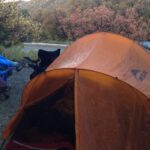
Even bivouac camping can be comfortable.
Basic bivouac camping gear saved our night as we drove along a rainy Ohio Interstate.
We were returning to Iowa from a business trip in New Jersey. The 1000-mile trip is too far for us to make in a day so we normally plan to overnight in a comfortable motel in Ohio or Indiana.
On this recent trip, we didn’t make a reservation in advance, so Marion called motels ahead of us as Rich drove through pelting rain. Bad news. They were all booked for the night.
Bivouac Camping Saved Us!
Our basic bivouac camping gear saved us. Marion spotted West Branch State Park on the map. Not far ahead of us and near the Interstate, we exited just as the downpour subsided. Soon we enjoyed a hot dinner inside a restaurant near our tent.
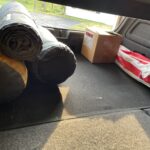
Lightweight camping gear stashed on the sides of the car.
Although we weren’t on a camping trip, we always carry basic bivouac camping gear just in case we run into a situation like our recent one. Modern backpacking gear is lightweight, compact, and effective. It’s essential for a long trail trek but also takes up little space in the car and comes in handy should camping be necessary.
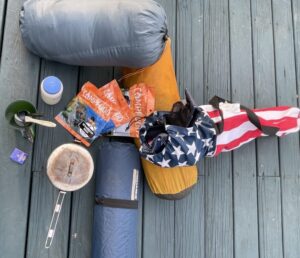
Here’s what we always slip into the car:
- Small nylon tent and ground cloth. Sturdy pegs (spikes or gutter nails are sturdy, don’t bend and so are useful to hold cords to tie a tent down.)
- Lightweight foam mattresses and sleeping bags.
- Folding chairs.
- Cooking and food gear that includes:
* Tiny featherweight butane stove and fuel bottle
* A few backpacking-type meals
* Basic utensils
* Matches! (Remember these!)
Cooking gear and dried meals fit in a small cardboard box and it’s easy to stash the other gear here and there in the car.
-
-
Looks like a lot! It’s not!
-

-
Essentials in box
The morning after our unplanned campout we woke well-rested, sipped instant coffee, packed up, found a breakfast cafe, and were soon back on the Interstate heading home.
A Note on Dried Food
Years ago, dried camping food was tolerable but hardly tasty. That’s changed. Modern foods are delicious. We keep two weeks of dried meals in our preparedness bin at home. Should we be impacted by a natural disaster we’d break out our camping stove and enjoy tasty meals. Although this food lasts for years we occasionally eat a few meals at home, on planned camping trips, and during emergencies. Then we restock with fresh meals. We have previously written about preparedness on our blogs.
by Winding Pathways | Sep 14, 2023 | Mammals, Nature, Travel/Columns
We were recently amazed to learn that Pennsylvania has a thriving herd of wild elk.
A couple of times each year we make the long drive from our Iowa home to visit relatives in New Jersey. We traverse Pennsylvania on Interstate 80. For years we’ve been intrigued by interesting and unusual town names we see on roadside signs. Jersey Shore, Mountain Top, and Snow Shoe are examples.
As we approached mid-Pennsylvania recently heading back to Iowa, we tired of the big semi-truck-filled road. So we exited at the tiny town of Snow Shoe and followed smaller paved roads through the forests and clearings of Moshannon State Forest. We soon reached the hamlet of Benezette, the epicenter of Pennsylvania’s wild elk herd.
Thanks to a stop at the visitor center of the Keystone Elk Country Alliance we learned the fascinating story of this massive deer’s return to an area called the Pennsylvania Wilds.
Where Elk Once Trod
When Columbus made landfall wild elk roamed much of what became the United States, even close to the Atlantic Ocean’s shore. Such tasty and large animals had little chance against explosive human population growth and the conversion of wild lands to farms, ranches, roads, and urban areas. By the late 1800s wild elk only lived in wild areas in the Rocky Mountain States.
Fortunately, that’s changed. Now there are wild elk herds in at least 19 states, including Michigan, Minnesota, West Virginia, Missouri, Arkansas, and North Carolina. Kentucky has the largest wild elk herd east of the Rockies with at least 13,000 of the massive deer roaming the state.
How It Happened
In 1912 a shipment of elk was trained from Yellowstone National Park to Pennsylvania and released in the north-central part of the state. It was joined by some animals from a private herd and further releases a few years later. The herd stayed small for years but began expanding during the past few decades. Today about 1,400 wild elk roam the area.
We loved our day in the Benezette area. The lands are managed so large patches of open woods allow visitors to see into the forests hoping to spot elk. It was hot, so the elk were somewhere deep in the shady woods. We didn’t see any but enjoyed learning more in the impressive museum. Then, we walked area trails looking for signs of elk – droppings, and rubs. Hot and thirsty, we stopped at the Elk Life Store for elk hot dogs and a cool beverage. Tasty and with great views. The hills shimmered in the light and streams coursed down the draws and valleys.
Elk bring tourists to the Benezette area. Small lodges, bed and breakfasts, and Airbnb’s abound. The most popular time is fall when male, or bull, elk bugle. Make lodging reservations well in advance. For information contact Keystone Elk Country Alliance.
-
-
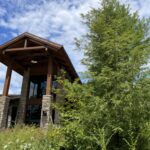
The Keystone Elk Country Land is a cooperative among agencies.
-

-
Gracing the entry
-

-
We enjoyed an elk dog and beverage.
-
-
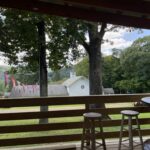
Rolling hills and small shops characterize Elk Country.
Pennsylvania’s Not Alone
Thanks to the efforts of state wildlife agencies, the Rocky Mountain Elk Foundation, volunteers, and financial donors elk are thriving in many states. Read where elk live. And, for a map, check out the Izaak Walton League’s site.
We even have about 15 elk in Iowa. They’re at the Neal Smith National Wildlife Refuge near Prairie City east of Des Moines.
A trip to Wyoming, Colorado, or Idaho offers wonderful chances to see elk, but elk can be seen far and wide across the Eastern United States.
by Winding Pathways | Aug 31, 2023 | Geology/Weather, Travel/Columns, Trees/Shrubs
Travels this summer showed how varied the North American continent’s vegetation, landscape, and weather are. Most recently we have journeyed from New Jersey to Southern Saskatchewan. Vegetation and terrain could not be more different.
Venturing from “Wide Open Spaces” to “Into the Woods”
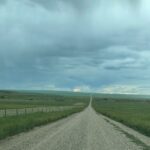
Native forbs and grasses cover the land.
The Dixie Girls’ refrain “Wide Open Spaces” describes the terrain we drove through in Southern Saskatchewan. One day Rich hiked to a high spot in Grasslands National Park. Beneath and beyond him were thousands of acres of grasslands – forbs and native grasses. Nary a tree poked upward in this vast and beautiful land.
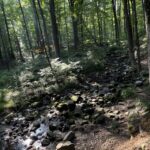
Brook waters tumble over rocks.
In contrast “Into the Woods” by Sondheim and Lapine would better characterize the roadside woods as our car approached New Jersey six weeks later. Jersey’s woods are so dense and thick that little sunlight filters through the leafy crown. On wood edges, impenetrable tangles of shrubs, brambles and vines seem to be everywhere.
Goldilocks Zone
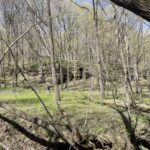
Iowa’s woodlands tend to be more open than eastern woods.
True to its location in “middle America,” our home in Eastern Iowa fits somewhere in between. You might say it is the “Goldilocks Zone” of vegetation. Midwestern woods tend to be more open than New Jersey’s but dense compared with Saskatchewan’s few low brushy areas. Iowa’s neither wide open nor dense but somewhere in between. It’s like a hybrid.
Location, Location, Location
What makes such a striking difference in vegetation extremes? These numbers tell part of the story:
Location Annual Precipitation Annual Mean Temp Wind
Saskatchewan 14” 39 F often and strong
New Jersey 54” 48 F calm to light
Iowa ranges in the middle with an average of 36” of precipitation.
Numbers don’t tell it all. New Jersey’s climate is moderated by the ocean, so the hottest temperature ever recorded near Rich’s hometown of Denville was 104 degrees Fahrenheit, and the coldest was -21. That’s a 125-degree variance. In Val Marie, Saskatchewan, the highest temperature ever recorded was 113 degrees Fahrenheit, and the lowest was -70. That’s a whopping 183-degree variance.
When we visited Val Marie, Saskatchewan, on the summer solstice, the sun was brilliant, the breezes gentle, and the night air cool. Sunsets lingered and the moon seemed to pop over the horizon and grace the landscape all night. Recently, thick smoke from wildfires blanketed the province like it has in Iowa and temperatures soared.
We hit New Jersey just right with warm day temperatures, a slight south breeze, tolerable humidity, and evenings that cooled down. The wildfire smoke had moved out. We were fortunate both times.
There’s more
Saskatchewan is much further north than New Jersey, so it receives significantly more summer light and much less sunlight in winter. Generally, Saskatchewan enjoys low humidity, while Jersey sweats in humid air year-round.
These differences in light and temperature plus topography, soil type, and the way people manage the landform its appearance and determine what species of plants and wildlife can exist there.
We noticed that people who live in the thickly wooded East are sometimes uncomfortable when traveling in the West’s wide-open spaces and Westerners feel claustrophobic amid the thick growth in the East. Comfort levels vary with the terrain.
Commonality
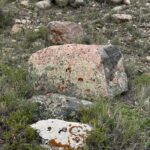
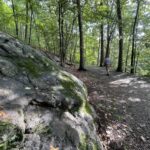
Both Saskatchewan and New Jersey do share a common feature. Rocks! Everywhere are pebbles, rocks, and boulders. Saskatchewan was glaciated and rocks, carried in by sheets of ice, litter the fields. Piles dot the fields where ranchers and farmers have piled them so they can till the sandy-type soil. New Jersey’s rocks are often bedrock with glacial striations and miles of rock and stone walls.
-
-
Lichen-covered boulders
-
-
New Jersey’s inland landscape is defined by boulders.
What’s the difference between a rock wall and a stone wall? Well, there really isn’t. Both are made of rocks. But some, like rounded glacial rocks, were hauled from fields and tossed into rows to make boundaries. It takes a lot of work to maintain them. As Robert Frost stated in one poem, “Good fences make good neighbors.”
Others, flatter rocks like slate and shale, are easier to fit together. Marion’s dad was a stone worker crafting rock walls, carefully choosing rocks to fit well together. These rock walls stand for decades. At any rate, both Saskatchewan and New Jersey have an abundance of rocks that influence how land is used.
One of our traveling pleasures is noting vegetation and topography through our car’s windows, even as we speed along. To us, all places are interesting, and no matter what the terrain and vegetation we’re passing through it’s fascinating.
by Winding Pathways | Jul 27, 2023 | Nature, Travel/Columns, Trees
Always Something New To Learn
Although we’ve lived in Iowa for over 40 years, we never knew so much history crowded into a small town in the mid-1800s not long after settlement. Our visit to the Lewelling Quaker Museum in Salem, Iowa, brought us up to speed on history. The small museum tells a fascinating, little-known history that impacted people far beyond Iowa’s borders. They focus on three significant areas.
Quakers
The Museum’s formal name is the Lewelling Quaker Museum. These peaceful people moved to the area during the decades prior to the Civil War. Among their many beliefs was a strong aversion to slavery. Neighboring Missouri settlers owned slaves just 20 miles south of Salem.
-
-
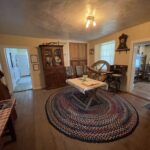
Decorated in the era of the 1800s.
-

-
_Note Height Difference
-

-
Way to make music
The Underground Railroad
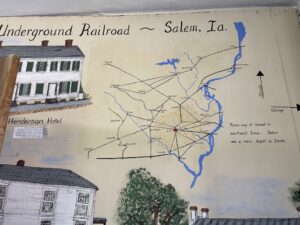
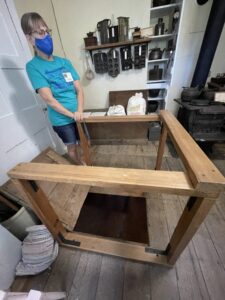
Salem area Quakers, joined by others of various faiths, were a significant part of the Underground Railroad that helped escaped slaves move north to legal safety in Canada. In the museum, located in an old home, we were able to enter the tiny crawl space beneath the kitchen where slaves hid from slave catchers. The process must have been scary for both slaves and those who helped them. Captured slaves were returned to their owner for likely punishment and continued to live in bondage. Whites who helped risked arrest and incarceration. Yet, the Underground railroad persisted and helped many people gain freedom.
-
-
Salem was a major depot.
-
-
A rug and kitchen table covered the closed trap door.
Fruit
The Lewelling Family were nursery people who cultivated and sold fruit trees. They developed several productive varieties of cherries and apples. In the early days of the Oregon Trail travel fever infected the Lewellings. They modified a wagon to hold tiny fruit tree slips and made the arduous trek over the Great Plains and mountains all the way to the Willamette Valley. Most of the baby trees survived the trip and were used to start the Pacific Northwest’s famed fruit industry. People enjoy different fruits and apple varieties to this day in part because of the families that carried the tiny fruit slips west.

18″ thick walls.
The volunteer-operated Lewelling Quaker Museum is open for tours Sunday afternoons from 1-4 pm May through September and by appointment at other times and dates. We found our visit fascinating and encourage others to go. Salem is located a few miles south of Mount Pleasant, Iowa, in the SE corner of the state. For information check lewelling.org.
by Winding Pathways | Jul 13, 2023 | Gazette Features, Travel/Columns
What is a Pilgrimage?
From: University of York: “‘Pilgrim’ and ‘pilgrimage’ are words that have carried a range of meanings over the centuries.
“The English term ‘pilgrim’ originally comes from the Latin word peregrinus (per, through + ager, field, country, land), which means a foreigner, a stranger, someone on a journey,…. It can describe a traveller making a brief journey to a particular place….”
Our Context
We consider travel a “pilgrimage.” The destination is not the sole purpose. We enrich our souls by being open to amazing travel surprises. Here are some we discovered on recent trips to New Jersey and Saskatchewan, Canada.
Interstate Highways are outstanding for getting places quickly, but we consider them a boring slog that bypasses fascinating places. Too many people focus on getting to a destination and miss intriguing sites along the way. In contrast, we often scan maps and brochures and, from time to time, duck off Interstates to drive on somewhat parallel, smaller roads stopping in towns bypassed by the interstates.
Two trips from this summer that highlight this concept come to mind. We’ve featured the Hopewell Earthworks around Chillicothe, OH, and took in great southern BBQ at Old Canal Smokehouse. The server presented us with an enormous slice of peanut butter pie and regaled us with tales of his childhood exploring the steep mounds and snaking earthworks while four of us made quick work of the dessert.
Easterly

An unusual cafe.
On our return from the East Coast, we needed a respite from the truck traffic and fast driving of I-80, so we exited and drove through Brookville, PA. Seeking coffee, we discovered the Calico Cafe. While ordering we asked the barista where the restrooms were. She responded, “You’ll find them through the cat room behind me.” Cat room!!!!! Well, we opened the door to find people petting cats. It was a place for them to get their cat fix. We’re not cat people but the experience was different……something that can’t be found in chain eateries along Interstate exits. And the coffee was decent.
Westerly
On a more recent drive to Saskatchewan, Canada, we were cruising north on Interstate 29 in North Dakota and spotted a tiny note on the map showing the location of North America’s tallest structure. It was along a small paved road that headed in the direction we wanted to go, so we exited, made a few turns, and saw, not a massive skyscraper, but a 2063-foot-tall television tower. To stabilize the tower, guy wires extended scores of yards out. Not terribly exciting but a sight we’d have missed had we stayed on the interstate. And it has a history.
Just north of the tower we passed through the small town of Mayville, North Dakota, and discovered a gem of a college called Mayville State University. With 80+ majors/minors, a student/faculty ratio of 14:1, and reasonable tuition, MSU would be a good bet for a solid education and a bright, “no-debt” future. Only a few miles north we tented overnight in Turtle River State Park. Songbirds serenaded us in the evening and greeted us in the early morning.
Medicine Wheel and College Towns
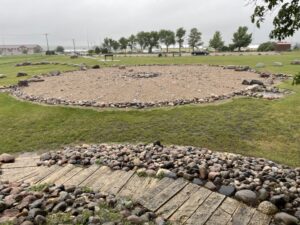
Glacial boulders align to the rising and setting sun and moon.
On our return trip we were eastbound on Interstate 94. We’d picked up a brochure at a North Dakota welcome station about the Medicine Wheel Park in Valley City, a town between Bismarck and Fargo. Even though it was raining we exited, donned raincoats, and walked around a fascinating and well-maintained medicine wheel almost adjacent to the big road. The structure, inspired by the Big Horn Medicine Wheel, marks the rises and sets of the sun and moon in relation to the Earth. Then we drove through Valley City State University before jumping back on the big road. VCSU has an interactive financial program with surrounding states and two Canadian provinces. Recreational opportunities abound.
Our western trip passed the geographic center of North America in Rugby, ND, (watch the video! It’s rather fun!), and a Continental Divide (Laurentian) between water flowing to Hudson Bay and that flowing to the Gulf of Mexico. Actually, a map reveals several watershed divides in the Americas.
Most travelers would have buzzed by these interesting stops. Curiosity grips us and leads us to unusual places we’d usually never heard of. We are richer for this.
Great Plains Colleges
Our son, Daniel, graduated from a college few people have ever heard of – Black Hills State University in Spearfish, South Dakota. It was an outstanding educational experience for him. And, tuition and living expenses were modest. He graduated debt free.
We’ve explored other colleges in small Great Plains towns, sometimes to have coffee in their student center, and to learn about them. Many, like Black Hills State, are little known, offer outstanding education, and are inexpensive. They offer students the chance to earn a college degree without debt.
Here are a few we’ve visited:
Black Hills State, Spearfish, South Dakota.
Valley City State University, Valley City, North Dakota
Mayville State University, Mayville, ND
Wayne State University, Wayne, Nebraska
Know someone considering college? One of these rather obscure but top-notch schools might be a perfect match……and there are many more we’ve yet to visit.