by Winding Pathways | Nov 10, 2014 | Geology/Weather, Nature, Reflections/Profiles, Wonderment
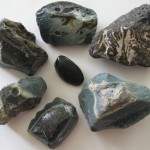
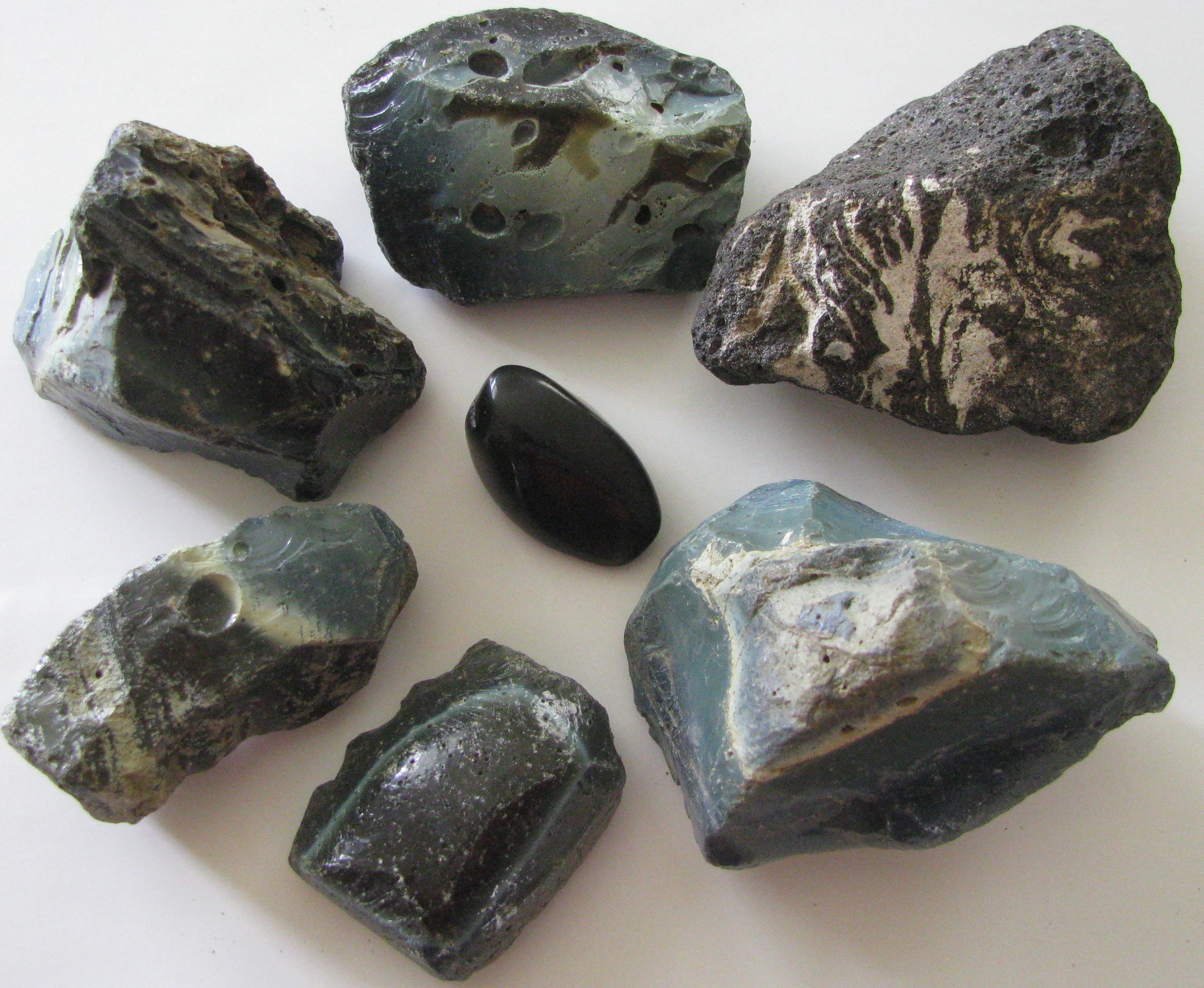
Obsidian has one characteristic that slag generally lacks – a hint of translucence.
On our recent Antiquities Tour, Rich and I came across interesting rocks on an abandoned railroad bed in Eastern Colorado. The chunks looked like obsidian. They fractured like obsidian and had the feel of obsidian. But, they didn’t quite look right. But blue and pretty! So, we put a bunch in the car. Rich was excited.
One of my geologists colleagues confirmed my observation on the fracturing and glassy feel of the rocks. But, they didn’t have the slightly translucent look of obsidian. Still I like them. So, I gave some to friends.
One scientist friend, Linda Mueller, appreciated the rock and investigated further. Here is our conversation on FB.
“I’ve been asking around about the rock you gave me. The consensus seems to be that the colors indicate that it’s slag glass and not obsidian. Certain areas in Colorado use it as railroad ballast. Obsidian and glass slag are so similar that it’s often difficult the tell the difference. Unscrupulous ebay sellers have taken advantage of this and have sold the artificial form as the real thing.
“Anyhow, whatever it is, I’m still fascinated by it. It’s beautiful and it will remain on my desk as a paperweight. Thank you again for it.”
I replied, “Thanks for checking this out!”
Linda added, “I was hoping for something interesting like turquoise. Still the stone is calming in a odd sort of way. It’s cool to the touch and smooth among the rough (parts).”
My thought: “Maybe good energy can come from slag. Say, that might be a good blog! Help me write it?”
So Linda did the work!
Linda: “I think so. The rock is truly entrancing. I can’t explain it. From the moment I saw it, I was fascinated by it. It was a special gift. I truly mean that.
“When you think about it, it does look a lot like obsidian, which is volcanic glass. I can’t remember what you said the spiritual properties of obsidian are but I wonder if they mirror the history of the stone? A huge amount of geothermal energy is needed to create obsidian. It flows from a volcano, then cools and solidifies. Tension moving toward calm? (Great analogy, I thought!)
“Glass slag is similar to obsidian; it, too, consists mainly of silica dioxide. It’s formed by heating ores (rock) to high temperatures. It’s a human-made rock, but it’s not a new technique. Humans have been creating it since the late bronze age (1500 – 1000 BCE). At least three thousand years! Wow! Ancient man found other uses for the leftover glass slag. They recycled it even then. Somehow we lost sight of that when technology gave us easier ways to make glass and pottery. Now we’ve come full circle and have found uses for it again.
“Might glass slag have properties similar to obsidian since the two are so similar? When I hold the rock, I feel calm. It takes away tension. The coolness and the weight of the stone is comfortable. Like obsidian, it was formed from heat/molten rock (tension) and it’s present state is cool/solid rock (calm).
“When you think about it, it fits. You and I have a strong interest in preservation, recycling, taking care of the earth. The rock cries out:
“‘Hey, look at the beauty and usefulness I have! Quit taking rocks from the earth to crush for railroad ballast when you already have me. I was needed for another purpose and now that it is complete, I’m moving on to my next one.’
“Everyone I’ve shown it to has had positive reactions to it. I wonder why that is?”
So, our on-line conversation ended here. But perhaps readers can weigh in and add to this. Obsidian or Slag – What Does it Matter?
The gift had the intention of love, perhaps that is a clue.
by Winding Pathways | Aug 25, 2014 | Labyrinths, Reflections/Profiles, Wonderment
Hot. Humid. Still. Not exactly an optimal day or time to walk a labyrinth. Necessary.
For weeks I have known that the labyrinth needed tending. The blooming grasses have shot up toward the sun and lodged over. Some completely block the path. Searching for the light, others have crowded into and narrowed the path. Deer have ripped off plant tops. The bird bath is dry. One area has too much sun. Plants are overly exuberant. Another has too much shade. Plants are withered. Creeping Charlie has overwhelmed the stepping stones. Too much and too little of everything. Everything feels out of balance.
Pausing, I begin to notice the beauty. My attitude shifts. Butterflies and other pollinators busily work the flowers. The occasional, slight breeze passes grass pollens plant to plant. The lyrical chatter of the goldfinches undulating across the yard brightens the day. In the shade a random breeze cools my skin. Suddenly the path widens – grace of my imperfect planning. Black Eyed Susans and nodding onions ready to harvest. Tiny purple blooms peek out from the robust prairie forbs. The magnolia pods are set for next spring.
As I notice the plants leaning into the light, Universe and I have a conversation. Behaviors are the manifestation of the negative energies that have persisted in the building and congregation. “What is my role?”
“A labyrinth walk for healing.”
Then, the counter thought: “Those who choose to heal will be here. Those who choose not to heal will not.” (And those who have been deeply wounded, will need to decide.) So, preaching to the choir. But it doesn’t invalidate the experience.
A Pema Chodron quote keeps coming to mind. “Our true nature is like a precious jewel: although it may be temporarily buried in mud, it remains completely brilliant and unaffected. We simply have to uncover it.”
“Simply.” That is the rub. Robyn M-K and Maria K’s service Sunday spoke to “covenant.” From the French covenir and earlier – Latin – covenire – “come together.” About “relationship.” What kind of relationships do we wish to have and in what ways can we move most successfully in these directions of “right relationships”? How do we relate to those who are hurt – even by their own actions? And those on the side who receive the hurt.
Unanswered.
On the way out I re-entered the heat and sun, spotting blooms that I missed on the way in. Joyful. I pushed aside the lodged grasses, intent on my mission. Blocks yielded easily.
Now what. Tranquility isn’t always easy to sort through.
by Winding Pathways | Aug 12, 2014 | Labyrinths, Nature, Reflections/Profiles, Wonderment
Resting.
Recently, a friend and I took a brisk walk punctuated by a “pucka brush” adventure. We ambled along a wide trail under trees, jumped over poison ivy, picked off stick tights, sweated and stepped in “scat”. Charming.
We spotted the most diminutive caterpillars ever – now officially named “toddler wooly bears”.
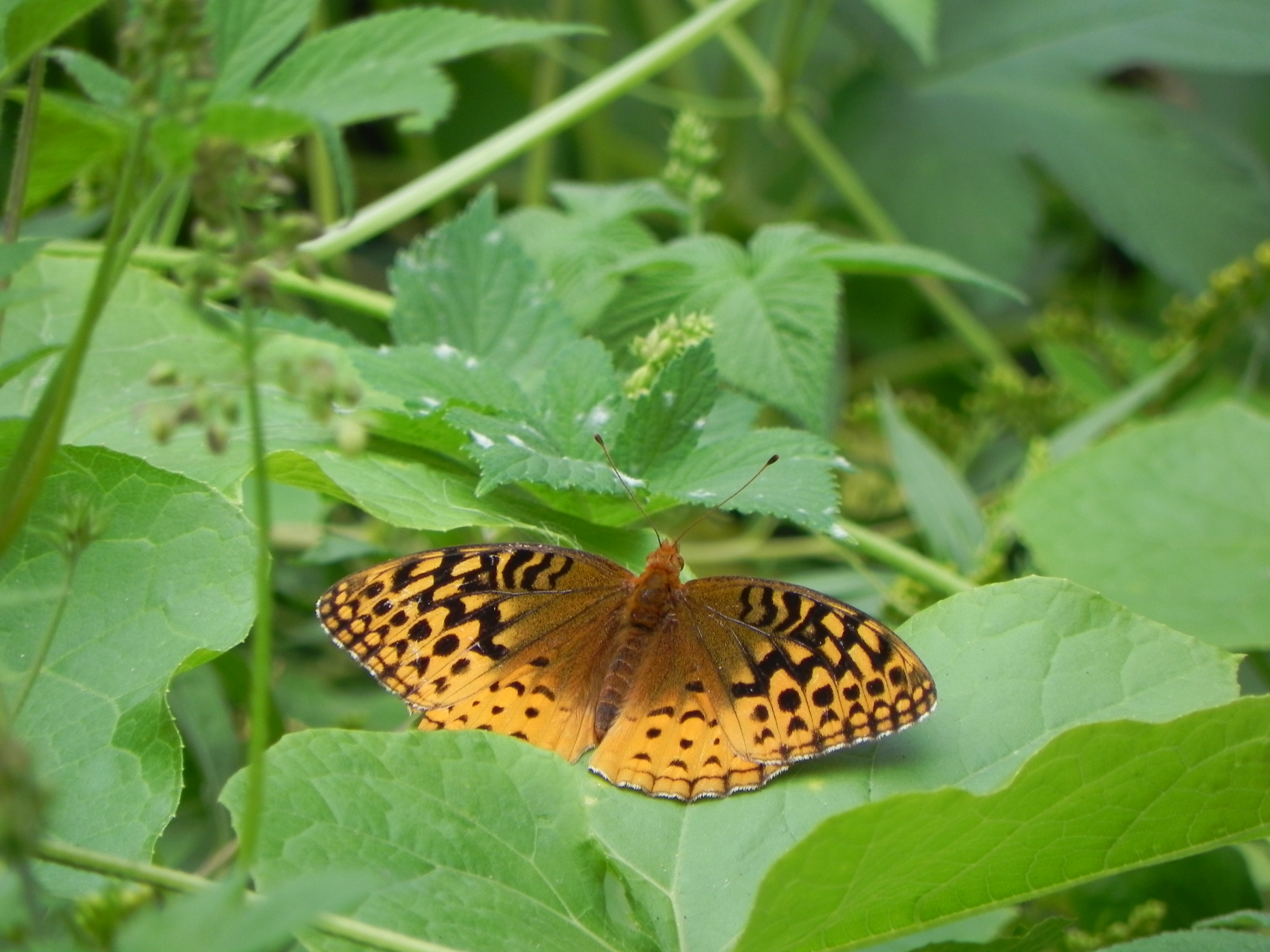
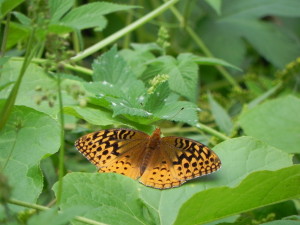
We paused to admire what I tentatively have identified as Polygonia comma (Eastern Comma) and Speyeria aphrodite (Aphrodite Fritillary) butterflies as well as Monarchs and Swallowtails.
Through the camera lens we captured Joe Pyeweed and goldenrod blooms against the dark woods green.
And, I came home feeling tranquil.
The afternoon was consumed with computer work, trying to figure out how to….you name it. Thank goodness Winding Pathways has an excellent Web Developer who, even at long distance keeps in close contact and fixes the “whatevers.” By the end of the evening I felt drained.
So, I wondered, what is tranquility? Defined as “The quality or state of being calm,” I have decided that tranquility has many faces. A person can be active yet tranquil – think running meditations or wandering though the “pucka brush”. The repetitious movements of ironing or gardening can be tranquil. Sitting quietly and watching industrious insects gather nectar and pollen, hummingbirds chase each other and rabbits forage on clover all can be tranquil.
Any activity that neutralizes the angst, the compulsive “gotta do” state that we regularly live in and transforms it to a sense of peacefulness can promote tranquility. But, this state of being is ephemeral and elusive.
Just as the early spring flowers bloom and disappear within a few weeks, tranquility will seem to pass all too soon. Are we failures? No. Like these tender blossoms it lies just beneath the surface. And, like the spring ephemerals, tranquility will return especially when we “tend the soil” so to speak. We can choose to access the state of tranquility any time.
Herein lies the elusive. To allow tranquility to touch us takes a certain amount of awareness and surrender. Allow the active mind to flow into settled stillness. Not emptiness – stillness.
Think of the ocean buffeted by winds and storms, cris-crossed by boats and littered with floating detritus. The surface is often rough and turbid. Not far below, currents flow more slowly and water begins to clear. Objects sink through the water. Heavier ones land on the bottom. Lighter ones, like silt, plants and plastics, hang suspended somewhere in between. At the depths of the ocean submarine currents move slowly influenced by density and temperature differences. Our thoughts can be like that, too. At some point our minds like water become clear.
Connected to each other and the earth, we can find tranquility.
To best access the state of tranquility, remember its ephemeral nature. We are not “less” when we are un-tranquil. We are just “on the surface” of daily activities. Grace and ease lie just below this patina of our exterior nature. So, we can choose to surrender into tranquility and be the ease, grace, joy and empowerment we are meant to be.
For me connecting with nature helps me attain tranquility. With the Laughing Labyrinth in our front yard the transition is usually simple. Then, I flow with ease, grace, joy and empowerment – even when I have stepped in scat.
by Winding Pathways | Aug 6, 2014 | Bugs, Flowers/Grasses, Nature, Trees/Shrubs, Weeds, Wonderment
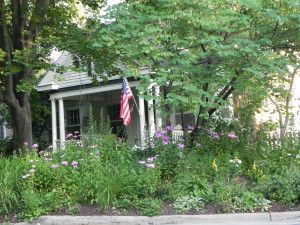
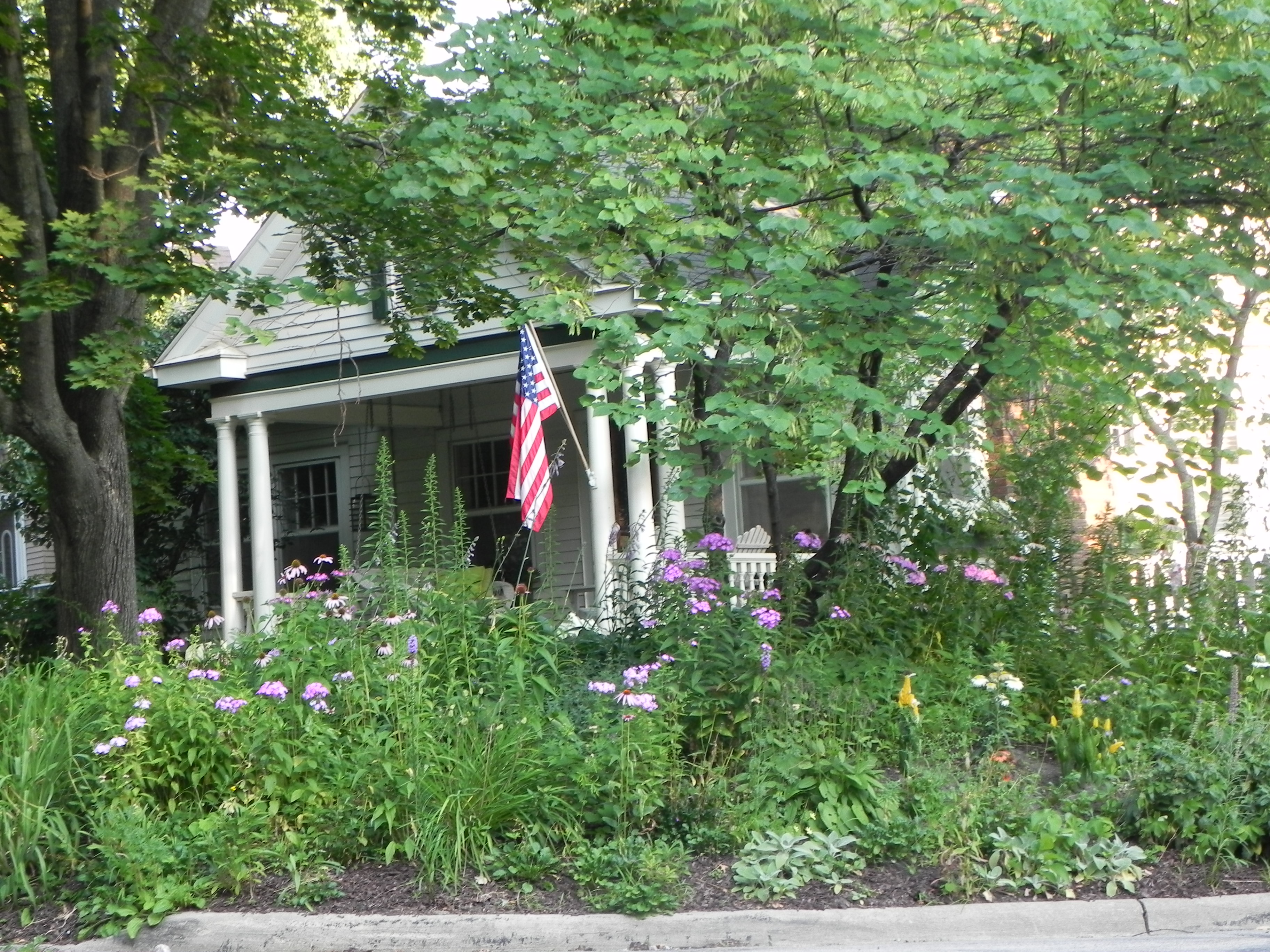
This lovely landscape adds beauty to the neighborhood and welcomes pollinators.
Worldwide concern over dramatic declines in honeybee populations the past few years have hit the news. These intriguing and highly beneficial insects pollinate thousands of species of flowers, but media reports lead us to believe that they are the only pollinator and the disappearance of honeybees will leave plants unable to pollinate. The result will decimate human food supplies.
That’s only true in context. Honeybees are Old World natives introduced to North America in early settlement days. Before Columbus there were no honeybees on the continent, but obviously plants pollinated, thanks to dozens of other insect species as well as a few mammals.
Honeybee loss is of huge concern to anyone who likes to eat because of the way our society farms. Immense monoculture orchards and fields lack habitat for native pollinators. Farmland is often doused with insecticides. Farmers place honeybee colonies in the midst of vast almond and fruit orchards as well as other crops to pollinate these giant biological deserts that can’t support other pollinator species.
Fortunately, there are ways homeowners can welcome pollinators to their yards.
Become a beekeeper. It’s a fascinating hobby that yields satisfaction, pollination and delicious honey. Learning beekeeping takes effort and may not be legal in some cities. Look for future Winding Pathways blogs on beekeeping or contact your local extension agent or nature center to learn about beekeeping classes and locate experienced beekeepers. Beekeepers are usually eager to mentor newcomers.
Create pollinator homes. Mason bees are efficient, fascinating pollinators that are easy to attract to yards. While they do not yield honey they do get the pollination job done. Mason bees lay eggs in cavities in wood and readily use nesting structures placed in a yard. Most garden supply companies sell mason bee “houses” made of many tubes joined together. A mason bee home can be easily made from scrap wood. We made ours from several pieces of scrap 2X6 lumber screwed together to form a thick short piece of artificial tree. We drilled holes in it for the bees to raise their larvae, painted it and hung it from our deck. A few bees used it the first season with more moving in the next year. Google “Mason Bee” and choose from the many plans.
Create a pollination pocket, or PP, in the yard. Many pollinators only need a small patch of tall vegetation to hide in and raise their young. Mowed and sprayed lawns lack pollinator habitat. Often vast subdivisions are so manicured that hardly a beneficial insect can live there. So, to create the simplest PP just stop mowing a strip of lawn and let grasses and weeds grow tall there. The bigger the patch the better but even a 10 or 20 foot long and two foot wide strip will house pollinators.
The downside of letting a patch of lawn grow up is that plant species diversity will be limited and problem weeds may grow. Pollinators love weeds, but neighbors don’t. Be creative. The greater the diversity of flowers the more colorful the PP will be, the more beneficial insects it will attract and the more neighbors will like it. Our PPs include a wide variety of native grasses and wildflowers. Because we live in Iowa many of our plants are native prairie species but we also encourage some ornamental exotic flowers. One of our favorites is the cupplant. It’s tall and gangly but dozens of insect species love it. So do goldfinches and hummingbirds! On most sunny summer days tiger swallowtail butterflies and bumblebees visit it. Goldenrods and milkweeds are also outstanding pollinator plants.
A PP can serve many purposes. Tall, colorful patches of flowers and grasses can form walkway boundaries – winding pathways – in the yard and also can put steep or rough hard to mow areas to good use. A PP does more. The plants sink roots deep into the earth holding soil and creating space for rainwater thus reducing runoff. For a tranquil evening activity, sit quietly near a pollination pocket with a pair of binoculars that will focus closely and enjoy the constant coming sand goings of dozens of species of intriguing insects.
Take a step in creating a wondrous yard by creating a pollinator pocket. It will add summer color to the yard and invite all sorts of delightful and helpful insects to cohabit your space.
by Winding Pathways | Jul 31, 2014 | Reflections/Profiles, Wonderment
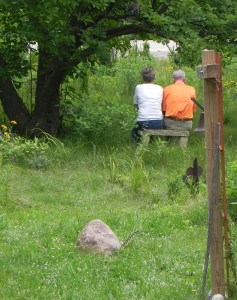
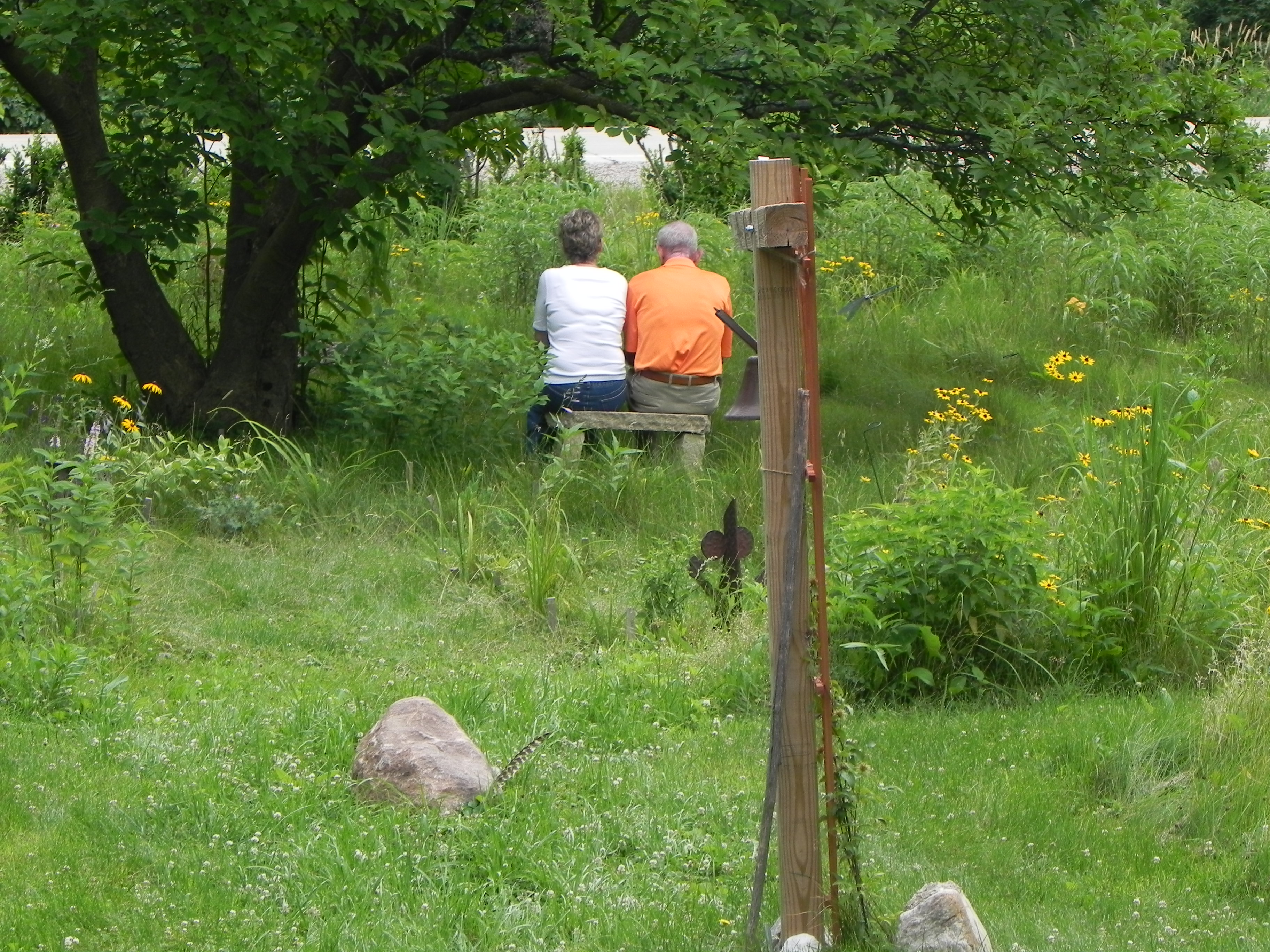
Enjoying quiet after a stressful day.
A home and yard can be a place to find peace and tranquility in a stress filled world. Many recent studies reveal that being embraced by nature’s beauty offers stillness that calms the soul. But, it does more.
Being in nature lowers blood pressure, stimulates the imagination, provides exercise and satisfaction, and nurtures creativity. Many people trek to distant parks, wildlife refuges, and wilderness areas to harvest nature’s peace. All good ventures.
Winding Pathways encourages people to create a wonderful natural area in the place where we spend the most time – at home.
The tiniest yard or even an apartment balcony can be coaxed into a space of beauty and peace.
Winding Pathways offers tips on how to transition a mowed and sprayed yard into one that provides the tranquility we need.
Your yard is the best place to unwind after a hectic day, and Winding Pathways will help make that yard a wondrous place.
There’s more to tranquility than the yard. We’re all bombarded by news reports of massive home-destroying storms and millions of people left without power. Winding Pathways will help you build peace of mind by showing you how to prepare for power outages, tutoring you in how to grow and find food in the yard, and helping you remember how to enjoy the simple quiet solitude in the back yard.
Your yard is also a place for adventure, especially for children and grandchildren. Bumblebees, woodpeckers, clover rings night crawlers, opossums and more are all fascinating to youngsters. A yard with places to explore, quiet nooks to hide in, and curious things to discover is a place of joy.
Winding Pathways will encourage you to craft your yard for your tranquility and a child’s wonder.
Co-owner Marion Patterson is the “tranquility guide.” In addition to sharing tips on how to nurture and enjoy a diverse and ecologically healthy yard she encourages you to connect with your inner space. Among the options is creating a contemplative labyrinth, exploring the quiet spaces within ourselves, and participating in spiritual retreats.