by Winding Pathways | Apr 14, 2022 | Preparedness, Reflections/Profiles
Both Marion and Rich at Winding Pathways are regular blood donors. Rich will reach a milestone in early April. He’ll give his 100th unit of blood to Impact Life in Cedar Rapids. Marion’s not far behind.
Giving blood is easy, costs nothing, and is a way we can help other people. Here are some interesting blood donation facts:
- An average donation is used to help three people, so Rich’s 100 donations have helped around 300 people and maybe saved some lives.
- A unit of blood averages about 500 milliliters, or a little more than a pint. Rich’s have averaged about 528 ml, so he’s given about 112 gallons over decades of giving.
- A person has 1.2 to 1.5 gallons of blood in their body, and a donation takes about 10% of it. The body replaces the lost blood. Donation centers require eight weeks between donations to allow for replenishment.
- Blood is typically given to people during surgery or for treatment of conditions like Sickle Cell Disease; to those who have suffered a trauma, like an accident; and during surgery or childbirth if needed.
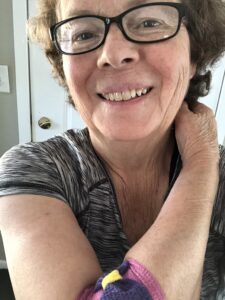
Giving blood is easy. And, Marion gets a cool blood band decoration!
We hope we’ll never need blood but if we do we’ll quietly thank the unknown donor. Both Marion and Rich at Winding Pathways encourage everyone to become blood donors.
by Winding Pathways | Apr 7, 2022 | Foraging

Enjoying coffee and a latte.
Every spring we enjoy a cup of free coffee. In good years it’s coffee plus free lunch. Nope, the coffee shop doesn’t skip our bill. It’s free because we’d just left the Marion Iron Company with cold cash after selling a year’s accumulation of scrounged metal.
Recycling, as most people know, is relatively new, but scrap yards have been buying and recycling metal for centuries. Here’s what we do to earn a few bucks.
We scrounge free pallets from businesses that toss them in heaps to be hauled to the landfill. Our Milwaukee circular saw cuts them into chunks that make outstanding wood stove kindling and fuel for outdoor campfires. When the ashes have cooled, we run a magnet through them, retrieve the nails, and store them in old metal paint buckets.
Picking Up Metal
Whenever we spot a chunk of metal along the road or in a parking lot, we pick it up and add it to our scrap metal trove. In some years we’ll have a couple of hundred pounds of nails and random scrap to sell.
-

-
We add our metal to th3e pile.
-
-
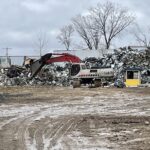
Big claws grip metal.
-

-
This metal may have crossed the ocean many times.
We like selling scrap. It generates money but mostly just feels good to see our nails recycled. We envy them for their travels. Many nails are made in China and make the long journey across the ocean to eventually be used by pallet companies. We sell the reclaimed nails at the scrap yard. They ship them to a company near Chicago that melts them into solid blocks of steel. Those are bought by all sorts of companies that make thousands of products from them. So, our old nails may end up as a car, pocket knife, re-bar, or who knows what? They might even cross the ocean to be sold to a foreign steel manufacturer.
Like-Minded Friends
We recently learned we’re not alone. Friend, Kurt Rogahn, saves bits of aluminum. When a small pile accumulates off to recycling, they go.
We’re not getting rich selling metal. The price per pound at the scrap yard varies from year to year. If we have plenty to sell and if the price is high our old nails buy us an elegant lunch. In a poor year, it’s free coffee.
Scrap steel and iron usually bring the lowest price per pound. Aluminum, copper, and brass sell for much more.
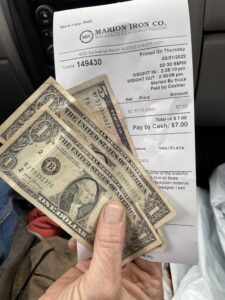
Cold cash for scrap.
After writing the above we delivered our metal to Marion Iron. It weighed 80 pounds, and we left with $7.00! Minutes later we were at Mr. Beans Coffee shop just down the road. Our cold cash bought us coffee and a bit more.
Recycling is the right thing to do with a free coffee bonus.
by Winding Pathways | Mar 31, 2022 | (Sub)Urban Homesteading, Chickens, Reflections/Profiles
Keep the Photos!
An old photo or letter can bring back memories. That happened to Rich recently and helped him recognize both good parenting and a lifelong passion.
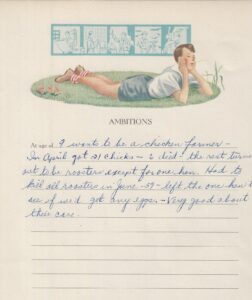
Rich was sorting through a stack of family documents when he discovered a paper his mother wrote in his “baby” book. Written in 1959, when Rich was nine, it stated that he wanted to be a chicken farmer! Of all things for a kid growing up in suburban New Jersey to say.
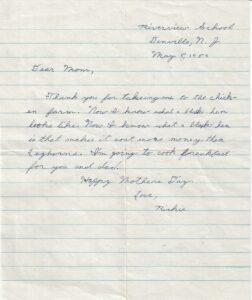
Rich became fascinated with chickens while only four or five years old. By the time his mother wrote in the book he had learned many chicken breeds. Another letter, dated May 5, 1959, was written as an exercise in his elementary school. The teacher was teaching students letter writing. Rich’s note to his mother said:
Thank you for taking me to the chicken farm. Now I know what a black hen looks like. I now know why one costs more than a Leghorn. I’m going to cook breakfast for you. Happy Mother’s Day. Love, Rich
A Budding Entrepreneur
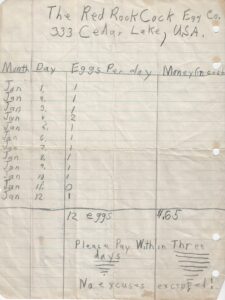
A third document is an account of how many eggs his hens laid each day and a bill presented to a customer. 65 cents for a dozen in 1960. Adjusted for inflation that dozen would cost $6.50 today.
-
-
Dreaming of the future
-
-
Expressing appreciation
-
-
Learning math and writing.
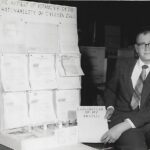
A pair of photos show 13-year-old Rich at his junior high school science fairs. One science project was titled, The Effect of Vitamin E on the Hatchability of Chicken Eggs, and the other demonstrated an incubator.
-

-
A science project
-
-
Scientific studies.
What Do These Documents Signify?
- Great parenting. It must have seemed weird to his parents that their young child had such an unusual passion, but they helped, learned, and encouraged.
- Chickens helped teach math, animal care, writing, business, and research methods.
- Chickens became a lifelong passion.
Rich encourages parents to encourage their children’s passions. They might lead to lifelong hobbies and, perhaps, even a career.
Update on Careers
Rich never became a chicken farmer, per se, but he is co-owner of Winding Pathways where we encourage people to be creative in how they interact with nature and to consider backyard chicken raising. He developed another passion, fish, and earned a degree in fishery biology, and served as a biologist in Alaska.
by Winding Pathways | Mar 24, 2022 | (Sub)Urban Homesteading, Energy Efficiency
Many people dread the arrival of the monthly electric bill. We look forward to receiving it.
A few years ago, we hired Site Gen Solar to install an Enphase solar electric, or photovoltaic (PV), system on our barn roof. Although it’s a small system, when combined with our energy efficiency, monthly bills from Alliant Energy are tiny.
Our PV system does more for us than make electricity. It’s an instant weather scanner. We can access our Enphase app from anywhere and it tells us how much energy our system is producing in kilowatt-hours. One kilowatt-hour is enough energy to power a 100-watt light bulb for 10 hours. Our bulbs are LED and on average consume 12 watts.
On clear days our small system produces about 12-kilowatt hours. It powers our refrigerator, furnace fan, computers, and lights. When it produces more than we use, the excess goes out to the grid, subtracting cost from our bill.
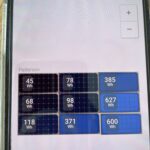
The app tells us more. See these photos. When snow covers some panels, we can tell from the app that they weren’t producing much. When all panels are producing poorly, we know it’s a cloudy day or snow is covering all panels. Sometimes when we are traveling we open the app and learn about Cedar Rapids’ weather.
-
-
The Enphase app shows which panels are covered with snow.
-

-
Production drops when panels are covered with snow or clouds cover the sun.
by Winding Pathways | Mar 17, 2022 | (Sub)Urban Homesteading, Garden/Yard, Garden/Yard
As we watched squirrels gleaning sunflower seeds from feeders in our backyard, we dined on 2021s sunshine!
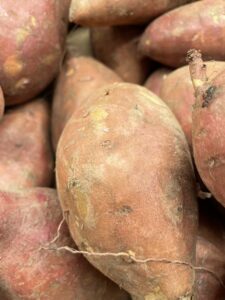
Sweet potatoes are a healthy vegetable.
Thanks to last season’s sun our crop of sweet potatoes produced a bountiful crop, and we ate them until our last one became part of our February 8th dinner. We’ve only been growing sweet potatoes for a few years because we’d heard they need a long southern summer to mature. We now know that’s not true.
We love sweet potatoes. They come in many varieties and color shades from white to purple and the common ones with deep orange flesh. This nutritious plant originated from tropical South America and is now grown in warm regions all over the world. Sometimes they are called yams, but these two plants are distinctly different. Yams originated in Africa.
Nutritious Vegetable
We love the taste and nutrition of sweet potatoes but here are some other ways we love this plant:
- They are easy to grow. We buy “slips” and plant them in late May or early June.
- The plants and flowers are gorgeous, and slips are sometimes sold as ornamentals.
- They store well. We carefully dig them before the first frost, let them cure for a couple of weeks, and then store them in a cool dark place. They last all winter.
Sweet potatoes are easy. No freezing or canning is needed. We plant, weed a bit, dig, cure, and store and then enjoy eating them all winter. This year we’ve ordered a variety of sweet potato slips from Sand Hill Preservation Center and look forward to a larger harvest. The company also sells heritage chicken breeds and vegetable seeds.