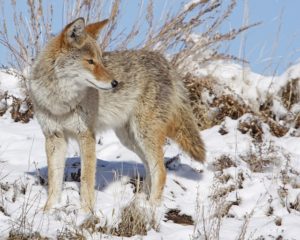
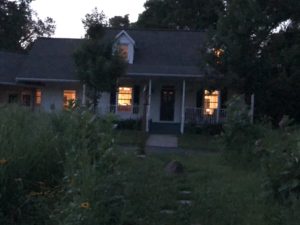
At 2 a.m. one frigid February night we were startled awake by coyotes yipping and yapping right behind our house at Winding Pathways. The next morning, we discovered their tracks all around our snowy yard. It explains why we haven’t seen many cottontail rabbits in recent months.
The amazingly adaptable coyote has spread to many parts of the United States. Most Americans might not realize it, but they live close to these efficient predators. In towns and cities, coyotes are most active at night, stay out of sight and are usually quiet. In rural areas they’re more likely spotted in the daylight and often vocalize at night.
Coyotes are amazingly successful predators. Adaptable and intelligent, they are common in Los Angeles and have been spotted in New York’s Central Park. A pair successfully raised young in a culvert near Chicago’s Soldier Field. Once only found in the rural West they are now common all the way to the Atlantic Ocean and thrive in deserts, forests, farmland, towns, and cities.
Coyotes prefer dining on mammals and specialize in eating mice, voles, cottontails, and other small furry creatures. They’ll also eat carrion and sometimes scrounge food from dumpsters.
Although coyotes will eat birds, they don’t target them and consume few. Numerous studies have shown that when coyotes increase foxes and raccoons decrease. Since these two smaller animals are the major bird and egg predators, an increase in coyote density often means more birds in the area. Anyone who likes pheasants should appreciate coyotes.
Coyotes pose no threat to humans. They thrive on a continent where people have eradicated mountain lions and wolves from most places where they once lived.
After a newly fallen snow do some backyard tracking. Wherever someone lives there is a chance of finding the doglike tracks of coyotes that worked the neighborhood the previous night.
This blog is similar to one that Winding Pathways wrote for the Cedar Rapids GAZETTE.
The subtleties of walking a labyrinth in fresh snow or in the dark have not been lost on me. Muscle memory, night vision, and simple observation help navigate the terrain when obvious landmarks are obscure.
Muscle memory helps find the path in the dark.
Before the snow fell, when I walk the labyrinth in the dark, the memory of the path, familiarity with the number of steps to a turn, and the various plant heights help me navigate. The funny little statues and boulders along the way form the boundaries. Lights from passing cars not only illuminate the path briefly and also wreck night vision. So, counting steps and simply being aware of where I am on the labyrinth help keep me on the path.
With snow on the ground, the snowshoes make terrific “pat down” equipment and after a few times walking is easy. So, until a new snow, I can just wear boots. Stay on the beaten path or find myself “post-holing” through deep snow.
The brilliance of a sunny day can be confusing, so after a fresh snowfall, I look for the burned stems of plants and the slight depression of past walks as guides. And, how the drifted snow reveals a different texture is fascinating.
Odd marks in the snow capture my attention. Little holes that appear from nowhere, then tiny tracks of a rodent, then another little hole where it dropped back in the security and relative warmth of the snow tunnels.
The fate of the incautious rodent is evident where tracks suddenly disappear with telltale feather strokes on the snow. Whoooo’s for lunch?
Walking the labyrinth in winter brings its own rewards.
Guest Blogger
Nancy Garberson shares these observations and photos with Winding Pathways.
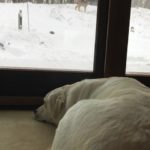
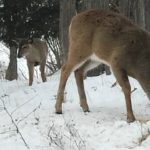
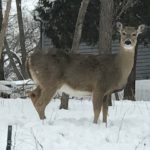
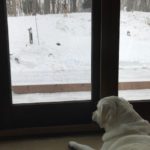
This time of year, we call it “wild kingdom” in our backyard because we see deer every day. All kinds of birds and tracks in the snow from the nocturnal creatures dot the snow as well. Our dog is fascinated by the steady entertainment. It’s funny but she never chases them, she respects them as if they were family.
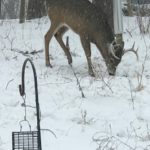
Watching deer roam in our yard can make us feel as if we are living in a natural paradise. Our neighbor has a pond and we have connecting woods. We think that’s what attracts the deer to our area. The deer feel safe and they have lots of water and natural food, as well as our feeder supply, to keep them happy. Another neighbor has an apple tree, which appears to be another draw for the deer. Even the bucks walk in nonchalantly to feed.
So, not only are we enjoying the winter wonderland, but we also have a steady showing of wildlife to enjoy on winter days.
Abby takes in the scenery.
The deer come to the feeder in the late afternoon.
Mice got into the hybrid system of my Prius and destroyed it. They also got into our greenhouse and ate some important seeds my husband Bob was growing. These critters are a common problem, but we have always used live traps; after all, they were here first and are just doing what they need to do to survive. That is until they crossed the line and, reluctantly, we declared war and the snap traps and peanut butter came out.
Once a nature lover, always a nature lover, though, and hoping that some good can result, Bob puts the dead mice out in places where they will be found by “someone” looking for an easy meal.
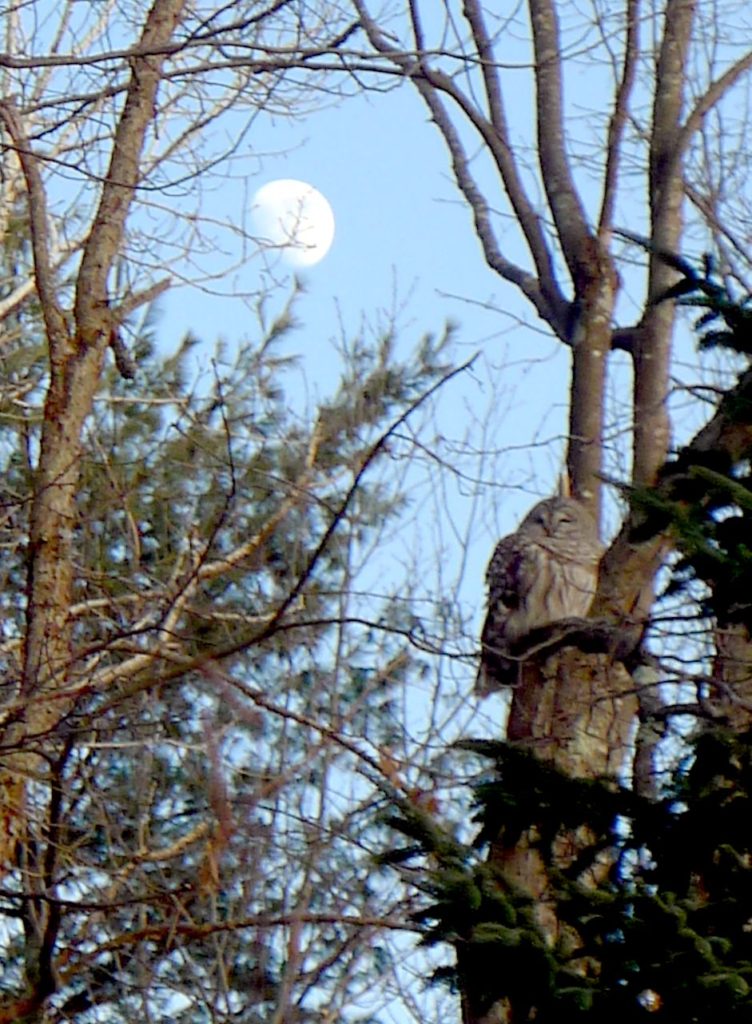
Yesterday he had an amazing experience. He had caught a couple of mice and put them out but yesterday afternoon no one had taken them, so he moved them to a more open place. As he was crouching down, he felt something soft. An owl swooped down and took the mouse while Bob still had the tail in his hand. The owl remained still in a nearby tree, for the rest of the afternoon while the second mouse stayed on the ground and we waited to see what would happen next, but nothing happened before dark. This morning both are gone.
We have hosted at least one pair of Barred Owls for many years. We rarely see them, so yesterday was a real treat, but we regularly hear them (“Who cooks for you?”) Since mice are the secondary host for deer ticks (those are the ticks that carry Lyme disease) these owls and the yearly expanding family of hawks which also lives here are very welcome.
Be sure to take in the International Owl Center in Houston, MN, this winter. Their Owl Festival is scheduled for March 1-3, 2019. Whooo’s up for it?
In December 2018 we spent a delightful two days in and around Pokagon State Park. It’s a great place to visit………..and scream like we did as we zipped down their famous toboggan run at nearly 40 miles an hour. Read about the Park and Steuben County in our travel feature that appeared in the Cedar Rapids GAZETTE on Sunday, January 27, 2019.